
 Membership
 Donate
 Shop
Shop

















The Scenic History of Denver Cemeteries: From Cheesman Park to Riverside
A review of Phil Goodstein's 2023 book.
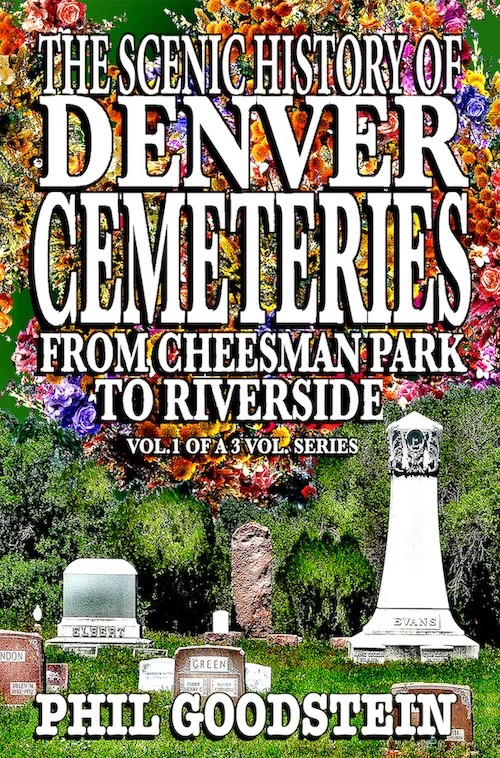
This is the first volume of a planned three-volume series on the history of Denver cemeteries by Phil Goodstein, a prolific writer of books on Denver’s history. In his introduction Goodstein mentions that he had planned to write just one book on the history of Denver cemeteries, but early in his research he realized that this would make too large a tome, so he decided to do it in three. In this volume he covers the first Denver cemetery, Mount Prospect, founded in 1859, and how after some additions and changes it now exists as Cheesman Park. The second Denver cemetery is Riverside, which is still operating today although quite altered, and not as popular as it once was. The book is amply supported with black-and-white photographs, many taken by Goodstein himself of the gravestones of people he discusses.
Goodstein has divided the book into three sections, the first on Mount Prospect and how it eventually evolved into Cheesman Park today. He explains the addition of Mount Calvary, the Catholic section, and the Jewish addition, as well as a small Chinese section. This chapter would benefit from a Denver street map so a reader who is unfamiliar with the area could better visualize where these sections are located. The city eventually took over all of these components and renamed the whole City Cemetery, which the city struggled to maintain. Complaints about the neglect mounted as fashionable residential areas (now the Morgan’s Addition and Humbolt Island Historic Districts) moved, respectively, into the south and west borders of the boneyard. He ends this chapter on the problems of closing City Cemetery and moving the bodies to other locations, and how Walter Cheesman was indirectly involved in transforming much of the cemetery into what is now Cheesman Park.
The second section, “The Rise of Riverside,” is a history of how that cemetery came to be founded in 1886, along with brief biographies of the eighteen founders, most of whom are buried in the cemetery. Riverside’s founders aspired to create peaceful parklike cemetery, but the vision faded when the Burlington Railroad line came along the east side of the grounds and with the rise of the more fashionable Fairmount Cemetery. Riverside ran into financial problems, leading to its eventual 1988 merger with Fairmount.
The last, and by far the largest section of the book, is entitled “A Walk around Riverside.” Here the author takes us through the cemetery, pointing out the graves and gravestones of interesting—and in some cases famous—people. For each he gives a brief biography, including date of birth, place of birth, occupation, name of spouse and the spouse’s date and place of birth, and both of their dates of death. Riverside contains many first-generation settlers in Denver. Names Goodstein points out include John Routt, Colorado's first governor and a Denver mayor; Aunt Clara Brown, a former slave and the only Black woman member of the Colorado Society of Pioneers; John Evans, the second governor of Colorado Territory, for whom Mount Blue Sky was previously named; and Augusta Tabor, the first wife of Horace Tabor, Colorado’s “Silver King.” Goodstein gives special attention to the Grand Army of the Republic (GAR) part of the cemetery, including the grave of Silas Soule, a Union officer who refused an order to take part in the Sand Creek Massacre and testified at the inquiry of his commander, John Chivington, before Soule was assassinated.
This book is of value to anyone interested in Denver history as reflected in the history of its cemeteries. We look forward to the second volume of the trilogy, in which Goodstein focuses on the history of Fairmount Cemetery, Denver's largest and most used.