
 Membership
 Donate
 Shop
Shop



















A High-Country Encounter
Season 1, Episode 6
The story of how legendary Colorado nature photographer John Fielder found his favorite place in the Centennial State.
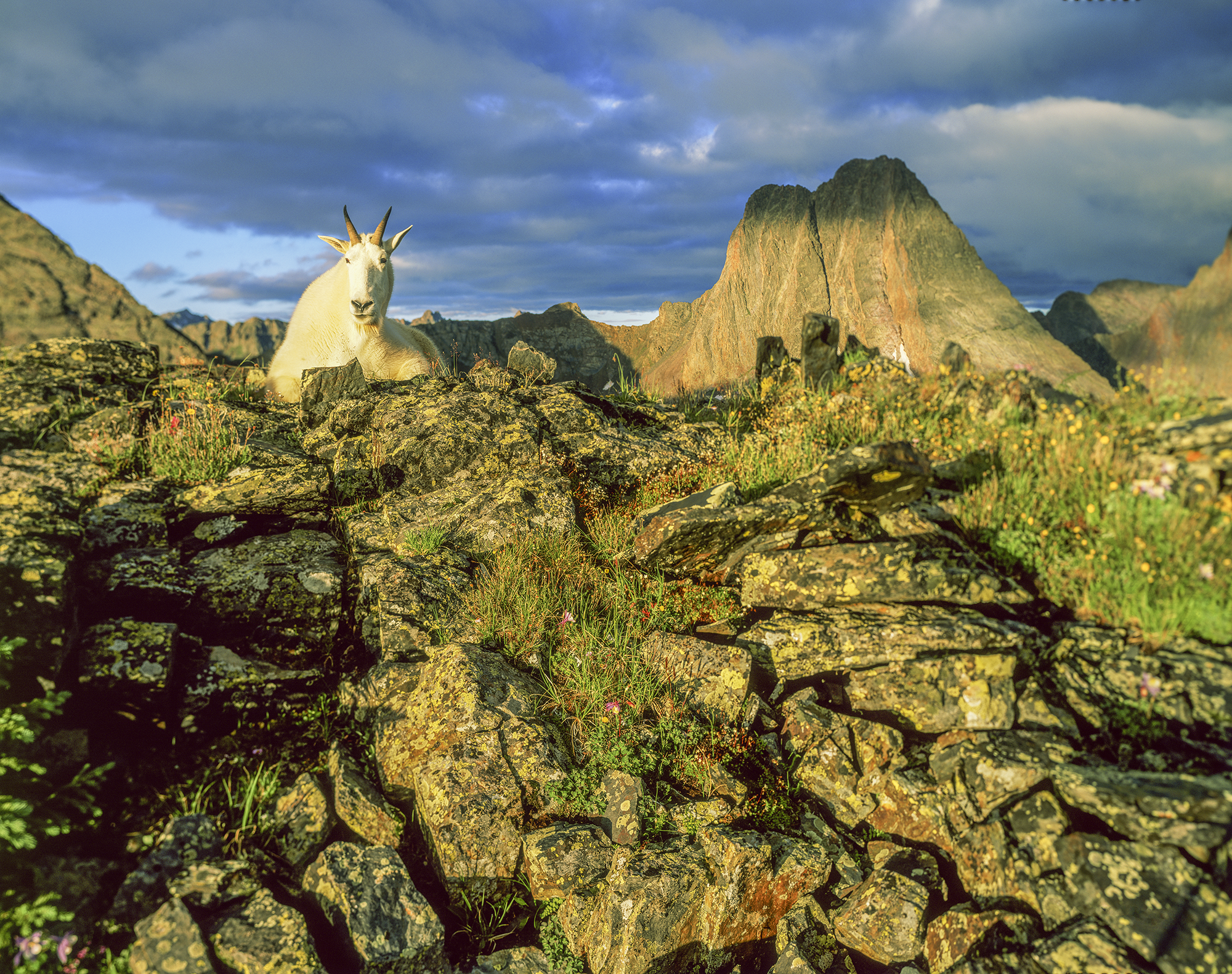
Billy goat below the Trinity Alps, Needle Mountains, Weminuche Wilderness.
Transcript
[Download]
Sam Bock [00:00:05] Welcome to the Colorado Magazine podcast from History Colorado. I'm Sam Bock, managing editor of the Colorado magazine, and I'm excited to bring you audio versions of some of our very favorite articles. On this episode, producer Tyler Hill brings you the story of how legendary Colorado nature photographer John Fielder found his favorite place.
Tyler Hill [00:00:34] I'm Tyler Hill, former producer and co-host of the History Colorado podcast Lost Highways with my friend Noel Black, and I've been asked to read this article from the archives of the Colorado Magazine for you. A High Country Encounter by John Fielder. Like most Colorado mountain ranges, the Needles are oriented north to south. On their east side, snowmelt and monsoonal summer rain drains through the canyons and Cedo Creek and the Animas River. Both eventually deliver water to the San Juan. With three peaks over 14,000 feet and dozens above 13,000, the range is high, remote, and extremely rugged. In my opinion, the most rugged in Colorado. Peaks made of pink aeolus granite have been carved into serrated spires and blades by glaciers, wind, and water over the past 65 million years. Creeks plunge down almost impassable canyons. Developed trails for humans are few. Though game trails blazed by elk, deer, and bear are ubiquitous. The Needles are part of the Wemanooch Wilderness. At over 500,000 acres in size, it's Colorado's largest designated wilderness. Eighty miles of the continental divide bisects the Wemenooch, a word originating from the Ute language, into the headwaters of the Rio Grande and the San Juan Colorado River Over the years I've conducted two llama pack trips through the wilderness along this mostly mellow stretch of the Continental Divide Trail, during which one remains above 12,000 feet in elevation for all but a few miles. The Needle Mountains lie in the wilderness to the west of the continental divide trail and provide an entirely different modus operandi. The trip on which I met my friend the Mountain Goat was the first of two traverses I've made of the entire range. This trip took us from north to south along the east side of the range's crest, the other along the west side about a year later in 2006. Though the range is 12 miles long as the crow flies, we hiked a 40-mile circuitous route weaving our way around peaks and in and out of drainages, starting and ending at the same place, what I call a loop trip. For nine days we picked and scrambled our way by day through the detritus of aging Mountains, Tallis Boulders, Down Timber, Boggy Tundra. And for eight nights, we camped at an average elevation of 12,950 feet on soft tundra amidst rocky mountain alpine wildflowers. We were in some of the most rugged and challenging terrain Colorado has to offer, and faced plan-altering challenges almost from the trip's very beginning. We captured some of most stunning photos of my career, but what I really remember was the 24 hours I spent in the company of a 250 pound male mountain goat. This is the story of that trip and of that encounter. Our hiking began and ended well above 12,000 feet at Kite Lake. We parked the four-wheel drive Chevy Suburban at the lake, hoping to return to it in nine days if all went according to plan. But nothing on this trip went according plan, except the photography, which I am happy to say was sublime. By the second day, I had lost the help of two of five porters. 17-Year-old Craig was a high school student in Grand Junction, Colorado, who had spent the first five weeks of his summer at a National Outdoor Leadership School, or NOLS, wilderness course, in the Wind River Mountains of Wyoming. By the time he got to me in Colorado, he had been out in the backcountry for a month, and having backpacked and camped at over 12,000 vertical feet the entire time was in superb physical condition. Our first night, we camped and photographed just below 13,000 feet near El Dorado Lake. The setting sun backlit Tundra that was made Irish green by the summer monsoon. The charcoal-colored clouds of a thunderstorm simultaneously reflected in the lake and dissected the rays of the sun, creating a landscape of alternating green highlights and shadows. Our first sunrise never happened. Clouds remained from the day before and blocked the sun at the horizon. Worse yet, when I woke up, I could hear someone in a neighboring tent with a loud hacking cough. It was Craig, and he was coughing up yellow phlegm. He was still coughing after breakfast two hours later, forcing me to decide whether to allow him to continue with us on what I knew would be one of the most demanding and remote backpack trips of my life. I diagnosed his condition to be some sort of flu and told him that he would have to discontinue the trip. This would require hiking back down to my vehicle, then another several miles to his car, which he had parked at a lower elevation before the four-wheel drive stretch. I was uncomfortable with him going back alone in his condition. And recruited another of our party, Eric, to escort Craig out. Knowing that I would lose the help of both young men for the balance of the trip, now three people would have to carry the load that previously was distributed among five. Food, tents, and sleeping bags for the remaining four of us. So regretfully, we said our goodbyes. Life got better quickly. The plan for day three was to camp on a finger-shaped ridge at 13,100 feet. Surrounded on all sides by thousand-foot cliffs that I had studied on my topographic maps and coveted as a potential photography location for 10 years. I had always suspected that from the ridge two of Colorado's most beautiful peaks, Vestal and Arrow, both just a few feet below 14-er status, would be, in our face, a half mile to the south and only separated from us by the chasm of the Vestall Creek drainage. I tried to get there on a llama pack trip years before, but was turned back by a single rocky slope. Not negotiable by soft-footed llamas. Now without livestock in tow, we had a pretty good chance of success. A steep descent into Elk Creek, followed by an equally precipitous climb of the rugged drainage I'd once marked on my map as the secret route, took us straight to the ridge. It was flat and covered in alpine tundra. As we casually ridge-walked south, suddenly the twin pencil-pointed peaks appeared front of us. Their half mile distance reduced to what seemed like only yards. The moment and the perspective were incredible. It was very much like the scene in the 1970s cult movie, Close Encounters of the Third Kind, when Richard Dreyfuss' character crests the Wyoming Hill in his car and sees Devil Tower for the first time. My first task at any new photo location is to find a sublime place to set up camp, but at the same time, not allow tents and gear to get in the way of any possible scenic image. It is a pleasing task and an acquired skill that has produced some remarkable campsites over the past 35 years. I had no idea how remarkable this one would turn out to be for as soon as the tents were pitched, the most beautiful mountain billy goat I have ever seen approached our camp. Though mountain goats are not thought to be native to Colorado, they were transplanted here beginning in 1948. They sure seem to fit in visually, if not biologically. A couple of thousand are estimated to populate at least 10 Colorado mountain ranges. They live year-round in high alpine environments and are most remarkable for their ability to dance along inches-wide rock ledges with ease. A solitary male, Billy, had chosen to investigate us humans in a place he had probably not seen people before. But the speed with which he began licking our freshly deposited pee confirmed that he had been around backpackers who spewed very yellow urine after long, waterless hikes. All mammals need salt in their diet and yellow urine is very salty. To be honest, I've always known this, and I do pee strategically in the high country. In other words, I urinate where goats and bighorn sheep might congregate in a compositionally correct manner, in this case, with goat in the foreground and mountain peaks in the background. No joke. Mountain goats are naturally curious animals and not intimidated by people, but that doesn't mean anyone reading this should follow my example. This was not the first time in my life that goats had arrived soon after me. But it was the first time that a solitary male, and most likely the dominant male in the entire Needle Mountain's herd, showed up. I had never seen a goat so beautiful. It had a very large body, perhaps weighing more than 250 pounds. Pure white wool, crap-short, and devoid of any of Winter's coat. A tiny waist and massive thorax, and an elongated skull as solid as the granite of his mountains. His head was decorated with two pointed black horns, framed by pointy ears. Stood still and stared at us with a complacency that could only have derived from his knowing that he was the baddest dude in the wilderness. Having always been a scientist at heart, and trained in scientific inquiry by 50 years of experimentation on my many pet cats, never injurious or fatal, seen by some as teasing, I decided it was time to experiment with a wild goat. With my crew standing behind me as witnesses, I was determined to ascertain who was the baddest in the wilderness. I stood facing the motionless goat with the two of us staring into each other's eyes. I looked back over my shoulder at my friends, smiled, and then walked two steps forward. He did not move, except to shake his head from side to side about three times and become still again. I looked at my friend once more and smiled, then stepped cautiously closer. Continuing to stay put, he shook his head and simultaneously snorted loudly for a seconds, then became still again. Clearly, his gestures had been warnings. Also staying put, I turned my shoulders slowly and smiled at the crew. They did not smile back. I think they were imagining how difficult it would be to carry my injured body from a remote wilderness to the nearest hospital. Of course, I took another step closer to the goat. As soon as my right foot landed on Tundra, he raised himself upright, acrobatically balancing on his hind legs with front legs towering above all six feet, three inches of me. As quickly as I could, I turned and ran back to my companions, by which time the goat was back on all fours, motionless and staring at me as before. End of experiment. The next morning, I climbed 200 yards from camp to the south edge of the ridge in order to photograph Vestal and Arrow Peaks. Byron and I had arisen, as always, before dawn, in order to be in position to photograph our remarkable venue progressively during each stage of sunrise. In the dark, it appeared to be partly cloudy around the peaks. But it was anyone's guess what might be happening on the eastern horizon not visible to us from where we stood. Clouds there could block the sun and deny us a sunrise. At about the predicted time, however, what turned out to be benign clouds behind Arrow and Vestal turned pink. So far so good. And with a telephoto lens, I isolated their jagged silhouettes against the colorful sky. If my luck continued, the tops of the two symmetrical mountains would light up. One minute later, the rising sun casts its first light. Progressing in color from red to orange to yellow on the peak tips. I couldn't believe what I was seeing. I knew it was likely that the next photograph would be of the sunlit tundra just in front of me with the mountains as the backdrop. As I began to replace the telephoto lens with a wide angle one, I heard the sound of hooves, clomp, clomp clomping behind me. I turned to see my favorite Needle Mountain's adversary, the Billy Goat, walking slowly behind me on his way to the edge of the ridge. Settled down in the middle of the exact place that was to be the foreground of my photograph. I couldn't believe it. The goat was back and about to ruin the most coveted image of the place I'd not only backpacked many miles to reach, but dreamed about for years. I reconsidered the situation and said to Byron, this day I will be a large format wildlife photographer. With the wide angle lens in place, I hurried to compose the goat in the foreground of the scene. And three mountains called the Trinity Alps, immediately to the east of Vestal and Arrow in the background. This had the potential to be one of the best mountain goat images ever made anywhere on Earth, if he would only remain still. It's very rare to make wildlife photographs with a large format camera. By the time you get the complex camera setup, the creature is usually long gone. Yet I seem to have made a friend during my experiment the day before. Small apertures, in this case, F45. Bring everything in focus from foreground to background. However, a small aperture requires a long shutter speed, in this case, one half of a second, in order to properly expose the film. So the goat would have to hold perfectly still if he were to be sharp and without blur in the photograph. And he did. He snoozed with droopy eyes and remained motionless for the next 10 minutes as the sun crested the ridge behind me and lighted the fur of his back and neck with yellow light. I was able to expose a dozen sheets of film of a finely focused and stationary goat. During the following half hour, I made a dozen more photographs of the goat from other directions. He eventually stood up, but remained still on the ridge to be photographed. We descended to camp and breakfast. Thereafter, I proceeded to wander over the top of a nearby hill to do my duty while the crew packed up camp. Cresting the hill, I spied the goat 50 yards away, laying in the soft tundra and again snoozing. I foolishly again decided that it was time to find out just how genuine our friendship was. I approached him slowly but deliberately, trying to show no fear. I stopped. He did not move, nor even look up at me. Was there now a genuine bond between us, male and denizens of the wilderness? I dropped to my knees and crawled towards him. I laid prone and parallel to his body with my head propped up on my hand. He was not intimidated and continued to ignore me. I began to talk to him. For the next 25 minutes, I enjoyed the most remarkable wildlife encounter of my life. I spoke to him all the while, making statements and asking him questions. I asked him about living throughout the year above the trees in one of the most beautiful places on earth. I asked about life with a harem of nannies all to himself. I told him about my life as a nature photographer and my appreciation for his place and all things wild and natural. The entire while he slumbered. This 250-pound miracle of a creature, not once looking at me, not once answering a question. Fortunately, for I would have later needed counseling. I can only assume that my voice soothed him, and that my presence and proximity was acceptable. I left the goat and headed back to camp. We hefted our packs and headed south towards our next camp, two drainages away. It would be a long but scenic day, meandering in and around the heads of drainages and the bases of the highest peaks of the Needles Mountains. Pretty much what I suspected the whole nine days would be like. Despite the loss of two porters, the trip was manageable and very successful, and the scenery and photography were extraordinary. Without a doubt, these were the most dramatic mountains in the Colorado portion of the Rocky Mountains. No mean feat, given the 28 distinct ranges in the state. We had camped night after night at elevations no less than 12,800 feet and navigated drainages named Elk and Vestal, Trinity and Leviathan. And finally, Sunlight Creek. In fact, our last and eighth evening was spent in the most remote part of this geologically complex cirque below Fourteeners Sunlight and Wyndham, next to what I believe is the highest lake in the entire Weminouch wilderness. It lies nameless at 13,100 feet, immediately below Wyndam Peak. Yet, there was a price to be paid for the loftiness and remoteness of this particular place. Day 9, our last, would require an arduous hike down from the lake to Viacito Creek at 9,600 feet, then up the creek to Hunchback Pass at 12,500 feet, and finally down to our starting point, Kite Lake. Sounds easy, right? Add to the massive elevation loss and gain 15 miles of hiking width, in my case a camera pack still weighing 65 pounds, and to that add the fact that we'd been doing this for eight days. Maybe it's a little easier to understand why none of us were looking forward to our last day. Then the rain came and added to the misery. After eight days of fine high pressure weather, that night, the inevitable August monsoon rolled in from Arizona. We awoke before sunrise to a drenching rain made worse by the fact that it was 33 degrees outside. Our dreaded last day's hike would be a wet and cold one. With no time nor sun to dry out tents and other sun-dry wet gear, We packed up a soaked camp and headed down to the forest through dangerous slippery talus boulders. Once on the trail, I commanded a forced march for the next 13 miles over no one's objections. We all wanted to get back to the warmth of a heated Chevy Suburban as quickly as possible. Nevertheless, strong packers can only hike 3 miles an hour going down and on the flat to uphill at best, so we knew there'd be no salvation for at least 5 hours. Except for a 10 minute break for lunch of cheese and sardines, we did not stop the entire way. The cresting of Hunchback Pass left only a rock-feel's worth of descent to the vehicle, which we reached shortly after 1pm. The journey to Kite Lake is on my top 5 Colorado most difficult and rugged drives to a trailhead list. From Lake City, the nearest town, it's 30 circuitous highway miles over 2 passes, Then another 15 miles on improved Forest Service dirt roads. Than 15 more miles on narrow, eroded, creek-bed-like, four-wheel-drive road. It's an unimproved, unmaintained, and unloved except by crazy-ass motorheads, dangerous 19th century mining road. Most people won't do it in a Jeep. I do it reluctantly in a 6,000 pound suburban. The drive time for the 60 total miles is not under three hours. That's how we got to Kite Lake nine days before. Wet, cold, and tired, the five of us tossed soggy packs in the back and dove into the seats. I extracted the ignition key from my pack's ditty bag and got the motor going. Soon there'd be heat. I engaged the transmission and drive and commenced the converse version of the drive up to Kite Lake from hell. I drove 50 yards and the vehicle suddenly stopped running. I turned the key and the ignition a dozen times to no avail each time. No juice, no gas. With a freezing cold crew still inside, I got out and popped the hood. In 40 years of dealing with vehicle breakdowns in the middle of nowhere, not once have I popped the hood expecting to find a solution to the problem. I am not a mechanic. Everything looked fine in the engine compartment except for a fraying of the fireproof fabric that lines the inside of the hood. No matter. Just wear and tear. Otherwise, the exhausted five of us were stranded at Kite Lake, a place too remote to attract many visitors, so nobody else was parked at the lake. We discussed our predicament and decided that two volunteers would walk down the road for as long as it took to hitch a ride to Lake City to get help. That could be as many as 15 more hiking miles to get to the more heavily traveled Rio Grande National Forest Road that follows the Rio Grande River. Just as I was about to appoint the volunteers, we heard the rumble of another vehicle. With eyes wide, we watched a pickup truck scramble up the hill towards us. Since we were blocking the road, it stopped in front of us, and four people got out. There were college kids who had just graduated in June from Oberlin College in Ohio and had journeyed to Colorado to celebrate with a week-long backpack in the Wemanooch Wilderness. They too looked under my hood and they too had no solution for the dead suburban. I noticed the North Carolina, my home state, license plate on the pickup truck and struck up a conversation with the young man who owned it. This culminated in asking him if he would loan us his truck to get back to Lake City and help. He generously agreed. Asking only that we return it to Kite Lake by the time they completed their hike a week later. We pushed the Suburban to the side of the road and headed down to Lake City. Three hours later, the still exhausted and wet five of us pulled up to the Cinnamon Inn Bed and Breakfast, looking for a couple of rooms. The owners had become friends of mine a couple years before when I was writing my travel guide, John Fielder's Best of Colorado. All of us enjoyed no less than the finest showers of our lives and the last two available rooms. Lucky for us, given that this was the peak of tourist season. The owners recommended the Lake City Texaco for help with the stranded suburban, so off we went to seek help. After describing the vehicle's resting place and situation, owner Pete agreed to take the job. As it turned out, Pete was famous in this part of Colorado's San Juan Mountains, which contained thousands of miles of 19th century roads, for rescuing people and their vehicles from predicaments like mine. He said that he would drive his pickup sized tow truck up to Kite Lake. Followed by another man who would drive the loner pickup that needed to be returned to the college kids. Given the roughness of that last 15 miles of road, I couldn't imagine how a suburban could be towed down. But I put my faith in Pete. However, there was a remaining loose end. What and how long would be required to repair the suburban, which would not start? Having been away from my family and publishing business for nine days, I needed to return immediately to Denver, and so did the crew. That evening. After the obligatory and mind-blowing steak dinner following 8 nights of instant dinners on the trail, I called my friend Dennis in Crested Butte about parts 2 and 3 of the rescue. Would he be willing to drive the next day to Lake City, pick us all up, and return us to Denver? Including getting back to Crestid Butte, Dennis' total drive time would be about 12 hours. Would he also be available to return another day to lake city to pick up the repaired suburban and drive it to Denver for me? Another 12 hours? Dennis agreed to all of the above. After the best night of sleep I'd ever had and a good greasy breakfast at the inn, Dennis arrived to get us home on day 10. As soon as I arrived back in Denver, I called Craig the porter with the hacking cough in Grand Junction to make certain that he had returned home safely eight days before and to discover more about his malady. In fact, he had acquired pulmonary edema, an illness often acquired by mountain climbers at high altitudes. It is deadly and can kill its victim within 72 hours of onset. The only cure is for the victim to return to lower elevations. If I had not sent Craig down on day two of the trip, he could have easily died with us. Two weeks later, a young man from inner city Chicago died from pulmonary edema while on a Colorado wilderness challenge course. And just like me, his counselors did not recognize the symptoms. As it happened, after leaving us at El Dorado Lake, Craig and Eric spent the next night at Kite Lake next to the suburban. His condition had deteriorated by then. The next day, they proceeded down the road and were picked up by four doctors fresh out of the wilderness. They immediately diagnosed the pulmonary edema, took him to his car at 11,000 feet, and told him to get down to Lake City immediately. Craig found a doctor who also diagnosed the malady and told that he would recover in a few days at home in Grand Junction, which he did. Though Craig had spent four weeks in the Wind River Range of Wyoming, well above 12,000 feet. On the NOLS course prior to hiking with me. Apparently, that was no guarantee of immunity to the disease. His father, a Grand Junction physician, speculated that Craig's descent to Grand Junctions at 5,000 feet for a week in between high-altitude trips might have been the catalyst for the pulmonary edema. This affair was a valuable lesson for me about wilderness medicine. Pete called the day after we got home to tell me about the vehicle rescue. He too had noticed the frayed fabric under the hood at Kite Lake. When he inspected the spark plug wires hidden in a remote area behind the engine, he discovered that one of them had been chewed in half, most likely by a marmot, a furry denizen of the alpine zone with an affection for rubber and nylon products. The marmot had apparently crawled into the engine compartment while we were on the trail and sampled this delicacy. One tiny wire was still intact when I had started down the hill, but the bumpy road must have been enough to pull it completely apart. Hence when it broke after 50 yards of driving. The Marmots had sampled the fireproof fabric under the hood, too. Pete and his helper twisted the broken wires together, which was enough to power the Suburban on its own down to Lake City, so it never had to be towed after all. Pete ordered new spark plug wires from Denver, and within a week, Dennis had delivered the Suburbans back to me at my home. The repair bill wasn't much, but how about the rescue bill and Dennis' 24 hours of shuttling? The whole affair cost me no time. Minor miracle considering the original predicament, but $2,000 to solve my problem. Would you believe that the comprehensive section of my auto insurance policy covered most of this? In the end, I was very little worse for wear. Not bad when it comes to being stranded in the middle of nowhere. But the photos I made and the encounter with the goat were things I would never forget. They were just a few of my best memories from life spent in the out of doors.
Sam Bock [00:26:01] Thanks for listening to the Colorado Magazine podcast from History Colorado. To read more articles, subscribe, or see some of the photos from these articles, visit us online at HistoryColorado.org slash publications.