
 Membership
 Donate
 Shop
Shop




















Black Cowboys Unveiled
Season 1, Episode 2
Assistant Curator of Black History Acoma Gaither brings us the story of Black cowboys in the American west.
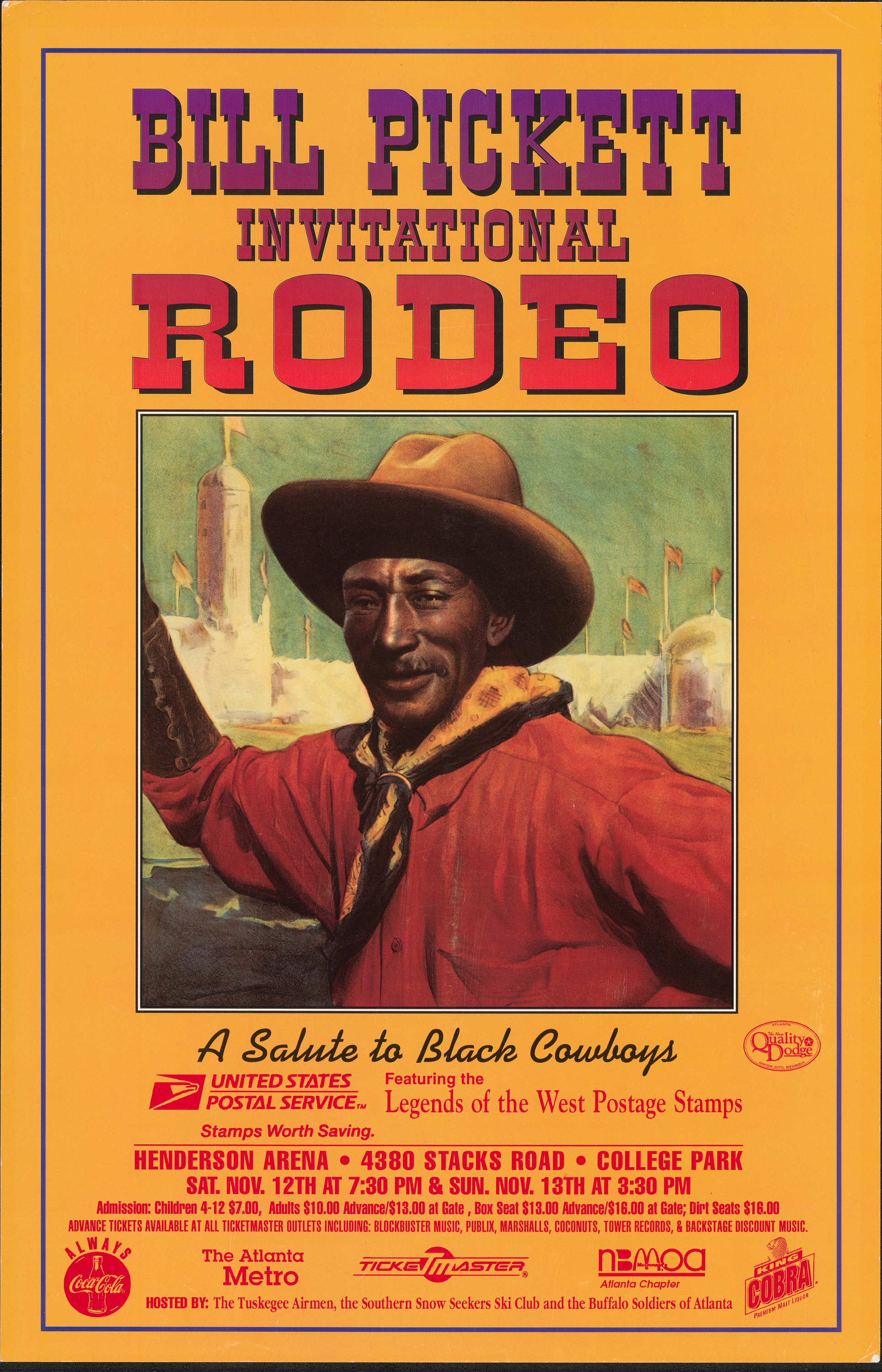
Poster for the Bill Pickett Invitational Rodeo, ca. 1994.
Transcript
[Download]
Sam Bock [00:00:05] Welcome to The Colorado Magazine Podcast from History Colorado. I'm Sam Bock, managing editor of The Colorado Magazine, and I'm excited to bring you audio versions of our very favorite articles. On this episode, Acoma Gaither brings you the story of black cowboys in the American west.
Acoma Gaither [00:00:29] Hi, I'm Acoma Gaither. I grew up watching Westerns with my father, which sparked a lifelong curiosity about the history of cowboys. I didn't know much about black cowboys until later in my life. So when I was asked to write about an artifact from the collection, I was immediately drawn to the powerful and often overlooked stories of black life in the West.
Acoma Gaither [00:00:52] Black Cowboys Unveiled by Acoma Gaither. Just thinking about the Old West can invoke images of vast landscapes dotted with canyons, cacti, and critters, occasionally presided over by a kettle of vultures. The people within them, at least in most popular portrayals, are usually mounted on horseback, often chasing herds of cattle over open prairie. And they're as mythic as the landscapes that they inhabit. These archetypal cowboys came into popular imagination in mass media and entertainment in the 19th and early 20th centuries. Dime novels, illustrations, paintings, and theatrical productions featured white European Americans. But these popular images obscured the true history of the American cowboy, one in which cowboys of color always played prominent parts and the diverse cultural tapestry. Of the American West. Today, black artists are working to recover and reclaim this history. Solange's album, When I Get Home, Little Nas X's, Old Town Road, and Beyonce's Cowboy Carter album focus on black cowboys in their lyrics and album covers. As I started thinking about these contemporary artists and their messages, I began wondering if any materials in the History Colorado Collection. Highlight the lineage of African Americans in the American West. What I found reveals that history Colorado has played a role in preserving this important history in its collections even as it has struggled to represent the shrouded legacy of black cowboys in Colorado. Black Cowboys Come West. Archival records show that slave traders specifically targeted African tribes familiar with cattle herding, like the Fulani of modernday Cameroon. Transported to the Americas, the enslaved persons with such expertise were assigned tasks like catching and tending wild cattle or driving long trains of steers led by oxen. This knowledge became even more valuable in the West as African Americans took on various occupations, including ranch handling, wrangling, gold mining, farming, trapping. And more. Following emancipation and the Civil War, many African Americans ventured into territories that would later become Colorado. At least a quarter of cowboys in the late 1800s were black, and alongside Native American and Mexican cowboys were central in transforming the social, physical, and economic terrain. Laboring as a cow hand was definitely not an easy task. But it was more profitable than sharecropping, one of the only occupations for freed men in the South. While instances of prejudice and racial violence were still common in Western territories, the rules of racism and segregation weren't as rigid here as they were in the south. Combined with the demand for skilled labor, for many, the West represented a chance for a new life and economic prosperity unavailable elsewhere in the country. One of the most famous black cowboys, William Bill Pickett, was probably born on December 5th, 1870 in Texas. Pickett left school in fifth grade to begin working as a ranch hand, where he started riding horses and learning rodeo performance techniques. His natural talent earned him victories in numerous rodeo contests and national competitions. Today, he is remembered as the creator of the bulldogging technique. Also known as steer wrestling. Bull dogging involves grabbing the stock by the horns to wrestle the animal to the ground, an event still popular in modern rodeos. Pickett went on to establish the Pickett Brothers' Bronco Busters and Rough Riders alongside his four brothers. In the early 1900s, he performed in the popular Miller Brothers 101 Ranch Wild Show, which also included famous cowboys. Like Buffalo Bill and Will Rogers. Some folklore even suggest that he taught Rogers some of his most famous tricks. Pickett is credited as being the first black cowboy star and later appeared in several motion pictures. Although black cowboys like Pickett were involved in rodeos for decades, many had to endure the same hostile conditions on the road that greeted other black performers. Promoter Lou Vesson decided to put black cowboys front and center when he moved to Denver in 1977. Upon arrival, he toured the Black American West Museum and discovered a trove of materials about African-American cowboys in addition to the outlaws, lawmen, soldiers, and ordinary citizens who were a vital part of the region's history. He was inspired to create the longest running black touring rodeo, which he rightfully named the Bill Pickett Invitational Rodeo in Denver in 1984. This event alone drew thousands of African-American fans to the sport in tours that still crisscross the United States today. Some of the highlighted events that both cowgirls and cowboys participate in are bareback riding, Bulldogging. Calf roping, and ladies barrel racing. The season opener begins in Colorado in February and travels to Oakland, Los Angeles, Atlanta, and Washington, D.C. Before ending in Fort Worth in September. Black Cowboys in the Collection. With this in mind, I began surveying the collection at History Colorado for items that illustrate the black experience. Peeking down one of the stacks in storage, a brightly colored shirt flashed out to me. As I drew closer, I was immediately struck by the traditional African kente cloth sewn around the cuffs and shoulders. This cloth has grown out of various weaving traditions that came from West Africa. Dating back to the 11th century. Weavers of this cloth are known by alternating colors in a warp, vertical, and weft horizontal fashion where complex patterns are valued for both their visual effect and symbolism. When I took a step back, I noticed how the colors and patterns danced in a rhythm across the cloth. Traditionally, the colors and patterns are used to symbolize a festive occasion, portray a story, or set of values. The cloth now has an involved meaning for displaced Africans and their descendants around the world, for whom it symbolizes a unity with their ancestors and the African diaspora's ongoing work to overcome discrimination and prejudice. As I started researching the donation records, I learned that Lou Visson donated the shirt to History Colorado himself. It would have been worn by a cowgirl who performed at a rodeo during the national anthem, and other women at the rodeo would open the day's events by riding a horse throughout the arena, carrying sponsor flags along with the stars and stripes. Following the paper trail also revealed a publicity poster for the Bill Pickett Invitational Rodeo, showing a colorful illustration of Pickett dressed in Western wear in front of a towering arena. This eye-catching poster gives a nod to the history of black cowboys with its playful artwork and storytelling. Posters like these are rare, highly valuable, and collectible. Fortunately, History Colorado was able to preserve this important piece of history. The true history of the American cowboy has all too often been obscured and veiled from collective memory. But the material record tells a different story. Photos and artifacts in the History Colorado collection are indelible reminders that Black people have not only always been a part of Western stories, but in many ways, the story of the West is also the story of Black Americans.
Sam Bock [00:09:56] Thanks for listening to the Colorado Magazine podcast from History Colorado. To read more articles, subscribe, or see some of the photos from these articles, visit us online at HistoryColorado.org/publications.