
 Membership
 Donate
 Shop
Shop



























Missing in Mesa Verde
A true story of fact versus fiction surrounding a disappearance in one of Colorado’s most famous archaeological sites.
On June 9, 2018, my wife, our young daughter Molly, and I visited Colorado’s Mesa Verde, one of the most spectacular archaeological sites it has been my privilege to visit in my close to fifty years as a practicing archaeologist.
Mesa Verde is known worldwide as one of the most important archaeological sites in the United States. It’s one of only five such sites in the country that is included in the United Nations Educational, Scientific and Cultural Organization’s (UNESCO) World Heritage list. That places Mesa Verde in the rarefied atmosphere of other culturally significant sites on that list including Stonehenge in England, the triad of enormous pyramids at Giza, and the Colosseum in Rome. Yearly attendance is about half-a-million, making it among the most visited parks or monuments in Colorado.
I had visited Mesa Verde a number of times, but it was a first for my wife and little Molly (who was not quite a year old). It was a spectacular experience for us all, but while planning it, I had never conceived, in my wildest imagination, that in the midst of that trip we would personally confront an absolutely bizarre conspiracy theory about America’s remarkable national parks and monuments.
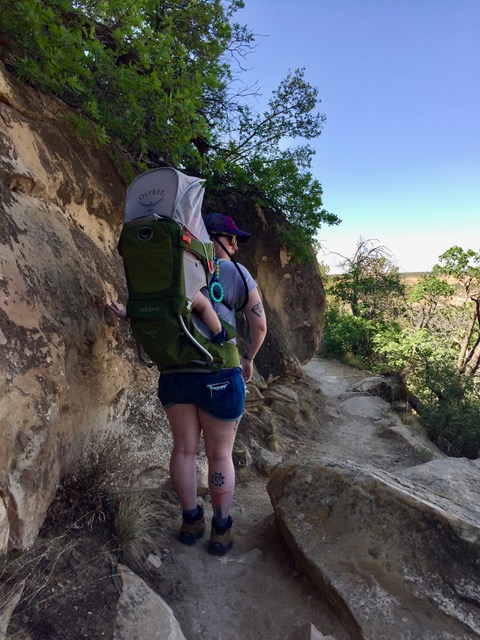
Jenn and Molly along the trail. You can see here that the trail looks pretty safe but the drop off is substantial. Care and common sense are, as they always are, essential in a wilderness setting, especially when there is substantial elevation involved.
The Trail to Petroglyph Point
With a toddler in tow, Jenn and I were somewhat restricted in what we felt comfortable doing in the park. It didn’t seem particularly prudent, for example, to sign up for the ranger-led tour of the Balcony House cliff dwelling which is ensconced in an overhang about seven hundred feet above the bottom of Soda Canyon. Visiting Balcony House necessitates climbing a thirty-foot ladder, with nothing but air behind you. Cliff Palace, while a bit easier to access than Balcony House, still requires ladder climbing that would have been challenging when carrying a little one.
So while up-close and personal examination of the stunning Mesa Verde cliff dwellings wasn’t on our agenda, it was nevertheless great fun even just to drive the loop road on Chapin Mesa and stop at every pullout to park, walk a little, and gaze at the remarkable 800-year-old structures below us or those nestled in the cliff on the other side of the canyon.
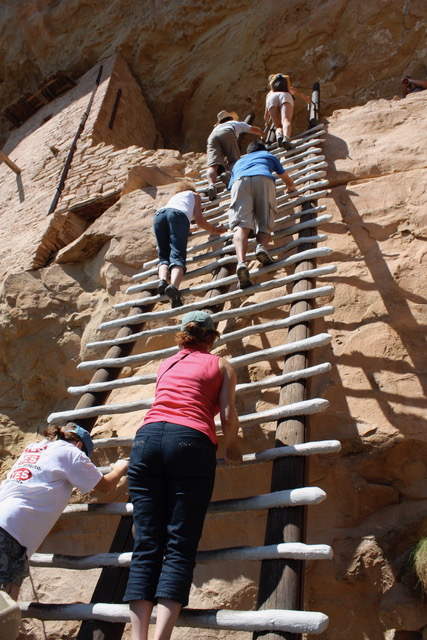
Balcony House is one of the remarkable Mesa Verde cliff dwellings accessible by a ranger-led tour.
My wife is an artist and is absolutely entranced by Native American rock art. Both before kids and later with Molly and then her younger sister Ellie, we’ve traveled to see an astonishing array of petroglyphs (images etched into rock) and pictographs (paintings on rock). We’ve visited sites across the country, from all the Four Corners states and also North Carolina, Ohio, Wyoming, Montana, and Minnesota. The kids love it and especially appreciate the scavenger hunts we set up in advance with pictures of various critters, the ancient depictions of which they search for in our rock art adventures.
As a result of my wife’s obsession, it didn’t surprise me when she decided that a kiddie carrier back pack would enable us to take the hike to the most accessible rock art in Mesa Verde, a dandy little panel located on what is called, appropriately enough, the Petroglyph Point Trail. It’s about a 2.4 mile loop beginning at the Chapin Mesa Archaeological Museum. Along the way, there’s an elevation gain of a little less than two hundred feet. It’s considered a “moderately strenuous” hike which I can attest to, but it’s something quite a bit more than that when you have twenty-plus pounds of one-year-old strapped to your back.
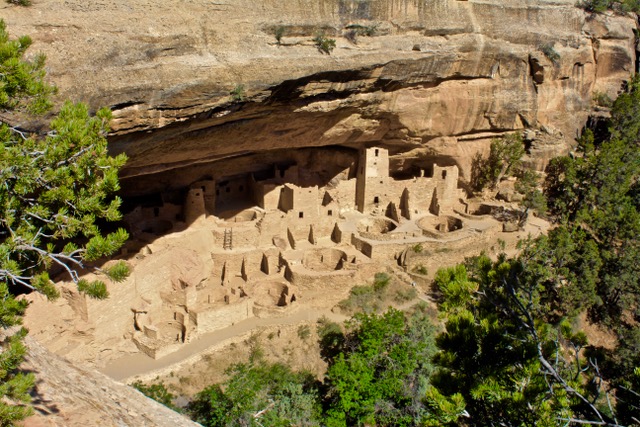
Cliff Palace at Mesa Verde is aptly named. Looking for all the world like a lovely palace, it is a spectacular cliff dwelling characterized by round and square towers. Visible from the top of the mesa, it can be visited through a ranger-led tour.
As a result of the two persnickety vertebral discs I carry around, my wife went into “beast mode” and made that hike safely and happily, carrying little Molly all the way while I voiced encouragement to her. Jenn can accomplish amazing feats when petroglyphs are involved.
Very few people made the hike on that day. We did pass a couple from California who were catching their breath, a challenge for sea-level dwellers as you approach seven thousand feet. They were only about halfway to the art and seemed to be a bit skeptical about their ability to continue up the trail. We stopped to chat for a bit, gave them some encouragement, bid them good luck, and then continued the ascent toward our goal.
It was wonderful to finally arrive, set the carrier down, and gaze at art dating to perhaps a thousand years ago. There on a ledge above our heads was a plethora of light tan images etched through the darker rock cliff surface which had been naturally varnished to a deep reddish brown. There were hand prints, a few spirals, a bighorn sheep, some images of what appear to be birds, assorted curved and straight lines, and about a dozen stick figure anthropomorphs, depictions of human-like figures with heads, torsos, arms, and legs. The beautiful setting, the spectacular views along the trail, and the art itself together made the somewhat arduous trip more than worthwhile.
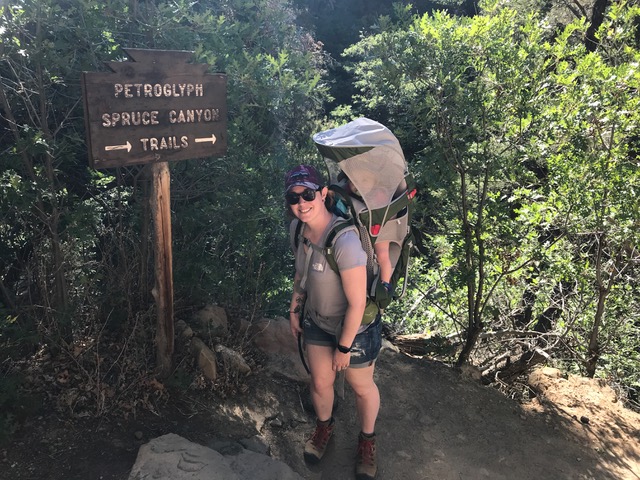
My wife Jenn, with baby Molly in tow, stands at the trailhead to Petroglyph Point.
A Disconcerting Encounter
As we reveled in the beauty of the place, and as Molly woke up from her bumpy trail-induced nap, we heard footsteps coming from the path behind us. It was a man who looked to be thirty-something, carrying a backpack and a walking stick. As hiking etiquette required, we warmly greeted him. It all seemed quite ordinary at first. Then things got weird. Really weird.
He asked if we were there for the petroglyphs. One would have thought it was self-evident that folks who had taken a moderately strenuous hike to a place called “Petroglyph Point” were there for the petroglyphs. We told him that yes, indeed, we were there to see the art. He let us know that he didn’t care all that much about the petroglyphs, and had another reason for the hike. He informed us that he was duplicating the June 9, 2013 hike of fifty-one-year-old Mitchell Dale Stehling from Texas—a man who had disappeared on that very hike. Without knowing it, we had been hiking the same trail exactly five years to the day after Stehling had vanished.
The hiker then told us a spooky story that seemed more appropriate for a midnight campfire than a beautiful summer day in Colorado.
On a visit to Mesa Verde, Stehling left his wife to walk to Spruce Tree House, a Mesa Verde cliff dwelling located off the Petroglyph Point Trail. The dwelling has been closed to visitors since 2015 due to safety issues, so we just walked by and photographed it on our way to the rock art. Our hiker friend told us—cue the spooky music—that Mr. Stehling walked that trail into oblivion and was never heard from or seen again, disappearing entirely and utterly, with no hint of his remains ever discovered. It was a longstanding mystery.
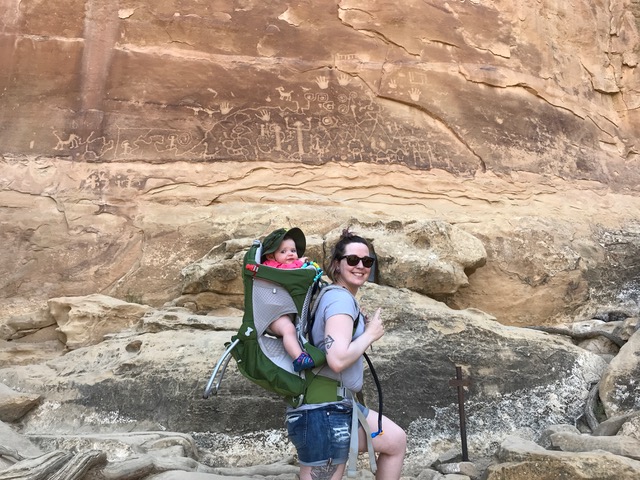
Jenn and Molly posed in front of the namesake for the trail, the Petroglyph Point panel.
As an insufferable rationalist, I suggested that, well, it really wasn’t necessarily all that mysterious. After all, hiking a trail like the one to Petroglyph Point isn’t without some inherent dangers. The trail is pretty narrow in places and runs alongside a steep drop-off. In fact, along the way we had encountered a couple of places where erosion had made the trail at least potentially treacherous and one certainly needed to pay careful attention with each step. One ill-considered footfall could lead to a bad result, especially if you were hiking alone. Disaster, though not terribly likely, was at least a possibility. Careless and unlucky are a dangerous combination when hiking on uneven, unstable ground along the edge of a cliff. And worse, in a back country setting, if you fall to your death, it’s not a certainty that anyone will ever find your body.
I thought I had made some valid points to dispel anything particularly enigmatic about Mr. Stehling’s sad fate, but our new friend would have none of it. He believed that something far more sinister than a misstep was going on. He assured me that a thorough search had been conducted once Mr. Stehling’s disappearance had been reported by his wife, but it was to no avail. He simply had vanished and there was no explanation for it.
“Well okay,” I replied to the hiker, “But isn’t it also possible that he’s totally okay, but as the result of some psychological trauma, disappeared himself and he’s living on his own, maybe under an assumed name as a way to escape, who knows what, maybe economic challenges or family drama?”
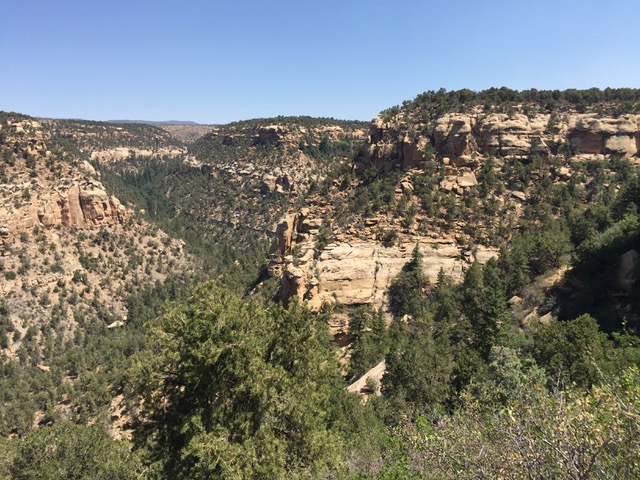
At an elevation of about 7,000 feet, the views along the Petroglyph Point Trail as you hike toward the featured rock art are quite impressive. The trail looks over Spruce and Navajo Canyons.
The hiker responded by saying that such an explanation had been considered at the time, but the people who knew him all felt that he had no reason to abandon his current life. I remember thinking, “Isn’t that always the case in such scenarios?”
Anyway, our hiker friend was skeptical of my skepticism but it did beg the question of why he was consciously replicating a hike if he was convinced that there was some terrible fate awaiting those who walked the trail. This is when our weird encounter got substantially weirder. He claimed to us that Stehling’s case wasn’t an anomaly, but a sign of something deeper and more menacing when you considered the big picture. “In fact,” he continued, “Stehling was only one of about fifteen-hundred people who have mysteriously disappeared on public lands over the last few years. There’s no explanation.”
Missing 411
Woah! What? There’s an epidemic of Stehling-like disappearances on federal land? As I soon discovered when doing some follow-up research on the topic, there actually is a popular and long-standing conspiracy theory that maintains that there have been well over a thousand inexplicable disappearances of hikers and campers on public lands in the United States and elsewhere. The theory is referred to as “411” (“four-one-one” when said aloud) and the primary purveyor of it has been an ex-cop, David Paulides, who has inspired a virtual industry based on the topic. He alone has written (and self-published) ten books expounding on the mystery, with his primary work being the 2012 book Missing 411: Unexplained Disappearances of North Americans That Have Never Been Solved.
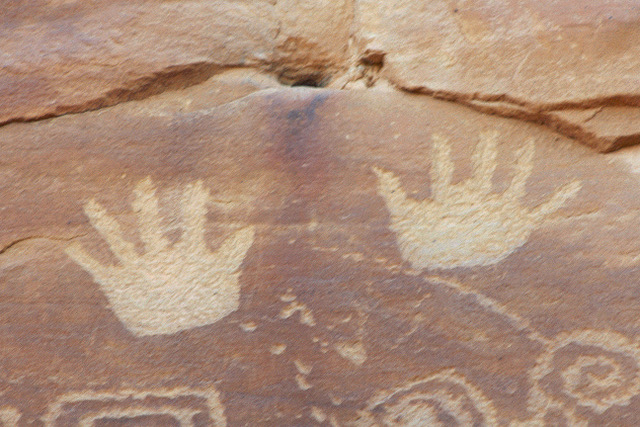
Among the images seen in the Petroglyph Point panel are depictions of human hands. Hand imagery is found dating to different time periods in ancient art all over the world.
Sure enough, and by no small coincidence, Paulides had highlighted Stehling’s disappearance in a 2014 book (and in an accompanying video, both titled Missing 411: The Devil’s In the Details). In it, Paulides recounts the few extant details of Stehling’s disappearance, even sharing that a voice crying out “help” was heard on more than one occasion, but no source was found. For those keeping score, in that book Paulides counts no fewer than twenty-three disappearances in Colorado, making it, apparently, one of the most dangerous states in the nation if you go outside.
On the general topic of Mesa Verde, Paulides attempts to frame Stehling’s disappearance as part of a broader historical mystery. In The Devil’s In the Details, he claims, “One of the long-held mysteries of this area is that archaeologists and historians don’t have any idea why the Indians left the area and vacated their buildings.” The video interviewer goes on to ask if there are legends of other disappearances in Mesa Verde. Paulides responded “other than the entire group of Pueblo Indians…”
Are we to take from this that the abandonment of Mesa Verde is just one big, spooky, seven-hundred-year-old example of 411 disappearances?
Well, not so fast. Very little of what Paulides states about Mesa Verde’s abandonment is true, and while we certainly don’t know everything about the ancestral Puebloans who lived there, the truth is far from mysterious.
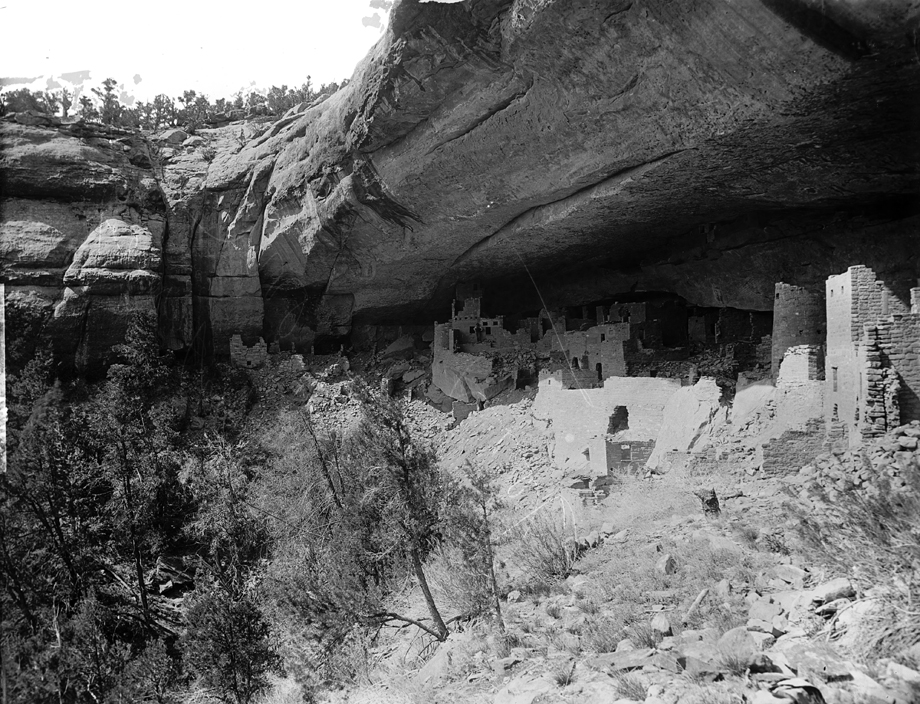
The Mesa Verde Cliff Palace, photographed by William Henry Jackson in 1874.
An analysis of tree rings in the area indicates that there was a prolonged drought between the years 1276 and 1299 accompanied by widespread crop failures and archaeological evidence of resulting social upheaval. This resulted not in any baffling disappearance of an entire group of people, but a migration to the south where conditions for growing crops were better. Far from missing without a trace, more than seven hundred years later, many of Mesa Verde’s modern descendants continue to live in Pueblo communities in New Mexico. Compared to the fantastical theorizing of Paulides and many others, this explanation has the none-too-subtle advantage of having actual evidence in its support.
It’s also interesting to note that on the whole, Paulides doesn’t really propose an explicit explanation for Stehling’s or the other more than a thousand disappearances, although he insinuates that, somehow, Sasquatch or feral “wild men” may be involved. Or maybe inter-dimensional portals. It’s all as bizarre as it sounds and his primary schtick appears to focus on the claim itself that people disappear mysteriously. Selling the mystery, not its solution, seems to be at the heart of his work.
After receiving a truncated version of this theory from our fellow hiker, I remember making eye contact with my wife. She picked up Molly in the carrier and moved a safe distance away from the stranger who, fairly or unfairly, we were beginning to worry might be a loon, and even potentially dangerous. While that might have been a little (or a lot) paranoid of us, it certainly seemed prudent.
After we met his further theorizing about the disappearance with some awkward hemming and hawing, the hiker went on his way. His final words to us were either portentous, or darkly comic: “Well, maybe I’ll see you along the trail further up. Then again, maybe not.”
Creepy. And off he went. And, indeed, he was never seen again. Well, not by us. I’m sure he was fine, but we wanted to keep as far away from that man as possible.
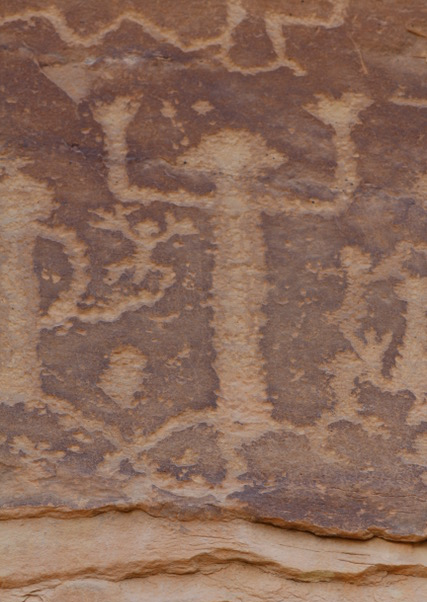
Here is one of the images of human beings at Petroglyph Point.
A Long Tradition of Going Missing
Humans have been going off-trail since we first had trails to follow. But today, in a world where we’re so used to interconnection and instant communication, it can be surprising and frightening to hear about someone who’s vanished. But for most of human history, we didn’t have paved roads and large, colorful street signs to guide us.
If Mr. Stehling along with so many other unfortunate public-lands visitors can so easily get lost in a wilderness area, it raises quite a few questions about the people for whom southwest Colorado is their homeland. Were the Native inhabitants of these places also susceptible to disappearing and dying as part of a longstanding pattern as described in the 411 phenomenon? Are these places simply naturally dangerous to anyone who enters into them? Or are tragedies like Mr. Stehling’s an inevitable consequence of entering into a wild space with which you are unfamiliar?
When asking questions like these, it’s important to consider the concept in behavioral geography of a “mental” or “cognitive map.” On more than one occasion when I have been a visitor to New York City, I’ve asked for directions from a resident who couldn’t easily articulate those directions with street names but told me, “You know what? It’s easier for me to just walk you to your destination.” Their internalized knowledge of the cityscape they’ve lived in all their lives provides them with a mental map by which they navigate their city accurately, and largely subconsciously.
The same thing recently happened to us at Halona, the primary settlement on the Zuni Reservation in New Mexico. We were lost and asked a young Zuni guy how to get to a local raptor sanctuary. He thought for a moment, gave up trying to tell us the way and said: “Just follow me in my car. I’ll get you there.”
In much the same way, the survival of the people native to Mesa Verde, lacking paper maps, Google Maps, or a handheld GPS device, relied on their internalized ability to navigate within their home territory. They knew where there were animal trails that were easy to navigate. They knew where there was fresh water. They knew where edible berries were abundant. They knew where slopes were too steep to move across safely. Of course this knowledge, both deep and broad, didn’t guarantee their safety, but it certainly increased the probability that they would be safe as they traveled within their home range.
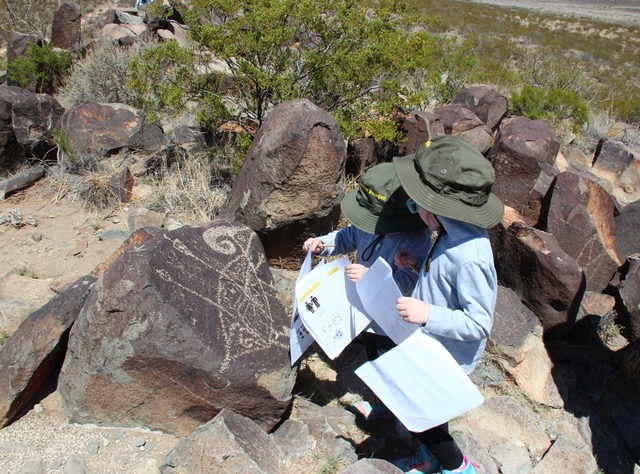
My daughters Molly and Ellie are huge fans of Native American rock art. Here they are investigating the remarkable depiction of a big horn sheep at the Three Rivers Petroglyph Site in New Mexico.
Modern visitors to Mesa Verde and other wild places included in our national parks and monuments are, effectively, aliens in those landscapes. As a result, we haven’t developed detailed mental maps of the federal lands we are only briefly visiting. To compensate for this, the National Park Service and other government agencies have created facilities and resources on the ground, including marked hiking trails, signs, roads, kiosks, and so on, to compensate for our unfamiliarity with the landscape. These facilities and resources contribute to a reasonably safe experience for those of us who are drawn to wild places with their remarkable vistas and yes, with archaeological sites that inspire us to consider the lives of people who preceded us on this land.
As good as the Park Service is, there are never guarantees in wild places, and all bets are off when we wander off the grid. Disappearances, like that of Mr. Stehling, do not represent great mysteries. The list of tragedies, instead, is a wake-up call for those of us who visit the wilderness, reminding us that we need to approach those places with respect. They aren’t our backyards or home turf, and we need to be clear-eyed about the genuine risks.
The Fate of Mr. Stehling
To return to the resolution of this story, once the hiker had walked away, we were still a bit uncomfortable about the entire experience. We pressed on and made the short climb beyond the petroglyph panel and continued the loop back to the trailhead, turning our attention back to the gorgeous views and commiserating with a very impressive, brightly-hued collared lizard.
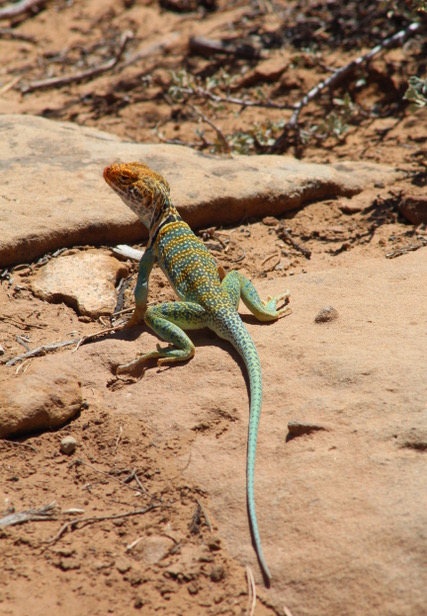
An inquisitive collared lizard joined us for a part of our hike back. We were not sucked into an inter-dimensional portal nor were we captured by wild men. I cannot vouch for the whereabouts of the gentleman replicating the hike of Mr. Stehling.
At some point later, once I was back in internet range, I did a little research about Mr. Stehling’s genuinely tragic fate. It turns out that a family of hikers actually reported seeing Stehling at the Petroglyph Point panel, but they moved on and didn’t encounter him again on the trail. Nor, apparently, did anyone else. I should also add that Stehling’s wife revealed that he hadn’t brought any water with him, which was a big mistake on a day that the Weather Service reported a high temperature of 91 degrees. Beyond this, he had no maps and was, according to his wife in news reports, “directionally challenged.” None of those details bode well for a solitary hiker.
Any great perceived mystery ultimately disappeared when they finally found Stehling’s body in November 2020, more than seven years after he disappeared and nearly two-and-a-half years after we were told his story. His mortal remains, clothes, and belongings, including his driver’s license, were found deep in the woods a little more than four miles from Petroglyph Point. Perhaps he fell. Perhaps he simply went off trail. He wandered for hours, without water. He got lost in the wilderness. And, sadly, he died.
There isn’t anything spooky or conspiracy-related about that. Just an all too familiar tragic story of someone making a poor decision in a wilderness area and paying the ultimate price. Rest in peace, Mitchell Dale Stehling. And hopefully, this can put a rest to any concocted mystery associated with his demise.