
 Membership
 Donate
 Shop
Shop























Echoes from the Valley
Hundreds of thousands of bats emerge from an abandoned mine, bringing life to a Colorado valley once shaped by miners and industry.
Surely we weren't the only ones staring up at the sky in this alpine valley, known as much for its stargazing as its stories of alien abductions. During the tail end of the Perseid meteor shower, Megan and I strained to spot fireballs dimmed by the glow of a waning gibbous moon. High above, meteors streaked through the atmosphere while Mexican free-tailed bats flitted through the air, feasting on insects and pollinating plants. That’s what brought us to the San Luis Valley. Bats. There, a colony of 250,000 emerges at dusk, forming a swirling, fuzzy-black commuter cloud of aerial acrobats taking flight near the ghost of Orient City.
The bats rise each night from the Orient Mine, a place once excavated for valuable ore before being abandoned. What people left behind, the bats claimed, turning absence into abundance. Their flight is more than an evening migration. It’s a reminder that Colorado’s story is as much about reinvention as it is about ambition. Towns fade, mines collapse, but life adapts, persists, and even flourishes. To watch the colony lift into the sky is to glimpse life’s larger rhythm and to feel, for a moment, part of it.
Peering into the mine for the first glimpse of emerging bats, the sheer effort of those who worked here becomes clear. The walls still bear the scars of pickaxes. It’s easy to imagine the miners chipping away at the rock day after day. Hands calloused, faces streaked with dust, they monotonously carved this shaft that looms as a reminder of the town and industry that once thrived here.
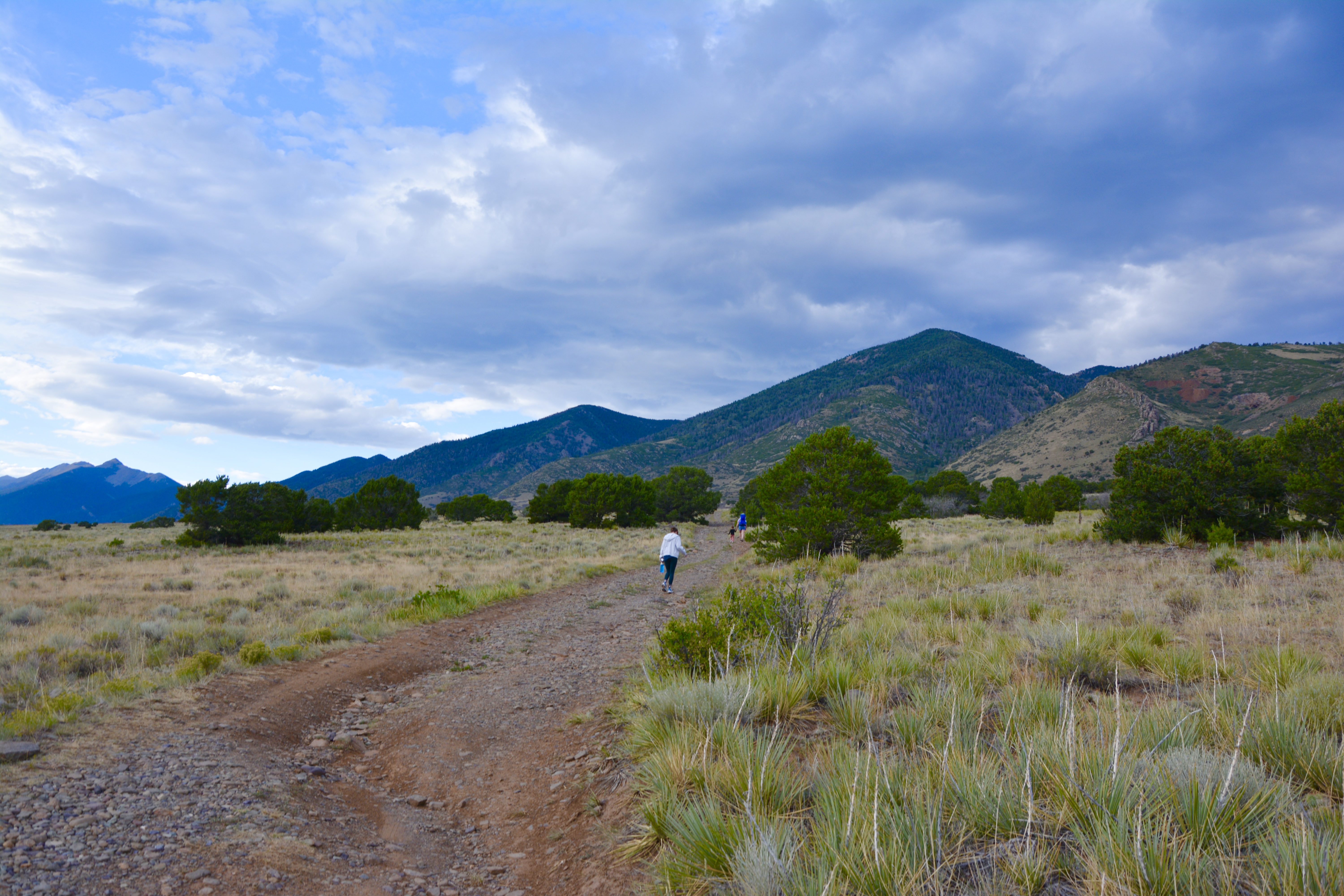
Hiking up the rugged BLM road.
The Orient Mine
The Orient Mine opened in 1880, carved into the eastern wall of the San Luis Valley to feed iron ore to Colorado’s growing steel industry. A year later, a narrow-gauge rail line snaked over Poncha Pass, and a bustling camp called Orient City took root. At its peak, 400 people called it home. It boasted a general store, library, barber shop, saloons, boarding houses, and a school for miners’ children.
Rugged laborers occupied the town and each day crowded into the mine, many of them immigrants chasing the promise of steady wages. An eclectic chorus of European languages mixed in the thin mountain air, rising and falling with the clink of hammers and the scrape of shovels. They were earning better pay than other laborers of the era, but they were also stepping into danger every day. Suffocating gas pockets, collapsing ground, runaway ore cars, sudden floods, and even mule kicks were all part of the job. Six fatal accidents are recorded at the Orient, each one a reminder of how narrow the margin was between routine labor and tragedy.
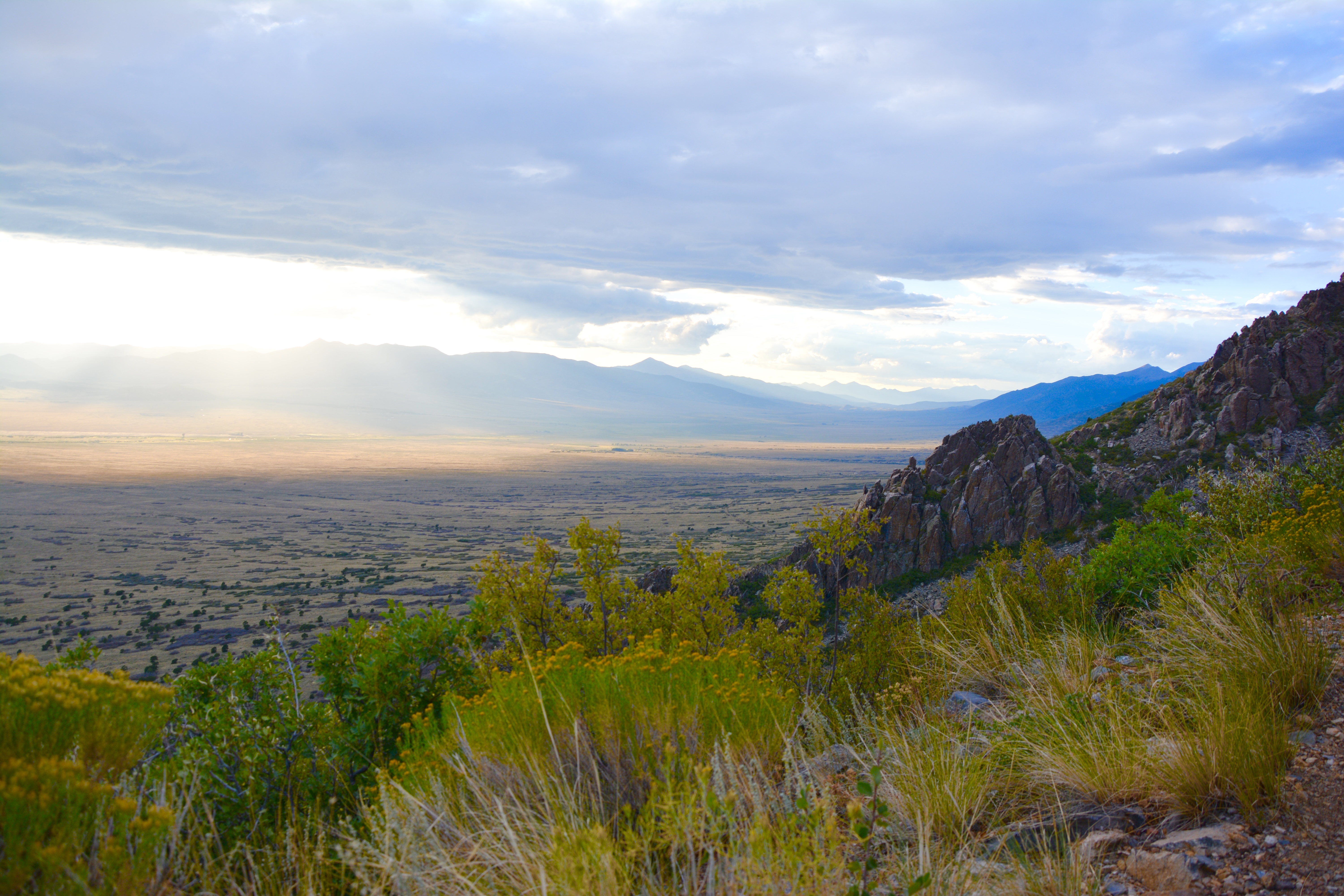
The sun sets over the San Luis Valley.
Iron dust hung in the air as twenty-nine year old George Malich worked in the Orient’s narrow, timbered stope. The Austrian-born miner spent many days shoveling and hauling rock, surely listening for whatever warnings the mountain offered. When a chunk of ore broke loose and struck him on November 15, 1894, the echoing crash must have rattled the tunnel, startling the men around him and carrying the news of disaster through the mine. Those who shared shifts and meals with him felt his abrupt absence. And somewhere, whether in Orient City or across an ocean, someone who once knew him simply as George likely carried the quiet weight of losing him, as so many miner’s families did.
For nearly two decades, the backbreaking labor of miners like George Malich made the Orient the most productive iron mine in Colorado. Approximately two million tons of iron ore came from its tunnels. But by the early 1900s, the best ore veins had thinned, and newer mines outpaced the Orient. The town’s pulse softened. In 1905 the post office closed, often the final breath of frontier settlement. Orient City, once a vital link in Colorado’s industrial rise, slipped into quiet decay, its glory days tucked into the folds of the valley hills.
Small pockets of ore were still mined until 1932, when the lodes were finally exhausted. To close mines, workers typically stacked timbers and rocks at key tunnel entrances and then set carefully calculated charges of dynamite to collapse the shafts. The goal was to seal off the passages, discourage trespassers, and prevent accidental injuries. Closing mines in this way reduced the risk of cave-ins, flooding, and exposure to toxic gases. By accident, the blast designed to seal the Orient opened a cylindrical tube with side tunnels, quiet and dark, a perfect bat refuge. No one knows exactly when the bats moved in, but humans first spotted them in 1967. Over time, the Orient became a destination for bat lovers, and nearly sixty years after they were first spotted, Megan and I made the journey to see them for ourselves.
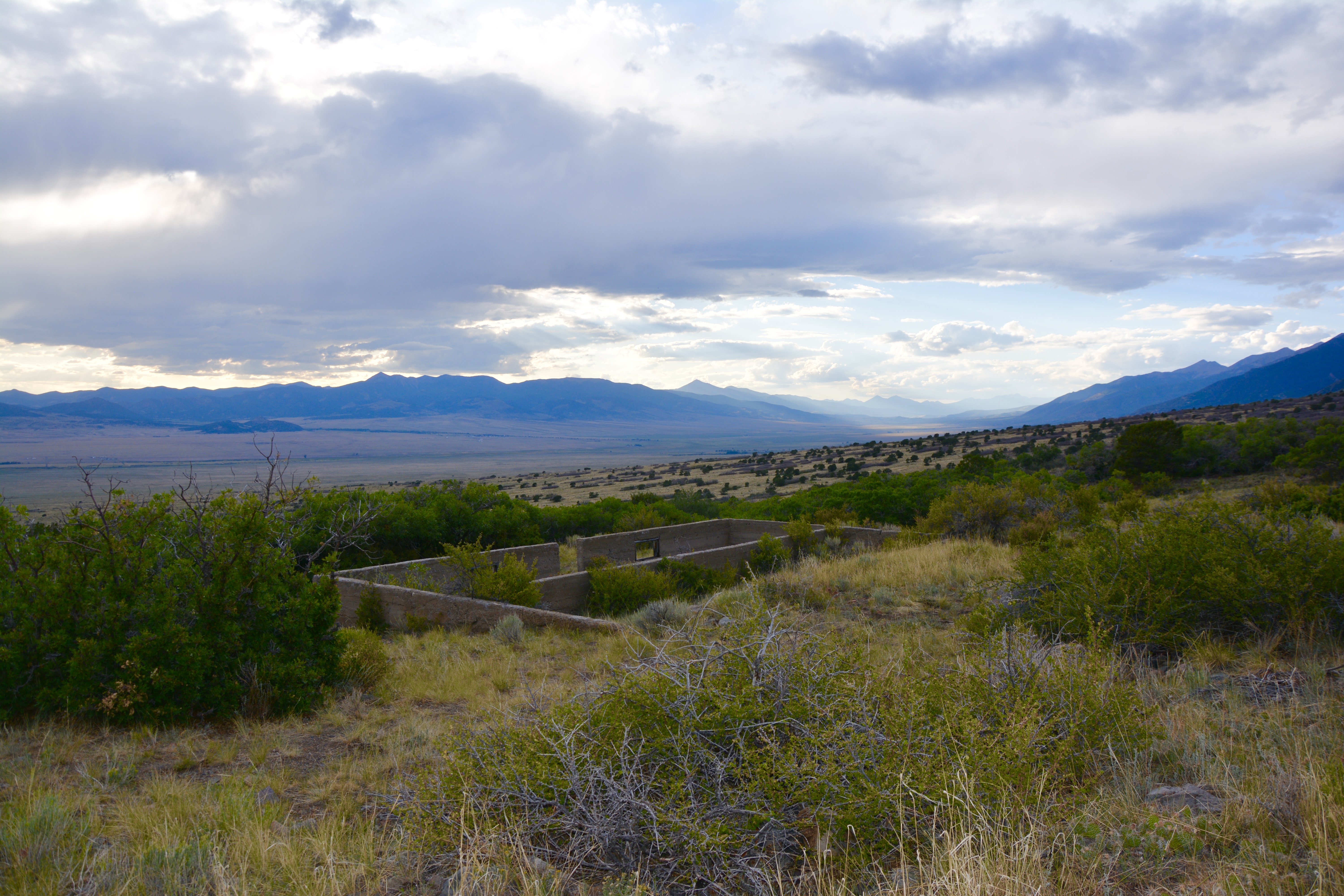
Foundations from a building in Orient City.
Driving to the Mine
Our Subaru Crosstrek never stood a chance against the second half of that rock gauntlet the Bureau of Land Management referred to as a road. We pushed the car hard, but barely got further than a nearby Tesla. Somehow the low-clearance sedan had clawed its way up here too. I could only assume its driver loved bats more than we did. I might have kept grinding uphill, but it was Megan’s car. Her tires, her undercarriage, not mine to sacrifice. So we eased off the road, parked, and added a mile to the hike.
We soon overtook a toddler and her mom, proud pilots of that improbable Tesla. They confirmed we were on the right road to the mine. The child knelt to marvel at a lumbering beetle, then nearly crushed it when her attention drifted. We stumbled past the young mom and daughter, over rocks, and up a rugged path that confirmed we made the correct decision by parking and hiking a little further.
Bright blue Pinyon Jays zipped past in a last-ditch dinner rush. Megan pulled out her bird app, which confirmed they were rare. Certified rare birds. You don’t see that every hike. Most people don’t get excited about a rare bird until they cross a certain birthday threshold. My bird enthusiasm graphs neatly against my age. Both keep trending upward. Hiking might be a young man’s game, but ornithology is ruled by the old.
As we scanned the sky for more birds, we glanced down now and then to avoid ankle-eating ruts and yucca spears waiting to stab us. The air was hot and stagnant. That’s the curse of dusk hikes. You have to wear a coat for the return trip. Our light jackets soon had us sweating, so we gave in and tied them around our waists.
We reached the official trailhead just as a guide led a group up from Valley View Hot Springs. Perfect timing, I thought. The guides must plan it so the hike tops out at the Glory Hole just as the bats pour out. That’s really what they call it. Every evening, thousands of bats stream from the Glory Hole. We pushed ahead of the tour group, hoping to reach the end of the trail before them.
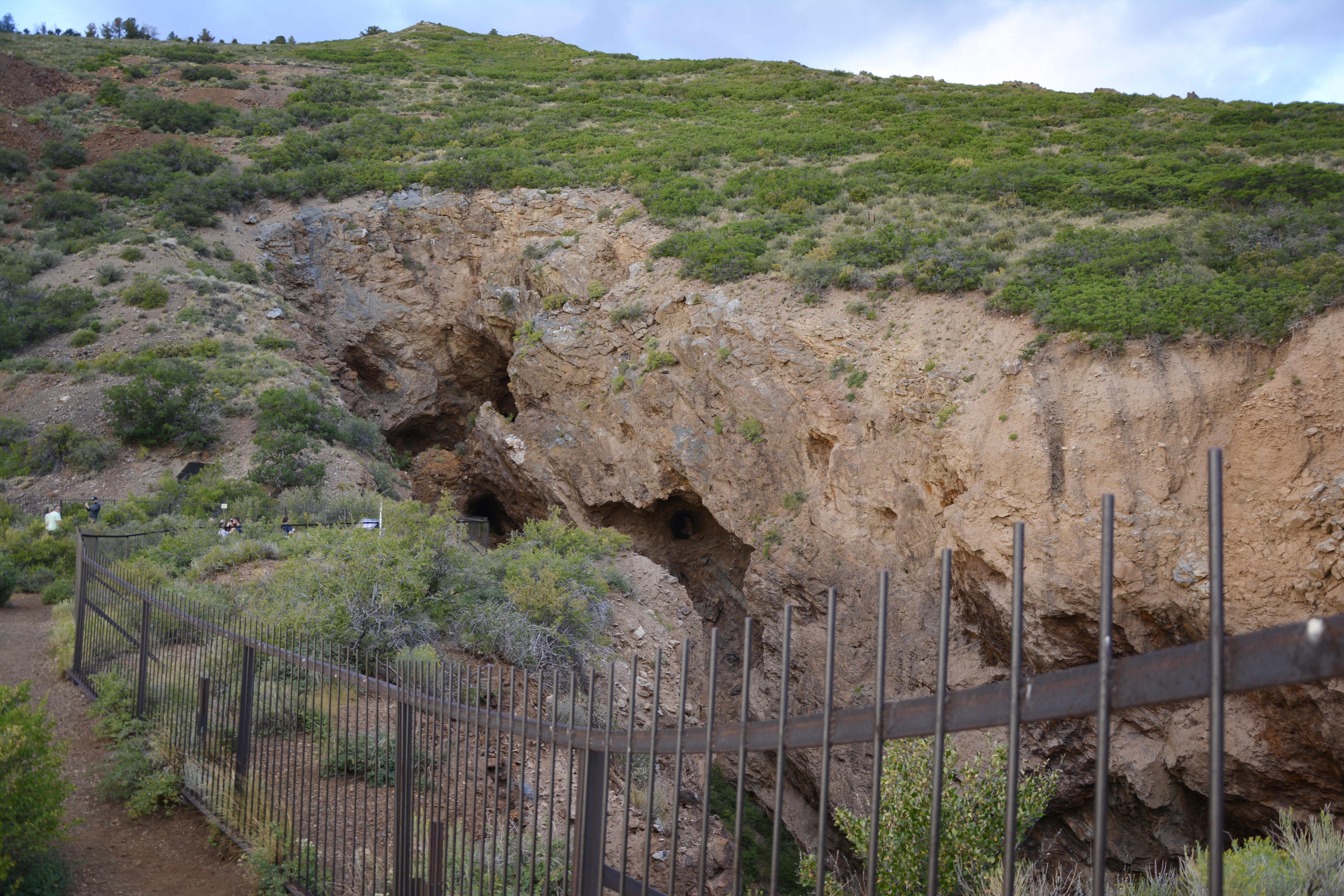
A railing guards the steep dropoff of the bat cave.
The Orient Land Trust
The hike winds past the remnants of Orient City—crumbling foundations, weathered water wells, rusted rail tracks, and towering piles of rock left behind by miners. Today, the surrounding landscape is protected by the Orient Land Trust, whose story begins in 1872, when the Everson family homesteaded a 760-acre ranch.
Shortly after establishing the ranch, a prospector named Frank Haumann discovered a rich deposit of limonite and iron ore on the property. The find caught the attention of the newly formed Colorado Coal and Iron Company based in Pueblo which leased the land to develop the Orient Mine and the nearby company town.
Decades after the mine and town faded, and not long after bats made the abandoned shafts their home, Neil Seitz began working for Roy Everson on the ranch. In 1975, he and his wife Terry became caretakers of Valley View Hot Springs. Today, that’s the main draw for visitors—the warm, mineral-rich, clothing-optional waters that Indigenous people had long sought in this part of the Sangre de Cristo Mountains, long before European settlers arrived.
With limited capacity and a strict reservation system, Valley View Hot Springs remains intentionally uncrowded. I reached out for an interview. They gave it serious consideration since I was approaching the story from a historical angle. That’s more than most writers ever receive. Ultimately, however, the Executive Director of the Orient Land Trust, Crystal England, politely declined: “As a rule, we don't advertise or give interviews, and we typically ask organizations not to write about us. It doesn't usually work, but I do ask!”
The Seitzes eventually purchased the land from the Eversons. Committed to preserving the springs and surrounding landscape for education and public enjoyment, they established the Orient Land Trust in 2001. By 2009, they donated the property to the Trust, safeguarding it from future development. Over time, the Trust expanded its stewardship to include the old mine, maintaining the area as both a living archive of history and a sanctuary for nature and reflection. As we hiked up to the bat cave, the unspoiled views across the sweeping San Luis Valley inspired gratitude for the decision to keep this remote, special place as protected, and as secret, as possible.
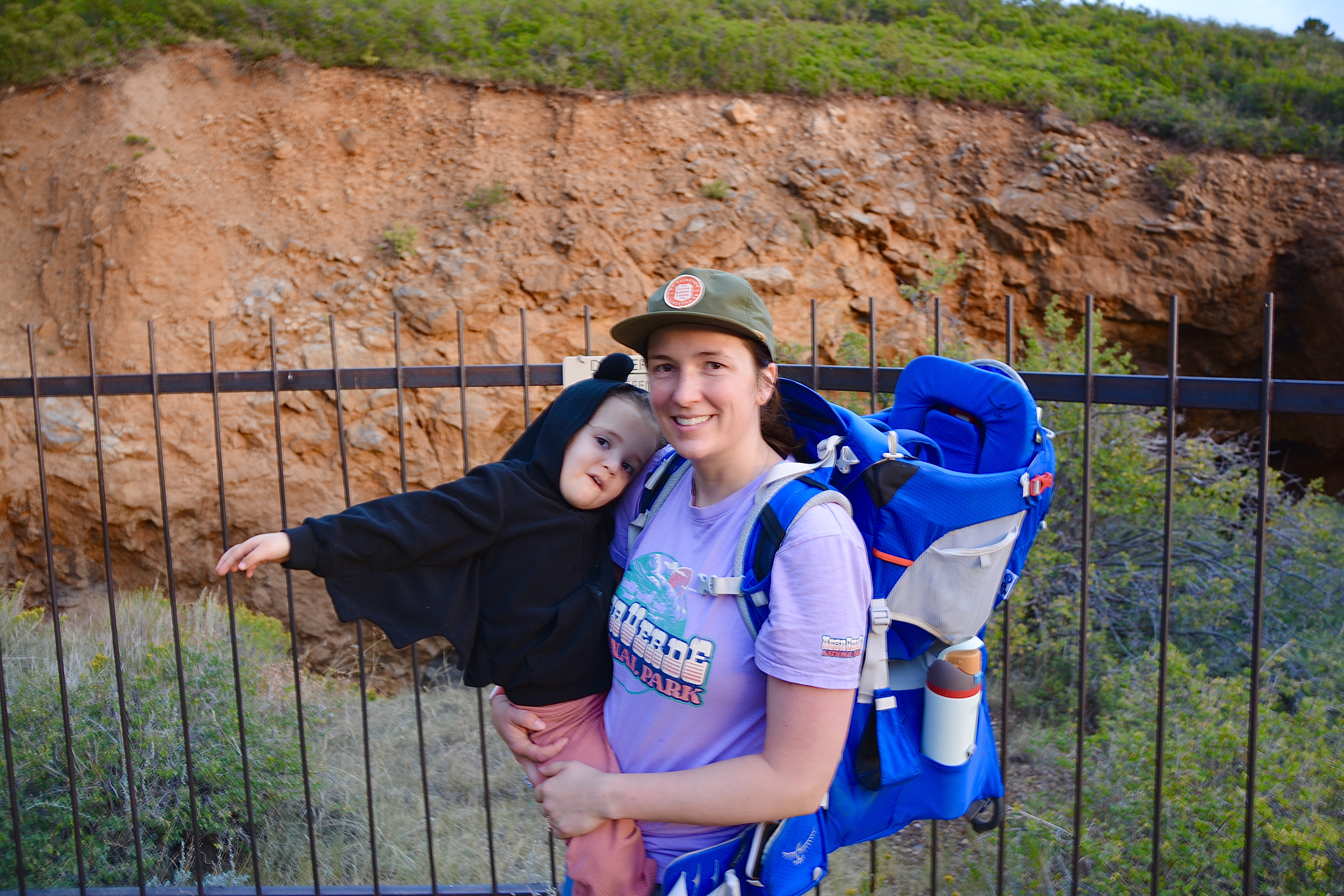
Hannah Evans-Hamer and her daughter.
The Swooshing of Bat Wings
Megan and I read the signs lining the uphill path, each one recounting the history of the mine. As we climbed, the setting sun dipped toward the horizon under wispy clouds, its crisp yellow beams slicing across the western edge of the valley. A San Luis sunset on a clear evening is hard to beat. Light spills over fields of green and gold revealing a harvest festival paused just long enough for you to breathe it in. It carries a sense of timelessness, the quiet urge to leave everything behind and take up ranching. The Eversons must have felt that same peace and equanimity all those years ago.
You smell the cave before you ever see it. For a bat enthusiast, there is nothing unpleasant about it. When the guano hit my nose, a broad, unforced smile spread across my face. It was a signal to my brain that something extraordinary was about to happen. We were about to witness a bat flight, a phenomenon Megan and I had only seen before at Carlsbad Caverns National Park. Both colonies are made up of the same species of Mexican free-tailed bats. The one at the Orient houses mostly males and is known as a bachelor colony. The bats at Carlsbad, on the other hand, are female. Like a fraternity and sorority, each colony retreats to its own gender-specific cave, maintaining secret hierarchies and unwritten rules.
For fifteen minutes we waited in silence, broken only by those who missed the signs to stay quiet or simply did not care. At Carlsbad the exodus trickles and grows. Here it erupted. I looked down for a moment, heard a gasp, and looked up to see a flood of hungry bats swooping ten to twenty feet above. A steady, surprisingly loud white noise rose from the swoosh of wings as bats poured out in an unbroken stream for nearly twenty minutes. Halfway through, they began darting up and down as they exited the cave. It was as if the performance had reached a crescendo, and they were signaling the final act of the show.
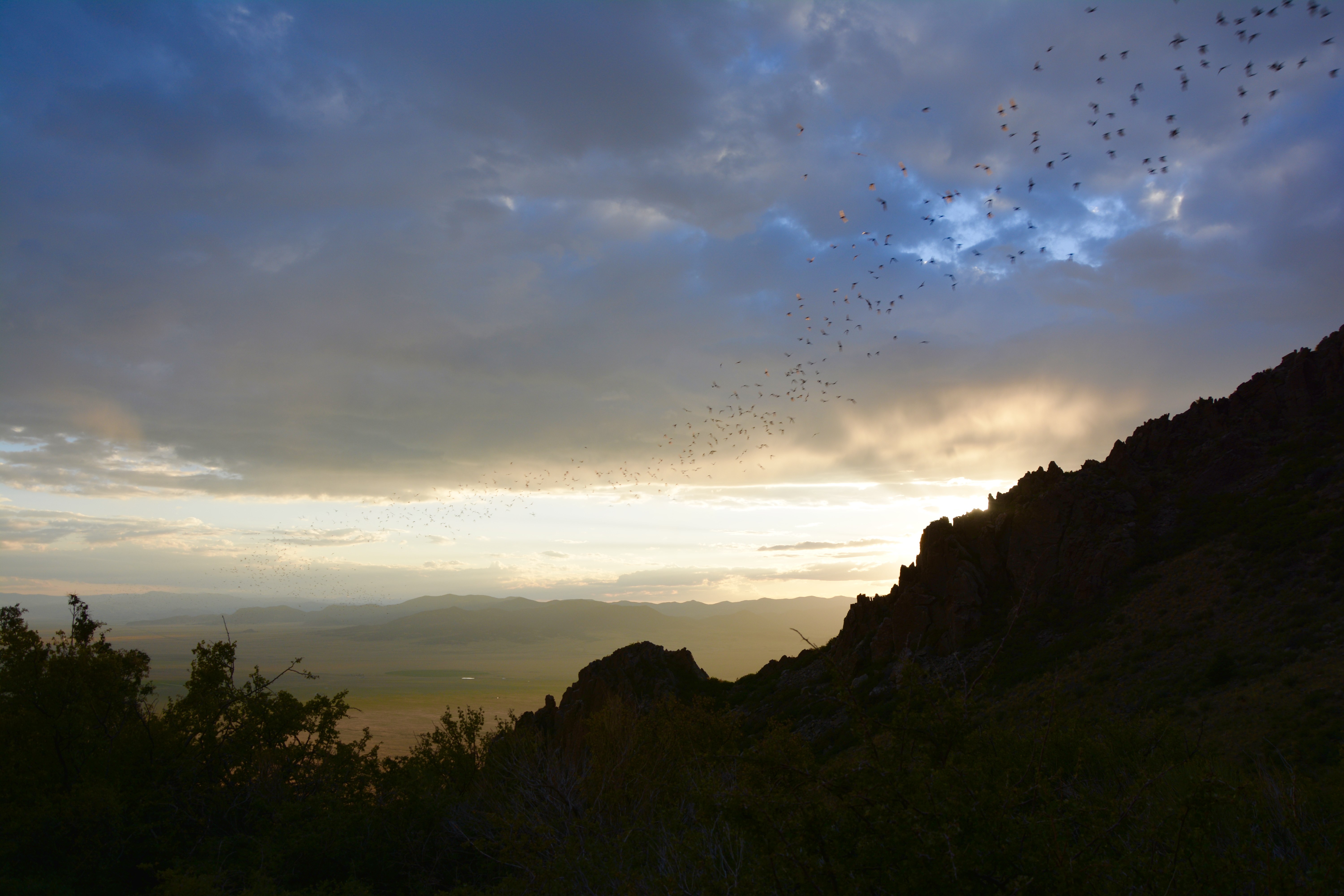
The bats take flight.
The guide from Valley View Hot Springs rounded the corner, his face falling as he realized the bats had already taken off. Their wings caught the sunlight as they flew toward their nightly meal, making each bat glow gold. The guide said this was a rare treat, something he had seen only a handful of times in over a hundred trips to the cave.
Megan noticed a small child stomping along the rocks, her black jacket flaring with every exaggerated step. As she lifted her arms the bat wings stitched under her sleeves fanned out. She added sharp, high-pitched squeaks that echoed the calls of the bats swirling overhead. It was the same kid we met near the Tesla at the start of the hike. I couldn’t help telling her mother how adorable the child’s bat imitation was. She smiled, a gentle warmth in her eyes, and explained that her daughter had first heard about the Orient Mine bats at the Denver Museum of Nature and Science. Since then, her fascination only grew, compelling the long, three-hour drive to the valley. They had battled the rough road, the Tesla jolting over jagged stones, plunging into deep ruts, and skidding on loose gravel. Now it all made perfect sense.
Threads of Connection
Standing there, watching the last of the bats vanish into the growing dark, it’s impossible not to see the threads that connect human curiosity to the natural world. It’s the urge to witness something larger than ourselves, to marvel at wonders beyond our control, that draws us to places like the Orient Mine. Whether it’s the thrill of a meteor streaking overhead, imagining the grit of forgotten miners, admiring the swirling dance of hundreds of thousands of bats, or a child’s delight at showing off the wings stitched into their jacket, we are compelled to observe, to understand, to feel connected.
The Orient Mine, once a symbol of Colorado’s industrial ambition, now shelters creatures that remind us of resilience, adaptation, and the quiet persistence of life. In its decay, the mine and the towns that sprang up around it tell a story repeated across Colorado. Humans arrive, shape the land, sometimes flourish, sometimes fade, but the landscape endures, reshaped by nature and memory alike. Perhaps that’s what Colorado has always offered, a place where human ambition collides with natural beauty, leaving both transformed.