
 Membership
 Donate
 Shop
Shop


















Changing of the Guard
Colorado's toppled Civil War monument and a new conversation about how we commemorate the past
We are a product of history, our lives and our communities shaped by those who came before.
In some cases—and in some places—we choose to spotlight and elevate certain individuals from our collective past to recognize their significant contributions to our communities, so that we may continue to draw inspiration from their example. Whether they are statues cast or carved to stand for generations, the names we give our parks and public buildings, or what we call natural landmarks, every monument is an instrument designed to transmit the stories, knowledge, and perspectives of one generation in a lasting way that we hope will benefit our descendants. In creating monuments, we inscribe our shared history on the landscapes and cultural spaces that provide the setting for our daily lives.
But what happens when generational values shift about who, or what, deserves to be commemorated?
This is the question many of us in museums, historical organizations, city governments, and local communities throughout the nation have confronted with growing urgency over the past decade. In Colorado, it recently took the form of an eight-foot-tall bronze sculpture of a Union cavalry soldier toppled during the protests for racial justice that erupted during the summer of 2020 in the wake of George Floyd’s murder. As the monument fell from its pedestal in front of the State Capitol, it raised a number of questions about how we should commemorate our shared history and what we owe to the people of the past who left us their guidance in the form of monuments. Questions that go to the heart of who we want to be.
In 1909, the bronze figure of a dismounted Union cavalry soldier was installed outside the Colorado State Capitol, Colorado’s contribution to the nationwide wave of monuments installed to commemorate the aging veterans of the Civil War and advance certain narratives about the meaning of their sacrifice. “On Guard,” as the artist John Dare Howland formally designated his work, occupied a place of honor. The bronze soldier stood sentry on the west side of the State Capitol, casting his fixed eyes over the Capitol’s “front lawn” in Denver’s Civic Center and beyond toward the sun setting over the Rocky Mountains on the horizon. Plaques affixed to the pedestal of the monument listed the engagements Colorado troops had fought in throughout the Colorado Territory and beyond, highlighting the state’s role in the national conflict.
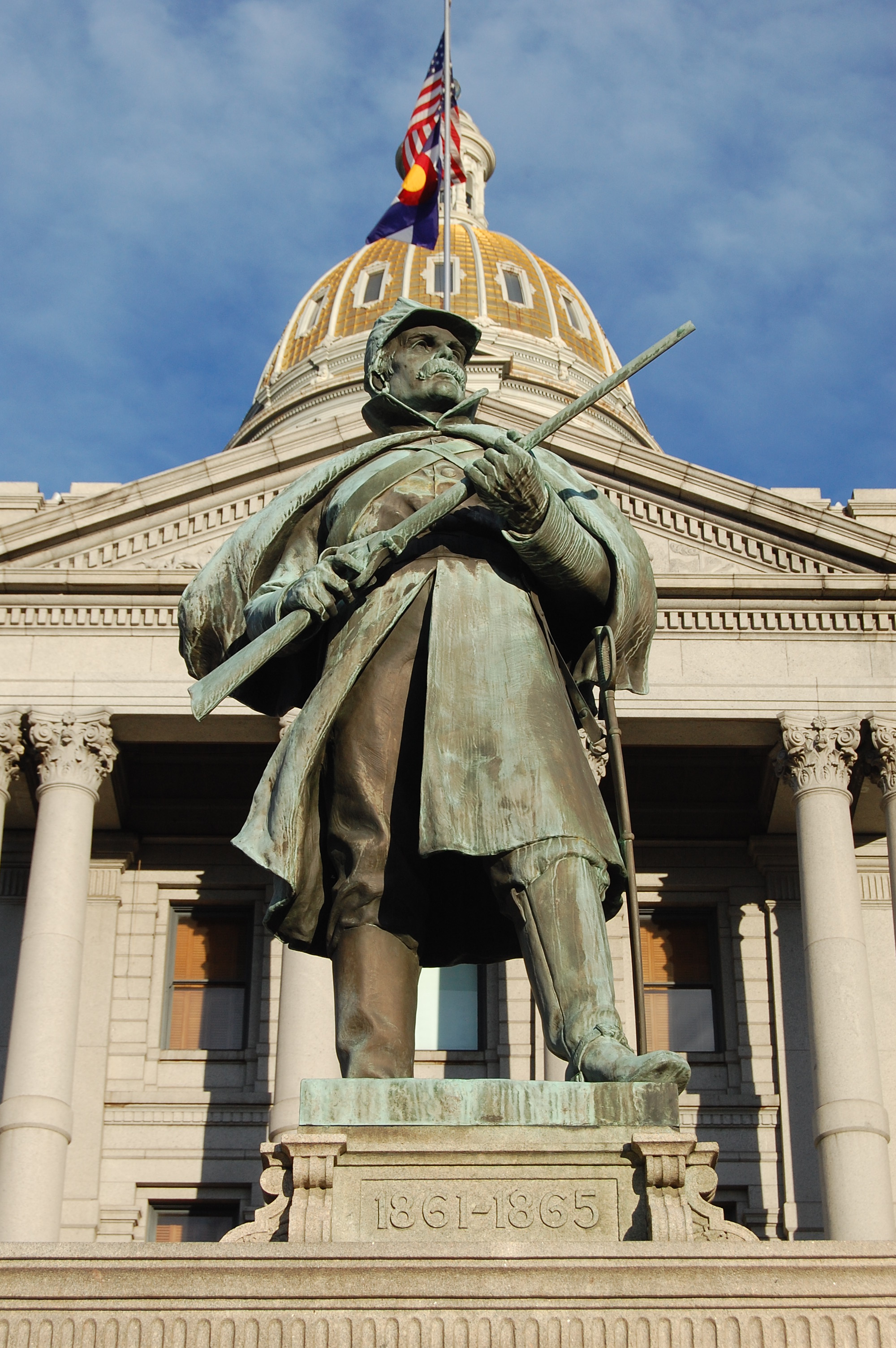
Colorado’s Civil War monument, “On Guard,” was installed in front of the State Capitol in 1909 to commemorate Coloradans who fought with the Union during the war. It stood there until it was toppled in the summer of 2020.
And there it stayed, more or less without change, standing silent guard over Civic Center through blizzards (like the whopper of 1913) and blazing summer days (ever hotter in recent years) for more than a century. Thanks to its location in front of the Capitol, it was a focal point for civic gatherings, protests, and ceremonies over the decades, from Super Bowl and Stanley Cup celebrations to immigration rallies, Occupy protests, women’s marches, anti-mask demonstrations, and more. During the summer of 2020, when Coloradans took to the streets demanding racial justice in the wake of George Floyd’s murder, the marches, rallies, and protests again centered on Civic Center, and “On Guard” stood, as it had so many times before, amid history in the making. Until the overnight hours of June 25, that is, when the monument was toppled by unknown actors.
At first, even some people who were generally supportive of removing offensive monuments were confused by the rage directed at this monument. After all, it honored Colorado soldiers who fought with US forces to preserve the Union and end the enslavement of Black men and women in the South. Many Americans think of the Civil War as an event that primarily took place east of the Mississippi River while those in the West remained largely separate from the fighting, but in important ways Colorado was born from the conflict. Colorado troops, drawn primarily from local volunteers, fought for the Union Army near and far from home. Most notably, Colorado's Union forces engaged in the Battle of Glorieta Pass in northern New Mexico, where they played a vital role in protecting western gold fields—and the financial support for the Union war effort they represented—from Confederate takeover.
But Union troops weren’t here only to hold the gold. Amid this wartime context, the US Army used military force to clear Indigenous peoples from their homes and secure the land for American settlement. In the most ignominious episode in that colonial project, on November 29, 1864, US cavalry regiments attacked a peaceful camp of Cheyenne and Arapaho people on Colorado’s eastern plains who had been promised protection by the Army. The soldiers murdered more than 230 women, children, and elders as they tried to run for safety. Upon their return to Denver, the troops paraded in celebration, proudly displaying trophies from the battle—some taken from the bodies of the dead.
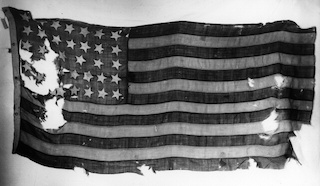
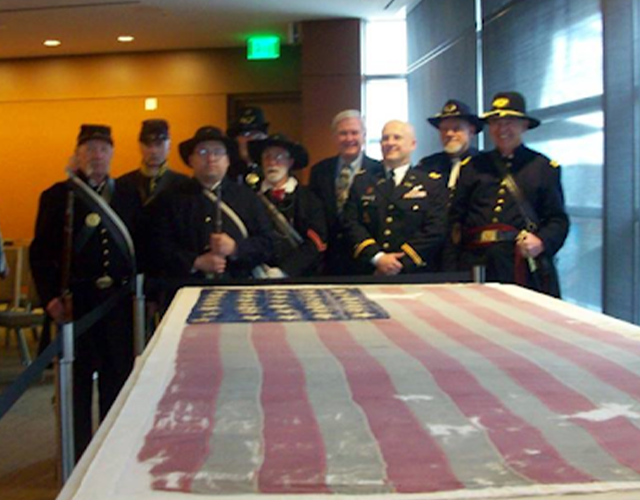
U.S. Flag carried by the 1st Regiment of Colorado Volunteers during the Civil War.
The Sand Creek Massacre, as it quickly came to be known, was the bloodiest day in Colorado history. The betrayal of the Cheyenne and Arapaho by the US government touched off decades of violence and warfare across the West that ultimately resulted in the government forcibly removing the region’s Tribes from their homelands and making various efforts to eradicate them completely.
The US Army and Congress both investigated and quickly condemned the attack. Congress’s 1865 "Report of the Joint Committee on the Conduct of the War: Massacre of the Cheyenne Indians" was the first to officially call it a massacre. But many of the people of Denver and in other communities throughout Colorado refused to accept that their relatives and friends had taken part in such a dishonorable action. When the “On Guard” monument was installed, its pedestal included a list of “Battles and Engagements” Colorado troops had fought in during the Civil War. The final entry on the list was “Sand Creek,” an assertion that the killing at Sand Creek was a legitimate battle that belonged among the other worthy actions of Coloradans during the Civil War.
That assertion, set in the legitimacy-conferring patina of weathered bronze, made the monument increasingly contentious in recent decades. At various times the plaque was bathed in blood-red paint, and at one point someone tried to grind the entry for Sand Creek off of the list. By the turn of the century, the Colorado legislature, which oversees the Capitol grounds, was searching for a solution. In 2002, with the input and guidance of the Tribal descendants of those killed at Sand Creek, the legislature approved the addition of a new plaque that was much clearer about the nature of the massacre, explaining that “By designating Sand Creek as a battle, the monument’s designers mischaracterized the actual events,” and noting that, thanks to the persistent advocacy of Tribal descendants of the attack and others, there was now “widespread recognition of the tragedy as the Sand Creek Massacre.”
But additional plaques—those attempts to augment flawed history with more information or correction—don’t seem to carry the same weight as the original, and it never sat right with some people. To date, we can only guess at the exact motives of those who toppled the monument, but for many observers the action read as an attempt to topple any vestigial apologism or pretense that Sand Creek can be understood as anything but an intentional, brutal, state-sanctioned, massacre of Indigenous people.
Once John Dare Howland’s cavalry soldier was discovered face down in the trampled flowerbed ringing the monument's granite pedestal, “On Guard” embarked on a new journey. Early that morning, it was unmonumentally laid on a flatbed truck and taken to a top secret warehouse in the care of the Department of Veteran and Military Affairs under the auspices of the Colorado National Guard.
At History Colorado, we had heard some people saying in the press that “controversial monuments belong in a museum." Good idea, we thought. Dawn DiPrince, our director, texted me: “Could we bring it to the History Colorado Center?” And so, with the blessing of the Capitol Building Advisory Committee and the amazing skill of our Exhibition Development, Collections Access, and Design & Production teams, we did exactly that, installing “On Guard” that October at the History Colorado Center, the downtown Denver flagship museum in our statewide system.
At the museum, we placed the monument at ground level in the crux of a spiral staircase, so visitors would not be looking up in awe, as we usually do with monuments, but would be able to view it from multiple angles, including eye level and even (my favorite) bird’s eye view. We knew that the monument and the questions swirling around it—why it was toppled, why it wasn’t immediately reinstalled, what would happen to it next—was a sensitive subject for many of our visitors and for people throughout Colorado. In fact, despite all the suggestions that controversial monuments ought to be in museums, we could not find an applicable example to follow from another museum. As far as we could tell, we were the first museum in the nation to attempt it in the aftermath of that summer’s protests for racial justice.
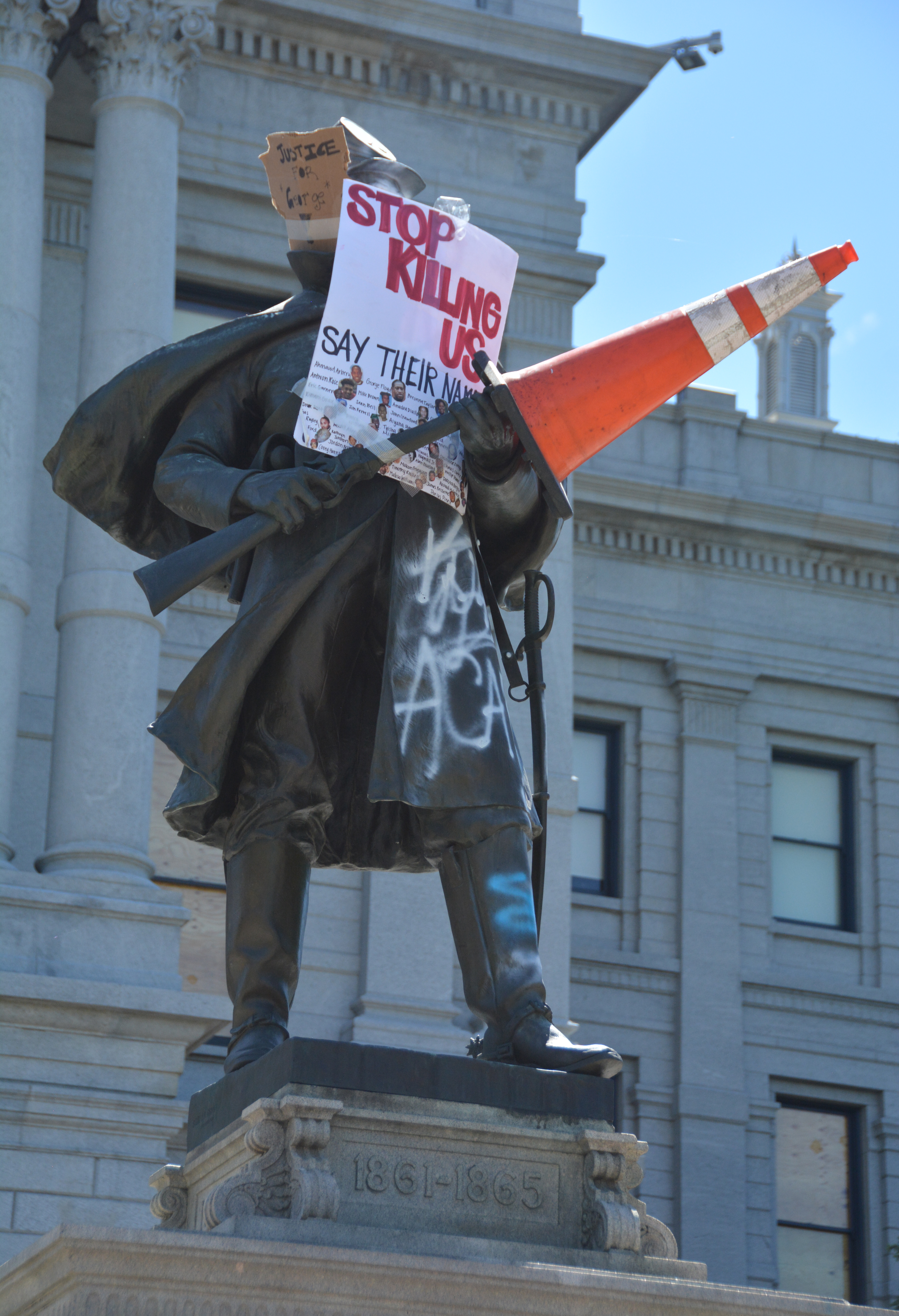
The Colorado State Capitol Civil War monument vandalized during the 2020 protests, with a sign that reads "Stop Killing Us."
Without established best practices or a playbook to follow, our Exhibition Development team devised a three-part interpretation strategy to present “On Guard” to our visitors and encourage them to consider it from a variety of perspectives. First, we shared some background on the actual events the monument was meant to commemorate. In this case, that meant a brief discussion of the actions of Colorado troops fighting for the Union during the Civil War, including the Sand Creek Massacre and participation in the Indian Wars. Second, we spotlighted the creation of the monument itself. “On Guard” was installed in 1909 after Denver’s city leaders had been embarrassed to realize, while hosting a reunion encampment of the Grand Army of the Republic, that the city did not have a monument honoring the veterans’ sacrifice and victory. Although Civil War monuments are not as common in Colorado as they are in states further east, Colorado joined those states in installing “On Guard” as part of a large wave of Civil War monuments being erected nationwide as the generation who fought in the war was passing away.
Finally, we knew that displaying a toppled monument meant we had to address the meaning of the monument today. We also knew that this was not for us to say. In recent decades, museums have recognized that we exist within spectacularly multifaceted and intersectional communities and can no longer credibly claim or even aspire to be the all-knowing voice of community hegemony anymore. So we solicited statements from multiple stakeholders, including veterans, Tribal representatives, artists, historians, and others, on what the monument meant to them. We heard that it was a tribute to those who have served and sacrificed in the nation’s armed forces, a reminder of atrocities committed against Indigenous peoples, a symbol of white supremacy and injustice, a casualty of destructive lawlessness, and more.
Operating from a fundamental belief that creating space for civil conversation about our different views is part of how we embrace our shared destiny and find our way forward together, we welcomed the public to join the conversation and created space for visitors to share their views. We wanted to give people a chance to think about what history they would like to see in their public spaces, and what the purpose of such public commemoration should be. We asked visitors to respond, if they felt so moved, to two questions:
- Do we need monuments?
- What do you think their purpose should be?
By far the most common sentiment our visitors offered—often in careful handwriting sized to fit complex ideas on the sticky notes we gave them to stick up on a wall facing the monument—was that monuments are critical pieces of social memory. Visitors overwhelmingly agreed that historic statues and other monuments should remind Americans of both the good and bad aspects of our history, and that in remembering, we may build upon the good and avoid repeating bad choices.
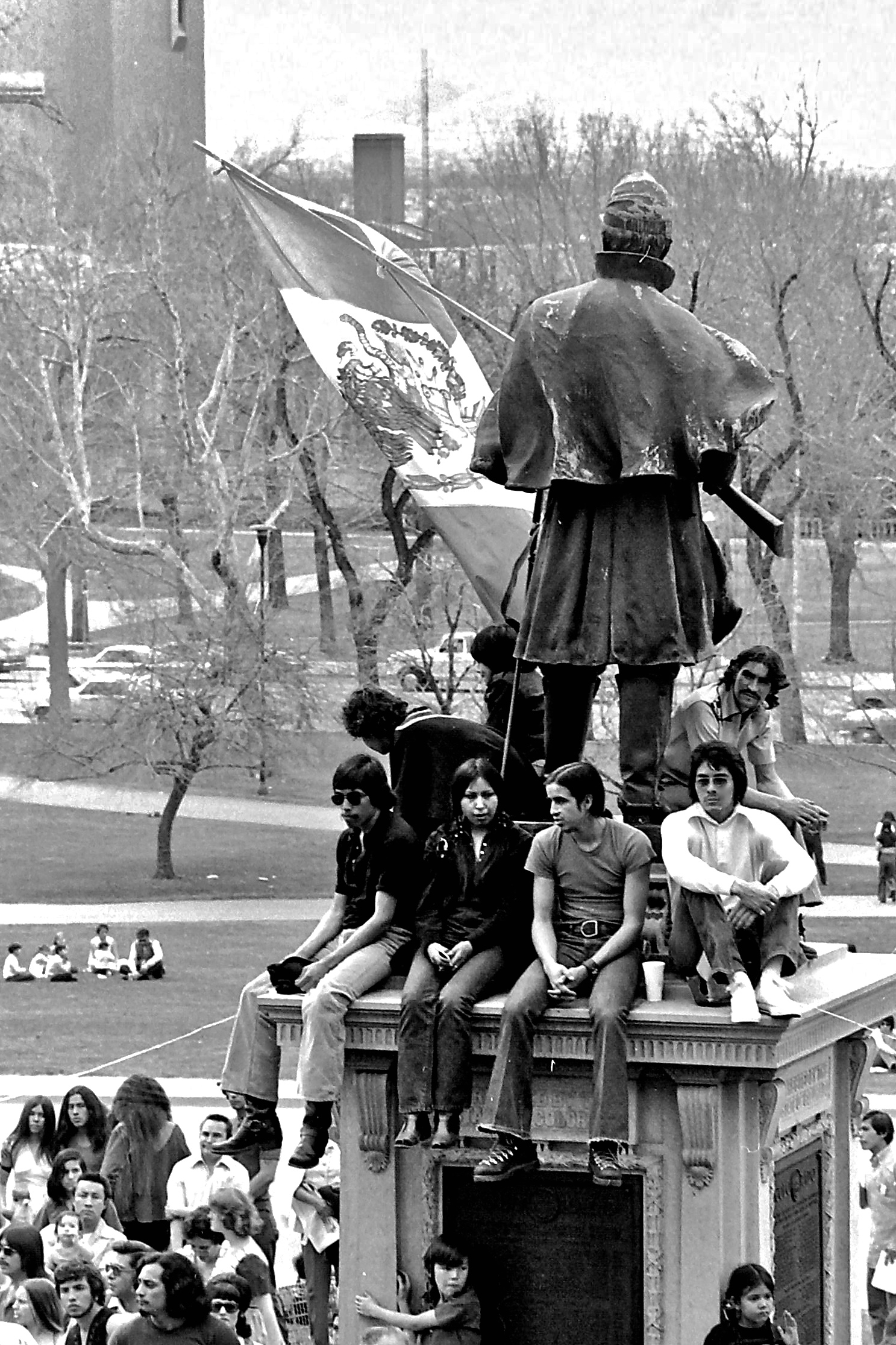
Standing in front of the Capitol made the monument a focal point for generations of protests. Chicano activists incorporated it into their civil rights protest in March 1974.
Other visitors tackled the question of what society should do with statues honoring values that we no longer agree with, or those commemorating moments most would prefer to forget. Visitors generally wanted these monuments to reside in museums where they can be properly interpreted and put into context. Erasing these monuments entirely from view, they argued, opens society up to repeating the mistakes of the past.
A notable, though small, percentage of commenters disagreed with the idea that we need monuments to remind us of the good and bad in American history. But their disagreements came from very different places. For some, monuments inherently reinforce the dominant culture’s values and version of the past at the expense of underrepresented voices and should therefore all be removed and not replaced. For others, monuments should honor sacrifice and heroism, and should encourage us to reflect on the times in which Americans have lived up to their values and the nation’s promise. Monuments, according to this latter group, should not dwell on the dark moments in the nation’s history or focus on what a few deemed “overly negative” depictions of the past.
All of the protest and controversy and discussion about monuments has not stopped us building them. A new monument to Major General Maurice Rose, son of a Denver rabbi, student at Denver’s East High School, the highest ranking Jewish officer in the US Army during World War II and the highest ranking officer killed in combat in the European theatre, and namesake of Rose Hospital was recently installed in Lincoln Veterans Memorial Park in Civic Center. Likewise, the City of Denver recently installed, at the urging of Colorado Asian Pacific United, a new historic marker commemorating the city’s historic Chinatown, replacing the white-centric text that had marked the place.
Ideally, to commemorate the actions of our predecessors in a place is to imbue the place with the story of that person or the collective individuals who achieved something worthy of remembrance, recognizing their contributions to and impact upon our world long after they have passed. But monuments also carry forward the flaws and shortcomings of those imperfect predecessors, and those who admired them, to be confronted by successive generations. In some cases, it may come to seem that those flaws outweigh the accomplishments that merited the honor.
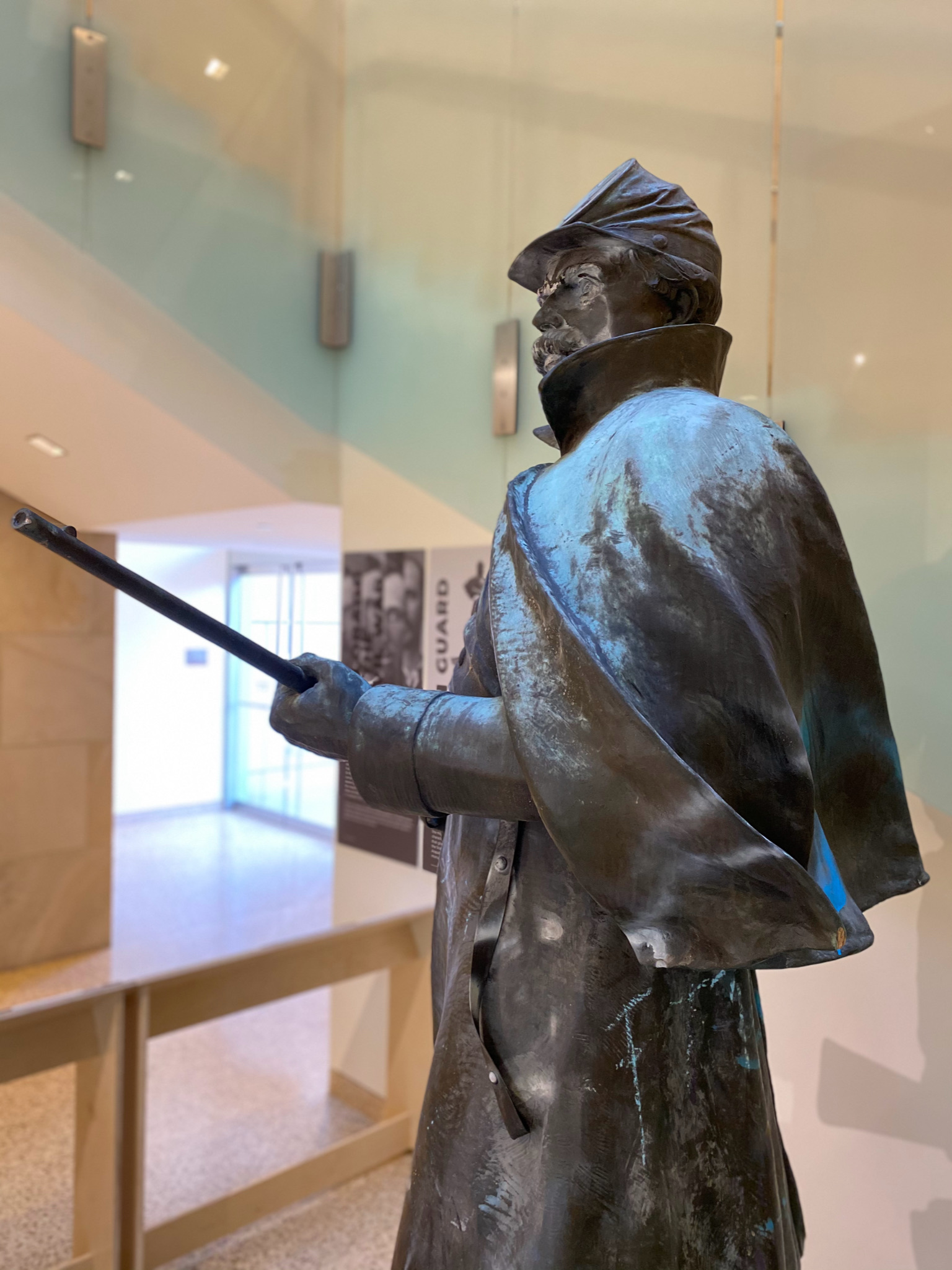
The Civil War statue that was toppled during protests became a temporary exhibit at the History Colorado Center, presenting an opportunity for broader, and often complex, discourse around race, identity, and social inequities within the community.
In such cases, residents and city leaders might consider whether the monument is achieving its original purpose or playing a constructive role in creating meaningful landscapes for our daily lives. This is especially important given the historical and current power structures that have prioritized Eurocentric, white, male, straight, abled perspectives in the naming process, to the exclusion of Indigenous people, people of color, women, LGBTQ+ people, people with disabilities, and other historically marginalized people. When the societal context has changed over time to the extent that there is strong evidence that retaining the name would be detrimental to promoting the values held by a community, it is appropriate to consider giving ourselves new monuments to look up to.
When the Colorado State Historian’s Council, which is a group of five esteemed historians from throughout the state convened by History Colorado, was asked by the City of Denver to guide its consideration of how to review and potentially address problematic place names woven into the city’s historic fabric, we developed a set of questions designed to ground and guide these conversations. The following questions were developed along with Nicki Gonzales, Jared Orsi, William Wei, and Ariel Schnee as part of that process. As communities throughout the nation vet the monuments and place names that proclaim historical narratives in their public spaces, we hope that asking these questions will generate a richer evaluation of controversial monuments.
The Scales of Justice: Which misdeeds overwhelm a person’s good deeds?
What qualities and achievements do we wish to honor? Which cannot be overlooked or balanced out?
Contributions of the Commemorated: What was the significance and impact of the person’s contribution to the contemporary community?
In their failures, those we commemorate were often men and women of their time. But in their successes, they were often visionaries well ahead of their time in ways that continue to reverberate today.
Beliefs Versus Action: Did the honored person express their problematic views consistently through action or did they hold their views more privately?
Are we prepared or qualified to judge what is in a person’s heart, or to judge them for it?
Societal Context: How has society changed in our views of who or what is being honored?
Judgments about a person’s character or the meaning of events can change over successive generations. What deference is due to the people whom our predecessors honored (as one day our choices will be similarly examined)? What obligation do we have to continuously interpret—and when necessary reinterpret—them for new generations?
What’s the Harm: Does keeping the monument harm residents of the community?
Honors bestowed in one age can have different—and sometimes detrimental—effects in subsequent generations. What harms are created, and to whom, by the meaning encapsulated in a monument? What remedies are available?
What Can We Learn: Does the name provide a learning opportunity that should be valued?
Those who originally decided to honor a person or event chose it for a reason. What can we learn from that choice? Does the monument provide an opportunity to confront and reflect upon the complex legacy that brought us to this place and time?
Erasure and Distortion: Does removing the monument have the effect of erasing history? Does preserving it distort history?
Monuments project a view of our shared history. What might be lost in changing them? What is falsely preserved by retaining them?
Current Meaning: Have current residents created a contemporary meaning for monuments and place names that have positive value, irrespective of the original intent?
People make their own meaning for places based on lived experiences. When those meanings are in opposition to one another, or to the name’s original significance, how do we determine whose meaning should be given preference?
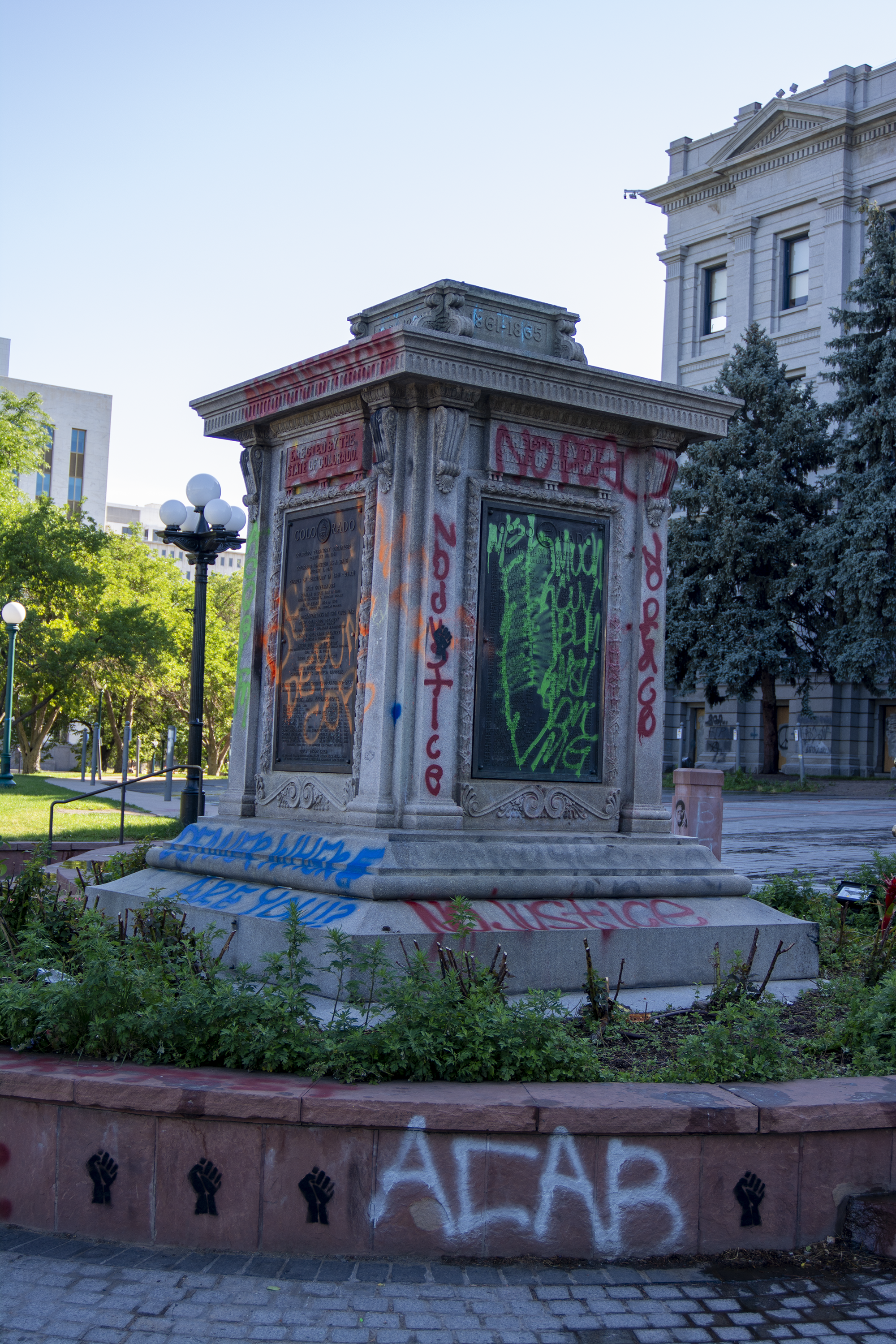
The Civil War soldier statue stood on the west side of the Colorado State Capitol until the summer of 2020, when it was removed by people protesting for social equality.
F. Scott Fitzgerald famously concluded The Great Gatsby, his tragically all-American tale of striving for wealth and love in the 1920s, by reflecting on the ways in which we are inescapably shaped by history: “So we beat on, boats against the current,” he wrote, “borne back ceaselessly into the past.”
Monuments, attempts by one generation to enshrine certain narratives and values for generations to come, are part of this current. But they have a permanence that human lives do not. Their goal is often perpetuity, perhaps because the creators of monuments know that nothing—not individuals, the communities they form, nor the nations they build—remains fixed and unchanging for long.
And that’s OK, says Lonnie Bunch III, the Secretary of the Smithsonian Institution, which is the nation’s official and most venerable keeper of our collective knowledge and shared history. “There is nothing wrong with a country recognizing that its identity is evolving over time,” Bunch told the New York Times in 2020, suggesting that some monuments ought to be removed or recontextualized. He added that “as this identity evolves, so does what it remembers. So does what it celebrates.”
How we choose to remember our shared history in our public spaces sometimes raises difficult but important questions that go to the heart of who we want to be as a community and what sort of place we want to live in. Many of us who practice historical work in public view believe that our shared history can help guide us to a brighter future. But people must be able to draw meaning, inspiration, and lessons from the historic reminders—big and small—that surround them. When that history can no longer serve those purposes, as new insights and interpretations arise and new information is brought to light, the people of a community, who are the keepers of all history, might understandably seek to revise or refresh the stories they call upon for inspiration and guidance.
Acknowledgements
Thank you to:
Nicki Gonzales, Jared Orsi, William Wei, and Ariel Schnee for their work with me on Denver’s renaming commission and for formulating the essential questions we should ask ourselves when reconsidering how historical narratives are publicly commemorated and reinforced.
Sam Bock, Jeremy Morton, Julie Peterson, and Shannon Voirol for their role in writing and seeking out the interpretive elements of our monument installation, which are featured in this essay.
Abby Krause, Bill King, Shawn Fausett, Ken Benson, and Kimberly Kronwall for designing the exhibition and arranging its installation.
The members of the Capitol Building Advisory Committee who agreed to loan the monument to History Colorado.