
 Membership
 Donate
 Shop
Shop


















Connecting Colorado Women in Thread
How a community project fifty years ago speaks to Colorado women today.
Nineteen women are memorialized in silken thread at the Colorado State Capitol on a nine by twelve foot tapestry. Titled Women’s Gold, the tapestry is delicately crafted on Irish linen by hundreds of citizens and artisans ranging in age from two to ninety-two, mostly from Colorado, but also from all over the world. This piece was envisioned by Eve Mackintosh, a Colorado educator, for the Centennial celebration of statehood in 1976. She observed that women were underrepresented in the Capitol, which was true. The historians, designers, and chief craft people she assembled and who made this tapestry happen were Colorado women as well.
Eve and her dedicated compatriots could have chosen lots of ways to potentially represent Colorado women. Busts and statuary are popular memorials, particularly at state capitols. They could have suggested a mural or painting. Instead they chose a medium that was often considered ‘women’s work,’ and ‘crafty,’ despite requiring attention to detail, years of practice, great skill, and artistry. Eve envisioned a tapestry, drawing on ancient traditions of storytelling in fabric, humble to some, but harkening back to monumental works like the eleventh-century Bayeux Tapestry.
Though there are only nineteen women on the tapestry, there were dozens behind the scenes who lovingly researched and designed it, and thousands who added a stitch or two as it was hauled from county fair to local historical society and back.
The tapestry’s name itself refers to the countless other women who helped make Colorado what it is today. The name, Women’s Gold, calls to the pioneer women who dedicated their work, their lives, and their futures to Colorado. As women traversed our vast country, they often brought flowers with them from their old homes to plant in their new ones. One such flower, a rambling cheerful yellow rose, called the Harrison’s Yellow, did particularly well in Colorado’s rocky dry soil. Because of its popularity among pioneer women, and as a nod to why these women came to Colorado in the first place, the Harrison’s Yellow Rose earned the moniker, the “Women’s Gold.”
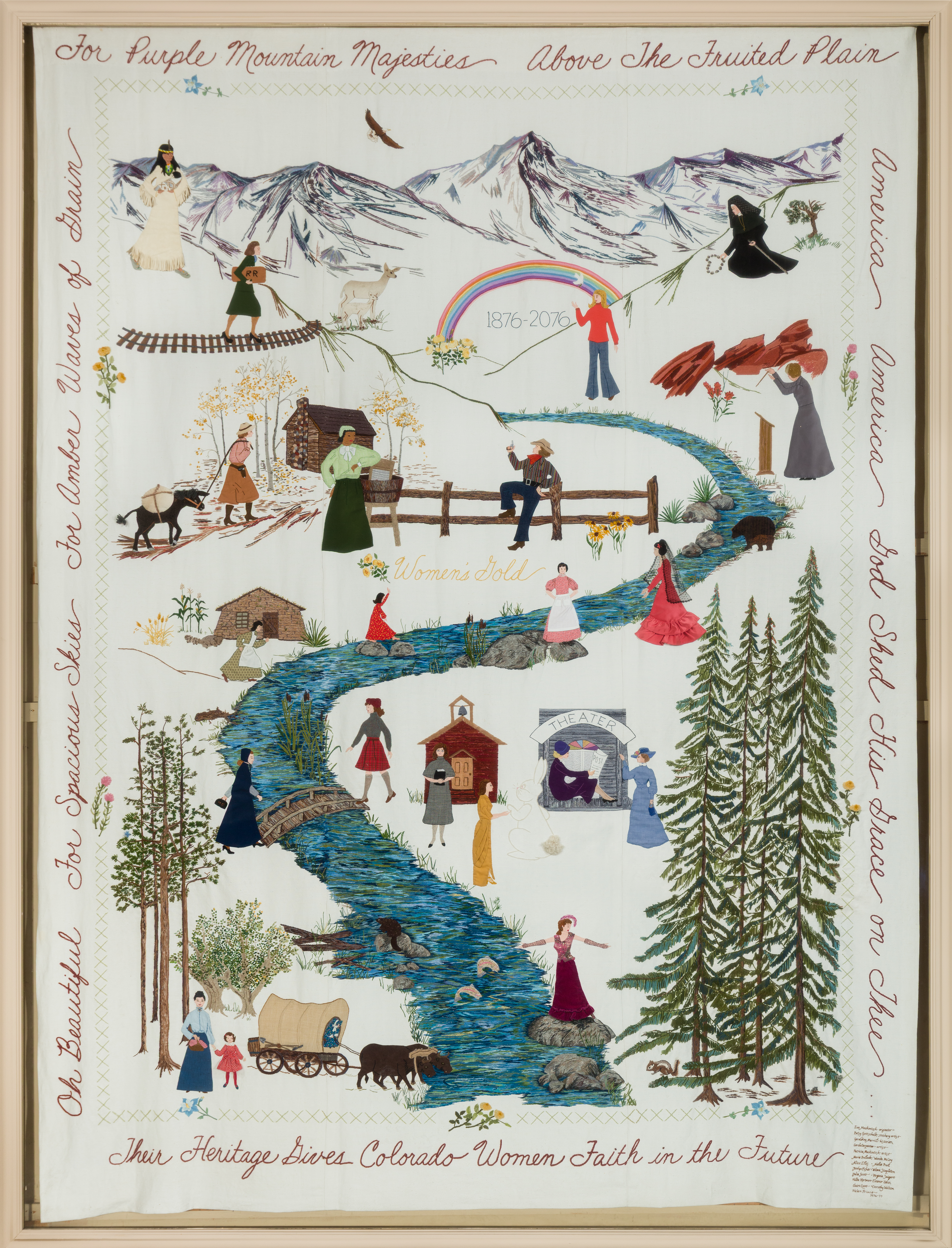
Colorado Women’s Gold Tapestry: This 9-by-12-foot tapestry, stitched in silk thread on Irish linen, is on permanent display outside of the Rotunda at the Colorado State Capitol. Thousands of visitors each year learn about it on field trips and tours.
But this tapestry is not just a memorial. Unlike the Bayeux tapestry, for example, it does not just tell of a particular moment in time. Near the top of the tapestry is a rainbow arching over a pair of dates: 1876–2076. The first date is the year Colorado became a state, August 1, 1876 to be exact. A moment in time, to be sure, but one that says nothing of the people and traditions that came before statehood, or the culture that arose and continues to change after it.
The second date, 2076, is far more nuanced, I think, and more interesting. In the year 2076, the state of Colorado will be 200 years old. The women of 2076 will face a world I can only imagine. There will be jobs I’ve never thought of, and technologies that don’t yet exist. The clothes I wear now, that I fancy are quite fashionable, will seem like costumes of a quaint past. The cities and towns of Colorado that I currently know so well would be unrecognizable to my eyes. My children may be grandparents by 2076, at least two generations past the creators of this tapestry, who to my eyes now, are quaint and old fashioned.
That date, 2076, was not put there as merely a marker of time, or a “nice round number.” It was, and is, a call into the murky future. A call to me, who was not yet born when this tapestry was finished, and a call to all the women who are yet to be born in Colorado. It says you, too, can make a life for yourself here. You can live and thrive, and create things out of whole cloth that will last for generations after you. You can create community and legacy and someone may remember your name and stitch you onto a tapestry. Or they may not, but your stitch is still there, held by silken thread, held in that future date the creators of this piece knew they would not live to see.
If I live to see 2076, I will be ninety-eight years old. I will have lived through almost half of Colorado’s existence as a state and seen it grow in so many ways. All those fourth graders I told about the tapestry on their tours through the Capitol will be adults, and will be contributing in their own ways to the state we all love. If I make it, I will have my daughter bring me down to the Colorado State Capitol one last time, whether I’m in a wheelchair or using a walker, and have my picture taken in front of this tapestry I love so much—adding myself in some tiny way to the legacy of the women of Colorado.