
 Membership
 Donate
 Shop
Shop


















What is Colorado’s Oldest Photo?
A photo, it’s said, is worth a thousand words. And I think we proved that’s correct.
One of the best things about my job is that I’m constantly surrounded by historical questions and people who have a passion for answering them.
Case in point: One pleasant summer day over pastrami sandwiches, Jim England and I got to chatting about the past (as you do, or rather, as we do). Jim is our department’s research volunteer extraordinaire, and as we chatted we found ourselves wondering what might be the earliest photo of Colorado. Neither of us knew what its subject might have been or who would have taken it. We were pretty sure it would have been a daguerreotype (a kind of early photographic method), but beyond that, we were stumped without doing a little digging.
So we got to work, looking to see if we could find a candidate. What we found turned out to be much more interesting than just turning up an old photo or checking the box marked “found.” So interesting, in fact, that we had to share it with the readers of The Colorado Magazine.
The Past Comes into (Hazy, Damaged) View
Jim quickly identified an image made by Solomon Nunes Carvalho in 1853 as a good candidate. It was taken during John C. Frémont’s 1853 expedition to explore and map the new United States territory acquired from Mexico following the Mexican-American War. According to the Library of Congress, the photo’s current caretaker, the image portrays a “View of a Cheyenne village at Big Timbers [near Lamar], in present-day Colorado, with four large tipis standing at the edge of a wooded area. Frame with pemmican or hides hanging at the right, two figures, facing camera, standing to the left of center.”
Photo found and case closed, right? Maybe, but as it turned out, the photo’s story revealed so much more than the image.
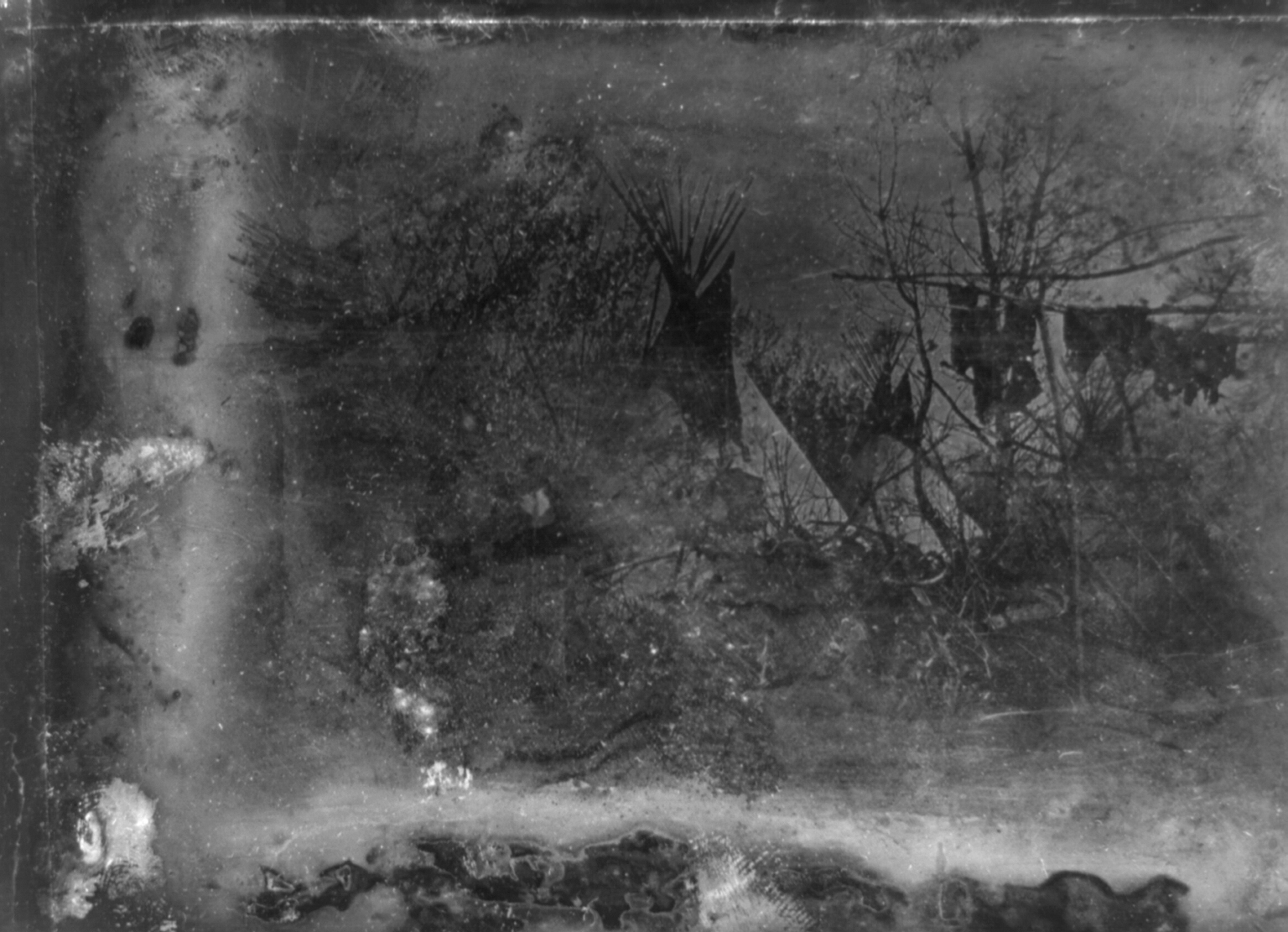
The oldest photo, featuring a view of a Cheyenne village near Big Timbers (present-day Lamar).
The obvious first thing you probably noticed about the image is the damage. Fortunately we specialize in blurry antique photos here at History Colorado. So our smart colleagues in collections care helped us confirm that the original plate had been in a fire, and Jim’s research indicates this may have been the only one that survived. Lucky for us (maybe) this one lived on, but it’s hard not to wonder what else Carvalho captured, and what else survives only in stories and memories passed down among the people he met and the men of the expedition.
The rest of the Library of Congress’s historical record is necessarily matter-of-fact, only revealing tantalizing glimpses of the intersecting stories behind the photo.
You see, Frémont’s privately-funded expedition was scouting out a transcontinental rail route during a time of profound upheaval for the many peoples of southern Colorado. Frémont, Carvalho, and their fellow explorers were sent out just five years after the Treaty of Guadalupe Hidalgo ended the Mexican-American War and made much of what is now the southwestern United States into American territory.
New maps drawn in the war’s aftermath in 1848 may have shown a massive transfer of territorial control, but that shift didn’t exactly mirror the reality on the ground. The Cheyenne, but also the Comanche, Kiowa, Arapaho, and Ute Tribes, among many other Native nations, were the dominant political and economic entities in the region in 1853. American and even Mexican settlements would continue to be sparse and small for another decade. Most of the non-Native population were seasonal and transient: gold seekers heading to California hoping to strike it rich; Hispano settlers who were suddenly Americans—strangers in their own homeland and wondering what becoming American would mean.
Frémont, Carvalho, and the rest of their expedition entered this shifting world with military precision and the energy of a mobilized, victorious nation. The cultural, economic, and natural landscapes they were employed to photograph had yet to come into sharp focus for most Americans and their government. It would be Carvalho’s job to provide that focused picture (and Frémont’s to project the military’s muscle) with a view towards massively expanding the country’s economic and political reach.
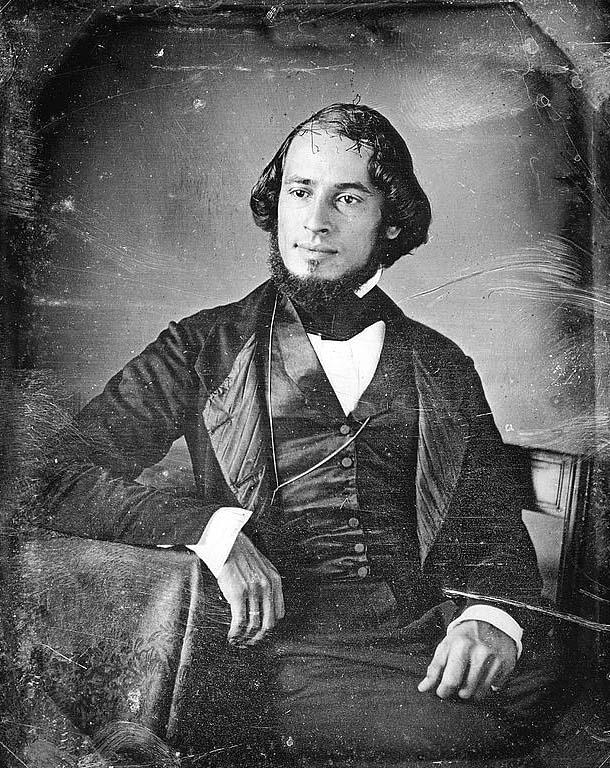
Solomon Nunes Carvalho circa 1850.
A Uniquely American Story
The story of how the image came to be, how it survived, and the context in which it was made drew us in. But what really made us want to work up a longer article about the photo was the story of its maker. His is a fairly well-known adventure, but it touches on so many important stories of the American West, illustrating the tumultuous tale of how Colorado came to be.
Solomon Nunes Carvalho was born into a Portuguese-Jewish family in Charleston, South Carolina in 1815. His grandparents fled Portugal amid antisemitic violence in the late 1700s, eventually settling in England. Carvalho’s father and uncle themselves then eventually emigrated to the US by way of Barbados, settling in the South and raising families of their own. Carvalho’s father helped found the first reformed Jewish congregation in the United States while his brother became a rabbi.
Carvalho grew into a great artist while helping his family develop communities of safety for American Jews all up and down the Eastern Seaboard. By the 1850s, Both Carvalho and his business-minded father became interested in daguerreotypes and had started an early portrait studio. Frémont’s previous attempts to capture images in the West failed, but he took an interest in Carvalho’s work while looking for investors in his expedition, and invited the emerging artist to join the expedition in 1853.
Carvalho barely survived. After enduring starvation, disease, and frostbite, he found refuge among the Mormon communities emerging in Utah, eventually making his way to Los Angeles. There he published his memoir from the trip and worked to develop a mutual aid society for the city’s small Jewish population.
Carvalho’s journey and the images he brought back were products of changing times in history. A Jewish man, openly serving not only his community but also his government, finding acceptance among the Mormons—themselves kinds of religious refugees—fleeing persecution in a time of American expansion into Indigenous homelands. These were things that would have seemed impossible just a few generations before and could have easily remained invisible if the fire that claimed the other images had burned just a little hotter or a little longer.
The stories made visible by this one simple photo and the question that led us to it reminded us of why we love history, and Colorado’s history in particular. They’re reminders of the relative newness of our state in comparison with the homelands that came before. Reminders that Colorado’s stories have always been deeply woven into the fabric of our nation’s story.
As for Jim and me, a reminder that good sandwiches can always be excuses for interesting conversations.