
 Membership
 Donate
 Shop
Shop






















Against Great Odds
Elizabeth “Baby Doe” Tabor’s wedding gown grew into a symbol of her controversial marriage to Colorado’s Silver King. Its rediscovery and display after her death echoes her own survival story.
Elizabeth “Baby Doe” Tabor first became known to me in the form of a warning, during one of my first few days as a curator at History Colorado. I was walking through the galleries with one of my new colleagues, getting to know what they knew about Colorado history. Among the many facts they sprung on me was the story of Elizabeth Tabor and her infamous wedding dress, long considered to be the jewel of the museum’s collection of historic clothing. “You should know Baby Doe,” they said, before launching into the now-familiar synopsis of her remarkable story.
My first glimpse of the dress was just a few months later when we pulled it out to examine it in advance of conservation treatment that would smooth and stabilize the wrinkles and tears it had accumulated over time. The dress laid there in its box—the biggest allotted to any one garment in our storage facilities—in a pile of carefully arranged folds. Once on the table, it unraveled to twice its folded size, requiring two additional tables to support its seven-foot train. It appeared as a sea of cream brocade, lacking any shape, as elusive to me then as Elizabeth Tabor herself.
To many Coloradans, the Tabor story is as familiar as a folk tale, passed down through the generations with evolving lessons about love, morality, and womanhood. But for anyone who might need an introduction, the crux of the story begins 142 years ago, on March 1, 1883, when the woman who had become known as “Baby Doe” stepped into her then-new wedding gown and walked down the aisle in a Washington DC ceremony that made headlines nationwide and wrecked her reputation.
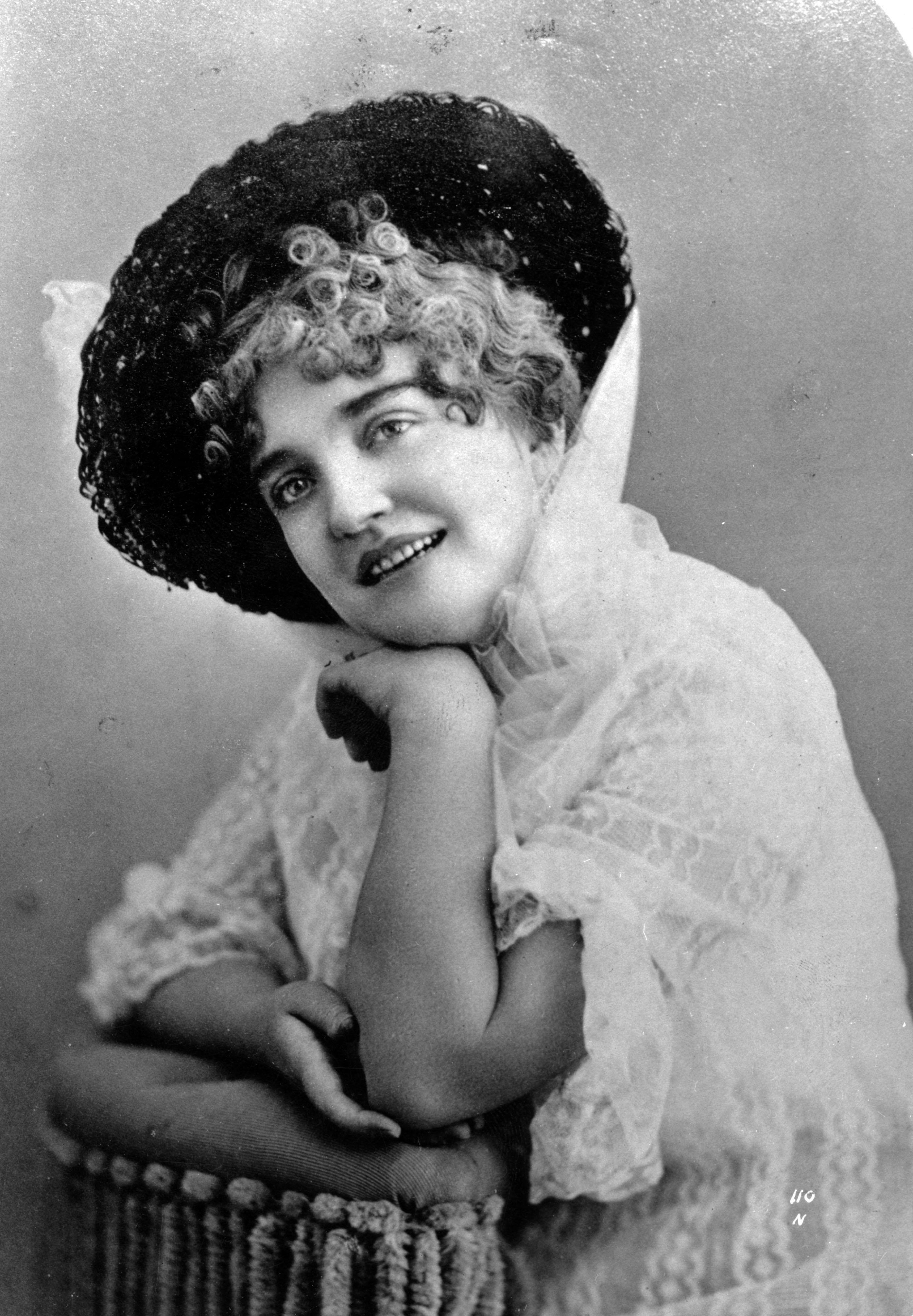
A cabinet card portrait of Elizabeth “Baby Doe” Tabor taken around 1886 by Wells & King, Denver.
Elizabeth was a divorcée nearly half the age of her magnificently rich fiancé, the mining magnate and so-called “Silver King” Horace Tabor, and his own recent divorce from his faithful wife, Augusta, only made the matter more contentious. When rumors broke that neither Elizabeth nor Horace had yet been legally divorced from their previous spouses, Victorian society erupted in a gossip storm the Tabors would never live down. When Horace died from appendicitis sixteen years later, the Tabor reputation remained in tatters and their fortune was exhausted. His death left Elizabeth to care for their two daughters and endure thirty-six years of poverty and public ridicule. Shunned by Denver society, Elizabeth would be spotted around town in the decades that followed, but was mostly ignored until she was famously found frozen in the Leadville cabin where she lived near the source of her husband’s brief but extraordinary wealth, the Matchless Mine.
This story, dramatically simplified here for the sake of an introduction, has been sensationalized time and again in the press and in popular magazines. It’s been turned into an opera and into films, fictionalized in novels and re-examined by scholars. When I first began overseeing the Tabor wedding gown’s conservation, I quickly realized the scale of the project would require me to know the dress and its wearer from the inside out. I was eager to dive into the wealth of publications about Tabor, but wound up troubled by what I found.
One after the next, beginning even before her death, each author and biographer spun a tale of a golddigging homewrecker whose impropriety and scheming came back to bite her in the end. She was a real-life beauty turned hag, her riches reduced to rags, and in this way her identity seemed to always be cheapened, then torn in two: the before and the after. It wasn’t until my readings entered the twenty-first century that I found the nuanced, feminist arguments that I was looking for in publications like Judy Nolte Temple’s book Baby Doe Tabor: The Madwoman in a Cabin, in which she skillfully dismantles the legend of Baby Doe and returns complexity and agency to the woman who preferred to be called Lizzie.
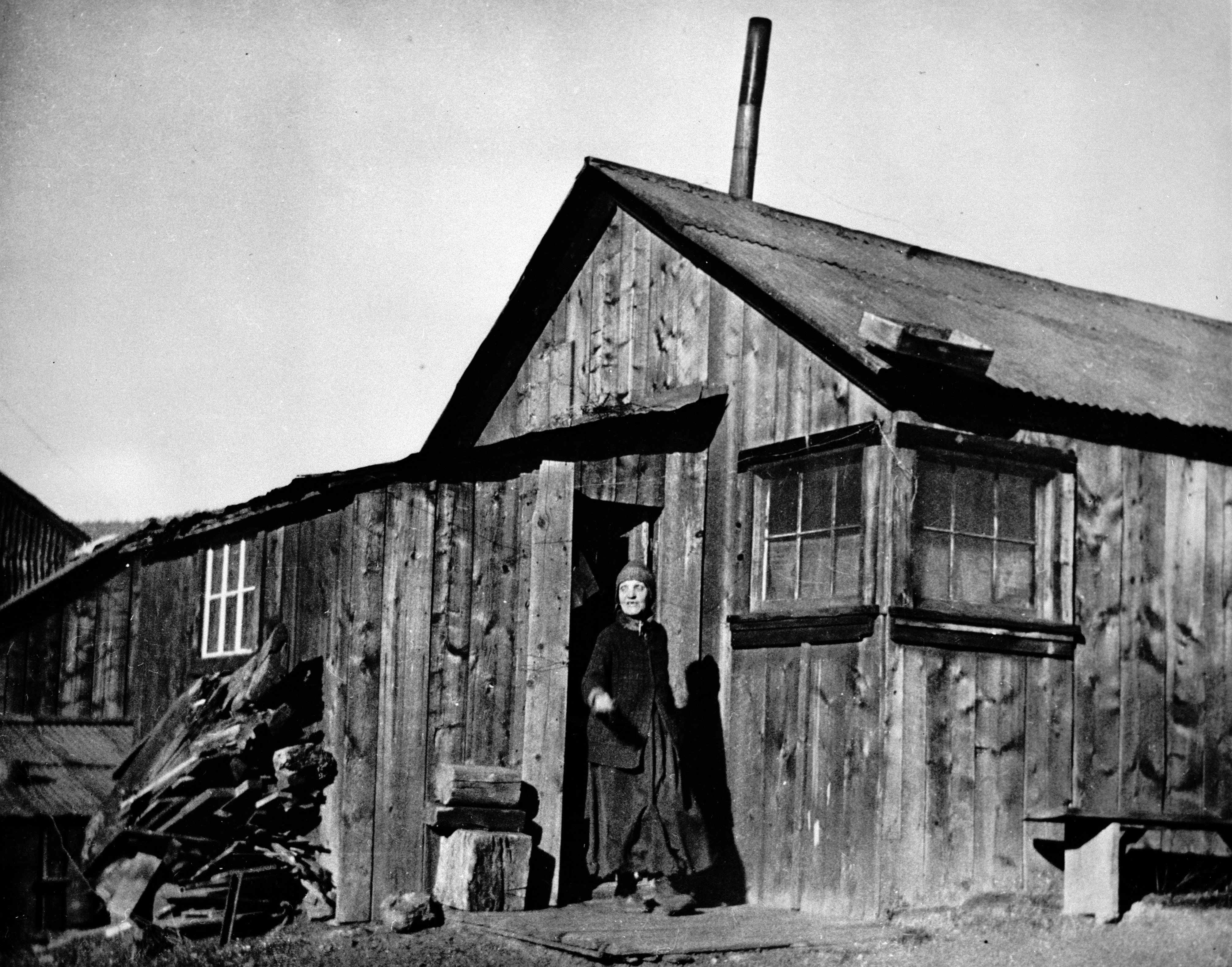
One of the last known photographs of Elizabeth Tabor, taken outside the cabin where she lived near the Matchless Mine.
As I continued researching the history of Lizzie’s wedding dress, I began to realize just how intertwined it was with the public’s fascination with the Tabors. Since the day of the notorious wedding, the dress has been nearly as famous as the bride, becoming a symbol of the scrutiny she and her story have received over time. Throughout its existence, the dress has come in and out of public view, and each time it resurfaces, the public discourse about it reflects evolving attitudes towards women’s dress and autonomy.
A Social Sensation
The dress first made its debut at the Tabors’ Washington wedding in 1883. Since no photographs of the ceremony survive, and no reporters were allowed inside, we can only rely on secondhand newspaper accounts and the dress itself to interpret how it first appeared when Elizabeth wore it. According to articles from the time, the private parlor in Washington’s Willard Hotel was transformed into a “perfect fairyland” for the Tabor wedding ceremony. Masses of flowers and plants were positioned before mirrors, twined around pillars, hung from chandeliers, and arranged into sculptural decorations, including a floral arch hung with a white wedding bell that served as the dining table’s centerpiece. It was a small but showy ceremony designed to advertise Horace’s unstoppable ascent into high society.
For the past month, he had been serving temporarily as Colorado’s US Senator, and he took the opportunity to wed his bride before an assembly of politicians and President Chester Arthur himself. Reports generally agree that Elizabeth wore a 7,000-dollar white silk gown, matching slippers, and a veil. Many mention elbow-length gloves and a bouquet of white roses, and several others write that the neckline of the dress was trimmed with either feathers or tulle. The style of the dress is alluded to with phrases like “low neck” and “short sleeves,” indicating what reporters considered notable style choices.
In comparison with more conservative styles of wedding gowns at the time, Elizabeth Tabor’s dress would have struck even the fashion-forward as a bold pick. Made with a shimmering floral silk brocade and a dramatic seven foot train, the dress reflects the trending silhouette of the time, with a boned bodice that slims and accentuates the waistline and a sloping bustle protruding from the back.
Despite looking through existing research and the Tabor scrapbooks, letters, and a pile of miscellaneous receipts, I was unable to find any references to who made the dress. However, I presume that Elizabeth likely would have commissioned it from a respected dressmaker or asked the favor of her father, who was a clothier back home in Wisconsin and whom she visited on the way to the wedding. Elizabeth may have chosen white for the color of the dress simply because it was in style, or to emphasize her newfound wealth, as white was a difficult color to clean or rewear. She may also have chosen it directly in reference to Queen Victoria of England, who had popularized the color decades before during her own wedding to Prince Albert in 1840. Tabor, whose scrapbooks are filled with clippings of foreign royalty and fashion, was well known for her love of nobility and high society and may have viewed her marriage to Colorado’s Silver King and US Senator as an event on par with a royal wedding. While brides of the time most often selected gowns with wrist-length sleeves and high collars, Elizabeth opted for an open neckline and short sleeves—features aligning with the era’s style of evening gowns but less common in bridal wear.
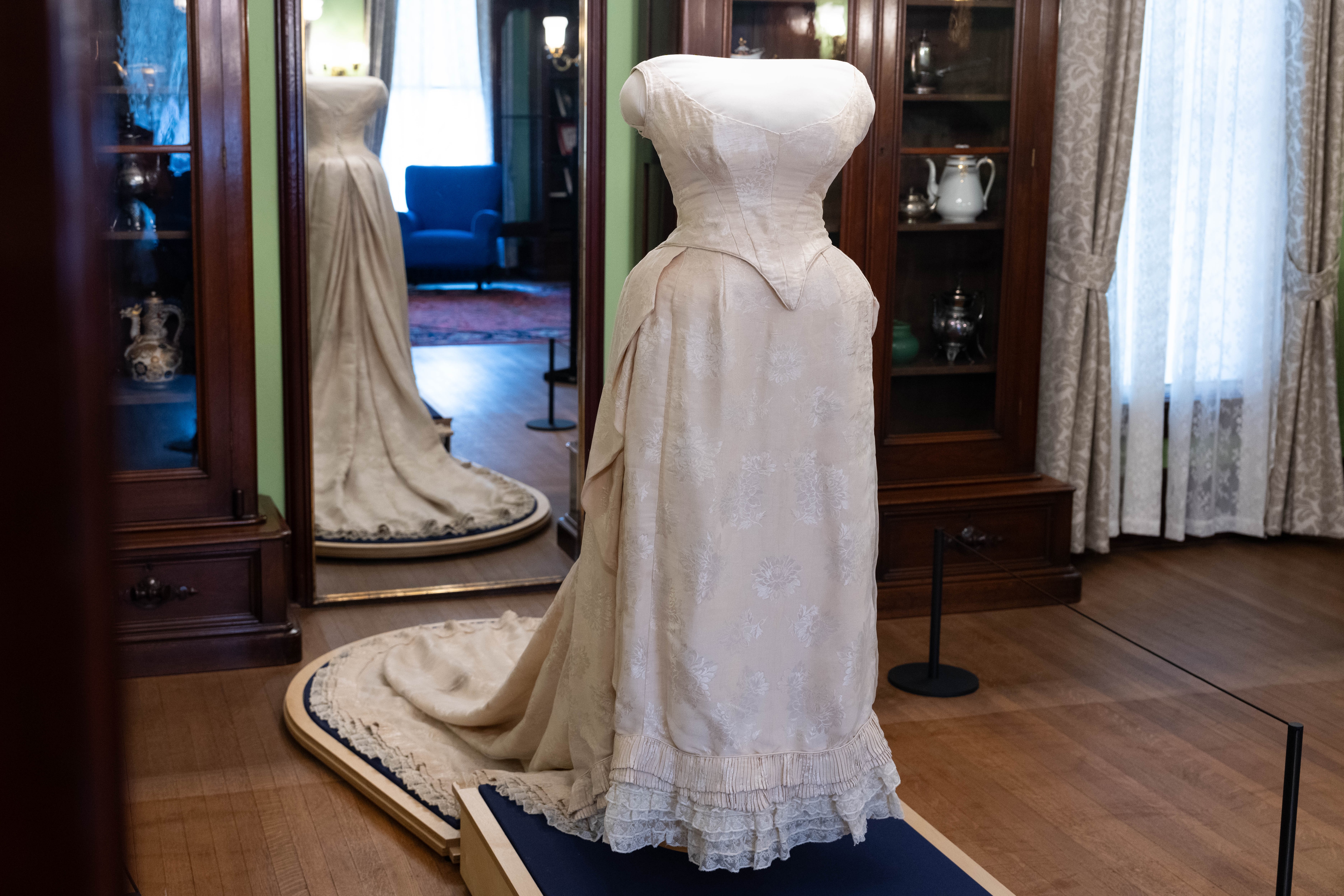
The wedding gown of Elizabeth “Baby Doe” Tabor on display at the Center for Colorado Women’s History, 2025.
Worn by a different woman in another setting, Elizabeth’s dress and its neckline may not have caused a stir. But amid her controversial ceremony to the much older man she’d perceivably snatched from his respected wife, her stylistic choices were interpreted by some as indicative of her lack of taste and morality. Three days after the wedding, Washington’s Sunday Herald published an article in its gossip column commenting on the “astonishing” ceremony that seemed like a “joke.” Describing Elizabeth’s wedding dress, the author noted its "extremely low corsage.” This drastic shift in tone, compared to initial reporting on the dress, was almost certainly tied to the scandal that broke shortly after the wedding when the priest who performed the ceremony was informed, apparently for the first time, that both Elizabeth and Horace had previously been divorced. Further yet, it was rumored that neither of their divorces had been legal, at least not according to the Catholic church, and that the two had already discreetly eloped in a secret ceremony in St. Louis just months before their extravagant display in Washington.
The entire affair was maligned in the press nationwide, and people close to the Tabors wrote in to provide their firsthand accounts. This list of contributors includes the priest who presided over Elizabeth’s first marriage to Harvey Doe, the man she followed to Colorado, and whose name likely inspired her own nickname. In the priest’s statement, he declared Elizabeth’s second marriage to Horace illicit. Similarly, Missouri’s Neosho Times went so far as to write, “Old Horace Tabor, the coarse and vulgar old scamp…has put away the plain old wife of the days of his poverty; his money has bought a divorce, and two or three weeks ago he married an Oshkosh (Wisconsin) ‘grass widder’ aged twenty-four.” (“Grass widder” is a slang misspelling of “grass widow,” itself a derogatory slang term for a woman who is divorced or separated from her husband.)
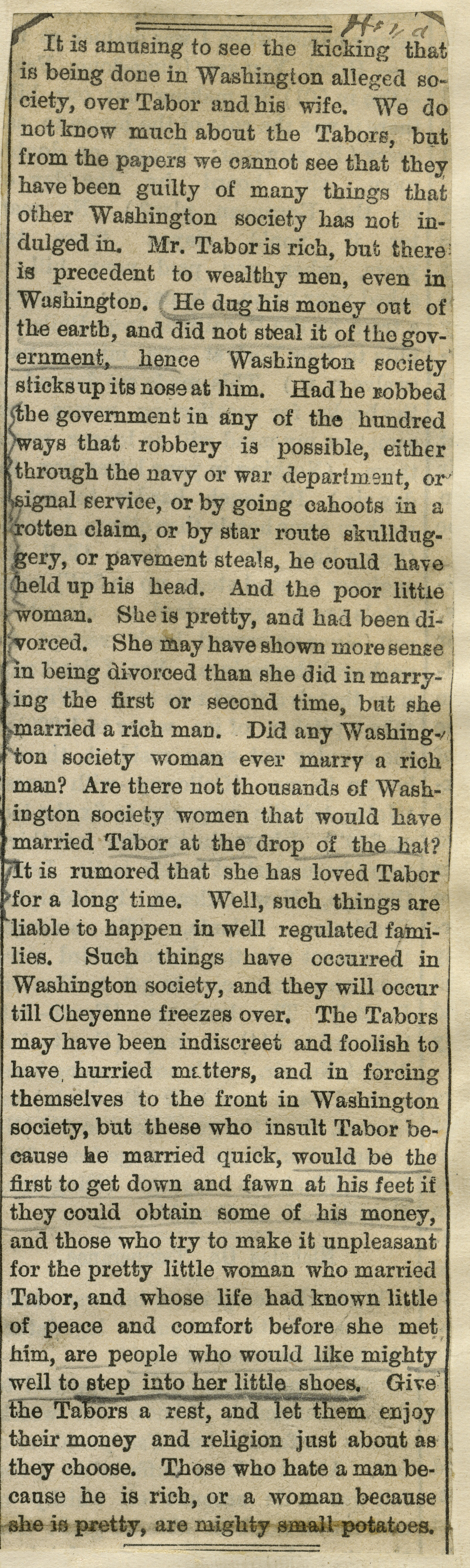
Unlabeled newspaper clipping pasted into the Tabor scrapbooks, with portions underlined possibly by Elizabeth Tabor.
Had Elizabeth worn a more understated gown during the ceremony, it may have gone unnoticed amid the furor surrounding the wedding. Instead, the press’s description of the open neckline as “an extremely low corsage” likely convinced the public that it was lower than it was, and no photographs of the dress were distributed to prove otherwise. The purportedly low neckline therefore became fodder for the morally superior public, who used it as evidence of Elizabeth’s indecency in marrying Horace Tabor.
Newspaper clippings pasted in the Tabor scrapbooks reveal clues about Elizabeth’s own opinions of the public outrage. In one article, the writers of Central City’s paper, the Register-Call, wrote a statement in support of Elizabeth, in which they said, “she was recognized while here as a woman of many strong and worthy qualities. She knew the right and dared to do it….She pursued the even tenor of her way, turning neither to the right or left, and is at last rewarded by becoming the bride of the richest man in the silver state.” Another unlabeled clipping makes an impassioned defense of the Tabors, and contains many phrases which have been underlined in pencil presumably by Elizabeth herself:
The Tabors may have been indiscreet and foolish to have hurried matters, and in forcing themselves to be the front in Washington society, but those who insult Tabor because he married quick, would be the first to get down and fawn at his feet if they could obtain some of his money, and those who try to make it unpleasant for the pretty little woman who married Tabor, and whose life had known little of peace and comfort before she met him, are people who would like mighty well to step into her little shoes.
Elizabeth’s clippings and annotations give us a glimpse into her state of mind, revealing her frustration with the hostility and controversy surrounding her ascent into high society—one she considered perfectly justified and deserved.
In Her Shoes
If we consider her perspective as a woman raised to use her beauty as a tool to secure her future, Elizabeth’s anger at the criticism she received for succeeding in this endeavor should come as no surprise. Economic and professional opportunities for women were expanding in Victorian-era America, but were still very limited in comparison to the opportunities available for men. Women were largely expected to fill domestic roles, and were raised to pursue marriage as their best bet for securing financial and social stability. Marriages were often akin to business deals, with the woman bringing a suitable dowry to her new husband as a means of providing future financial security for both of them. The husband’s own financial security was always a factor in the marriage, and it was not uncommon for a particularly beautiful bride to marry upward in social class.
Elizabeth Tabor, who had been born Elizabeth McCourt in 1854, and whose beauty earned her the nickname of the “Belle of Oshkosh” in her Wisconsin hometown, recognized the opportunity her beauty gave her to advance. This consideration factored into her first marriage to Harvey Doe in 1877, whose attention she allegedly caught by flashing her ankles during an ice skating competition in Wisconsin, and again with Horace Tabor in 1883. By the time Elizabeth met Horace, she’d already earned the nickname and reputation as the Colorado mining community’s youthful and beautiful “Baby Doe.” When Horace publicly began to make moves to divorce Augusta and wed Elizabeth, Elizabeth’s reputation as the local belle became the foil to Augusta’s mature and modest character and further villainized her as an already-divorced homewrecker who broke up Tabor’s marriage to the well-respected Augusta. Despite the fact that Horace and Augusta were already privately heading toward a potential separation, Elizabeth seems to have been the impetus for the divorce, and this, in combination with the astronomical wealth she would receive access to in marriage, insulted those who held on to traditional beliefs about the sanctity of marriage. Further, after the Tabors’ fortune eventually took a turn for the worse, the public and the press interpreted Elizabeth’s aging and unkempt appearance as another punishment imposed upon her for utilizing her beauty to secure a future that was not hers to claim.
I have to assume that the Tabors put the wedding dress into storage upon their return to Colorado, where they received a chilly welcome. What little rapport Elizabeth had with local women in Denver seems to have vanished, and Horace’s political career took an unexpected hit. His reputation as a generous businessman and respectable politician faltered when he refused demands for increased wages, then threatened striking workers. Between the exploitation of his employees and his disputed divorce and marriage, Horace lost the support of both the working and upper classes, and his chance to be a full-term senator fell through.
Nevertheless, the Tabors relished their wealth and spent it extravagantly, which only seemed to increase their status as a polarizing public spectacle. They were seen regularly traveling through town in their carriages and attending shows at the Tabor Grand, which Horace had funded in 1881, dressed exquisitely and often toting their young daughter, Lily, who was born in July of 1884. That same year, the Tabors moved into their new Denver mansion, where they kept over 100 peacocks on their three-acre grounds. Their second daughter, Silver Dollar, was born in 1889. Elizabeth resented her social exile but in at least one instance faced it with humor. Judy Nolte Temple writes in her book that when Elizabeth received criticism for the marble statues of nude Roman goddesses she had imported from Paris and arranged in her lawn, she instructed her dressmaker to cover them in chiffon in a sardonic display of modesty.
She must have maintained some relationships, however, and especially in Leadville where the community was more tolerant and supportive of her, as her archives contain many party invitations, event tickets, and letters of correspondence. In 1893, the last year the Tabors had wealth, she also demonstrated political interest when she temporarily lent a room in the Tabor building to the National Women’s Suffrage Association, of which she was a member, an action that likely further cemented the local conservative community’s low opinion of her progressive character.
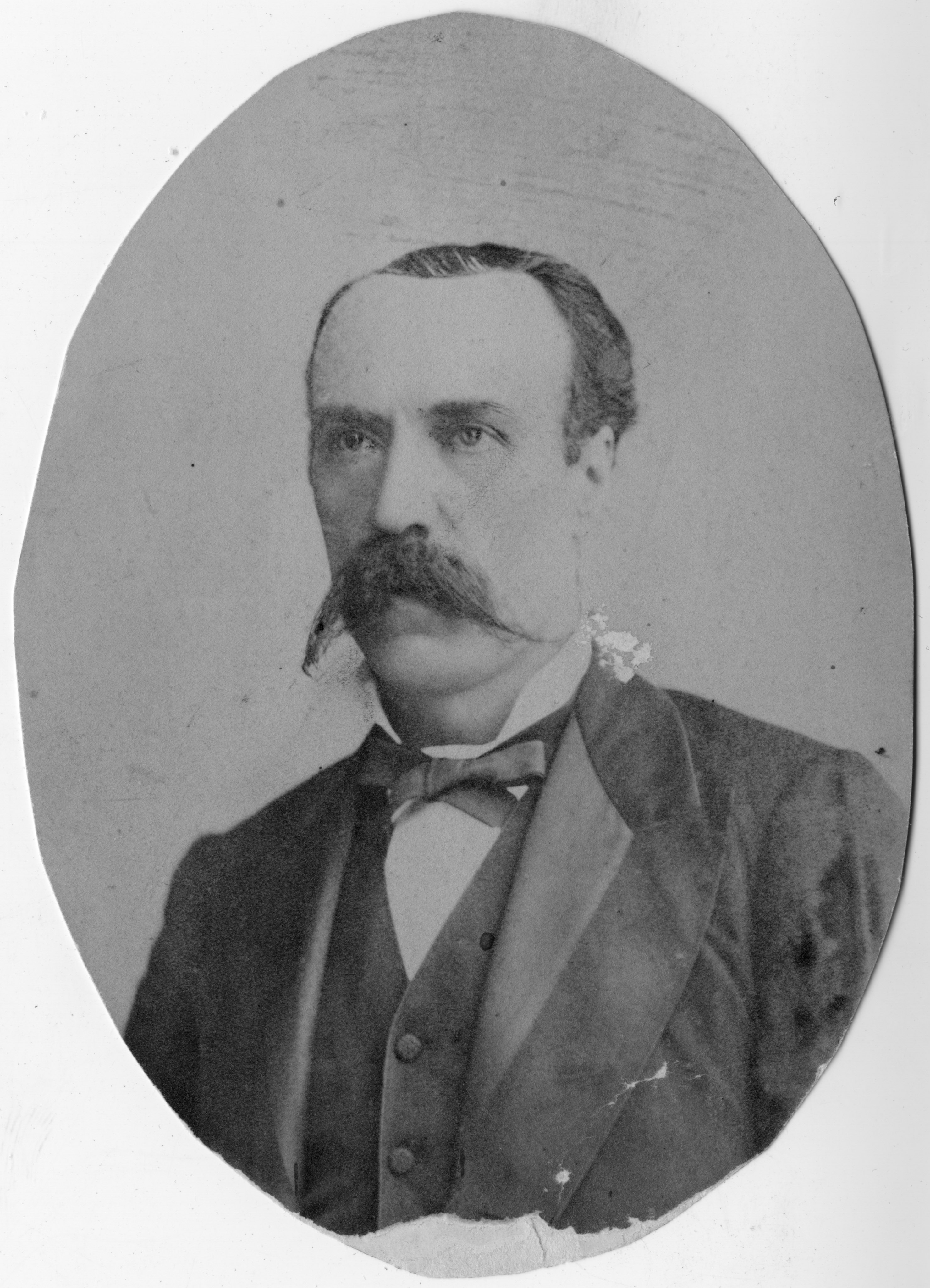
A portrait of Horace Tabor taken around 1882.
Two major factors played into the Tabors’ economic decline. First, Horace Tabor made a series of bad investments, which is sometimes credited to his inability to properly manage his money and other times to his generosity, as he was constantly funding new building projects throughout Denver and Leadville. The second factor was the devaluation of silver. While the Coinage Act of 1873 demonetized silver, the US government continued to purchase it in large quantities for the next several years until the repeal of the Sherman Silver Purchase Act in 1893, causing a near-complete collapse of silver prices. Almost the entirety of the Tabor fortune was created by Horace’s success in silver mining, so the one-two-punch of devaluation and withdrawal of government silver purchases turned out to be disastrous for what little money he had left after his poor investments. Nonetheless, for the next six years, the Tabors tried to keep up appearances, living in their mansion for as long as possible despite losing their other properties and possessions. Horace worked for a while as a day laborer and then was appointed Denver’s city postmaster in 1898, an opportunity that could have served as a new beginning had he not become sick and died of appendicitis the very next year on April 10, 1899.
Maintaining the Tabor name
This juncture in the Tabor story is typically when the legend skips a few years and has Elizabeth immediately falling into a state of despair and running to the hills of Leadville to live out the rest of her days in an abandoned shack. But Elizabeth persisted in Denver for years after her husband’s death, during which time she fought to financially support her daughters by leasing the Matchless Mine to people willing to work it, with the hopes of extracting more valuable ore. When one of those lessees accused her of fraud, the Denver Post reported on the court proceedings. Elizabeth, fed up with the accusations and public scrutiny, wrote a rare response to the Post that was published in the November 29, 1903 Sunday paper:
It is not easy to tell how much I was astounded to read in this morning’s papers, under large and glaring headlines, the statement that I had been sued because of “fraud and deceit.” Since I have had to battle alone with the world and provide for two young children and sustain the sacred name bequeathed them by their honored father, I have had to do much against great odds, with only good health and high hopes to support me. I have not carried my grievances into the newspapers, and would not now were it not solely in the interest of my children. For their sake the public should not be left in a moment’s suspense as to the stain so heartlessly and untruthfully put upon their mother.
It is clear from this statement and from records in the Tabor papers that Elizabeth fought to support her daughters and to redeem their family name, not only managing the Matchless but putting on boots and working the mine herself. Yet despite her efforts, the Matchless proved a futile pursuit.
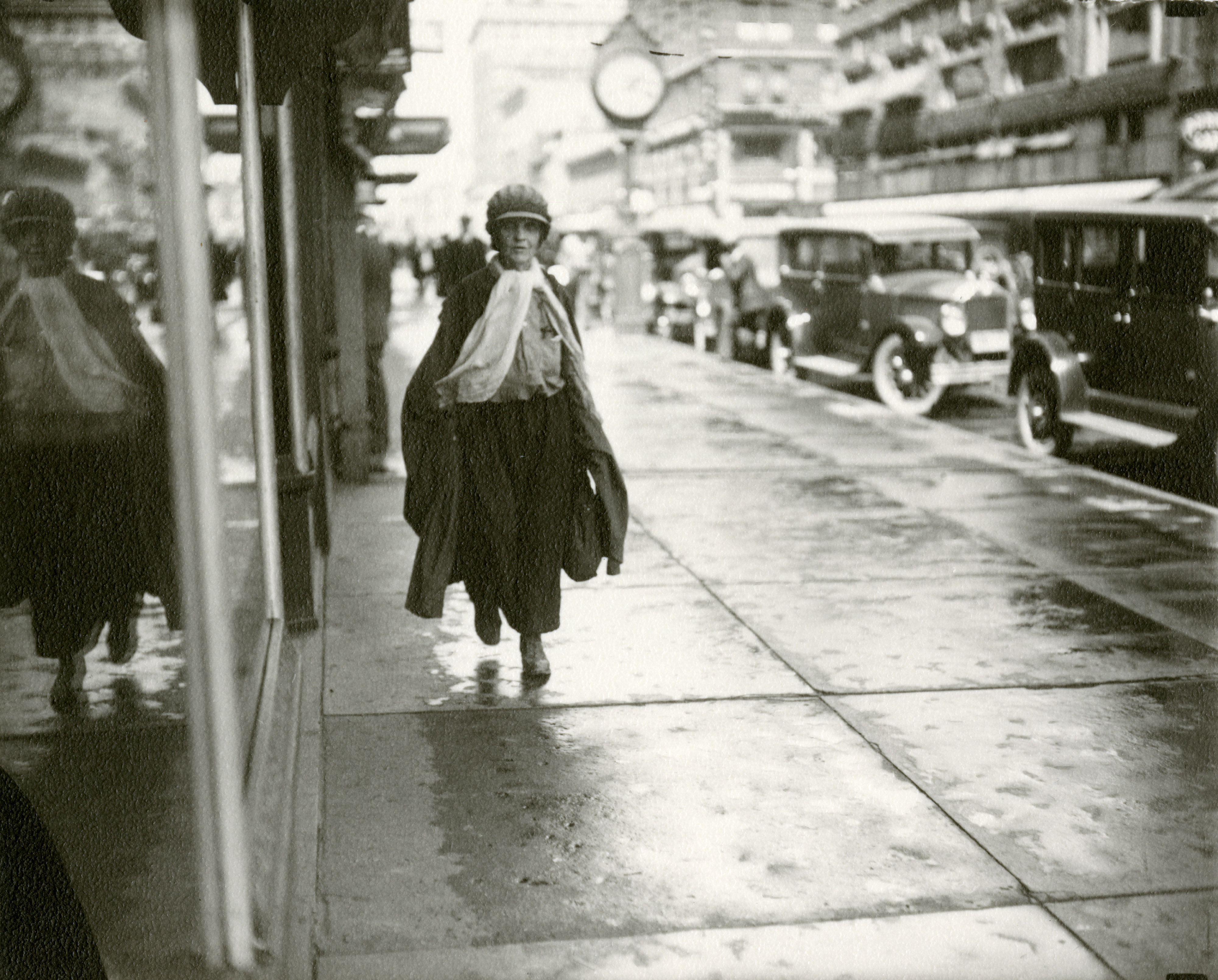
Elizabeth “Baby Doe” Tabor walking down the streets of Denver, 1929.
Elizabeth’s social exile worsened as she fell deeper into poverty and removed herself to the cabin near the Matchless, where she turned to her Catholicism for solace. Her daughters both left Leadville, Lily to live with her mother’s family in Wisconsin and Silver to pursue an acting career in Chicago. Though the three maintained contact and sometimes traveled to visit each other, notes in the Tabor papers reveal Elizabeth’s distress at living away from her daughters and the extent to which she suffered from poverty and starvation. The words “I am alone” constantly pepper the papers, and she took notes on the remainder of her food supply, which often consisted of only coffee and bread. She relied primarily on loans and frugality to survive, but was known to vehemently reject any help she considered charity. I suspect that accepting help from the very people who had long scorned her may not have appealed to Elizabeth, who maintained pride in the Tabor name and legacy.
By this time, Elizabeth’s role as a local spectacle had made a 180-degree turn from the elaborately dressed hyper-feminine enchantress to a disheveled, cross-dressing loner. She stopped wearing expensive dresses, though was sometimes seen wearing her old capes, and had taken to wearing men’s pants and shirts. When another well-known wife of a mining magnate, Margaret Brown, helped Elizabeth find the money to retain the Matchless Mine in 1928, she was quoted in the Post in defense of Elizabeth and her “manly attire,” saying “She is a miner at heart, a miner in manner, and so why not a miner in dress?” Brown also marvels at meeting Elizabeth for the first time and hearing her story firsthand. The article concludes with a question about Elizabeth’s continually changing luck, asking, “Is it possible for the last member of the Tabor family, ‘Baby Doe,’ to bring the name back to the place in Colorado that it occupied a half a century ago?”
Elizabeth’s luck, as it turned out, would not take a turn for the better. In her last years, she stayed in solitude in her cabin in Leadville, occasionally meeting curious citizens. Oral histories with Leadville residents describe her daily walks on feet wrapped in cloth down the hill from Matchless to the local church, where she would pray. They also describe how children would pelt her with stones as she walked, seeing her only as the old crone who lived alone up on the hill. Her mental health deteriorated into what some have called madness, but also could have been undiagnosed dementia or lead poisoning caused by the nearby mine, as researchers like Judy Nolte Temple have theorized.
In 1932, a film based on the Tabor story titled Silver Dollar debuted in Denver to a packed theater. When a group of lawyers offered to sue the producers of the film for Elizabeth at no cost to her, she wanted no involvement. It seems that she had had enough of the public’s invasive attention, and simply wanted to be left in peace. Three years later, after a winter snowstorm, a neighbor noticed that the chimney in Elizabeth’s cabin had stopped emitting smoke and found her deceased. Her death quickly became front-page news, with a particularly grisly headline reading, “Woman Once Sought for Beauty, Power, and Wealth Lies Alone Two Weeks on Bleak Leadville Hilltop, a Frozen Corpse.” Soon after, the cabin where she had been living was ransacked and destroyed. Even in death, her privacy and dignity were cast aside for the sake of curiosity.
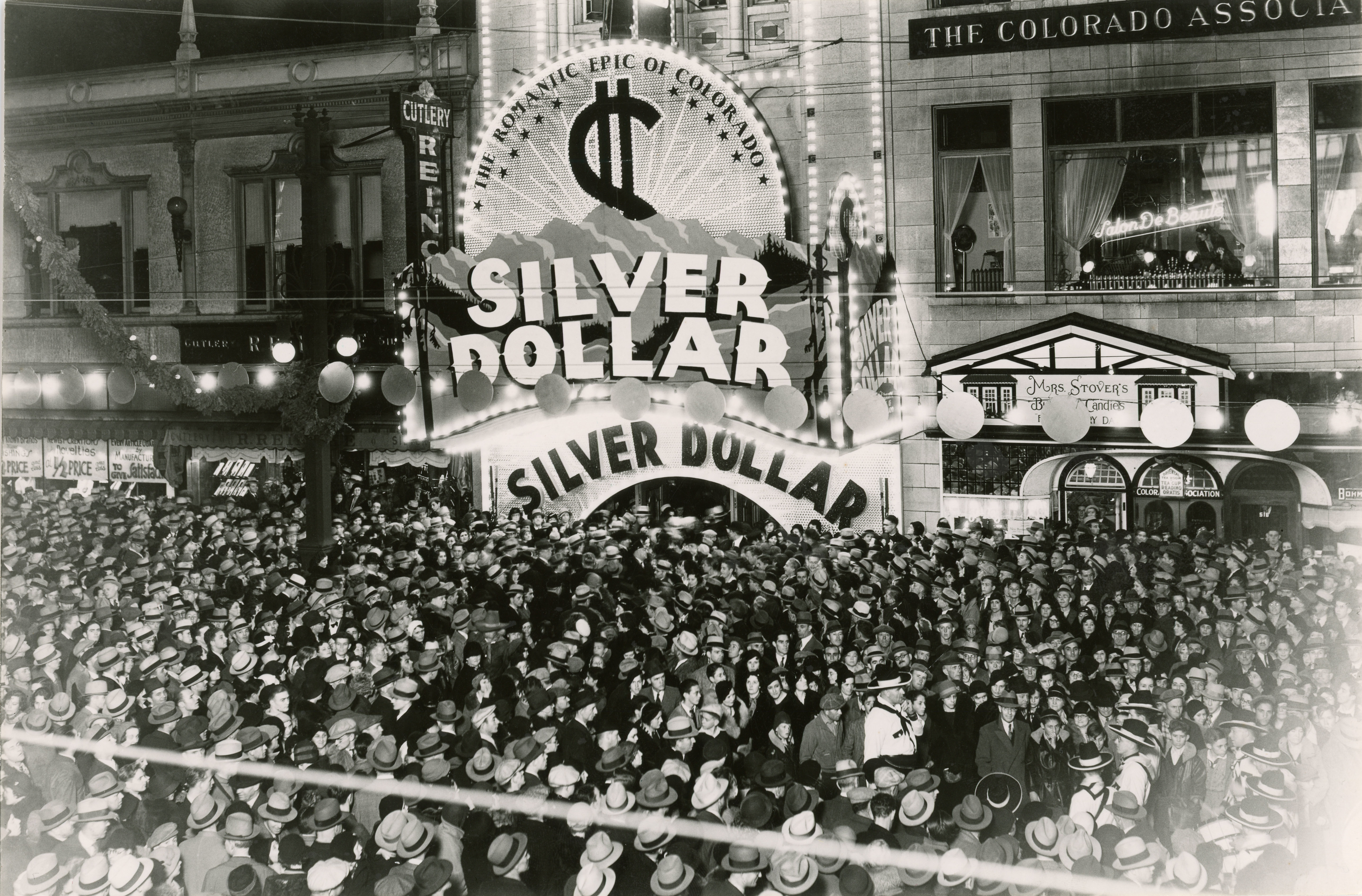
A large crowd gathered outside a Denver theater for the premiere of the motion picture “Silver Dollar,” 1932.
The Dress’s Legacy
The next time Elizabeth Tabor’s wedding gown emerged into public view was when it was rediscovered weeks after her death. Elizabeth’s brothers obtained the appointment of officials at the State Historical Society of Colorado (now History Colorado) to administer her estate, which she had left behind without a beneficiary. Only two weeks after her death, and with the press on site, museum staff opened several trunks containing the Tabors’ belongings in the warehouse where they had been stored, and among the many items they pulled out was the famous wedding dress. The Denver Post dedicated three separate articles to the event on their front page, with one headline reading “Finery of Tabor Women Crumbles Like Their Lives.” The wedding gown was deemed to be “the most valuable treasure, from a historic standpoint” though it was noted to have been “discolored with age and perhaps ruined from water and mildew.” More belongings were later found in a hospital in Leadville, where nuns Elizabeth had befriended stored them. When the Tabor estate was eventually put up for public sale, a group of local citizens purchased what they considered to be the most important items and transferred them to the Historical Society’s collection.
Just a few months later, the museum’s very first Tabor display opened to the public. A photo in the January 1936 edition of The Colorado Magazine shows the wedding dress displayed in a case dedicated to the ceremony, and it would rarely be taken off view for the next seventy-five years. In the absence of the spectacle Elizabeth herself provided in the last decades of her life, her wedding gown was quickly subbed in as the next best thing—an extravagant relic from the biggest and most notorious night of her life, now stained and time-worn. Historical Society curator and administrator of the Tabor estate Edgar McMechen wrote in The Colorado Magazine that in the new exhibition, “it is as though a faint incense—the essence of Baby Doe’s vital spirit—hovers over the cases.” Tabor was shunned and ignored while alive, but after her death, she and her wedding gown were perceived with a sense of nostalgia and romanticism, as if her passing automatically granted her status as one of Colorado’s beloved historical figures.
Tabor’s death and the unveiling of her estate reinvigorated public fascination with her story. The Denver Post continued running daily front-page stories about the Tabors, reporting on new findings within their estate and the museum’s efforts to display the items. Simultaneously, the Rocky Mountain News published a lengthy twenty-part series that rehashed the Tabor legend with dramatic flair. While the series indulged in sensationalism, the tone toward Elizabeth Tabor became more sympathetic after her death, noting that despite her few years of unapologetic extravagance, she had not left her husband when his wealth disappeared, as the public had predicted. Two years later, another series published in True Story magazine demonstrated a similarly sympathetic yet sensationalistic tone that would cement certain aspects of the legend for decades to come.
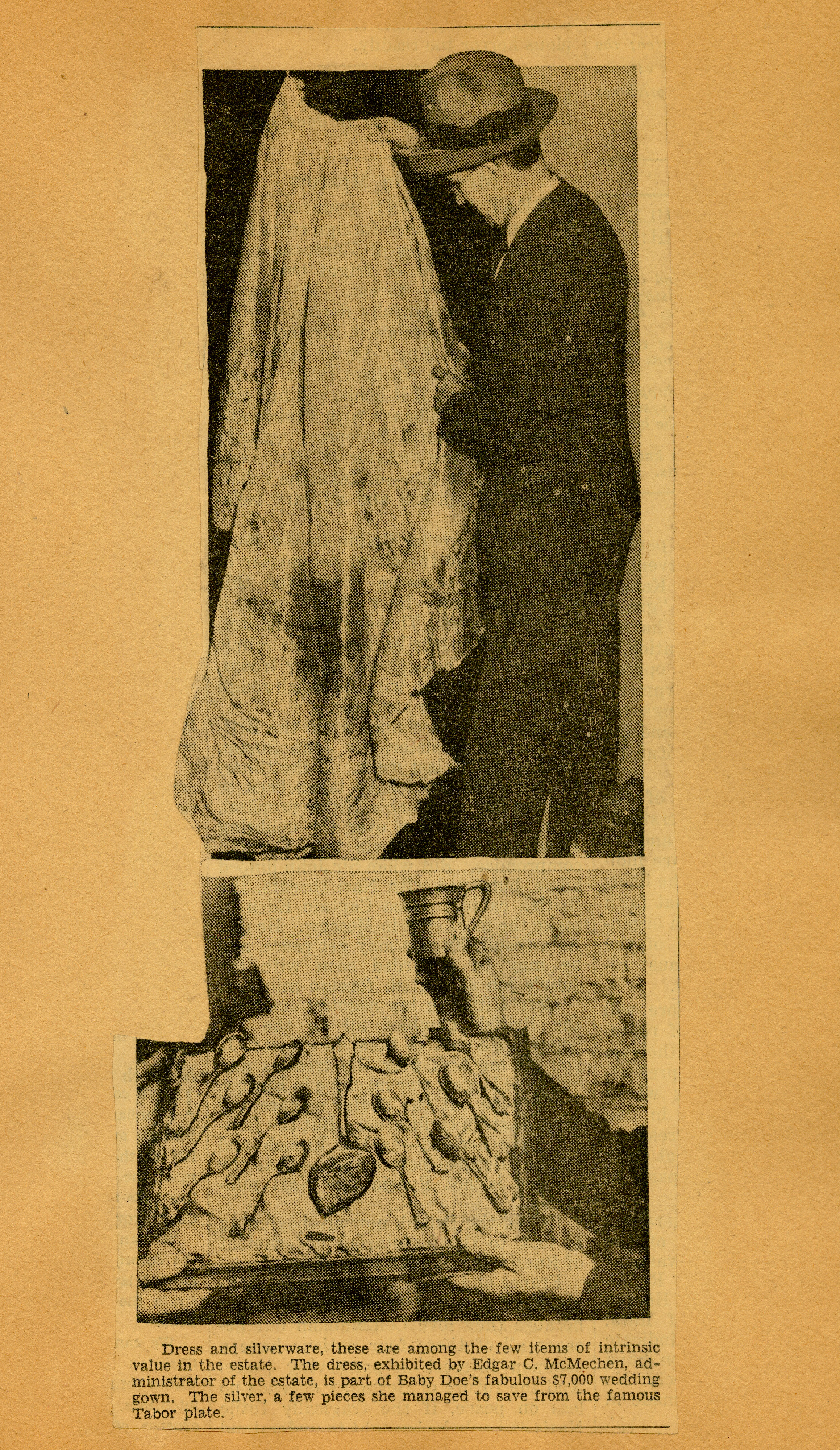
Unlabeled newspaper clipping depicting the rediscovery of Elizabeth Tabor’s wedding gown after her death.
“Silver Queen: Baby Doe’s Life Story as Told to Sue Bonnie” was a five-part series purportedly written by Sue Bonnie, a woman who had befriended Elizabeth in her last years. Having heard her recount her life story, Bonnie apparently wished to free the truth about Elizabeth. The article reads in Elizabeth’s first person voice and is written like fiction, with plenty of dialogue among its cast of characters. In truth, the article was actually written by popular Colorado historian Caroline Bancroft, who had purchased the rights to use Bonnie’s name for the article in order to meet the publishing requirements of the ironically-titled True Story magazine. At the time, the Tabor papers, found with the rest of Elizabeth’s belongings after her death, were kept under lock and key by McMechen and so Bancroft, who had openly admitted to embellishing her biographies for the sake of good storytelling, relied primarily on secondary sources for her article. The resulting piece is riddled with hyperbole and is responsible for popularizing many of the most recognizable facets of the Tabor legend, including rumors about Tabor’s wedding ensemble.
The open neckline of Tabor’s dress is mentioned in the True Story series once again, but this time it is framed as a design choice meant to accentuate the expensive diamond necklace Horace Tabor gifted his bride. Like the dress itself, the necklace is mentioned in nearly every newspaper report published after the 1883 ceremony, though most describe the necklace as a forthcoming gift that was yet to be complete, and a few reports specify further that the bride wore no jewelry at all. Sources disagree on exactly how much the gift cost, but estimates range from 75,000 to a colossal 500,000 dollars. Such inconsistent reporting was noted by the press even at the time, and by Elizabeth herself, who pasted an unlabeled newspaper clipping into her scrapbook reading, “The Tabor necklace grows in diamonds. The Green Bay Advocate made a handsome contribution, placing the value at half a million dollars.” Over time, the necklace earned a reputation for having been sourced from a collection of jewels that Queen Isabella of Spain had pawned to finance Christopher Columbus on his colonialist quest, and as a result it became known as the Isabella diamond. This background is included in Bancroft’s True Story magazine, after which she writes, in Elizabeth’s voice, “My dress was made very decolleté so as to show off the necklace to the best advantage.” Bancroft’s interpretation of Tabor’s open neckline departs from earlier nineteenth-century critics, who perceived the neckline as indicative of Tabor’s youthful daring and lack of decorum, and instead claims that it was a method to showcase the high-priced necklace from her husband.
While we might never know whether Elizabeth wore the necklace with her wedding ensemble, Bancroft’s interpretation indicates that, in the ever-evolving discourse about Elizabeth’s dress, 1930s audiences cared less about how low the neckline was and more about how wealthy the Tabors once were. This riches-to-rags storyline likely appealed more to people grappling with the economic devastation of the Great Depression, to whom extravagant clothing and jewelry were a luxury that had long been a foreign concept. To this audience, the Tabor legend as told in True Story magazine became a fictive escape from daily hardship and a lesson in the dangers of managing money recklessly.
The dress remained on exhibit at the Historical Society but moved around a little in the 1950s, when it experienced another shift in its display and reception. In 1950, McMechen purchased white marabou feathers from a local department store and used them to trim the dress’s neckline and waistline, since some newspapers had mentioned this design detail in their 1883 reporting, but the feathers were assumed to have disintegrated while the dress was in storage. This styling can be seen in photographs from the dress’s subsequent display in 1952 in the Denver May Company’s exhibition celebrating the store’s 75th anniversary, for which they showcased a selection of historical fashion. The dress, styled with the feathers, a veil, and a specially made wig, was photographed and advertised in the September 25 edition of the Post. In this round of public attention, the dress was interpreted not as scandalous but as simply “costly” and “fashionable,” indicating again a more modern and favorable attitude toward its silhouette and wearer.
The Tabor wedding dress moved in and out of public view for the next several decades, and concerns for its preservation intensified. It is unclear when the feathers were removed from the dress, but notes in the museum’s files mention that it underwent conservation treatment in the early 1960s. In 1977, the dress was removed from display at the Historical Society in preparation for the organization’s move to its new building, the Colorado Heritage Center. At this time, staff noted that the dress was in a state of extreme disrepair, and in 1981 it received its most extensive treatment yet, when it was taken apart piece by piece, cleaned, and reassembled for permanent display. It remained on view until 2010, when it was finally allowed to rest in storage as the museum prepared to move once again to its current building, the History Colorado Center on Broadway in Denver.
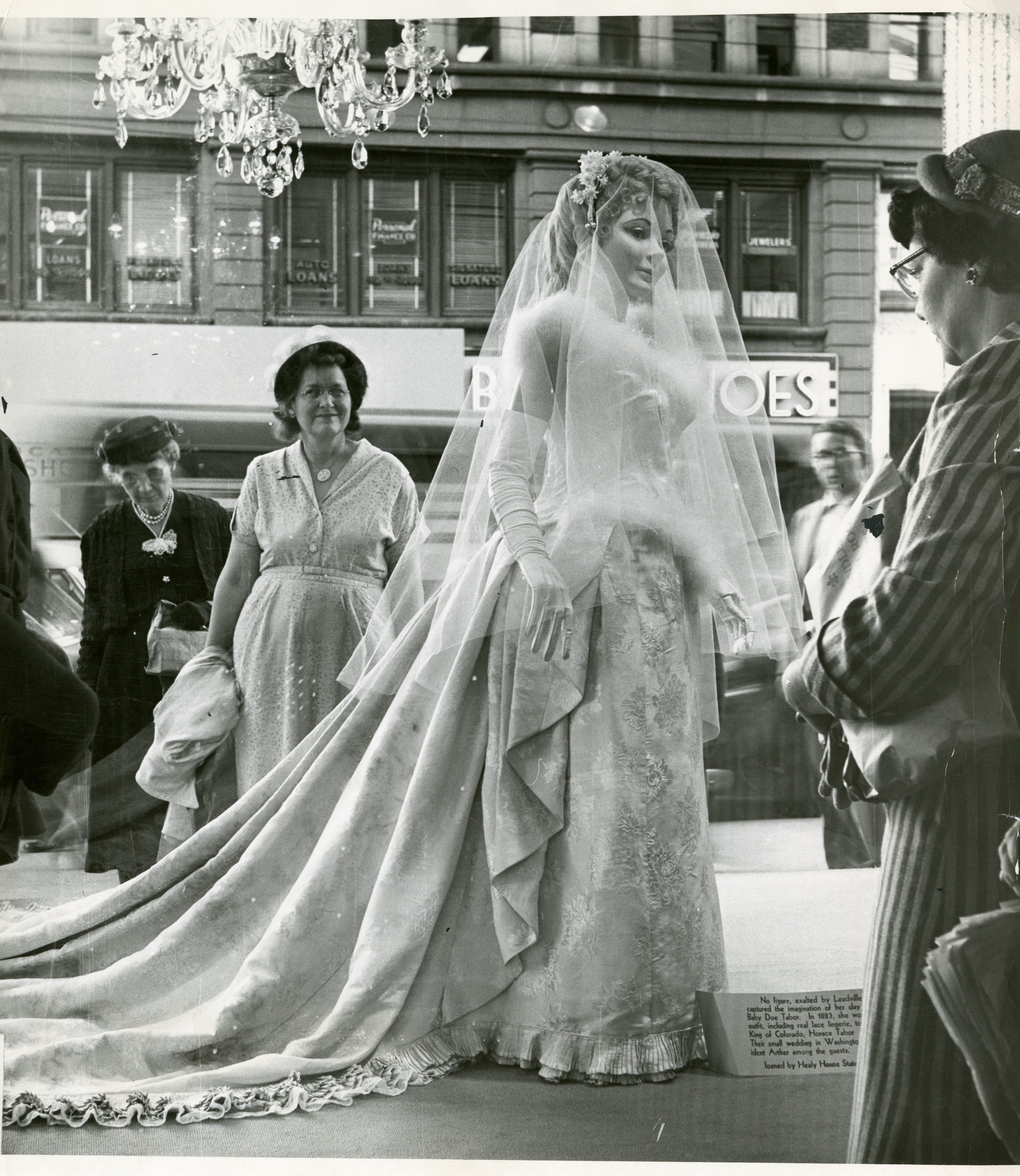
The wedding gown of Elizabeth “Baby Doe” Tabor on display at the May Company’s 75th anniversary celebration in Denver, 1952.
A Stand-in for Lizzie
In both design and display, Elizabeth Tabor’s wedding gown stands in as a symbol for Elizabeth herself. As with Elizabeth, relentless observation of it both fueled and satiated public fascination but caused its slow deterioration.
During the decades it had stood beneath bright exhibit lights, the silk weakened, then fell apart. While the conservation treatment of 1981 has continued to hold the threads in place, the dress will only ever be preserved, not restored. The damage to Elizabeth Tabor’s story and the dress has been done. As I continued my own work on its most recent conservation efforts in 2024, I began to grapple with this thought, and the sense of responsibility that seemed to linger over the latest effort to bring the dress back into public view. The goal of the project was to both stabilize any damage that had occurred since the dress’s last treatment and to create a custom three-dimensional mount that could support it wherever it went, including on exhibition and in storage. In other words, our task was to recreate the shape of Elizabeth Tabor in a manner that was both safe for the dress preservation-wise and historically accurate. A conservator studied the dress and sculpted a form that imitated Elizabeth’s curves, a difficult task that required multiple fittings and adjustments. After months of collaboration between museum staff and conservators, the dress that first appeared to me as an endless, intimidating sea of fabric suddenly came to life on a three-dimensional form, and the resulting figure of the famous Baby Doe Tabor appeared surprisingly small.
The dress is currently on display at the Center for Colorado Women’s History, where Coloradans can see it and consider Elizabeth’s story for themselves. Over time the neckline has weakened and stretched wider than it ever was, but the dress otherwise maintains the elegant and modern design that Elizabeth chose for herself for her wedding day. In the spring of 2026 it will be returned to storage where, like the Tabor papers, it will remain available for research by future generations. I say it’s time for new scholarship to echo the most recent publications and consider Elizabeth Tabor, not according to the legend, but for all her complexities as a woman who refused to adhere to society’s expectations and who survived, against great odds, on persistence and high hopes.