
 Membership
 Donate
 Shop
Shop


























Domestic Terror Strikes Denver
How racial violence entrenched segregation around City Park.
Editor’s note: This article contains a racial slur, quoted from a threatening letter the Carrington family received in 1926. We chose to print the slur in full as part of our ongoing commitment to fully and honestly confronting systems of discrimination, dehumanization, and violence that have long been a part of Black Coloradans’ lived experiences.
Early one Friday morning in December 1926, the Carrington family was jolted awake by an explosion. A bomb had detonated under their front porch in Denver’s City Park West neighborhood, ripping a hole in the porch and shattering their front window. None of the house’s residents—E.E. Carrington, his wife, their sixteen-year-old son, and their maid—suffered any injuries. But injuries were not the point, at least not yet. The point of this particular bomb was simply to scare the Carringtons, a Black family, into leaving their lovely house located in what was then a fairly new middle-class neighborhood.
A letter in their mailbox explained: “Nigger tenant, 2253 Vine street, you have come into a district where you are not wanted. You have ruined property. Get out and stay out or take the consequences. They will be swift and merciless. The Committee that means business.”
As that threatening letter suggests, the Carringtons were considered urban pioneers of an unwelcome character. Early in Denver’s history, the city’s Black population was dispersed throughout town, with some larger clusters in cheap areas near the river and the railroad. As Denver developed, however, the frontier fluidity of the city’s early residential patterns hardened into neighborhoods that were defined more strictly by race and class. After the turn of the twentieth century, Denver’s Black population simultaneously grew in numbers and contracted in space, becoming increasingly concentrated in the aging Five Points neighborhood just northeast of downtown.
Yet Five Points had fuzzy boundaries and, by the 1920s, middle-class Black families like the Carringtons were testing its edges in an attempt to secure better housing in newer neighborhoods where they could raise their kids in a less-crowded environment. This meant moving into overwhelmingly white neighborhoods such as City Park West, where they did not receive a very warm reception.
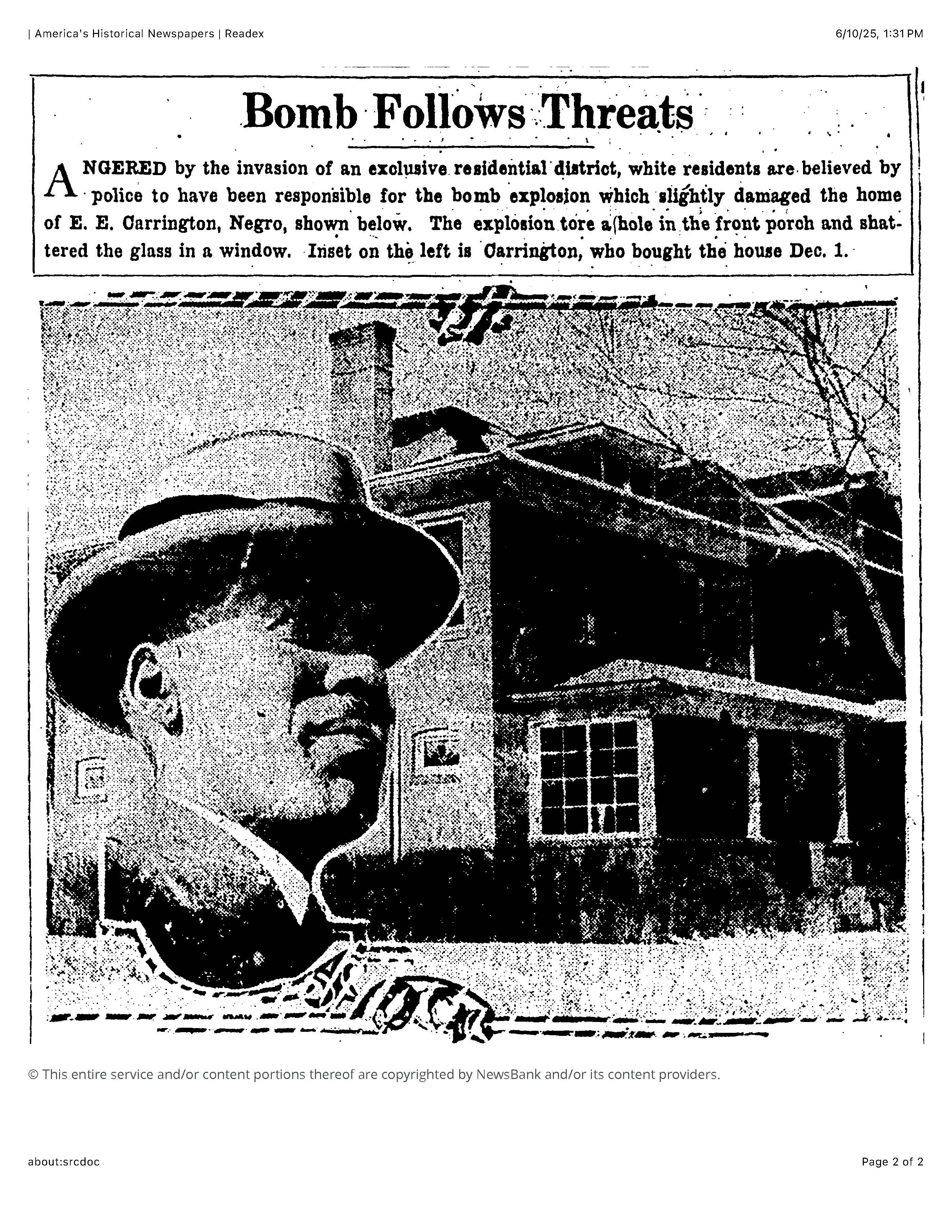
E.E. Carrington (pictured) endured two bombings and two shootings after his family moved to Denver’s City Park West neighborhood in 1926.
Just three weeks after the Carringtons’ house was bombed in December 1926, the family suffered another series of attacks. This time Mrs. Carrington was out on the porch talking with a friend when a flurry of bullets flew past. The women ran inside and called the police, who came to investigate but found no leads. Apparently the police also offered no protection, because that very night, as the Carringtons slept, another shooter riddled their sleeping porch with more bullets.
Now the Carringtons requested nightly police protection, which the city provided. But they still were not safe. Early one evening in January, about two weeks after the shootings, E.E. Carrington was in his front room chatting with a friend when they heard something land on the porch. Carrington rushed outside and saw a bomb. Thinking quickly, he chucked it into the street, where it detonated with only minor harm to a neighboring house.
By that time, however, deeper damage had been done to the Carringtons and the surrounding community. The priest at nearby St. Ignatius of Loyola Catholic Church presented a petition from the neighborhood to the mayor protesting the Carringtons’ residence there. At Cole Junior High, the principal had to call the police to prevent a riot when white and Black students got into what the Denver Post called “a heated discussion” about the Carrington attacks. And the Carringtons themselves had finally had enough. They sold their house to a white family and moved half a mile west, to a block well within Denver’s established Black neighborhood. A large crowd watched as the moving van carried their things away.
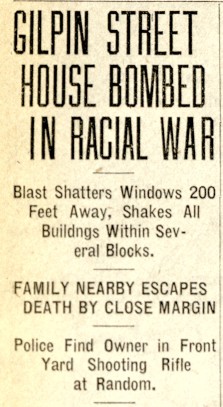
The bombings near City Park were big news in the 1920s, with stories often appearing on the front page of local papers under tabloid-esque headlines that hyped the violence.
I came across the Carringtons’ story during my research for the Colorado Black Equity Study—a groundbreaking project, housed at History Colorado, that aims to document the constraints that Black people have faced in their quest to attain a decent quality of life in the Centennial State. The study started in late 2024, and our team of researchers is already hard at work examining subjects such as banking, business, criminal justice, employment, education, healthcare, infrastructure, and investment.
My own research has focused on housing. I started by looking at early twentieth-century Denver. Why, I wondered, did the city’s growing Black population become increasingly concentrated in Five Points? What combination of social, economic, and legal constraints caused the majority of Black Denverites to live in decaying old houses in one relatively small corner of the city? And what effects did that housing situation have on their quality of life as well as their ability to accumulate wealth?
Those were the questions that led me to the Carringtons. Aside from the violence and the persistence of the people who wanted the Carringtons gone, the other thing that stood out to me about the Carringtons was their address, 2253 Vine. It’s just two blocks from where I live. I must have walked by it dozens of times with my kids and my dog.
The house, built in 1910, still stands; it’s near the corner of a pleasantly leafy block of attractive old brick residences located just steps from City Park and two miles from downtown. With modern updates, the house would now be worth more than one hundred times what the Carringtons paid for it a century ago. But the Carringtons never got to enjoy the appreciation of their property, nor the simple pleasure of living in the area, because they were bombed and bullied out of it.
Sadly, the Carringtons’ experience was not uncommon during the 1920s. As the Great Migration brought an influx of Black newcomers to many northern and western cities, white residents across the country pushed for stricter residential segregation.
At first they resorted to the violent means of mobs and bombs. Chicago saw fifty-eight bombings of Black houses from 1917 to 1921, and cities such as Detroit and St. Louis were also rocked by racial terrorism.
Denver followed a similar pattern. As middle-class Black residents like the Carringtons began to push east from the older Black neighborhoods of Five Points and Whittier into newer and more desirable neighborhoods near City Park, they faced violent efforts to evict them.
In 1920, a Black fireman named Claude DePriest moved into 2649 Gaylord Street, just northwest of City Park, with his wife and mother-in-law. Soon some 250 whites marched on the house two nights in a row to demand a sale. The Denver police declined to offer protection even as the group’s leader, Foster Cline—a lawyer who would later be Denver district attorney during the Carrington attacks—declared that he could not guarantee the DePriest family’s safety from the mob.
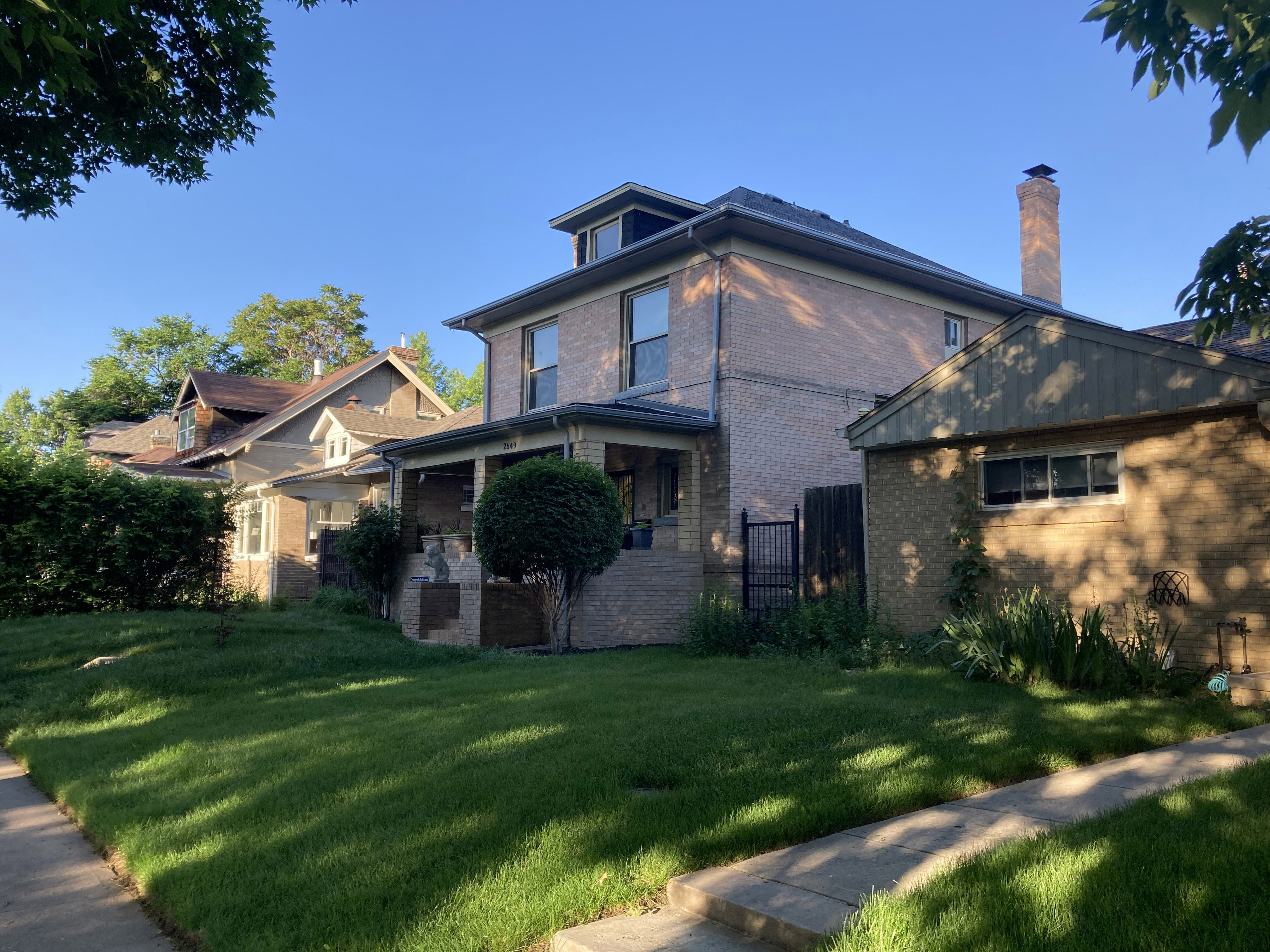
When the Black fireman Claude DePriest moved into this house on Gaylord Street in 1920, a mob of some 250 whites marched on it two nights in a row to demand that the DePriest family leave the neighborhood.
“In my opinion, sooner or later, there will be serious difficulty and perhaps bloodshed, when colored people move into the midst of a white neighborhood,” Cline wrote. “...It may not come this week, this month, or this year, and perhaps it may not come to you people, but sooner or later it must come.” Within weeks, the DePriest family sold the house to Cline’s group for $6,000. Today it is worth more than $650,000.
Cline’s prediction of violence soon came true. A year later, Walter Chapman, a longtime government mail clerk and secretary of Denver’s Colored Civic Association, moved with his wife to 2112 Gilpin Street, a few blocks west of City Park. Chapman received threats and reported them to the police, but no one followed up. Then, around 10:30 one night, someone in a passing car threw a bomb onto the lawn. It ripped a hole in the grass and shattered windows at Chapman’s house and the house next door. Sitting inside, Chapman and his wife were knocked from their chairs but not injured.
The Chapmans moved out, and another Black family, the Starrs, moved in. Charles Starr worked for Denver’s parks department, and the house’s location near City Park must have appealed to him. But like Chapman before him, Starr was not welcome there.
In November 1921, another bomb exploded at the house with such force that it was reportedly heard as far away as Broadway and “felt all over East Denver.” It tore holes in Starr’s walls and shattered windows all along the block. Inside, Starr, his wife, and their ten-year-old daughter, Ceressa, were unharmed. But they must have been shaken. Starr stepped outside carrying his Winchester rifle and began to fire wildly into the street, spraying bullets into the doors and walls of nearby houses.
Denver police soon arrived and pledged to protect Starr’s family, but the promise must have rung hollow. The Starrs soon sold the property and moved. Today the house is worth roughly $900,000.
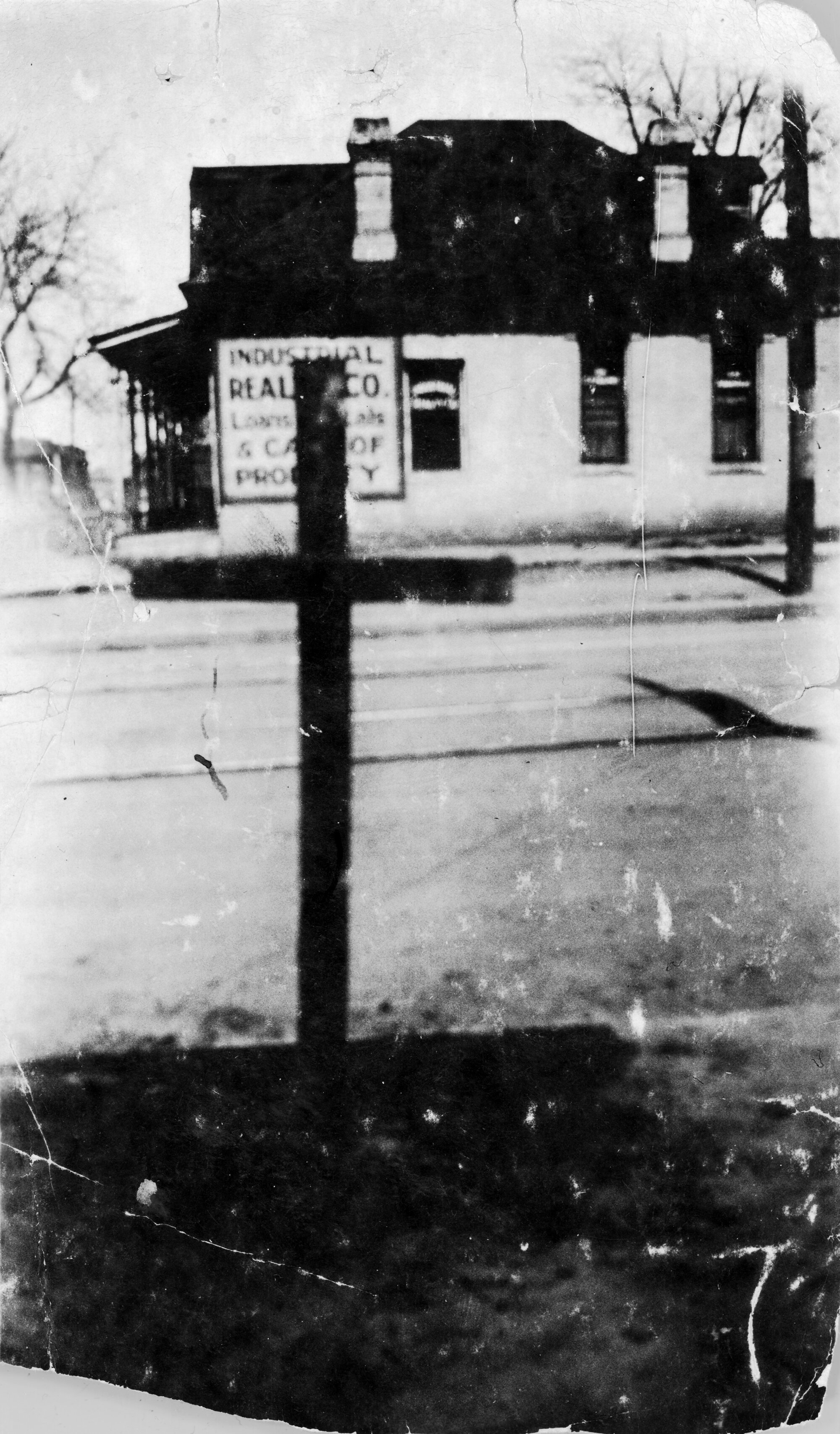
In 1925, the Denver Ku Klux Klan burned a cross on the lawn of Dr. Clarence Holmes, a Black dentist in Five Points and early member of the Denver NAACP. This photo of the burnt cross was taken shortly afterwards.
As in other northern and western cities, Denver’s reign of domestic terrorism did not last long. By the late 1920s, the mobs and bombs that terrorized the Chapmans and the Starrs began to go out of style as segregationists turned to other, less violent tactics—methods of containment and constraint that were less likely to blow out the windows of other homeowners and give their city a reputation for lawlessness. They shifted, in other words, to even more powerful barriers: the kind that can hold up in court.
One of these tactics was zoning. In 1922, the same neighborhood improvement associations that often promoted residential segregation began to push for a comprehensive zoning plan to regulate residential, commercial, and industrial areas across Denver.
The city’s Black press saw the proposal as “nothing more nor less than a residential segregation scheme.” The zoning proposal was considerably more than that, and would shape the city in far-reaching ways that went well beyond race. But it is also true that the commission advocating for a citywide zoning law included at least three men who were or would soon be members of the Ku Klux Klan. A subsequent commission to draft the zoning plan included one Klansman, Edgar H. Coykendall, who lived a few blocks from 2112 Gilpin Street and was active in efforts to prevent Black people from living in the neighborhood. Perhaps not surprisingly, the city’s zoning map, implemented in 1925, drew a line about three blocks west of City Park, beyond which it required larger lots and dwellings that were less likely to be affordable to Black Denverites.
Even more powerful than zoning was the restrictive covenant—an agreement written into property deeds, or made between neighbors, stipulating that houses would not be sold to Black people (and often other groups as well). In 1926, the US Supreme Court ruled that property owners could enforce such restrictions, and four years later the Colorado Supreme Court followed suit; racial restrictions would continue to be enforceable until 1948.
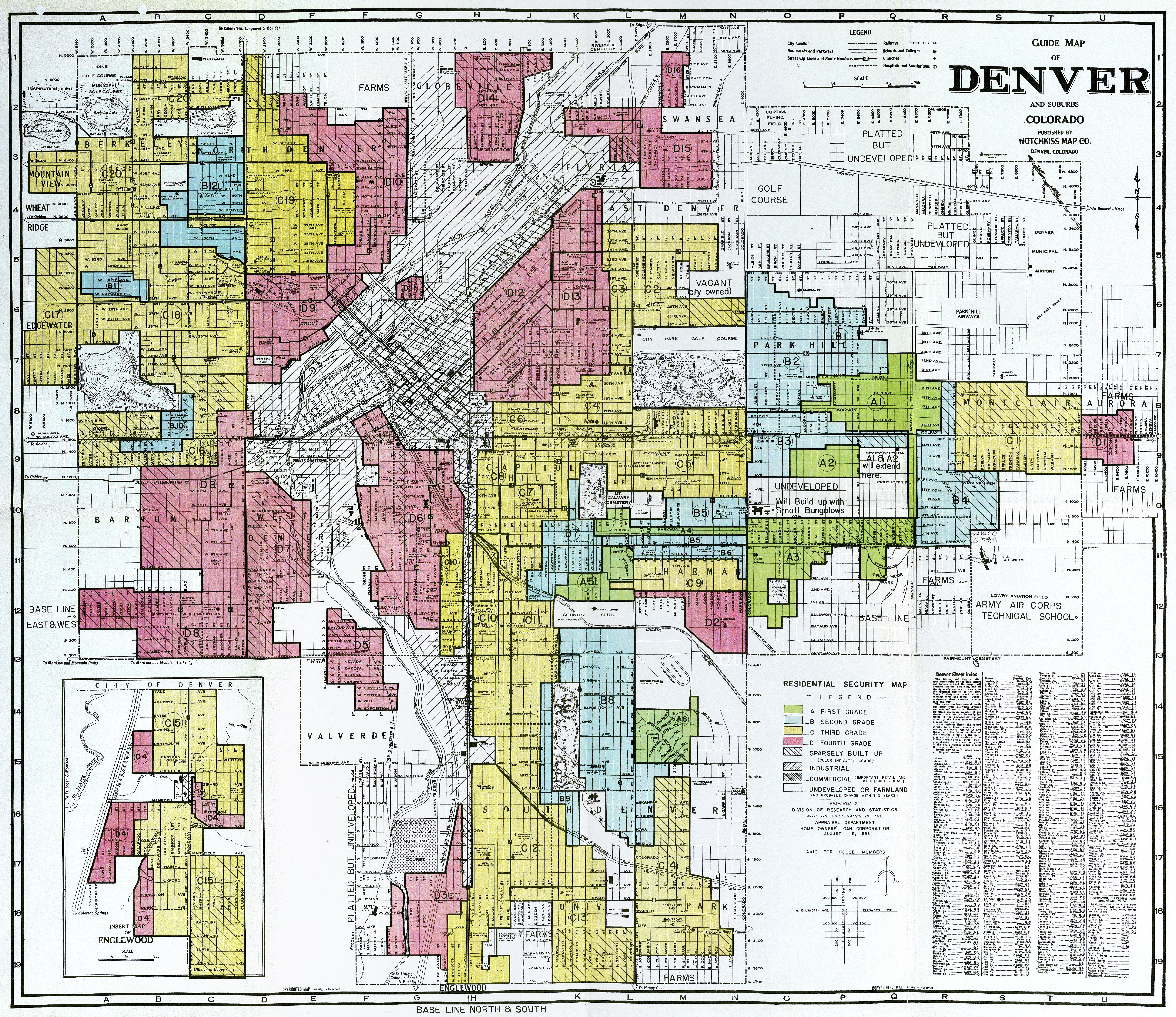
The location of the bombings of Black families in the 1920s tracks closely with racial boundaries that would later be enforced through legal means such as restrictive covenants, zoning, and redlining.
Neighborhood improvement associations near City Park were advocating the use of restrictive deeds by 1922, sometimes in collaboration with the Denver Real Estate Exchange. In 1925, for example, representatives from the McCullough, Columbine, and Clayton Improvement Associations met at the City Park golf course clubhouse to discuss segregation. Coykendall, the Klansman on the zoning commission, was on hand to explain how to file racial restrictions on property deeds.
Soon racial restrictions reportedly covered the McCullough and Clayton Additions at the northwest edge of City Park—the neighborhoods where the main acts of domestic terror had taken place in the 1920s—as well as the Berger and Ashley Additions north of the park. These agreements effectively made the blocks on both sides of York Street into a racial barrier. They could not eliminate Black residents entirely, especially west of York, but they came close enough that one part of the neighborhood would later be known to some Black Denverites as “Snow White Row.” This legal regime of residential segregation was considerably less flashy than the mobs and bombs that characterized the early 1920s, but it would prove more enduring, leading to limited mobility and lower wealth for countless Black Coloradans in Denver and beyond.
I live in City Park West and walk these blocks every day. When I started my research for the Colorado Black Equity Study, I didn’t expect to be studying my own neighborhood. Yet perhaps I shouldn’t have been surprised. Even in the short time our team has been at work, we’ve found Black history nearly everywhere we’ve looked. All it takes is a little digging. I hope the Black Equity Study can bring more of these stories to the surface—and prove, in the process, that we will never fully understand our state’s history without a better understanding of its Black history.
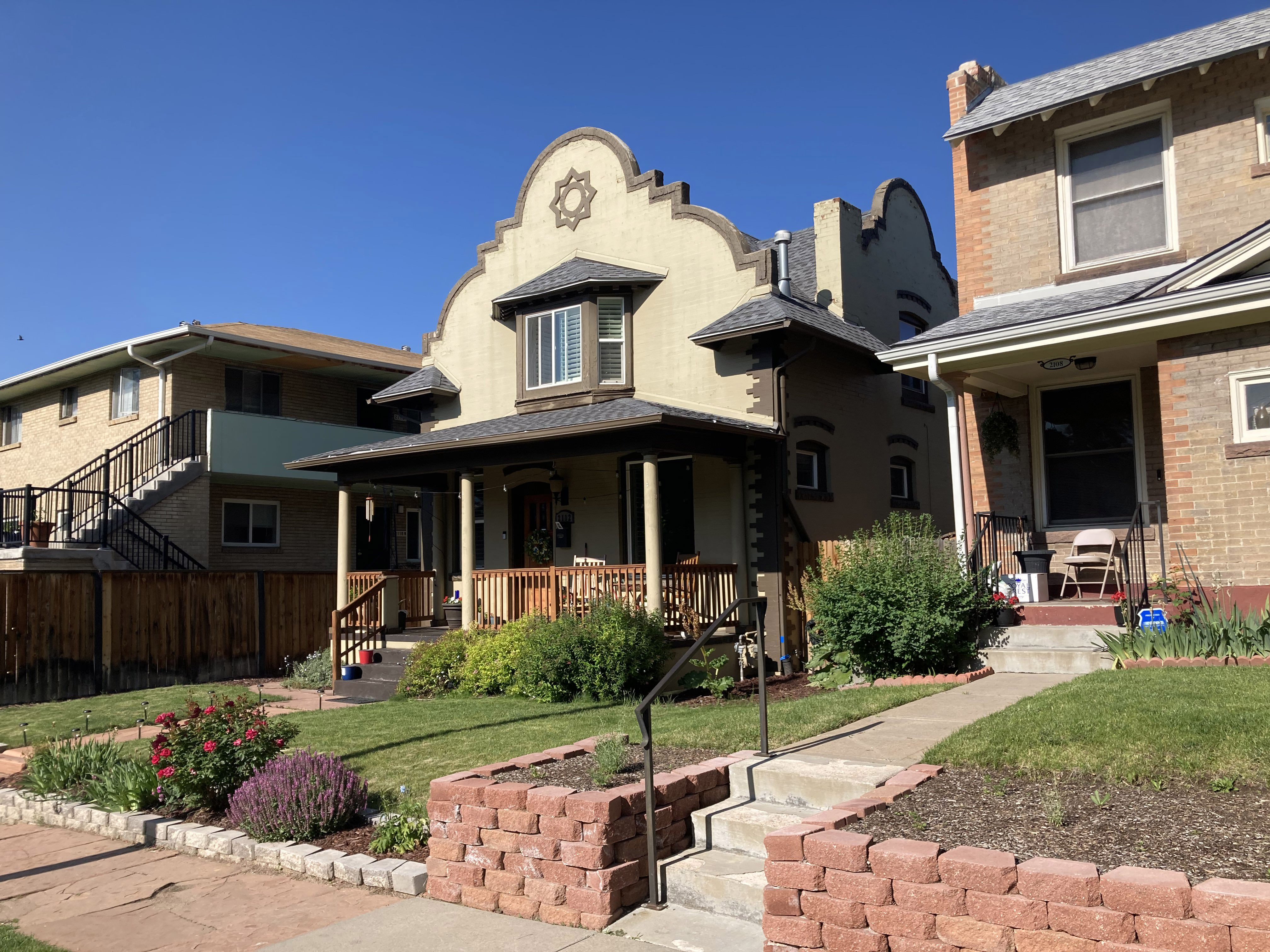
Bombs terrorized two different Black families living at this house on Gilpin Street over the course of several months in 1921. One of the bombs, which targeted the Starr family, was strong enough to shatter windows up and down the block.