
 Membership
 Donate
 Shop
Shop



























A Black Studies Professor’s View on “Restoring Truth and Sanity to American History”
Freedom is precious, and attaining it demands much of our nation.
Over 150 executive orders, hand-signed in front of TV cameras, have been a centerpiece of the second Trump presidency. As a scholar who specializes in Black Diasporic Studies and the former Colorado State Historian who continues to serve on the State Historian’s Council, I am involved in several history and humanities projects and initiatives, and some of the orders have had direct impacts on my work. The executive order focusing on history—“Restoring Truth and Sanity to American History”—however, in particular provides all of us with an opportunity to continue ongoing discussions about the role of history in the public square and in framing narratives of national identity. It can be another catalyst for urgent discussions about how we present history (both in and outside of the classroom) and, ultimately, how we think about the most highly treasured of American values: freedom of speech and thought.
As an interdisciplinary scholar, my focus has always been on how stories—remembered, imagined, preserved, or overlooked—are the foundation of knowledge about human life and experience. Whether around a rowdy kitchen table or in front of a box of crumbling newsletters in a quiet archive, at academic conferences or in solitude with a novel that allows us to hear the voices of characters very different from ourselves, through myths and religious rituals or museum exhibits, stories connect us across time and place in powerful, complex ways, as human beings and Americans. We can use our shared stories to build a more just, humane society in which all peoples and individuals are free to thrive and participate. For it is not enough to simply be exposed to other people’s stories—to witness, for an afternoon in a museum or a few days with a book—what it might be like to see the world from a time and place different from your own. If we are in agreement that a strong, inclusive, democracy that allows all of its peoples and citizens to be respected and free is a good thing, then uncovering stories, understanding stories, and sharing stories is just a first step, and a prelude to hard work that must be done together in the project of creating “a more perfect Union.”
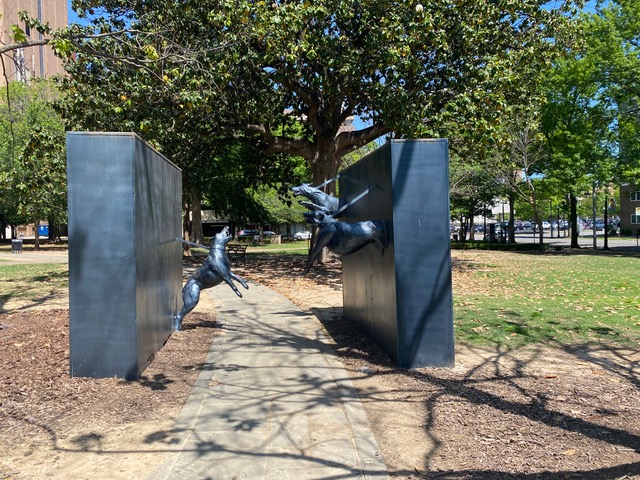
Civil Rights Memorial in Kelly Ingram Park.
Like many other executive orders we have seen this year, “Restoring Truth and Sanity to American History” justifies its actions by asserting they are responding to years of dominance of “improper ideology” that is not aligned with the worldview and policy goals of the Trump Administration: “Over the past decade, Americans have witnessed a concerted and widespread effort to rewrite our Nation’s history, replacing objective facts with a distorted narrative driven by ideology rather than truth.” This “revisionist movement… casts[s] [the US’s] founding principles and historical milestones in a negative light.” They claim that bringing attention to the roles of racism, sexism, exclusion, and other forms of systemic and social oppression is “corrosive” and “divisive” and based on lies.
This particular Executive Order (EO) echoes a worldview included in many other presidential EOs and policies that emphasize the Administration’s commitment to eradicating any activities in any realm of American society that support diversity, inclusion, and equity (DEI). Ironically, this EO on history proposes a strictly ideological and highly partisan approach to a field that is dedicated to uncovering, sharing, and discussing the complex facts of our shared past. The Administration seeks to purge what it considers “improper partisan ideology”—from the Smithsonian museums, the national parks, Independence Hall, and other historic institutions and spaces—and replace it with a different partisan ideology. In short, this document and other executive orders and policies are seeking to control and define the definition of “proper” ideology, and to silence any work that diverges from the narrow path laid out and approved by the White House. This is nothing short of an attempt to ensure all depictions of US history conform to a narrow range of ideas regarding what and who is important in American history, and this involves the erasure of those communities and individuals who struggled to achieve their human, civil, and citizenship rights in the face of social, legal, educational, and economic policies designed to exclude them.
Americans have long harbored a distrust of “ideology” and an almost instinctive rejection of the imposition of it. Playing on the suspicion of “ideology” was a powerful rhetorical tool in the US government’s fight against Communism, socialism, and other “left-wing” radical movements since at least the 1930s and plays into the moral panic created during periods of “Red Scare,” most recently during the Cold War. The Trump Administration is using the same term to inspire distrust and fear rather than a robust discussion among a multiplicity of viewpoints based on critical thinking, verifiable evidence, and an understanding of democracy that includes all Americans.

Detail of Civil Rights Memorial in Kelly Ingram Park.
We have already seen examples of the implementation of what constitutes the appropriate partisan ideology. In June 2025, President Trump restored the names of US military forts that had been named for Confederate military leaders who led an insurrection against the United States government and lost the Civil War. In an effort that started more than ten years ago, these forts had been renamed for military heroes whose sacrifices and patriotism had not gotten the recognition they deserved: people like Dr. Mary Edwards Walker, a civilian battlefield surgeon during the Civil War and the only woman to receive a Medal of Honor; Lt. General Hal Moore for his leadership in Vietnam and his wife Julia Moore for her advocacy for military families; and President Dwight Eisenhower for his actions as Supreme Allied Commander during World War II. Fort Bragg, named after a particularly brutal white supremacist general, was renamed Fort Liberty. Long an advocate for those committed to honoring Confederate heroes of the “Lost Cause,” President Trump worked around the Congressional law banning the honoring of (though not the historical recognition and inclusion of) secessionists whose commitment to the slavery of African-descended peoples sparked the Civil War. The President and the Secretary of Defense found obscure, undistinguished, and in many cases emphatically unheroic soldiers with the same names as the Confederate generals. In honoring those who attempted to destroy the United States and were unsuccessful in doing so, this move is clearly an act of partisan ideology rather than a tribute to outstanding patriotism and courage. It is a move intended to control a narrative of American history that venerates those who held and wanted to continue to hold millions of Americans in the bondage of forced and unpaid labor with no legal or social rights and protections.
The ideology that the current administration seeks to implement is aimed at airbrushing the inhumane and difficult aspects of our long and complicated shared history. It demands instead that history focus only on the positive, innovative aspects of American society that have made it a beacon of hope for those throughout the world—those who still suffer the pangs of oppression and prejudices against their identities and beliefs. The executive orders issued forth from Washington seem to call for an erasure of the role of race and culture in the social, political, economic, and legislative history of our country.
For example, they suggest the focus of history should be celebration, not analysis, understanding, and appreciation of facts. While there is much that is wonderful, innovative, and worthy of pride and celebration in our shared history, this approach keeps Americans and those around the world who look to the United States as an exemplar of freedom and democracy from fully valuing the enormity of the struggles Americans of all backgrounds have pursued and endured in the never-ending pursuit of the basic freedoms guaranteed in our nation’s founding principles. Without understanding the costs, risks, and seeming intractability of the obstacles to individual freedom, we can’t truly appreciate and celebrate the triumphs, values, and groundbreaking ideas that make our nation unique. History, in this Administration’s view, should only focus on American “greatness” and “innovation.” In the section of EO 14253 focused on “Restoring Independence Hall,” the order states that “all public monuments, memorials, statues, markers, or similar properties within the Department of the Interior’s jurisdiction do not contain descriptions, depictions, or other content that inappropriately disparage Americans past or living (including persons living in colonial times), and instead focus on the greatness of the achievements and progress of the achievements and progress of the American people or, with respect to natural features, the beauty, abundance, and grandeur of the American landscape.”
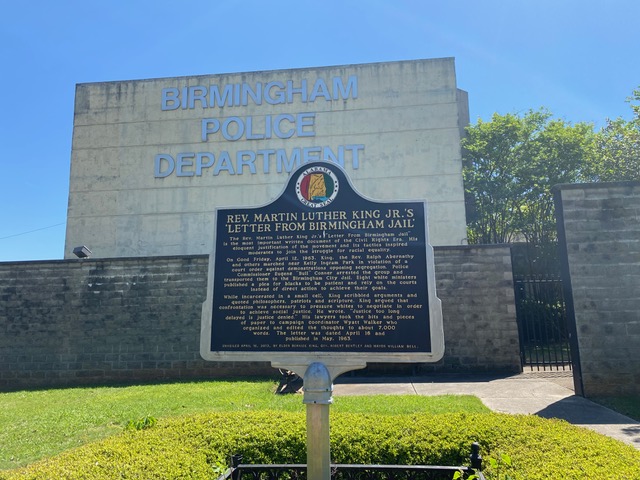
The Birmingham Police Department building and “Letter from a Birmingham Jail” Historical Marker in Alabama.
At its core, it’s plain that this order’s approach to history is itself ideological and partisan, but also comes with an implicit threat to disparage and punish with funding cuts and staff reductions those agencies and educators who do not agree with the prescribed view of American history. This full-throttle rejection of thoughtful and evidence-based research by trained historians rests on a laundry list of willful obfuscations: the authority of those whose lives have been impacted by larger historical trends and events; the ideas expressed in original historical documents and primary sources; laws enacted by those elected to represent our values and hopes; court decisions; and federal, state, and local policies. Importantly, in the wholesale rejection of these diverse viewpoints, the only-celebration approach to history sees as unpatriotic any attention to or study of how racism, exclusion, sexism, heteronormativity, and other barriers to the full participation of all American citizens in our democracy. It sends a loud and clear message that those who at various points in our history have been intentionally excluded still have no place in stories of American history and development. It turns a blind eye to truly noble efforts and struggles that have allowed us to advance so far as a nation, one in which we can be rightfully proud.
What many Americans see as noble efforts to tell more-inclusive stories are identified in recent orders as the “influence of a race-centered ideology” that is especially bad because it “portrays American and Western values as inherently harmful and oppressive.” One can certainly say that there have been some exhibits, lectures, books, particular students, or organizations that may espouse this view. But this is just one perspective in conversation with many others. As a longtime and avid reader, museum-goer, and professional scholar whose research, teaching, and personal interests lie mostly in the nineteenth and early-twentieth centuries, I can say with some confidence that a critical mass of African American appeals for freedom and justice have been based firmly in arguments that have their roots in Christian values and democratic principles as professed in the US Constitution and other literature of American democracy. While some particular exhibits may in some of our eyes “over-emphasize” passive victimhood at the expense of a focus on agency and self-determination, the diversity of perspectives and experiences is crucial to the substantive and inclusive conversations that we must have among and between communities to understand both our shared past and common future.
In a society that highly prizes individualism, the sin of United States racism has primarily been against the individual: for example, treating African Americans as if just because they were members of the “African,” “negroid,” “colored,” “Negro,” “Black” or “African American group” that they were inherently inferior. Less intelligent. Not suited for particular jobs. Not worthy of having access to education at the level that white and other groups had. To keep African Americans in an inferior position and to limit their access to educational, social, and job opportunities. To bar their full political participation as citizens of the United States. To prevent them from reaping the benefits of their tax dollars such as being able to attend state universities. The list goes on and on.
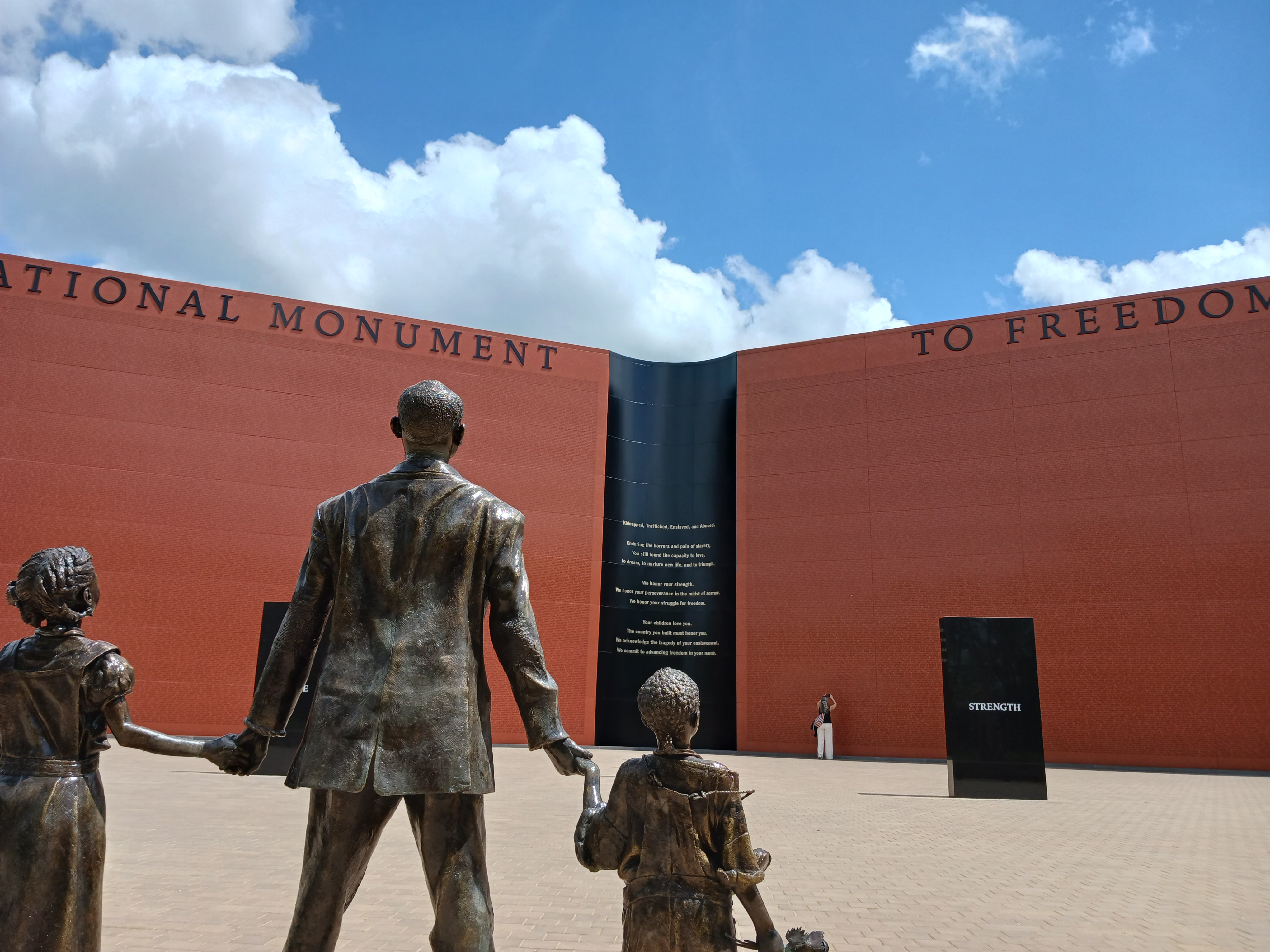
The National Monument to Freedom, a memorial in Montgomery, Alabama, lists the surnames of every individual who was freed from enslavement by the Thirteenth Amendment.
So it is no surprise that some Black Radical traditions—based on the evidence and consistency of discriminatory laws, actions, and teachings—may indeed agree with Thomas Jefferson and Marcus Garvey that it is impossible for free Black people to live alongside free white people in the United States because it is “inherently oppressive” (see Jefferson’s Notes on the State of Virginia, 1781 and Marcus Garvey’s “Africa for the Africans,” Negro World, 1922). But this should be a matter of informed debate that involves evaluation of the evidence on both sides of the argument, not a refusal to present the ideas of both white and Black advocates of segregation, “back to Africa” movements, or Black nationalism and other forms of government.
President Trump’s “Restoring Truth and Sanity to American History” actually advocates substituting one-sided partial stories and factually inaccurate claims for the tales of what real people lived through, and ideology for truth. Although the order makes the broad and vague claim that “Americans have witnessed a concerted and widespread effort to rewrite our Nation’s history, replacing objective truth with a distorted narrative driven by ideology,” this Executive Order is calling for the Smithsonian and other historical organizations and entities that present history to do exactly this.
Ideology—proper or improper—has no place in the study and sharing of historical knowledge. Genuine historical research—whether by a scholar or a family historian—is driven by questions, usually attempts to recover the significant unknown that has an impact on the present or to resolve an apparent paradox or contradiction in the evidence, such as how a brilliant man committed to democracy who believed that enslavement was contradictory to democratic values could be a slaveholder himself.
Our nation’s history is rich, complex, and still in the making. Different individuals are affected by different aspects of our shared history in multiple ways, depending on point of view, background, regional characteristics, class, and culture, to name but a few. It has unfolded over hundreds of years, influenced by peoples, explorations, and terrain that pre-existed the revolutionary war that set us free to create our own government and vision of citizenship.
Simplifying complicated stories to erase unpleasant truths and excluding people or factors because you don’t like them is propaganda, not history. Propaganda fears the truth. It is a tool wielded by those who want to hold on to their own power and privilege at all costs because at root they feel their actions and values could not support the scrutiny of truth. All ideologies work against truth, which is messy and complicated, because they try to wedge it into a neat, simplistic story that fits current political needs. Replacing what the Executive Order refers to as “improper partisan ideology” with “proper partisan ideology” is inconsistent with traditional American democratic values and principles. The current administration sees any dissent or divergence of opinion from its own as unpatriotic and perhaps even criminal, and so seeks to silence, erase, discredit and threaten those who disagree, rather than engage in respectful and fact-based debate.
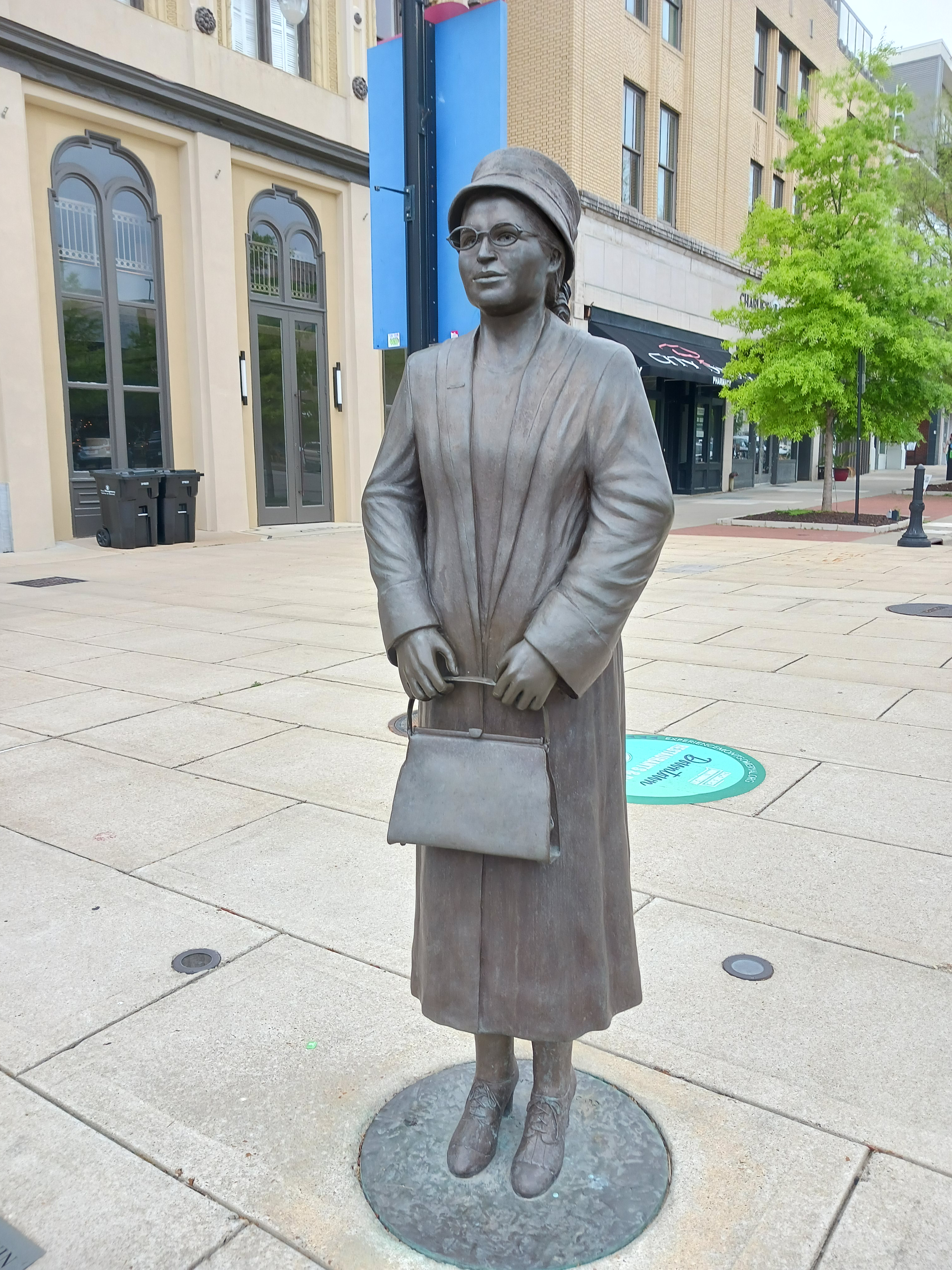
A statue of Rosa Parks in downtown Montgomery, Alabama, commemorating the spot where she was arrested for refusing to surrender her seat to a white woman.
Communications from the Administration often target Black or African American-related people and activities as egregious examples of demands to include historically oppressed and excluded communities. It is an indisputable fact that for the vast majority of our nation’s existence, local governments, state governments, and the federal government created a series of laws in just about every realm of civic and social life to constrain the freedom and liberty of African Americans. The vast majority of schools in the United States until the last three decades of the twentieth century were formally and informally segregated according to race, and not because non-white people preferred this arrangement. This changed in a major way only in the last sixty to seventy years with laws such as the Voting Rights Act and educational institutions’ efforts to develop curricula that included the experiences of women, LGBTQ+, and non-white people. If this isn’t an example that “[s]ocieties including the United States have used race to establish and maintain systems of power, privilege, and disenfranchisement,” then what is?
The fact—and it is a historical fact—that African Americans have been struggling to be free and fully participating citizens in the United States against what might seem an overwhelming combination of laws, social practices, economic exploitation, and government barriers to education makes the story of African American liberation and triumph over the odds even more impressive. Of course, it took years and years. Of course, there was backlash along the way. Of course, African Americans worked with Americans of many different backgrounds who shared their vision of a true and inclusive democracy that gave all Americans respect, opportunities, and the ability to be judged on their individual talents, aspirations, and pursuit of happiness. White women in the North played a significant role in helping Black abolitionists reach wide audiences and bring an end to chattel slavery. During the twentieth-century Civil Rights Movement, people of faith—including many white ministers, pastors, and Jewish rabbis—travelled to southern states to fight racial segregation. White and Jewish college students were incensed by the unfairness and injustice they learned about and risked their lives to fight for voting rights and an end to discrimination both in the North and South. What a testament to faith in American democracy that they felt it their duty as citizens to ensure that all Americans enjoyed the respect and fruits of citizenship! Their efforts were met with violence by white supremacists who at the time held all the political and social power. But the activists’ courage and patriotism led them to persevere.
The claim in this order and other statements from the government that the US record of progress on the racial front has been “consistent” and “unmatched [in its] record of advancing liberty, prosperity and human flourishing” is simply not true. Basic human and civil rights were hard won for many Americans. To truly be able to marvel at and celebrate the courage, persistence, faith, and risk taken by those who wanted to see democratic principles put into practice in the United States, we have to know what they were fighting against and that the majority of powerful white Americans for many years resisted these demands for fairness and fought back with laws, violence, and social exclusion. True American democratic ideals did not always prevail, and often took generations to be realized.
This goes for describing freedom struggles of all groups and individuals: the Norwegians’ patience in coaxing dry and wild plains into productive farms; the Chinese in California and elsewhere using community resources and meager earnings from excruciating physical labor to build economically and culturally thriving Chinatowns; the fur-trappers from many backgrounds who married into the communities of their trading partners; the variety of people of different classes, national origins, and genders who set out in ships, canoes, covered wagons, military caravans, and on foot not knowing what they would find in two months or two years. To only celebrate the happy endings while forbidding talk of the journeys or not sharing what they were liberating themselves FROM makes these celebrations ultimately disrespectful and superficial. Freedom is precious, and often, attaining it demands much of our nation.
Personally, my respect for Thomas Jefferson’s genius is enhanced by knowing that he wasn’t a saint, but a highly intelligent person committed to democracy but who also profited directly from living in and promoting a slavocracy. He actually struggled to make sense of his conflicting ideas that all human beings deserved to be free but that African-descended people could not coexist in a democracy with white people. History is a discipline based on evidence and arguments for how that evidence could be interpreted given particular questions we have about who we are as a nation or evolving socio-cultural, political, and economic contexts. Ideology, be it “proper” or “improper,” has no role in historical research and presentation. However, as human beings, the questions that we ask and the topics that interest us are inflected by our values, individual and collective, and there is nothing wrong with that as long as we maintain a free, uncensored marketplace of ideas where people can evaluate arguments and the evidence used to support them for themselves. Suppressing certain topics, arguments, and ideas that meet disciplinary standards is antithetical not only to intellectual freedom but to democratic principles.
Narratives of the struggle for liberation and freedom unite us as Americans. Erasure, silencing, and contempt divide us. Conversations based on evidence and due respect to varying experiences and perspectives will help us articulate our shared values, and allow all to play a part in supporting and advocating for not only preservation of our common past but understanding how it relates to our present and future as Americans. It is our responsibility as citizens of this great and unprecedented democratic experiment to know our history and integrate it into the role that we each play in constructing a “more perfect Union,” and a future in which all have the opportunity to thrive. The study and presentation of US history should inspire questions, reflection, and conversation; open doors rather than close them; foreground and work through paradoxes and contradictions rather than pretend that they don’t exist; and include all of our experiences and dreams.