
 Membership
 Donate
 Shop
Shop






















A Reverend Reflects
Remarks for the 2025 Amache Memorial Service.
Editor’s note: Reverend Brian Lee gave these remarks at Amache National Historic Site near Granada, Colorado, on May 17, 2025. The Reverend was addressing an annual gathering and ceremony commemorating the history of those of Japanese Americans illegally imprisoned at Amache, also known as the Granada Relocation Center, during World War II.
In the Hebrew Bible, or the Old Testament to Christians, there are stories of significant places being marked with stones to help future generations remember God's presence and faithfulness. After crossing the Jordan River into freedom, the Hebrew people were commanded to take twelve stones from the riverbed and set them up as a memorial, and they were given a way to remember in the form of a child’s question to their parent - What do these stones mean to you?
The question is an invitation for the parent to tell their story to their child or to recount the stories from grandparents, aunties, or uncles of what happened. Talking story brings the past to the present, and it shows that it is still shaping us now.
Today, we are here to answer the question, what does this place mean to you?
For some of us, this means telling the memories of what happened here. For some of us, it will be recounting the stories from grandparents, parents, uncles, aunties, mentors, or friends. For some of us, today will be a day of being like a child asking the question and listening.
Friends, we live in a time when suppression and erasure are very real threats. There are those in power who would outright lie or, worse, tell partial-truths to excuse injustice and harm. Now, more than ever, we need to tell the world the stories of what Amache means to us. We need to tell stories of not only perseverance and resilience, but also the stories of wounds and brokenness that never healed.
Today, as we remember, turn to your fellow pilgrims and ask one another, what does Amache mean to you?
As we gather once more on this sacred ground—drawn here year after year by memory, by grief, and by love—we come to honor the lives that were uprooted, to name the injustice that was done, and to speak truth in the face of silence. Again and again, we feel compelled to gather—not only to remember what happened here, but to learn from it. As we begin, we pay tribute to those who endured this place: who lived through dark years with quiet courage, who built community from exile, and who found a way to care for another with dignity and resolve.
May the stories shared, the footsteps retraced, and the memories rekindled stir within us a deeper commitment to justice. Let our hearts be open to the lessons of this place—lessons of resilience, of the harm caused by fear and prejudice, and of the healing that comes through remembrance and truth-telling.
Today, we wish blessings upon the survivors, their descendants, and all the pilgrims present today and in the past. We are reminded that the work of memory is sacred, that honoring the past is part of shaping a better future. We renew old friendships and make space for new relationships to take root. Let this be a time of connection, of storytelling, of learning, and of hope. And may all that we do here today plant seeds of compassion and courage in us all.
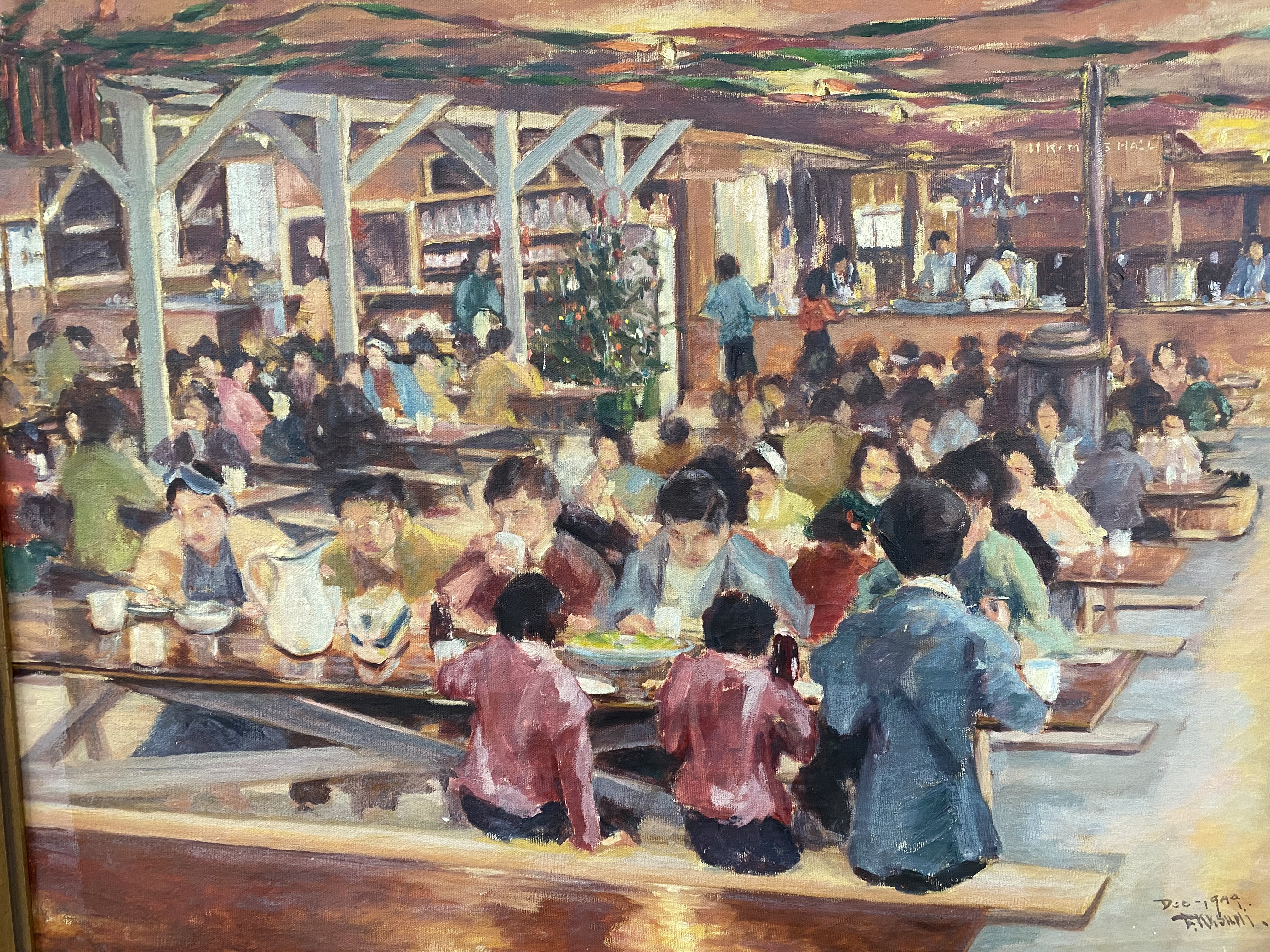
Amache Mess Hall, by Fukunosuke Kusumi (1894–1973), watercolor on paper.