
 Membership
 Donate
 Shop
Shop
















Out of the Closet and Into the Mountains
How lesbian feminists fostered women’s community in twentieth-century Colorado.
Editor's note: This article was adapted for The Colorado Magazine from an essay submitted to the Emerging Historians Award contest, a program of History Colorado’s State Historian’s Council.
In the 1978 issue of Denver newsletter, Gaynin’, written by and for Colorado’s gay community, Tea Schook wrote, “There are many lesbians, notably feminist, who feel uncomfortable and excluded by the term ‘Gay.’” Gay liberation. Gay community. Gay politics. Gay bars. The word gay and its connotation to male homosexuals pervaded the homophile movement and often excluded lesbians from the community. Within the liberation movements of the 1960s, many lesbians were left out of so-called gay issues; gay men focused on sexual liberation, but many lesbians saw this a heteronormative ideology. Under the guise of the second wave feminist movement, women knew they were not sexually liberated in the same way a man would be. Women’s sexuality was defined and built by straight men; moving into the 1970s, women began to create their own definitions. Publications and newsletters that revolved around the gay community often ignored the needs of women, and instead focused on gay erotica, personal ads, and male issues. In an effort to distinguish themselves from the male-centered gay community, lesbians often aligned with women’s movements instead, highlighting lesbianism as an integral part of the female experience and resistance to patriarchal expectations.
The intertwining of lesbians and feminists created a new idea of what was allowed for women during the late twentieth century, and this new idea of an independent, sexual, and intelligent woman was sustained largely through media. With the connection to the women’s movement, Colorado women fortified the idea of a political lesbian, or lesbian feminist, adapting the definition of lesbian to center on any love between women. Historian Lillian Faderman and lesbian feminist Adrienne Rich have contributed to the changing identity of lesbians, their definitions help to examine the lifestyle of Colorado women and highlight the significance of the lesbian feminist culture. Women-centric publications like Big Mama Rag (BMR) included monthly calendars inside their issues for Colorado women to feel a part of a statewide women’s community, even for women outside of major big cities. Lesbian-centric publications like the Double Standard often ran issues dedicated to lesbian feminist news and featured segments from Colorado women’s organizations like the Outdoor Women’s Group or the Dykes of Estes (DOE), to build the connection between women’s culture and lesbian culture while emphasizing community-building activities and outdoor recreation.
First issue of Big Mama Rag, a feminist newspaper, is founded in 1972.
In fact, lesbians in Colorado became almost synonymous with outdoor recreation in the late 1970s to mid-1980s. Colorado lesbian feminist publications almost always included event programming that strayed away from the typical gay bar scene, instead highlighting age-inclusive environments. Colorado gay publications often ran advertisements for popular gaybars, nightlife, and personal ads, as did many urban-located lesbian publications. But more commonly, Colorado lesbian feminist publications centered around picnics, dance parties for young lesbians, and summer events with free childcare. This inclusivity allowed for more alignment with women’s movements and created a lesbian community that was less sexuality-based and open to more groups of women than many bar-oriented scenes like New York or San Francisco.
Nationally, the lesbian and gay community is largely known through their urban lifestyles, hidden in dangerous bars and supplemented with a never-ending stream of liquid courage, but non-urban communities are often ignored from national gay organizations. Throughout the 1970s, Colorado lesbians were supported by a network of women and created a community that used their geographical location to their advantage. The gay community of Colorado often failed to account for lesbian needs, forcing lesbians to make space for themselves within the women’s movement. Lesbian feminists of Colorado used media and women-centric publications to create a statewide community, regardless of proximity to major cities. Fueled by the radical social change of the 1960s, Colorado lesbian feminists formed an inclusive, often anti-bar space, nourished with regular social events and outdoor recreation.
“Bend over and take it like a man!”
The Mattachine Society, the national homophile organization for gay men, was having its Sixth Annual Convention in Denver in 1959. National president, Hal Call, stood above the bustling crowd of men to invite Del Martin, president of the lesbian homophile movement, Daughters of Blitis (DOB), onto the stage and into their movement. Fighting against the merging of DOB and the Mattachine Society, Del Martin took over the podium and issued a call to action: “Lesbians are women, and this twentieth century is the era of emancipation of women. Lesbians are not satisfied to be auxiliary members or second-class homosexuals.” Even with the second wave of feminism being years away, Del Martin’s words were a harbinger of a deepening schism between gays and lesbians across the nation.
Gay liberation groups and popular gay movements prioritized gay males and often revolved around male issues. Lesbians were excluded among gay bars, sex-centered culture, and differences of ideology. Gay bars, which were a major place of connection for gays in large cities, did not always play the same key role in community for gays out west. Although many gay bars existed, most were frequented by gay males and lacked space for lesbians. Gay publications served as hotspots of connection for the gay community, both men and women. However, popular Colorado-based gay magazines, like Out Front, catered to gay males with erotica, male-centric political op-eds, and even explicit classified ads. Lesbians who subscribed to these magazines and newsletters could be greeted by gay bar advertisements, drag show schedules, or male personal ads calling to “TRY DENVER’S LARGEST!” for men “Seeking... HOT, sweaty sex,” or wanting to “Bend over and take it like a man!” for thirty dollars an hour.
If lesbians got lucky, sometimes these magazines or newsletters would set aside a single page for them in the full twenty-page spread. This page would often include mental health services, hair and salon services, and “Lisa’s Recorded Love Stories,” where she would “whisper sweet nothings in your ear.” Even Colorado-based publications committed to gay healthy living, like Quest, would center male homosexuals, with lists of male recreational activities and ads like “Dial-a-Hunk” included within the issue. The heavy focus on erotica and sex was an act of male chauvinism and exclusion of lesbians. Lesbians as women could not gleefully partake in the “male-defined” sexual revolution. Lesbians started to distance themselves from a lesbian-gay alliance, and instead sought to align themselves with the women’s movement, which was increasingly radicalizing through the 1960s and well into the 1970s.
Meanwhile, "second wave" feminism was rapidly being saturated by “The Lavender Menace,” as Betty Friedan infamously called the lesbian feminists within the movement. Lesbianism had not only grown from the consciousness-raising, free love movement of the hippies, but also in part as a political tactic by feminists. Lesbian feminsit activist Adrienne Rich described the effects of patriarchal influence on lesbian culture, calling out the “violent, self-destructive world of gay bars,” and the ways in which lesbians have been erased from history. Stuck in between two male-centered worlds, the gay community and heterosexual society, lesbians struggled to exist without being perceived as the foil to the straight woman or imitation of the gay male. The so-called sexual revolution worked as a column of support for the patriarchy, and popularized unsafe and sadomasochistic sex, pornography, and sexual promiscuity. Women were still beholden to expectations of the times, and were constantly grappling with sexism; porn, promiscuity, and prostitution all served men, while aiding women’s public humiliation and degradation.
In this context, lesbian feminist publications served as the glue to strengthen the movement and spread word across America, and even more localized, across the state. These lesbian feminist publications often used language as a tool to decenter maleness, like changing “woman” to “wimmin,” “womyn,” or “womben,” and reclaimment of the word “dyke.” Decentering maleness was foundational to creating a women’s space. Many of the lesbian feminist publications in Colorado not only used these language interventions, but also ran ads exclusively for women. Lesbian feminists across Colorado were trying to bridge the gap between heterosexual women and lesbians, starting with the easily accessible newspaper, magazines, and newsletters. All the answers to lesbianism, compulsory heterosexuality, and women’s community could be delivered right to your doorstep.
“We’re not gay, we’re angry!”
Out of a basement on Gaylord Street in Denver, Colorado, and into the homes of women all over the state, the lesbian newspaper Big Mama Rag was a point of connection for lesbian feminists. Some of the women who founded the paper were lesbian feminist themselves, like Chocolate Waters or Tea Schook and would often write poetry, columns, and op-eds revolving around lesbians. In BMR’s first issue in 1973 there was a dedication for the women readers with, “Our hope is that the feelings expressed through Big Mama Rag will relate to the feelings of all women everywhere.” Several issues of the newspaper focused on feminism and lesbians. Enfolded in one special, summer issue, “We’re not gay, we’re angry,” there was an interview with lesbian feminist, Del Martin. In her interview, Martin poses the concept of lesbian feminists as crucial to the movement and to lesbians' own self-liberation. For women to truly begin to question patriarchy, they must understand the lesbian lifestyle which decenters men and finds love, compassion, and even sex with another woman. In the midst of the political pieces and detailed, first-person accounts of protests, a woman saw a 1974 poem by Chocolate Waters, reading:
“She died to live she
lived to die she
died inside him where she lived
so long dying
TO GET OUT!”
This poem was like a call to action for some women, especially those feeling lost in their heterosexual partnerships. Instead of feeling stuck, these women could look at Waters and her life as an out lesbian woman and feminist, and know that they too can leave the man behind to focus on the woman within.
Much of the BMR content urged women to get out (of unhealthy relationships with men), and come out (of the closet). But not every woman reading or buying or even writing to the paper was a lesbian. In the 1973 “Ask a Lez” column, one woman wrote asking for advice about her sexuality, the “Lez,” Aggie, answered back in good humor, writing, “What you could have is heterosexuality and it afflicts many members of our society.” Colorado women with such afflictions did not have to worry, BMR strove for inclusivity within women’s culture. A woman picking up her copy of BMR could thumb through the pages and find ads for consciousness-raising sessions or self-defense classes for women. Although Big Mama Rag ran ads for bars, primarily lesbian bars or those deemed lesbian-friendly, a woman would be much more likely to spot an ad for a women’s health clinic or support group.
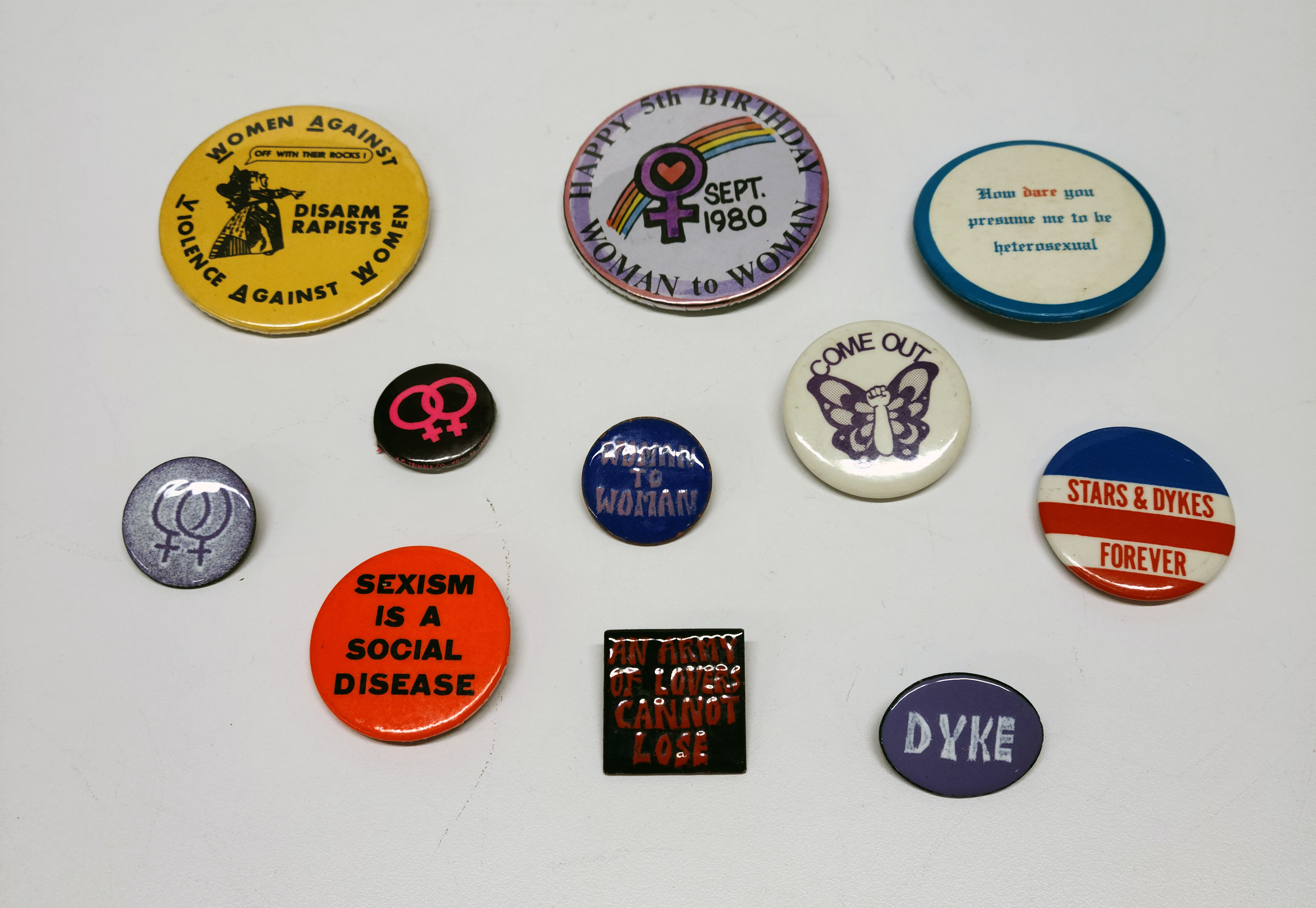
Vicki Piotter, who operated Woman to Woman Feminist Bookcenter and was involved with Big Mama Rag, a feminist newspaper, donated these buttons to History Colorado.
Writing to emphasize inclusivity amidst class differences, a 1979 volume of BMR ran a “Feminist Calendar” promoting the Denver Women’s Health Care Clinic, which advertised that “No woman turned away for lack of funds.” The focus on healthcare meant different things for different women; BMR also included LUNA meetings in Denver, which was a “feminist support group for lesbian alcoholics.” Lesbians and alcoholism was a repeated narrative in lesbian feminist publications, and founder and staff writer Chocolate Waters utilized her position to write about “the trouble” of women’s bars, focusing on the dangers that are presented at women’s or lesbian bars. Lurking within these Greyhound bathroom-sized bars were bad drinks, ex-girlfriends, straight couples, and even a “token policewoman who’s probably a dyke herself but wants to haul you in just to prove she’s not.” Many lesbians joined the backlash against bars, primarily butch women who could be put in unsafe situations just based on their appearance. Similarly, Black lesbians also found it more difficult to enjoy bar culture as Black women were at a higher risk of refusal of entry, physical altercations, and arrests. This shift of focus from bars to bars’ baggage became a norm in lesbian feminist publications, especially in BMR which would continue to prioritize women’s health and include lesbian alcoholism support group forms in issues going into the 1980s.
Bar culture was burning out in Colorado come the early 1980s. Instead of women finding community in the ill-lit nightclubs of downtown Denver, women found themselves at the forefront of various support groups. Double Standard, a newspaper for Colorado lesbians, replicated the same anti-bar politics of BMR. Each monthly issue of the Double Standard carried a calendar containing support groups like CHOICES, The Group, and even Brown Bag Reader’s Theatre, a lesbian theater troupe centered around lesbian alcoholism. The turn from bar culture was seen by the large number of women who expelled themselves from that narrative. Many lesbians saw bar and alcohol culture as contributors of shame; instead of being out and proud, they were stuck in a cycle of “just one drink, then I can socialize.” Often, lesbians found themselves out of the closet and into the bottle, using alcohol to cope with the hardships of living outside of a heteronormative, patriarchal lifestyle. Throughout the 1980s, the number of support groups geared toward mothers (specifically lesbian mothers) grew steadily. Lesbian Mother’s Support Group, Motherlode, and the Boulder Lesbian Mother Group were all meeting frequently, sometimes even multiple times a month. Colorado was distinct in its focus on later-in-life lesbians, or “vintage” lesbians, who most likely already had kids before they came out. Support groups reached out, holding joint meetings or even planning dances, picnics, and events to foster an age-inclusive atmosphere. Instead of being forced into bars or into hiring babysitters, Colorado lesbians moved outward.
“Amazon nation out here in the mountains”
Rejecting bar culture, Colorado lesbians moved out of the closet and into the mountains, creating community with women away from the rest of patriarchal civilization. The Boulder Lesbian Network (BLN) newsletter published monthly events and group meetings in its issues, writing that groups are a “valid structure for giving lesbians support–emotional and social support…” Not only did this mean support groups but also the plethora of sports clubs and outdoor recreational clubs. A monthly calendar from the BLN would contain a softball schedule for games at North Boulder Park and different picnic celebrations, with childcare included. BMR was often in the same field, showcasing outdoor events like summer solstice celebrations, motorcycle trips, and the varied hikes offered year round. Summer solstice events took place in a range of locations depending on that year’s planning and events varied year by year, however one thing remained the same: absence of men. Advertised as an “Amazon nation out here in the mountains,” summer solstice celebrations were full of women and children living together without patriarchal inclusion. Most summer solstice events, if not all, offered picnics, consciousness raising sessions, and more importantly, free childcare. BMR even highlighted outdoor events going on outside of Colorado, for women readers beyond state lines, or those who may want a change of pace. In a 1977 issue, BMR recommended its readers head to Athol, New York, to experience “A Woman’s Place” with workshops, classes, and outdoor living, or even Tishommingo, Oklahoma, where “women who want to work with other women in farming, general growing, and recreation” could thrive. Big Mama Rag solidified the nature of their audience; women who were wanting to work, play, and love with other women, whether it be inherently sexual or not. These women sought each other out both through media and newspaper communications, but primarily through event programming. Plenty of these kinds of events, large-scale and outdoor, took place in Colorado, along with smaller and more consistent events.
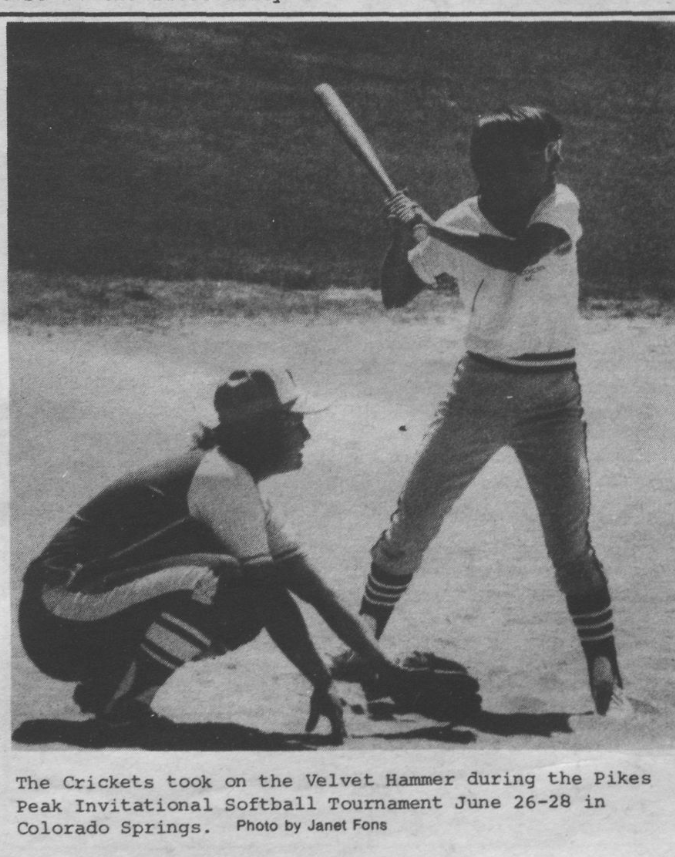
Newspaper photo of two women on the women's team The Crickets playing baseball.
Moving into the 1980s, Colorado lesbian feminists created their own women’s communities. Whether it be for the weekend or longer, women attempted to create close-knit relationships through these recreational outdoor events. In 1981, The First Annual End of Summer Colorado Lesbian Dance and Moonlight Celebration was held in Eldorado Springs by Double Standard and Sage Productions. The event aimed to draw in women from across the state and rented out the entire resort and campsites, hoping women from outside the major cities would “make a weekend out of it.” The two organizations also provided free childcare, a call to the many lesbian feminist mothers within the Colorado community. Other women attempted to create female-separatist communities for women to enjoy for extended periods of time. In 1981, two Colorado lesbian feminists, Betty Danko and Ann Morrow, bought about 130 acres of “mountain land” bordering Pike National Forest and planned to cultivate it into a “secluded educational, recreational retreat for women.” As a result, Womanventure Ranch was created as a space for women to be free and exist within nature, particularly as a place to practice new skills and learn from one another. Women were also encouraged to bring their children with them on the adventure. On top of owning the ranch, Danko and Morrow worked in Denver at their individual psychotherapy practices with the Feminist Counseling Collective.
In a similar vein of interest, the Dykes of Estes, or DOE, also frequently advertised for women to come visit the Rocky Mountain National Park. Their mission was to “organize meaningful women’s tours of the Rockies for our visitors.” DOE often wrote “Mountain Musings” for Double Standard and often included a callout for any woman interested in visiting, or living in the area, to join in on any DOE activity. Typical DOE activities would be hiking, fishing, and skiing in the Rockies; some of the “Mountain Musings” would share DOE opinions on recent films, or even the activities of recent guests. DOE reflected the Colorado lesbian alignment with the women’s community in their musings.
“Experiencing Mother Nature on her own terms”
“As the snow melts in the high country and wildflowers begin to appear on Mountain slopes, the Dykes of Estes continue to enjoy a variety of events,” read one of the “Mountain Musings” from 1981. DOE mused about hiking in the park, moon celebrations, “slumber” parties with friends from Fort Collins, and even the possibility of an “ancient matriarchal society of mountain women.” Dykes of Estes aimed to have a far reach, even outside of Colorado, and made attempts to draw in visitors as well as educate and entertain their audience. The next event listed was a visit from Boulder women and children to learn about DOE history, then head to Sprague Lake for a trail hike, which they acknowledged was “designed for handicapped visitors and is wheelchair accessible.” In a later musing, DOE cheerfully reported that they could no longer carpool in one car, instead they were searching for a bus to fit their growing population. Women were excited to join a community centered around women, even if just for a short period of time. And DOE was equally excited to welcome guests, provide an inclusive atmosphere, and revel in the beauty of nature.
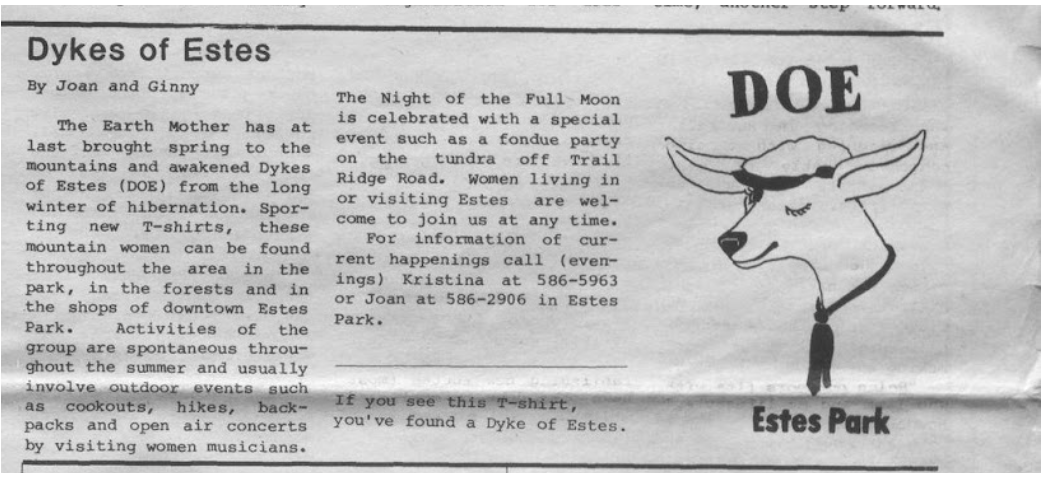
Dykes of Estes’ (DOE) “Mountain Musings” feature in Double Standard. (June, 1981)
Even though the Dykes of Estes had open arms for visitors coming in from outside Colorado, they consistently reinforced ideas of a Colorado women’s community. In one 1981 Double Standard issue, DOE wrote that they had gathered “almost all of our (known) dyke population,” and mentioned how they had worked to improve local cabins in the area with outdoor work like roof repair, gardening, and even paint jobs; they also mention that they welcome “spur-of-the-moment” events like picnics, barbeques, or “homemade ice cream parties.” In this column, DOE welcomed all the women in the area and stated who to call if they would like to be included in their “spontaneous get-togethers.” Women living in Colorado and reading Double Standard could call and arrange for a lesbian-led tour of the Rockies, inclusion in outdoor recreational activities, and mingle with a local group of women. One woman who did travel and meet with DOE wrote that it was a “delightful time,” and “to share good experiences of mountain women and the scenes of Rocky Mountain National Park.” Dykes of Estes utilized the widespread reach of lesbian feminist newspaper publications to invite women (and their children) into Rocky Mountain National Park to enjoy nature, recreational activity, and women’s company. Other Colorado-based groups similarly advertised their events, groups, and outdoor activities through lesbian feminist publications, particularly Double Standard.
Women’s clubs and organizations allowed women and lesbians in Colorado to look forward to outdoor recreation no matter the season. Big Mama Rag advertised overnight cross-country skiing at Duck Lake in January, or even a bicycle tour of South Denver in May. Some of these adventures were short day hikes, but others were longer and more strenuous in activity, like the two-week-long “All Women’s Canoe Trip” to the Canadian water boundary, sponsored by the Women’s Outdoor Club of Colorado. Many of these outdoor events were put on with or by the Women’s Outdoor Club, especially those advertised by Double Standard, the newspapers for Colorado lesbians. In a partnership with the newspaper, the Women’s Outdoor Club had frequent mention in their monthly Colorado Calendar. Whether it be a backpacking trip to Loch Vale in the Rocky Mountain National Park, birdwatching in Denver, or a bicycle trip to Cherry Creek Reservoir, the Women’s Outdoor Club would often be in attendance. Other clubs gained prominence through the newspaper too. The Amazon Adventures, a group of women, predominantly lesbians, participated in various hikes throughout the month, mostly in the warmer weather seasons, but the Women’s Outdoor Club operated year-round. The Women’s Outdoor Club held regular meetings and an array of activities, often making sure to include accessible events like picnics or easier hiking trails, sometimes even scheduling strolls in their monthly events list. Even those who were not athletic could enjoy outdoor leisure. Because of meeting places, carpooling, and even busing, women in Colorado had ways to access their natural environment, and form close bonds with other women along the way.
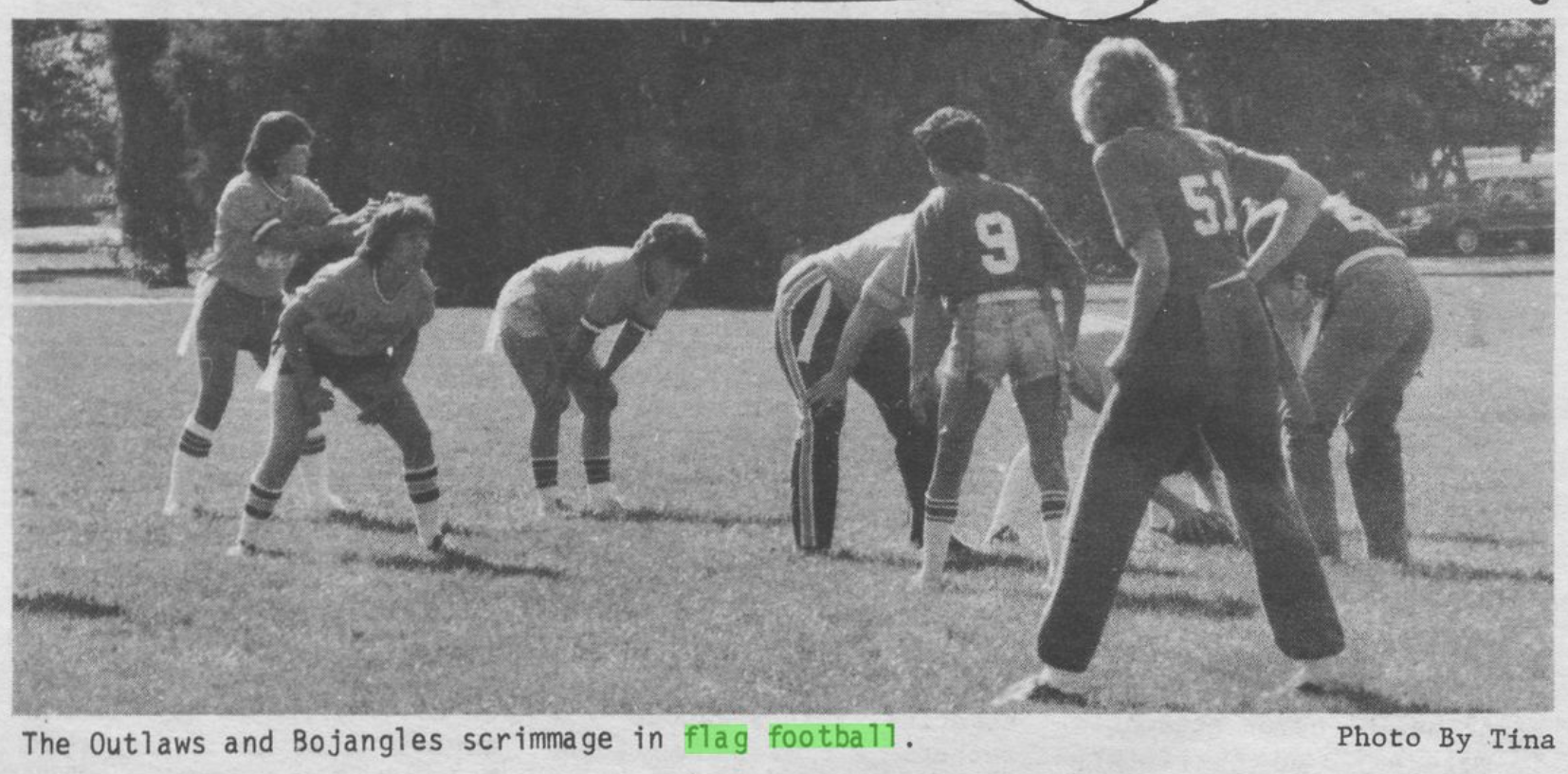
Women's teams The Outlaws and The Bojangles facing off in a flag football scrimmage.
“Worried Well: men and women who feel the AIDS crisis has affected their lives”
Throughout the late 1970s and early 1980s, Colorado lesbian feminists had been growing interested in physical health. Whether this be through women’s clinics, environmental protection, or a nature-based style of living, lesbians in Colorado were concerned with health and wellness. Not just in Colorado but across the nation ecofeminism had been a large movement for women. There was an increased awareness of health as a political issue and lesbian feminists often urged gay men and women to see their physical wellbeing as a political discussion and not a medical one. Many historians and scholars of sexuality have studied the lesbian feminist response to the AIDS crisis, and the overall consensus is that lesbians often took on caretaking roles for gay men. Groups like the San Diego Blood Sisters or the Lesbian and Gay Switchboard, which published articles throughout the 1980s and ’90s to remind lesbians that “low risk isn't no risk,” worked to unite lesbians and gays through a mutual focus on AIDS. Lesbian feminists used their newfound health focus and stepped into caretaking roles by organizing blood drives, candlelight vigils, and realigned themselves in the gay and lesbian liberation movement.
Although the term lesbian feminist matched the description of these women, the AIDS crisis caused a schism in the feminist community where many feminists did not see AIDS as a women’s issue. Many lesbians became less involved in the feminist movement during their realignment with gay liberation. Historian Annelise Orleck framed the founding of Aids Coalition to Unleash Power (ACT-UP) in New York as a major part of lesbian activism in the 1980s. Lesbian feminist mistrust of masculinized medical science helped to further their work in the AIDS crisis. The women of the group held protests across New York City to dispel the myth that women are not impacted by AIDS; they passed out pamphlets, distributed condoms, and promoted sex education. The women’s previous roles as mobilizers and political leaders in the feminist movement made lesbians powerful allies for gay men. Most research on lesbians involvement in the AIDS crisis has focused on major cities, like New York and San Francisco. However, there is evidence of lesbians shift to gay liberation during the AIDS crisis in Colorado through local publications. Denver lesbians were quick to offer support and activism to the gay community in the 1980s.
Colorado-based publications BMR and Double Standard ventured into different directions during the mid-1980s. BMR continued to support feminism and reported activities for the women's community, often with a more intersectional focus to include women of color and women abroad. However, Double Standard became much more heavily involved in Colorado's gay and lesbian community, often advertising events for both men and women during the mid-1980s compared to the women-centric focus in the early 1980s. In October of 1983 Double Standard advertised a Denver-based candlelight vigil for AIDS awareness. The vigil was organized by the Colorado AIDS Project, which Double Standard partnered up with several times over the course of the 1980s. Earlier that year in August Double Standard, the Colorado AIDS Project, and the Gay and Lesbian Community Center of Colorado organized an auction to raise money for the center. This was the second auction, the first had made over $5,000, and now the community hoped for more funding to “hire a part-time employee to enlist volunteers to provide in-service training for local hospitals, to coordinate various support groups, and to provide media education.” An AIDS beer bust benefit was thrown during Gay and Lesbian Freedom Week and the Gay and Lesbian Community Center of Colorado (GLCCC) sponsored an AIDS forum during the week. GLCCC was frequently advertised and mentioned in Double Standard. Similar to the bookstores like Woman to Woman or Lilith in the 1970s, GLCCC became a hotspot for support groups, workshops, and community meetings.
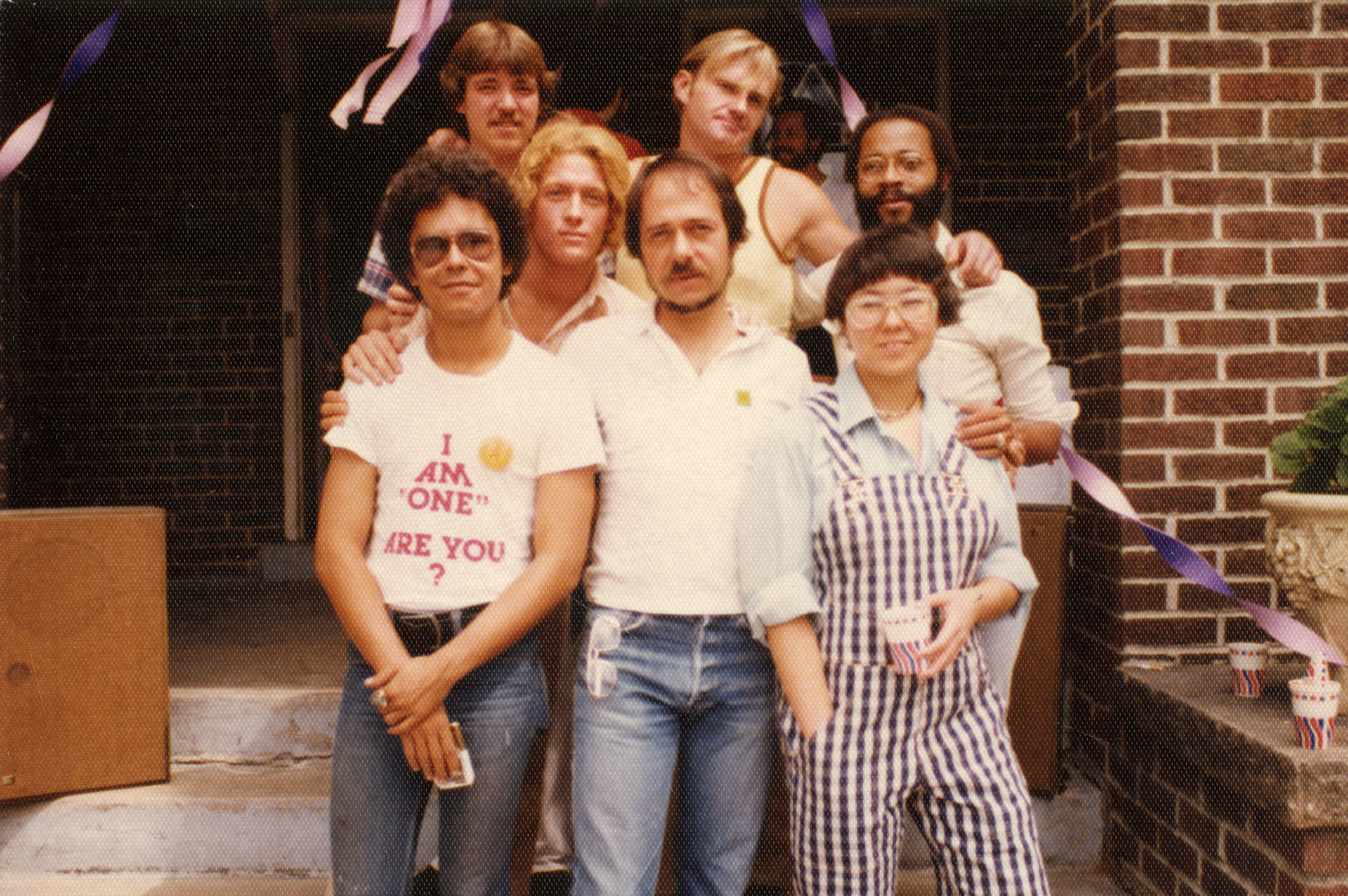
The Gay and Lesbian Community Center’s inaugural board members at their Capitol Hill building in 1977.
Double Standard advertised the GLCCC all throughout 1984. Sponsored by the Colorado AIDS Project, GLCCC hosted Worried Well, a “support group for men and women who feel the AIDS crisis has affected their lives.” The GLCCC also hosted support groups that were women-only, such as Vintage or CHOICES. Vintage was a support group for older lesbians to meet and talk; CHOICES was an alternative to AA for women who struggled with alcohol abuse. Lesbian feminists were prominent leaders in the GLCCC as board members, staffers on their newsletter, or simply as community mobilizers. Events advertised by Double Standard continued to center around outdoor recreation, but the lesbian community had begun welcoming gay men to these events. From 1982 to 1984, there were about 30 events of outdoor recreation advertised in Colorado-based publications for both gay men and women. Colorado’s Gay & Lesbican Newsletter (CG&LN) and Gaynin’ advertised bike trips, photo excursions at Denver’s botanical gardens, and “a ski tour to Saints Johns - an historic mining camp.”
Big Mama Rag and Double Standard continued to advertise and sponsor women-only, feminist events, but more and more events were centered around the gay and lesbian community. During Gay Pride Week in 1984, which had been named Gay and Lesbian Freedom week in the 1970s, GLCCC had a number of events advertised in Double Standard’s monthly calendar. One event, called “Picnic in the Park,” was advertised to be held at Cheesman Park in Denver. The advertisement called for attendees to “bring a dish.” This 1984 community picnic shows Colorado lesbian feminists' gradual move from feminism to gay liberation. Colorado lesbians began joining and endorsing gay organizations, while feminist business and centers continued to face financial struggles throughout the 1980s. Lesbians shifted their mobilization efforts from feminism to gay liberation, and their support for the second wave of feminism waned throughout the late 1980s. By the end of the decade the third wave was emerging, and these feminists would begin to focus on the perceived shortcomings of the second wave.
Even with these seemingly shortcomings of second wave feminism, women across the nation were focused on women’s liberation. Colorado lesbian feminists are a great example of community mobilizers and creators of identity culture. Colorado lesbians fostered a woman-centric community, regardless of sexual orientation, providing safe spaces for women-identified women to have fun together. There is a lot to be learned from studying the pioneering feminists who came before us, and I speak of myself as a new generation of feminist. Women’s liberation is no easy task, but it can be made easier when there is a support system to lean on. Colorado women were committed to providing this support. In this twentieth century women’s community, women prioritized each other politically and socially, using recreation as a form of political resistance.
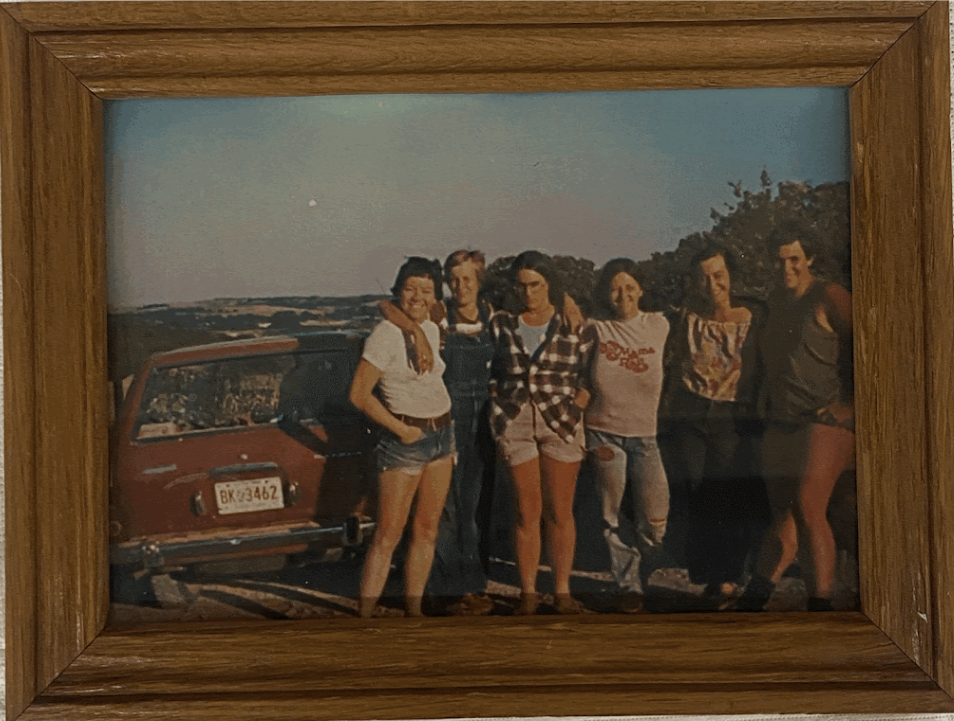
A 1975 photo of a group of “Denver Feminists” on the way to a Women in Print Conference in Nebraska. Pictured, left to right, Eileen Bresnahan, Katie Sharp, Tea Schook, Vicki Piotter, Pet Rapp, and Clair Strann.