
 Membership
 Donate
 Shop
Shop




















The Folly and Fate of the Solid Muldoon
Mystery swirled around the discovery of a petrified giant, but was it the find of a lifetime or the greatest fake of its age?
William Conant seemingly unearthed a marvel in September 1877. While searching for fossils near Beulah, Colorado, Conant had stopped for lunch when his attention was attracted by curious-looking stones protruding like toes from the ground. As he cleared away the dirt, he exposed what resembled a human foot, thirteen inches long. Further digging uncovered an entire human figure: seven feet and six inches in length, with arms measuring four feet and one inch long, its shoulders two feet in breadth. At the end of the backbone was a tail about two or three inches long. In some of the first coverage of the discovery from September 1877, the Rocky Mountain News described the figure as reclining, with “one arm being crossed over his breast, and the other lying along his side with the hand resting on his leg.” The remarkable find appeared to be the petrified remains of a man.
Conant arranged help to remove the 600-pound “petrification” to a stable in Pueblo, where according to an account written by Conant in the Rocky Mountain News on October 2, 1877, “many hundred visited and examined” the figure. It was moved the next day to a public hall and Conant said “many thousand did see it.” Conant telegraphed none other than P.T. Barnum, who was in Denver, about his discovery. After viewing the figure, Barnum offered Conant $20,000 for it. In a retrospective article about Conant’s discovery, the Colorado Daily Chieftain of January 1891 quoted Barnum as saying that he was “not sufficiently posted in such matters as to be able to say whether it is a petrifacture or a work of art; looking at it with the eye of a showman, it would be equally valuable to him in either case.” Reportedly, Conant refused Barnum’s proposition, but offered to sell it to Barnum and retain one-fourth interest in it. Barnum countered with $25,000 if Conant agreed to submit the figure to scientific examination and the result proved “satisfactory” to Barnum.
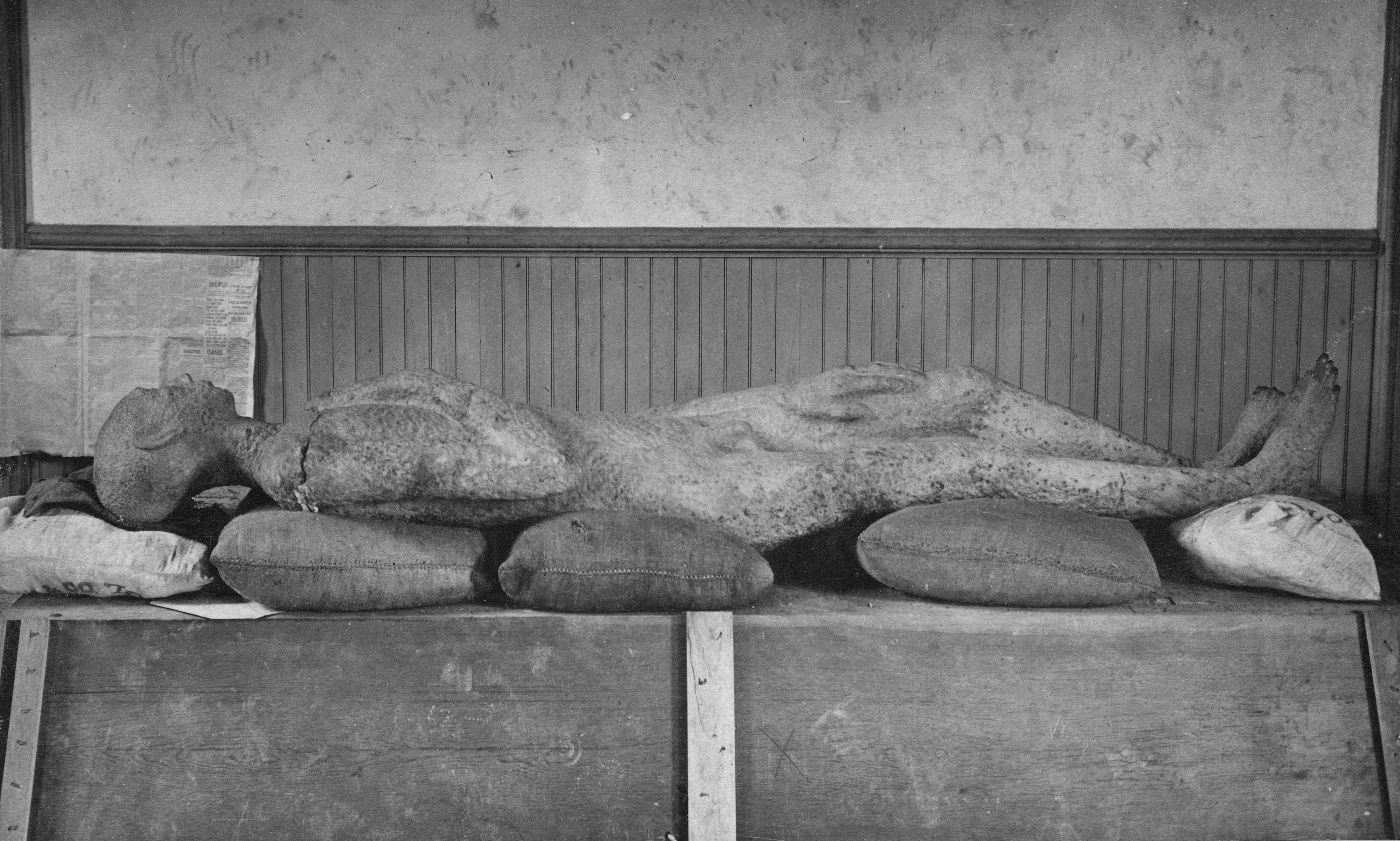
“Solid Muldoon” in repose.
Conant staunchly maintained the figure was a petrification; however, a well-known painter and sculptor working in Colorado, John Harrison Mills, cast doubts upon Conant’s giant in the press. Mills noted in an October 3, 1877 statement in the Weekly Rocky Mountain News, that among many anatomical impossibilities, “the brain is small at base, neck small with inadequate support for the head…ears flat to the head and awkwardly modeled…no marks of sternum, floating ribs or pelvic bones, though the subject lies upon his back.” Frederick Samuel Dellenbaugh, an explorer, artist, and author, also published his misgivings about what was by then known as “the Solid Muldoon,” referring to a popular tune of the day by Edward Harrigan. In a Rocky Mountain News article that ran on September 30, 1877, Dellenbaugh said: “I accept the term ‘Muldoon’ because it is meaningless and is therefore well applied.” He denounced the Muldoon as neither a petrification nor a piece of ancient sculpture; rather “it is plain that the intention of the perpetrators of this fraud was to palm the Muldoon off on the community as a ‘petrification’ and attempt to make money by causing people to believe that the Muldoon was a verification of the theory of evolution.” It seemed too obliging toward Charles Darwin and those interested in finding the “missing” evolutionary link, according to the Chicago Inter Ocean, that the figure “carefully drew up his left leg so as to afford a good view of his rudimentary tail.” Even the Darwins weighed in on the authenticity of the Muldoon as the “missing link” in a story run in the Rocky Mountain News of November 6, 1877. Reacting to a stereoscopic view of the figure taken while it was in Colorado Springs, Francis Darwin spoke for himself and his father by saying, “there seems to be a strong probability that the whole thing is an imposture.”
Taking the Show on the Road
Conant arrived in Denver and unpacked his great discovery in a room at the corner of Sixteenth and Lawrence and opened the doors for a public exhibition. “Many hundreds of persons visited and inspected it yesterday…but no one was prepared to give any satisfactory solution to the mystery” of whether it was natural or artificial curiosity, said the Weekly Rocky Mountain News of October 3, 1877. Conant traveled east with the Muldoon, going first to Cheyenne and then Omaha and stopping at towns along the Missouri River. In Council Bluffs, Iowa, the Muldoon’s arrival was the “means of throwing the scientific portion of that populace into discussion as to the genuineness of the discovery, and where the ‘Muldoon’ was pronounced a first-class fraud…in language more emphatic than elegant” according to the Rocky Mountain News, January 19, 1878. Eventually, Conant and his Muldoon arrived in New York “with the hope of course of lining his pockets with the shekels of the verdant and curious” the Colorado Daily Chieftain of January 1, 1891 observed in a retrospective piece. According to the Chieftain, the New York Tribune—other accounts say the New York Times—declared that the Muldoon was not a genuine petrification and went to work to find out the origin of the hoax.
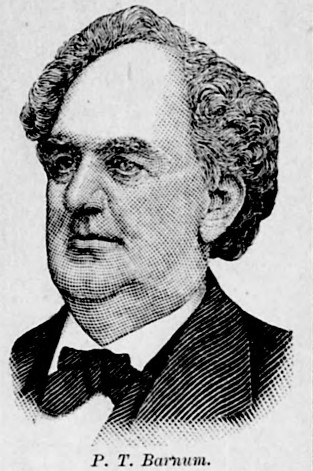
The World’s Greatest Showman, P.T. Barnum, printed in The Colorado Daily Chieftain, January 1, 1891.
Enter George Hull, a tobacconist and trickster who had perpetrated an earlier hoax: the Cardiff Giant. The Cardiff Giant was one of the nineteenth century’s most elaborate frauds. A ten-foot-tall, 3,000 pound “petrified man” was uncovered in October 1869. The Cardiff Giant was in fact designed to imitate the form of Hull and was carved out of gypsum. It was treated with stains and acids to make it look old and weathered. Hull spent nearly $3000 to fabricate the Giant and transfer it by railroad from Chicago to his distant cousin’s farm near Cardiff, New York, where it was buried in a hole. Once “discovered” by workmen digging a well, the Cardiff Giant drew crowds who paid fifty cents each to view the wonder, “and the proprietor of the farm took in more money than if had discovered a rich vein of gold-bearing quartz,” the Scranton Tribune reported on June 24, 1899. Some believed that the figure was the petrified remains of an ancient, Biblical race of giants, while others believed it was a statue carved by French Jesuits in the sixteenth or seventeenth century.
Looking back on the phenomenon, the Detroit Evening Times of August 31, 1941 reported that everywhere it went, the Giant drew crowds of those who “believed they had gazed upon the hardened remains of the biggest American who had ever lived and those who squawked because they had been swindled by a big but not-too-good example of the stonecutter's art.” P.T. Barnum saw the Giant in Syracuse, New York and reportedly offered to buy it, but his offer was refused. He commissioned a sculptor to create a replica and displayed it in his Manhattan museum which drew more crowds than the original. After bringing in $20,000 from his share of the enterprise, Hull revealed his hoax to the press in December 1869, saying it was his attempt at proving the gullibility of people who would believe the figure to be of an ancient clan of giants.
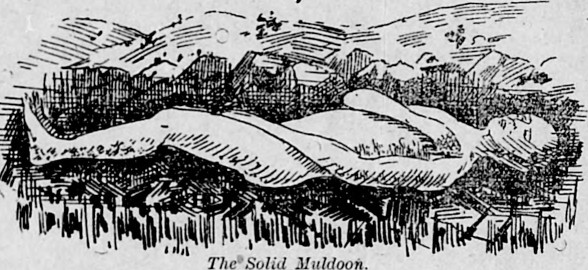
“Whether I’m a humbug, image or monster grand, or Darwin’s link of a pre-historic date.” This illustration of the Solid Muldoon and verse appeared in The Colorado Daily Chieftain on January 1, 1891.
Media Circus
But Hull wasn’t quite finished bamboozling folks. From a little mountain town in northern Pennsylvania, Hull hatched a scheme to create another humbug in the manner of the Cardiff Giant. “Hull had for a long time intended to deceive the public with this pretended petrification,” said the Colorado Daily Chieftain. A slurry of ground stone, ground bones, clay, plaster, blood, eggs, and other materials were baked for weeks in a kiln to create the stone man. The Chieftain continued: Hull used steel needles, fastened in lead, and went “over the entire surface before it was baked, producing the ‘goose flesh’ appearance which [had] so puzzled scientific men.”
Hull applied to P.T. Barnum for financial support once the stone giant was finished. “It was a white elephant on his hands. He had no money to plant it with” reported the Weekly Rocky Mountain News, on January 30, 1878. The News continued that it was “plain that Barnum was both wet nurse and godfather to the Colorado giant and furnished the money and part of the strategy to foist the humbug on what proved to be an incredulous world.” In whatever capacity, Barnum provided financial backing and intended to plant the giant in the Rocky Mountains.
The giant was shipped to Colorado Springs and then reshipped to Pueblo. W.A. Conant, allegedly under Barnum's employ, was present for the deposit of the giant at Beulah. Hull, disguised as a farmer named George H. Davis, also arrived in Pueblo where he heard Conant had been “fooling” with the giant and broke off the head and a leg. “However, the giant was skillfully mended and the discovery was made according to the plan” assured the Weekly Rocky Mountain News, January 30, 1878. (Conant damaged the giant a second time by trying to pry it out of the surrounding clay with a cedar branch and broke its neck and shoulder.)
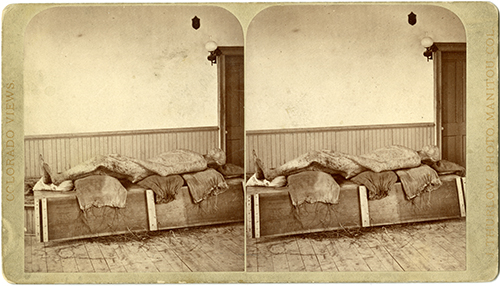
Stereographic View of the “Solid Muldoon.”
That’s when Barnum appeared on the scene, in September 1877, with his $20,000 offer, which Conant scornfully refused. Barnum then offered a $10,000 reward to “any man who would prove that the giant was made by chisel.” Barnum leaned into the ruse and paid a certain Professor Taylor $100 plus expenses to prove that the giant was a petrified man by boring into the arm of the figure and noting the resulting crystal dust that it would produce. The Rocky Mountain News alleged in January 1878 that “Hull obtained the crystal to correspond, and by sleight of hand exchanged it for the dust of the boring implement which was first handed to him by Professor Taylor.”
During a tour stop-over in Quincy, Illinois, Barnum ordered it brought to New York City, where it was soon revealed as a hoax and the jig was up. The Colorado Daily Chieftain said in 1891:
[T]he reputation of the “Solid Muldoon” waned as rapidly as it grew. What became of the Giant the Chieftain has never been able to learn, but its “discovery” will be recollected by old timers in Pueblo and by many people throughout the United States as one of the greatest fakes of the age.
P.T. Barnum, renowned showman and huckster, went on to co-found the first three-ring circus, Barnum & Bailey’s, in 1881. He also lent his name to the Barnum neighborhood in Denver when he purchased 760 acres outside Denver in 1878 and the Barnum subdivision was platted a few years after. The Town of Barnum was incorporated in 1887 and was an independent Colorado town until it became part of the city and county of Denver in 1903. William Conant faded into the background and worked as an agent of the Atchison, Topeka & Santa Fe Railway. George Hull, perpetrator of sensational hoaxes, died impoverished, having lost his “giant” fortunes, and in obscurity, in Binghamton, New York in 1902 at the age of eighty-one.
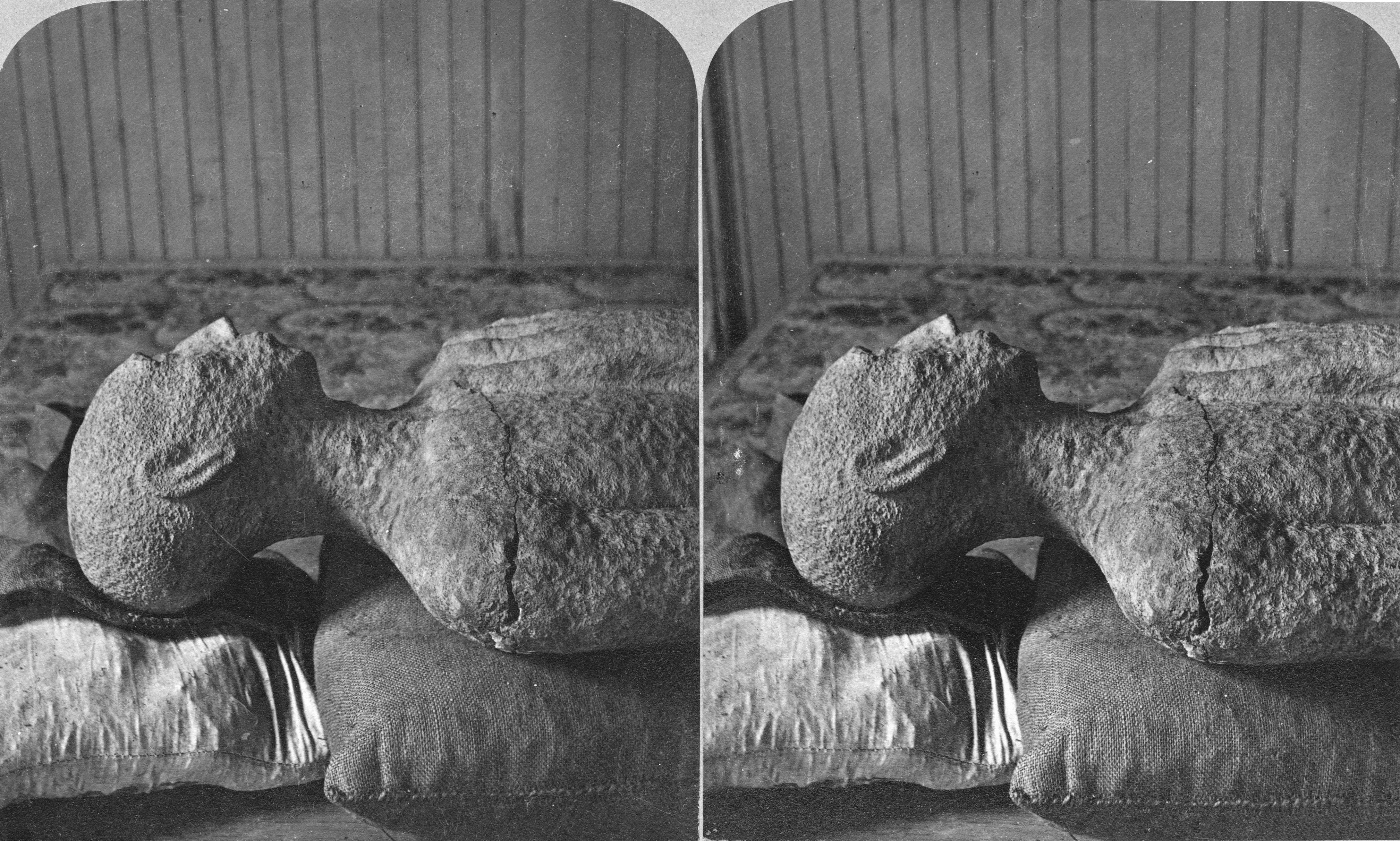
Head and Shoulders of the “Solid Muldoon.”