
 Membership
 Donate
 Shop
Shop


















Tag Team Back Again
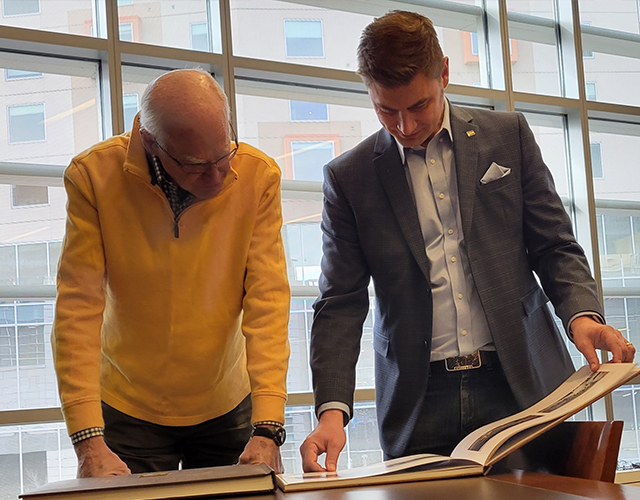
History Colorado curators Acoma Gaither and Tara Kaufman recently sat down with Cecil “DC” Glenn and Steve Gibson of the iconic hip-hop duo Tag Team, who got their start in Denver and whose single “Whoomp! (There It Is)” went multi-platinum in the ’90s.
DC and Steve, when did your families first come to Colorado?
DC: I was born in Chicago, Illinois, in 1966, and my brother was born four years after, and one of my father’s best friends, who I’m named after, moved to Denver and he was like, “Come on out here, man. We can make this happen.” So my father packed us all up and we moved to Denver. We’ve always been in the community of Park Hill, first lived on Grape Street, and then we lived on Krameria. And I had a great childhood growing up in Denver.
Steve: My family came to Colorado, I think it had to be maybe 1970. I was born in Omaha at Offutt Air Force Base in 1966. My dad was in the Air Force. That’s where he and my mom met. When I was four, we came to Denver and dad had a job at 3M. He was a microfilm processor back then, and my mom was a secretary. She worked at an advertising agency, so we lived in an apartment first and then we moved down on York Street. And that’s where I grew up, at 2700 York Street.
Can you tell us what your childhood was like?
DC: Our childhood consisted of riding our bikes all over the city. We would ride down to Washington Park. We all would ride as a group. All the kids in the neighborhood had bikes and if we wanted to go somewhere, we all had trusty RTD. If we wanted to go to Target or if we wanted to go out to the mall somewhere or, whatever we wanted to do, we could catch a bus there and we just played every season. In the summer, we played tennis, baseball. When fall came around we played football, and we played basketball in the winter. I just had a great childhood. I went to the incredible, greatest school on Earth, Manual High School, junior and senior year, class of ’84. And we would go swimming at every swimming pool, we’d go fishing at City Park. We’d go catch crawdads. Like anything you could imagine that kids would do, we did.
Steve: I grew up on the East side. Just a block away from City Park. Man, we used to just run around doing kid stuff back then, you know, it wasn’t computers and cell phones back then. We used to go fishing at City Park, or sometimes we’d get in the car and go with our older siblings and go somewhere else and fish. We played outside, football, sports. Man, it was just always neighborhood stuff.
When did you first start becoming interested in music?
DC: My father had a basement full of instruments. He played the trumpet. He was like, “Y’all boys are gonna learn how to play music.” So like every kid, my mother made me go to piano lessons and I just hated it. And I had to take trumpet lessons and I remember I cried because I didn’t want to go. I’ve always been music oriented, but it really didn’t come to a head until I went to Manual High School and I sat next to Steve. That’s how far we go back.
Steve: It actually started when I went to Cole. There was this guy named Dexter Benjamin. It was 1980. He wrote rhymes, and was the first one that influenced me to do what I do. I played drums back then, and my friend Howard played the bass—so Dexter wanted us to accompany him on stage at a talent show. He rapped and I was like, wow, this dude is rapping like those records that I have. And I was just blown away. And that’s what made me get into rap.
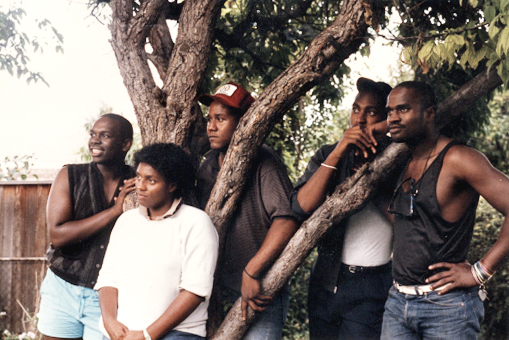
The Bizness Band. Pictured Cecil Glenn, Georgette Tillman, Howard Hobbs, Steve Gibson, and Wayman Walker. Not pictured is Otis Preston.
That was back when rap was new. What was that like when it started?
Steve: Man, you could just tell that it was something special. They were saying, “Man, what is this? This is not going to last. This is some garbage, blah, blah, blah.” It was when “Rapper’s Delight” came out, and actually, “Rapper’s Delight” was not the first rap song that I’d ever heard. Right at the end of ’79, me and my dad went to Baltimore and I bought two records there. Somebody at the record store was like, “Man, you should get these records. These are the good records, they’re the new music.” It was Grandmaster Flash and the Furious Five, “Super Rappin.’” The other one was Funky 4 + 1 and their song was called “Rappin’ and Rocking the House.” Those records just had me. I was just blown away. I kind of associate it too with my friend that grew up two houses away from me on York street. His name was Wayman Walker, RIP. His mom would play records and there was one that I used to love. It was called “Here Comes the Judge,” by a guy named Pigmeat Markham. It was an old song. I think it was made in ’68, but he rapped on there and I didn’t realize what he was doing back then, but that was my favorite song. I would ask her to play it over and over and she’d be like, “Alright, Steve, this is the last time I’m going to play this.” I think that was my first introduction to rap music, really, because I loved that song.
DC: I went to the fall dance at Manual, and that was the first time I saw two turntables, and records, and a mixer and a microphone, because that was the beginning of hip-hop. Planet Rock was out, PAC Jam was out, all these old electronic New York records. And I knew that’s what I wanted to be. I went and bought a rinky-dink Sherwood turntable from a pawn shop and a Technics turntable and a RadioShack mixer. And I was a DJ. And the neighborhood used to be mad at me because I couldn’t play anymore because all I wanted to do was stay downstairs and just practice and tear up my dad’s records.
How did your first music group come together?
Steve: On 26th and York there was a guy named Rodney. He was one of my great friends. Him and my buddy Howie came to me one day and told me that they were forming a band. I took over the drums. Rodney eventually dropped out of the band, but me and Howie stayed. Matter of fact, me and Howie are still doing music today. But that’s how I got into the band. And we had to figure out a name and I think I came up with The Bizness Band.
DC: It was Steve, Otis Preston, Georgia Tillman, Howard Hobbs, and Waymon Walker, RIP. And I was like, I got to be in that band. And I just badgered them and badgered ’em and badgered ’em and eventually I got in the band.
So fast forward, the band is playing all over the city. We would play at Sky and we played down at places like Red Shield, 16th Street Market, Juneteenth. We played everywhere. And we would practice at our house. That developed our musical skills.
What were some of the places and hangout spots that you and Steve would go to in Denver?
DC: The Pub. The Pub was down in this basement. They had a dance contest where Lisa G would win every week. Then you had Scooters, which was out on Parker Road. We used to play downtown, on the 16th Street Mall, when it was kind of brand new and when they just built it. And then what really helped us, like, we go back so far because every time we would record, we would ride out to Boulder to a lady named Becky Davis. Becky Davis had the only Black radio station. We would drive up there and she would let us play our music on I think, Sunday night. And we saw her, we did a fundraiser for Michael Hancock and she had to come see us. And she was like, “I’m so proud of y’all. Cause y’all never gave up. And y’all made it.” So it’s just, it’s so much history, right?
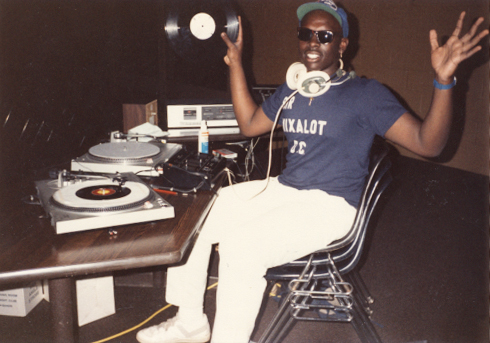
DJ Sir Mix-A-Lot DC at Sac State University in 1985, now DC The Brain Supreme, of Tag Team.
What was the Denver music scene like in the ’80s?
Steve: There were bands, we kind of mimicked those bands that we looked up to. I remember it was some guys that were just like a couple of years older than us, but they played so strong. The drummer played real hard. The bass player was just a good bass player. He’d take off his shirt, his big nappy hair just going crazy. Me and my buddy Howie used to look up to them. It was a really competitive scene back then. There was another band called The Queen City Boys and they were kind of like our competition. And then with hip-hop there was a guy named Reggie Simon, and Brother Jeff had a group called the Legion of Doom, and it was a dude named Ricky Springs in there. And Ricky was like the best. There was a guy named Starchild and some other guys. It was just a lot of rappers back then. And I used to produce. I might have been the first one making beats out there. I bought a sampler back in the day. My grandfather lent me $1,000 and I remember going up to Boulder and picking up that thing and there was a big, big old keyboard called an Emax. Then I started buying drum machines. I would go down and it was a place called Bobby’s Music on Broadway. They would let you put stuff on layaway. And I used to just work hard and buy stuff and make beats.
How did Tag Team come together?
Steve: There was another member of the band who came in before DC. Otis Preston. We were called The Disco Two. That was our original name. We used to rap so much that the girls at the school used to make little tombstones that said “Death to the Disco Two.” But I knew we had to have another name so one day I was in Target—that Target that’s off of Colorado Boulevard and Alameda—and I was walking through and there was a T-shirt type thing that was hanging there and I saw it said “Tag Team” on the front of it. I was like, “Hey, that’s a good name for our group.” So when I went home, I called Otis and he was like, “That’s perfect, man.” So me and Otis were Tag Team first. And DC was our DJ actually.
DC: I had moved to California. I went to Sac State and back then, you had to go to the studio to record music. So when I would come home for breaks from college, B Stephen, Otis Preston, we would go save up our little coins and we would go to the studio, used to be called Free Reelin’, it was a couple of blocks after the Capitol, right on Broadway. And we would record there. And those were the beginnings of Tag Team.
Steve: Then we changed the name to Tag Team Cru because it was a lot of people from the neighborhood that would go. Whoever has some money can go to the studio with us. If you chip in, you can come and rap with us. I think it was like twenty-five dollars an hour back then, and that was kind of expensive. So we would all chip in and get us two or three hours and go down there and record.
DC: And in my freshman year, a white kid named Johnny Z got a four-track. Now, everybody can record their music on a computer, but the four-track was the first home apparatus that you could record songs on. And Z was like, “Man, I don’t know how to use this thing!” I was like, “I’ll figure it out.” So instead of going to class, I spent about three months trying to make records, and I put together about ten songs. One of my friends had an 8O8 and we had a little rinky-dink drum machine. And I just laid down a bunch of beats. And then I was putting anything I could, I would sing, I would beat box, I would beat on pots and pans, played a flute, anything—cut and scratch—anything I could think of. And I created about eight songs and I sent a cassette tape to Steve in Denver. So he got his 8-track tape. Now we’re sending mix tapes back and forth of our songs.
My DJ career in college was incredible. And during that time, that’s kind of how me and Steve became Tag Team because the band disbanded, because we were young people growing up.
Steve: Otis went into the army and DC said “Man, I’ll rap with you.”
DC: So me and Steve continue making songs back and forth and trying to get a record deal while I’m in college. And Steve moves down to Atlanta in ’88 and he’s like, “Man, you need to come down here and chill with me.” So I went down on Christmas of ’88. The first place he took me was this place called Magic City. It was an adult entertainment club. And right then and there I knew I was moving to Atlanta.
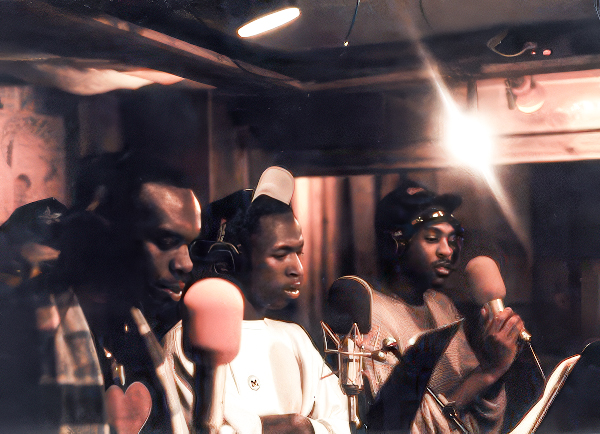
The original Tag Team Cru, pictured from left to right: Cecil Glenn, Otis Preston, and Steve Gibson.
How did you get into the music scene in Atlanta?
Steve: I was going to the Art Institute for audio engineering and video production, and it was a waste of money, to tell you the truth, because I already had equipment and I was recording. So I dropped out maybe about nine months into it and I had the idea, I was like, “Man, I program music. There’s not many of us out here. I’m going to call around to a couple of studios and see if they need somebody to program music.” And they just started giving me a bunch of work. A lot of rappers would come into the studio and they didn’t know how to program their music. So I would go in and sample the stuff that they wanted and put it together and they’d rap on it. And that was how I started.
DC: I had a job at CNN because I didn’t think I was going to be a DJ. I thought all the DJs would be better than me in Atlanta. We went to Magic City, and I was like, “I could work here.” I became pretty much the biggest DJ in Atlanta. I knew everybody—all the Falcons, all the Braves. It was the golden era of Atlanta because that’s when everything started. I mean, LA Reid started LaFace, you know, their first group was Damian Dame. But then here comes TLC, then here comes Usher.
Steve: We put a record out. It was called Strictly Political. DC was rapping like some old conscious stuff, like Public Enemy. It was around that time. And then everybody started saying “Whoomp, there it is” in Magic City. It was a chant that was going on and DC called me one night and was like, “Hey, man. Let’s do a song called ‘Whoomp, There It Is!’” And I’m like, “What?” He’s like, “Yeah, whoomp, there it is!” I’m like, “How do you spell it?” Because it was just so weird to me, you know?
DC: I told Steve, I was like, “We’ll never get out of here if we don’t do something uptempo.” And I knew that we couldn’t do bass music and booty shake because we’re not from Atlanta. We’re not country, southern like that. So I went back to the genesis: Planet Rock, Egyptian Love, what we grew up on. I said, Let’s just make it like that and where everybody can enjoy it. Then we took our first attempt at “Whoomp! (There It Is).”
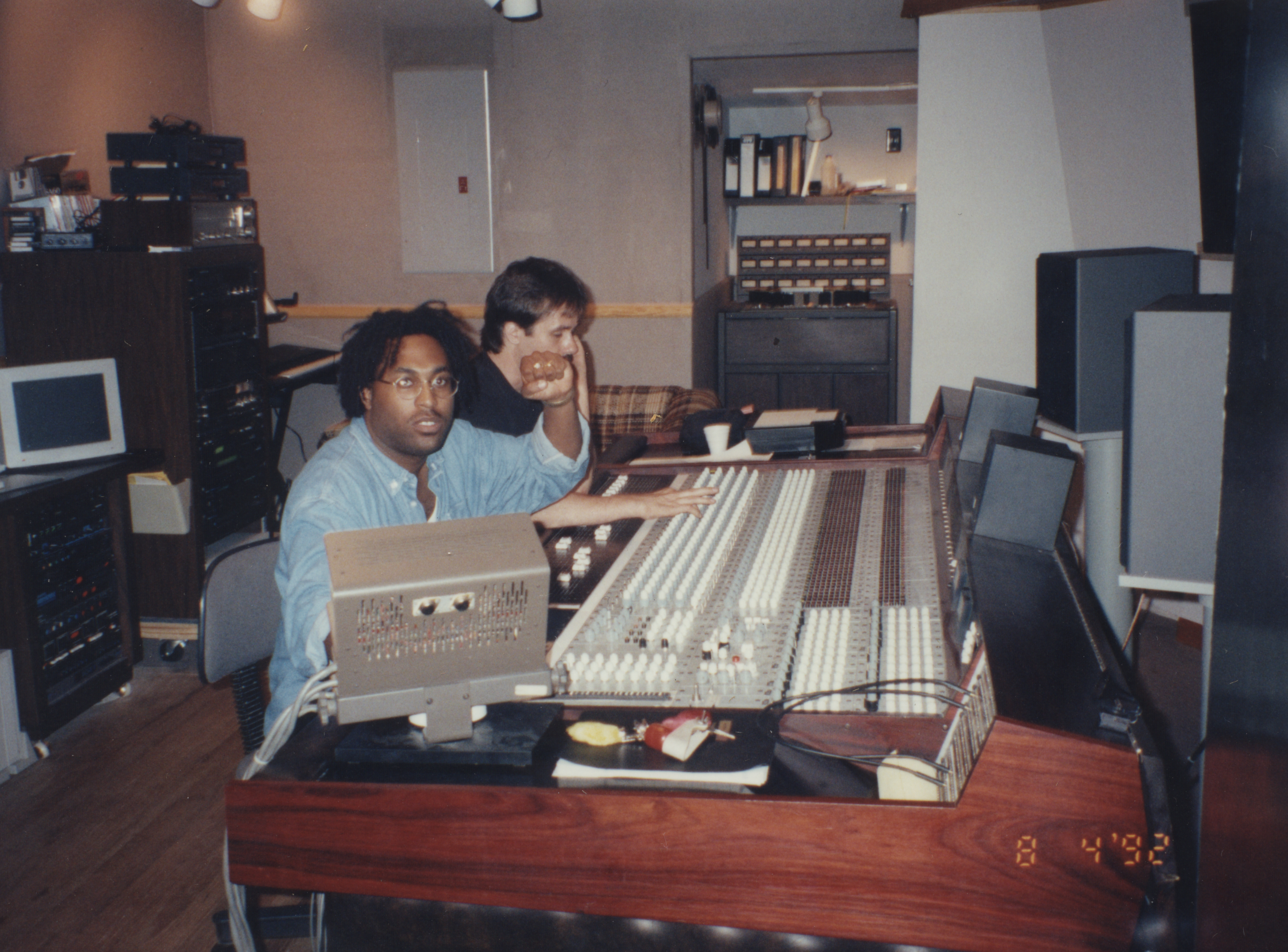
Steve Rolln and studio engineer Harry O’Brien recording "Whoomp! (There It Is)."
DC (cont.): I’ll never forget it. It was Thursday, we went to the studio, summer ’92, and recorded the record, and I had it on the cassette tape. I had to go to work. When I came to work, set up, popped the tape in, it was the first thing on my shift. And to this day it’s the biggest response on any record that I’ve ever seen. At least fifteen people came to the DJ booth like, “What is that? You got that on tape?” My hubris took over and I’m like, anything I do is going to be the bomb, so I’m making records and just testing them out. And so I actually shelved “Whoomp! (There It Is).” In the fall, one of the girls was like, “How come you don’t play “Whoomp! (There It Is)” no more?” I played it again, and the same thing happened. Everybody’s like, “What is that?” But this time, record rep Alan Cole from Columbia Records, he came and was like, “Give me that. Cause I’m going to New York and I want to let them hear this.” And next thing you know, I’m talking to Columbia Records the next week.
I was like, this will work for every label. So I give all my people I know from all the labels the record and everybody’s vibing on it and everybody wants to do something, but they don’t know what to do because everything is New York and LA and they’re used to dealing with hip-hop and R&B. What do we do with this bass? And I almost gave up because everybody was playing with me and a lady named Lisa McCall, she was like, “You need to talk to Al Bell.” I was like, Al Bell? “Yeah, he put out “Dazzey Duks” by Duice the year before and it went gold.”
And for those who don’t know who Al Bell is, back in the beginning of soul music, there were three labels: Philly International, Motown, and Stax Records. Al Bell was president of Stax Records. And fast forward, he has a new record label called Bellmark, and Bellmark signed Duice and they’re off to the races. They’re a national group now. So I called him and he called me back two weeks later and I was like, “Man, I got a hit record. It’s been tested. You got to sign this.” He’s like, “All right.” I was like “Nah, nah, nah, don’t play with me. Why are you playing with me, man?” I said, “You ain’t even heard the record!” I’ll never forget these words, he said, “Brother, I don’t have to hear the record. I hear it in your spirit. Let’s agree to agree, we’ll get this thing moving.” And I was like “Word!” And I gave my two weeks at Magic City, signed a messed up record deal, and then in a month and a half, Tag Team was platinum, and the rest is history.
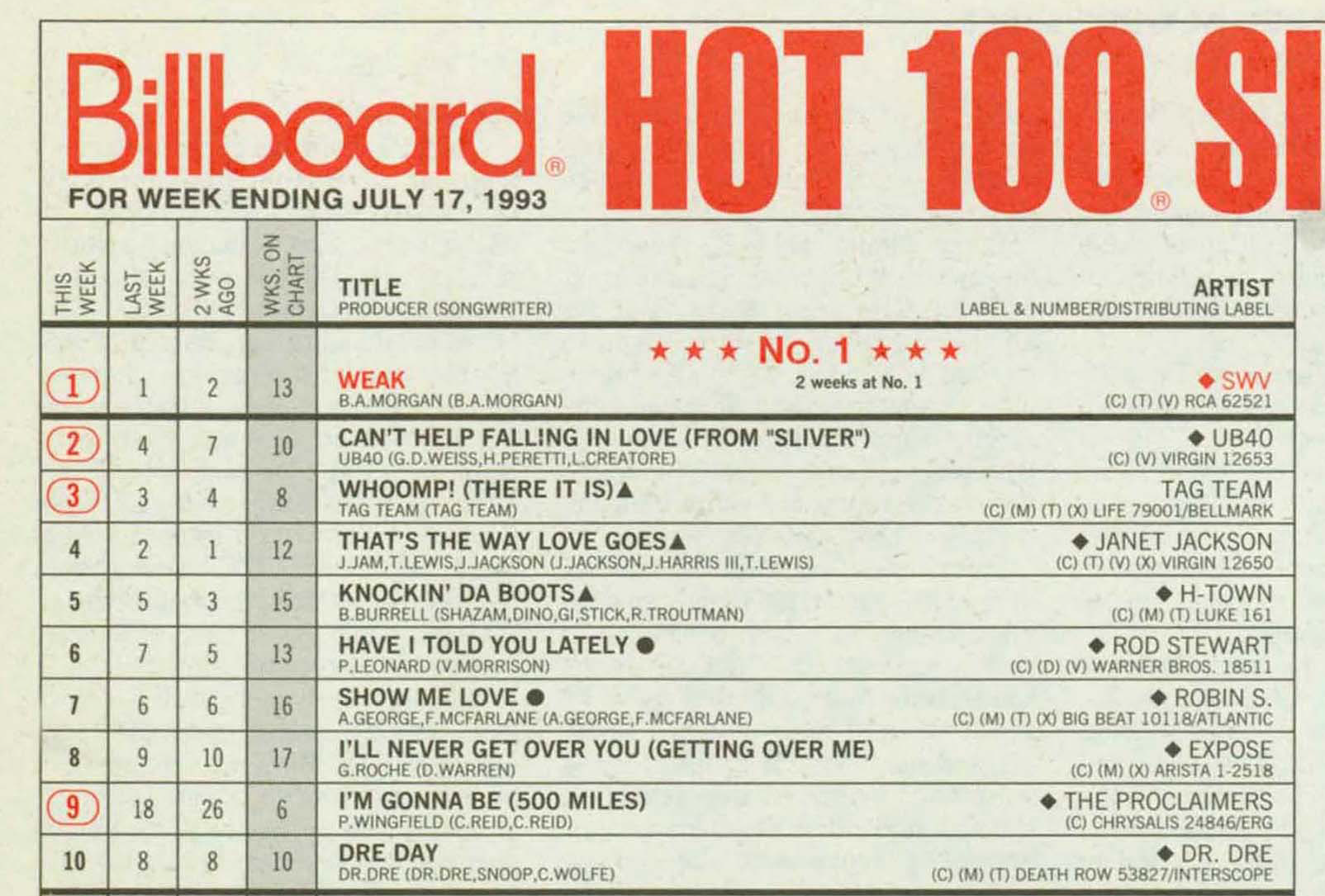
Tag Team soaring up the Billboard Hot 100 charts in the summer of 1993.
What was the music industry like in the ’90s?
DC: Just young, dumb kids partying together. Everybody gave us respect because “Whoomp! (There It Is).” It got so big. I remember our first show in California was with Tupac. His mom lived in Atlanta, so he would come down to Atlanta and we would see each other in the club and we would party a little bit. Not a lot, but just, “What’s up, man?” We’d see each other on the road and it was just mutual respect. I remember we was backstage with Kid ’N Play at the American Music Awards and I’m introducing Whitney Houston. And I kiss her on the cheek, “Congratulations.” Come on, man, what? I mean, I have been a part of a lot of historic things in hip-hop. But for us, it was just young kids having fun. On our first tour, we were on tour with SWV, Jade, Bell Biv DeVoe, Shai, MC Lyte, and Silkk, and we would rock the house because when “Whoomp! (There It Is)” came on, it was over. I remember we did Buffalo, New York, and we were late, so we had to go in the middle of the order and we did “Whoomp! (There It Is)” and everybody else came out of the dressing room because it rocked the arena that loud. Everybody’s going “Whoomp, there it is!” And like, Salt-N-Pepa, we were on tour with them, and one of our greatest shows was with CeCe Peniston in London, the Hippodrome, like, I’m blessed, especially for a kid from Denver, to get to do all these things.
DC, can you tell us the story behind your rap name?
DC: When I graduated from high school, I got an opportunity to go to Sac State University. So I get to California and I get to the dorms and automatically befriend a lot of people because I’m probably one of the only Black people around. There was a lot of Black people, but when I first got there, it was like, just me, and they were like, “What’s your name?” I was like “Cecil.” And they was like, “Where are you from, Cecil?” I’m like, “Denver, Colorado.” They’re like, “What?” They said, “There’s Black people in Denver, Colorado?” I’m like, “Yeah!” So they’re like, “We’re going to call you DC.” And then it just spread, everybody started calling me DC. So my name was just DC, but my DJ name was Sir Mix-A-Lot DC until Sir Mix-A-Lot came out with “Baby Got Back,” then I was like, I can’t even use that name no more. So, that first summer, I was in the basement with a guy named Roy Lee Davis. We were doing what young people do, you know, having a drink and having a smoke and philosophizing as you do. And one thing people notice about me is that I always figure things out. And Roy is like, “Man, we’re going to call you the Brain Supreme.” Like, what? “The Brain Supreme, man. Because you always figure things out. Everything out. You come from a different perspective.” Then everybody started calling me that. I’ve been DC the Brain Supreme ever since.
What is the meaning of IT in “Whoomp! (There It Is)”?
Steve: Whatever you want. You see guys on TV catching a football and they say, “Well, there IT is,” you know? And so IT was the catch. It might have been a lady cooking something and the food was good. And she said, “there IT is,” and it pertained to that food. So IT can be anything.
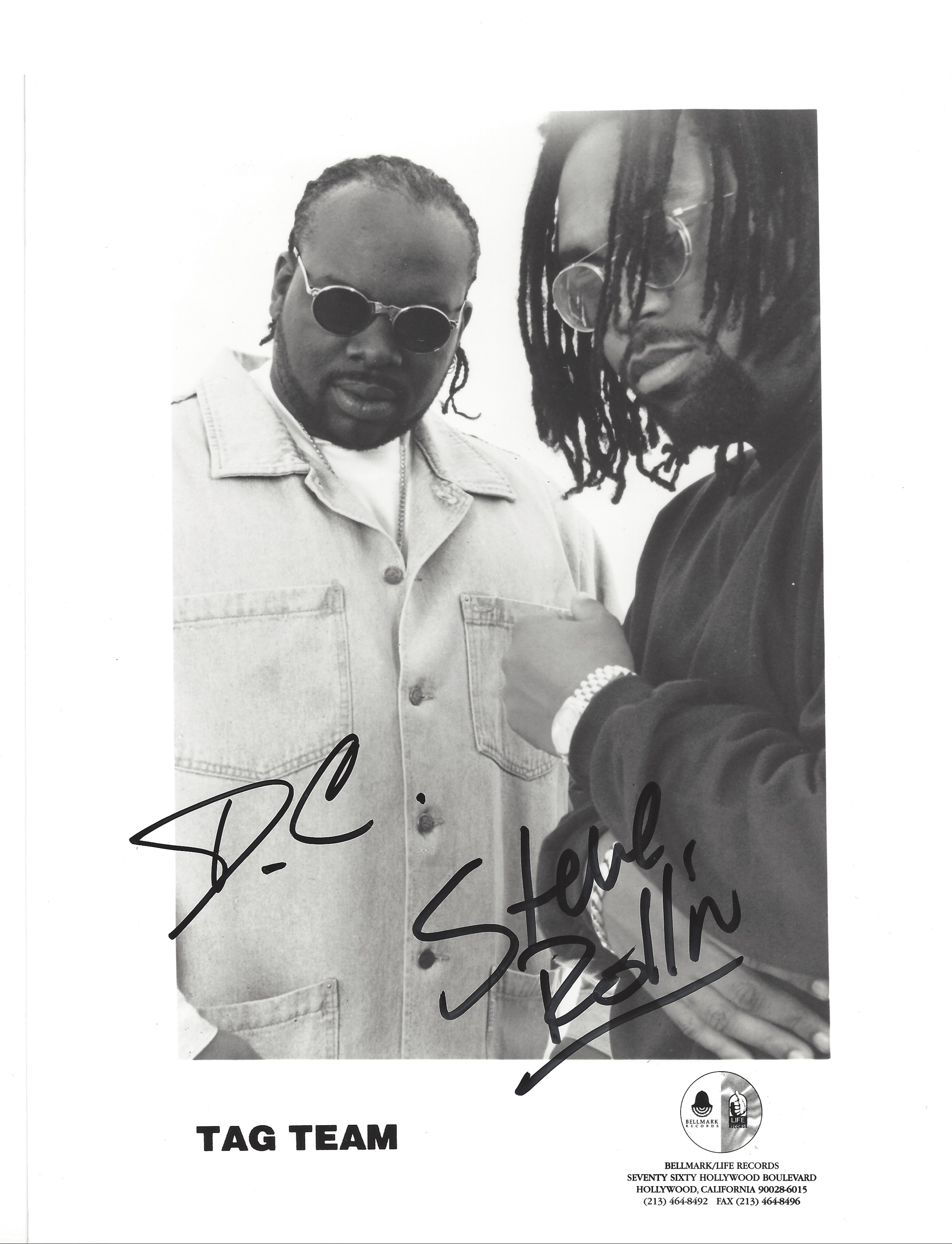
Tag Team promotional picture, 1993.
Can you share some more memories of your time in Denver?
DC: The beauty of Denver is that as a community, everybody raised everybody else. I’ve had influences from my high school, everybody from all the offices to the secretary. They all influenced me. They’re all proud of me because they had a part in my upbringing. And I’m lucky because I had a father who was educated and I didn’t really realize all the things he accomplished until after. He’s all over the country speaking and, you know, I’m looking at pictures with him and Stokely Carmichael and all the leaders of the Civil Rights Movement. And I’m just like not knowing, right? It’s just, that’s just dad to me. But as you get older, you realize, whoa, you did that? And he tells the story.
When we moved out here, he had a job at CU because they were starting an Ethnic Studies Department. But the guy who started this department, the guy that brought him here, got shot up in Boulder. Right in front of him. And my father, he spent everything to move his family out here, and he’s staying with his best friend and he’s like, “What am I going to do now?” But he had this meeting at CU. He went up to Boulder and he became the dean of Ethnic Studies, University of Colorado. And then he moved down to Denver after he got his doctorate degree from CU and then did the Auraria campus, University of Colorado Denver. And he got thousands of kids through school.
He was the dean of Ethnic Studies till, I think a little bit before 2000, he retired. And he, Mayor Pena, and Jimmy Carter were instrumental back in the late ’80s in moving Stapleton to DIA [Denver International Airport] because we stayed on 26th and Krameria and them planes used to come through. I mean one day it was band practice and I’m sitting out on the driveway—I’ll never forget—a Continental did a fly by, but it couldn’t gain altitude and all you heard was a rumble and you just saw the fear of everybody. And that thing came over the house. It was probably about 1000 feet over the house, and you could see the wheel wells. And I just watched it go. And that was it. Everybody was like, that’s it. And by like two years later, they moved it. And they were instrumental in moving it to DIA. He was a great man. He did a lot for Denver, Colorado. I’m Catholic, so I went to Blessed Sacrament and went to Machebeuf. I was an altar boy. Any bishop or cardinal that came to town, I was the altar boy for him. And all of that is from Denver. You know what I mean? Like, everything that I am is because of this city. I can honestly say that.
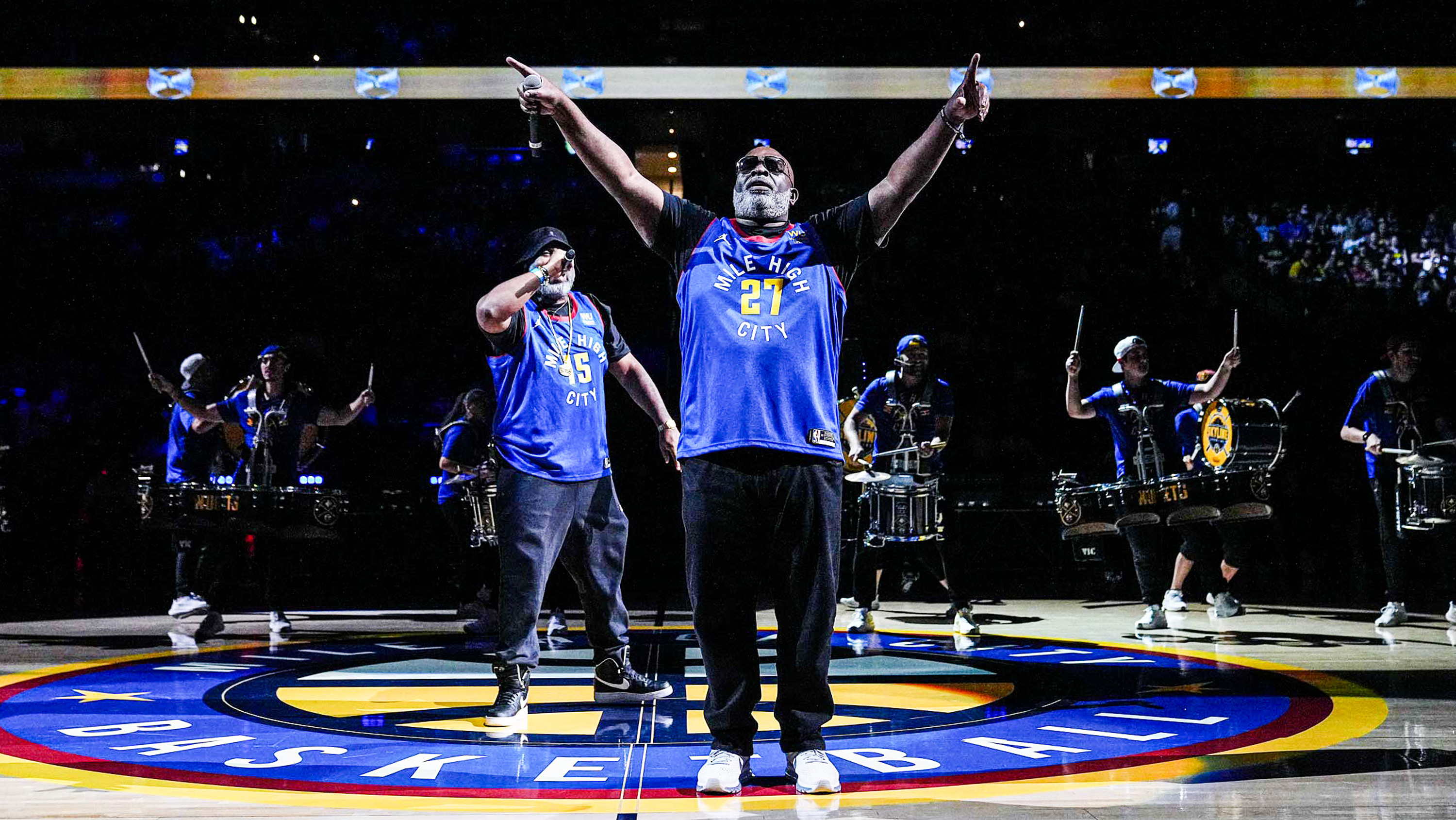
Tag Team delivering an electrifying hometown performance at the Denver Nuggets halftime show!
What’s one of the most memorable moments of your career?
DC: You can just drop us anywhere and everybody knows “Whoomp! (There It Is)” and they’ll appreciate it even if it’s in the middle of a country show, everybody, they’ll start line dancing. I remember I performed at the National Speakers Association 50 Year Ball and they didn’t expect it, it was at the end of the ball, and everybody’s got on gowns and everybody’s tired, and this is just like a thousand people in a room. And I got out there and I’ve never seen joy like that because everybody had won their awards, everybody got their accolades. It was just a star studded night and I ended it. And I’ll never forget this because Black folks are doing the electric slide, people have the cha cha line, people were doing the line dancing in ball gowns and tuxedos. Every dance you could think of in every genre and every race, everybody was doing it to “Whoomp! (There It Is).” And I’m walking through the crowd and I end up having like a Peter Piper line because I had to go back to the DJ booth, I was going to give it to him and he was going to finish, and I look back and it’s just everybody dancing, people with shoes off, women with their heels in the air. And I went back to DJ and he was just tripping too, and he played “Celebration” by Kool & the Gang. And it just capped off the night so well. And just to be able to experience that, right? Just to get that much joy out of people because of me, because of something me and Steve created.
What advice would you give to young artists today trying to navigate life?
DC: Everybody’s success story is different. Because we’re from Denver, Colorado, and we made it and it was hard. It was not easy.
Steve: There’s no blueprint. Just always try to do something positive and it’ll turn into some positive. You got to just keep moving, and it eventually becomes something that’s good for you.
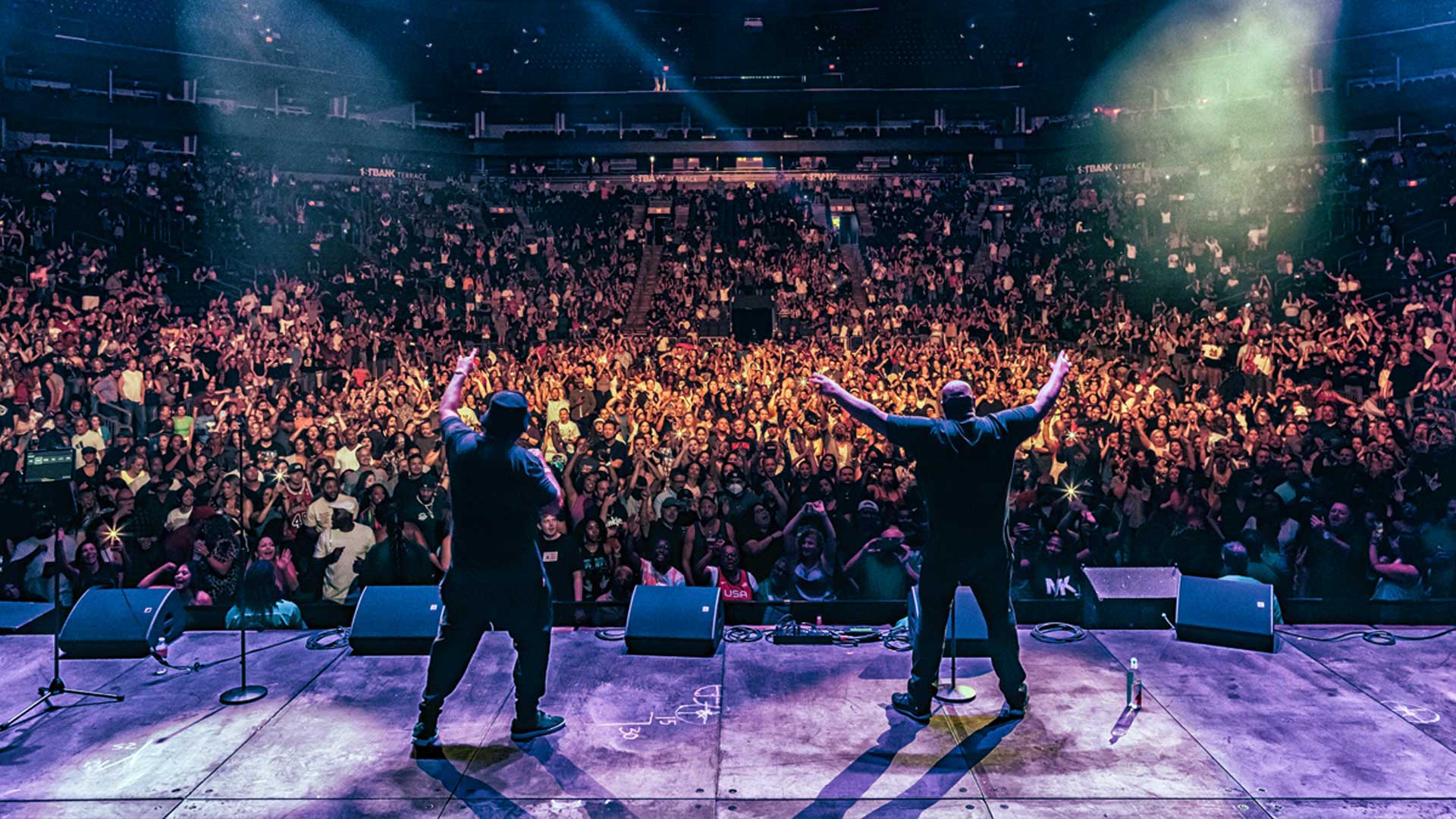
Tag Team electrifies an arena crowd, celebrating over 30 years of global tours and iconic performances!