
 Membership
 Donate
 Shop
Shop





























A History of the Alien Enemies Act
One of America’s oldest and most controversial laws is in the spotlight once again.
During a campaign rally at the Gaylord Rockies Resort in Aurora in October 2024, against a backdrop that read “End Migrant Crime” and “Deport Illegals Now” accompanied by large photos of men identified as members of a Venezuelan gang, then-presidential candidate Donald Trump spoke broadly of his concerns that the recent surge of immigrants at the southern border was having a detrimental effect on the nation, and specifically of reports that violent gangs of Venezuelan immigrants had taken over apartment buildings in Aurora. Toward the end of his speech, he said, "I'm announcing today that upon taking office, we will have an Operation Aurora at the federal level to expedite the removals of these savage gangs, and I will invoke the Alien Enemies Act of 1798—think of that, 1798, this was put there 1798; that's a long time ago, right?—to target and dismantle every migrant criminal network operating on American soil."
A moment later, decrying the state of the nation as "in tremendous distress" and "a failing country," he expanded on the promise, saying "We will send elite squads of ICE [Immigrations and Customs Enforcement], Border Patrol, and federal law enforcement officers to hunt down, arrest, and deport every last illegal alien gang member until there is not a single one left in this country." Those in attendance at the rally cheered in support. Aurora City officials pushed back, pointing out that it was categorically wrong to claim, as Trump did in his speech, that their city was “invaded and conquered” by immigrant criminals.
When Donald Trump invoked the Alien Enemies Act as a legal basis for mass deportations, he added a new chapter to the long history of one of the nation’s most controversial laws. This essay explores that history by examining the act’s origins, its applications across more than two centuries, and the controversies surrounding it.
The first thing to note is that the Alien Enemies Act was part of a series of laws known collectively as the Alien and Sedition Acts of 1798, enacted during a two-year undeclared and limited naval war with our erstwhile ally, France. Since France was at war with Britain (in the so-called French Revolutionary Wars), the French took umbrage at America’s apparent partisanship toward their enemy and began seizing American merchant vessels. As if the ruination of American commerce was not enough, French officials requested an enormous bribe (the infamous XYZ Affair) before they would negotiate the restoration of amicable American-French relations. Americans raised a hue and cry over France’s actions and started seizing armed French vessels in retaliation.
Taking advantage of the quasi-war with France, the US Congress enacted the four Alien and Sedition Laws: the Naturalization Act, the Alien Act, the Alien Enemies Act, and the Sedition Act. Historians today have generally viewed these laws as unjust and, most importantly, unconstitutional. It is also important to note that the acts were largely passed for partisan political purposes rather than reasons of national security, despite national security being the rationale provided at the time and repeatedly thereafter.
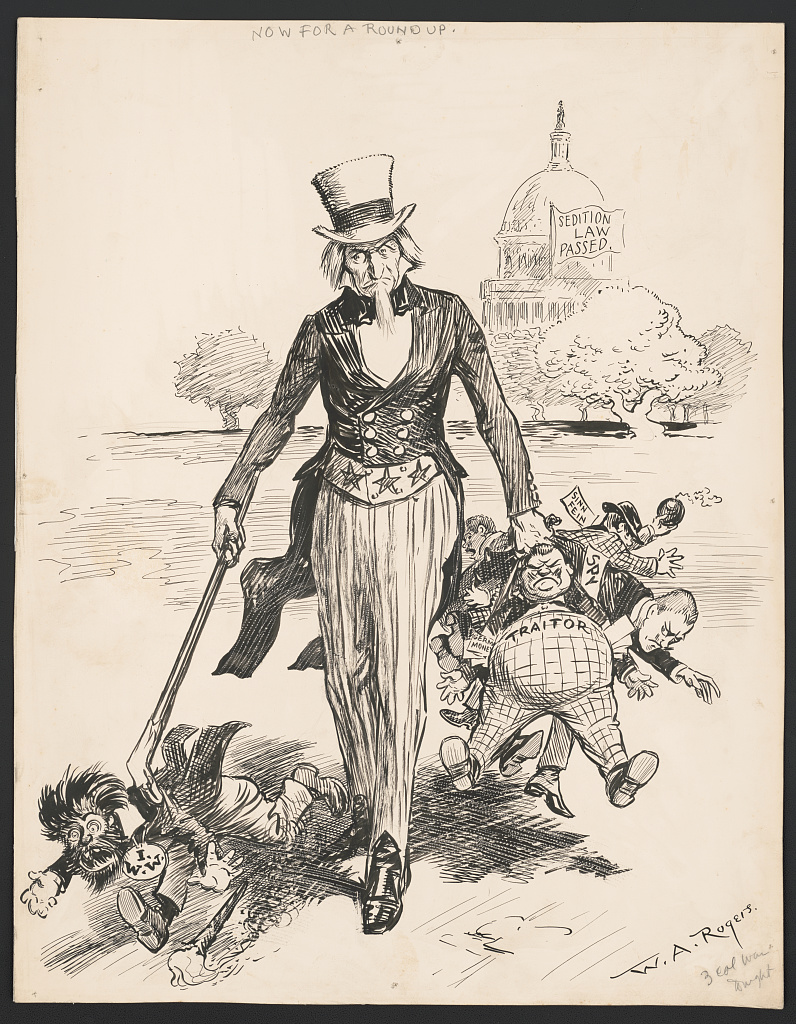
“Now for a Round-Up” by W.A. Rogers. This political cartoon was published in the New York Post following the passing of the 1901 Sedition Act, an updated revival of the original law that targeted Filipinos, Latin Americans, and union organizers.
It was the Federalist Party, which controlled the federal government in those years, that passed these draconian bills, and President John Adams who signed them into law. Both the party and the president were concerned about espionage and internal subversion by French immigrants—potential “fifth columnists” who might support France against America when war broke out between the two nations. They were also apprehensive about importing radical ideas from France that could adversely affect their fledgling nation. However, the underlying reason for the passage of these laws was to undermine their political opponent: the Democratic-Republican Party led by Thomas Jefferson. In other words, national security became a pretext for political repression.
The Naturalization Act and the Alien Act restricted immigrants who were believed to favor Jefferson’s Democratic-Republican Party. The former increased the residency requirements for citizenship from five to fourteen years. The latter granted the president unilateral authority to deport “aliens,” meaning immigrants considered dangerous to the United States. The Federalists sought to protect themselves against a “horde” of Irish Catholic immigrants arriving in their fledgling country who might vote for their political opponents, as well as potentially dangerous Frenchmen promoting revolution on their shores.
The legislation that provoked the most objection was the Sedition Act, which responded to the rise of the partisan press and rival political parties. Through this law, one of America’s most repressive statutes targeting political activity, the Federalists sought to suppress dissenting (i.e., disloyal) opinions against Adams’s administration by criminalizing political speech. The law was used to imprison nearly a dozen pro-Jefferson newspaper editors nationwide, and its enforcement violated the First Amendment, one of the most treasured rights granted to Americans in the Bill of Rights. The Naturalization Act was eventually replaced, and these original Alien and Sedition Acts expired.
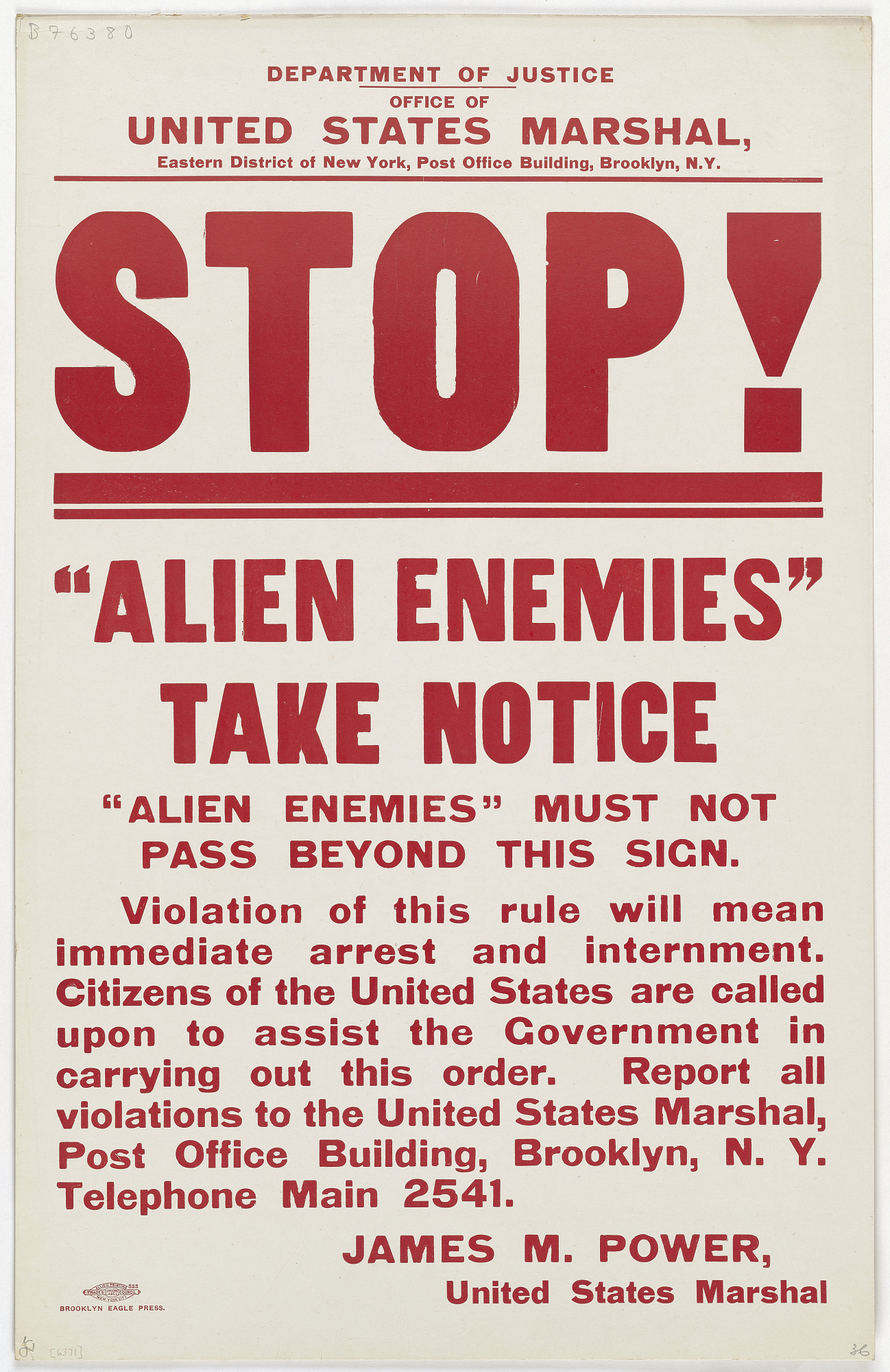
This sign was posted during the First World War to forbid Germans and Southern Europeans from entering certain parts of a post office.
American historians have long viewed these laws as repugnant, regarding them with contempt and scorn for being products of partisan politics. What has concerned them most is that the laws granted the president excessive arbitrary power, undermining the system of checks and balances that is the hallmark of the U.S. Constitution. It is crucial to note that many Americans also viewed them as repugnant, and these laws were in some part responsible for John Adams’s unsuccessful bid for reelection in 1800. Adams likely regretted signing them into law as, instead of consolidating his power, he lost it. As the eminent historian Gordon S. Wood has noted, the Alien and Sedition Acts were a “disastrous mistake” that “thoroughly destroyed the Federalists’ historical reputation.”
Since war was never officially declared against France, the “Alien Enemies Act” was never enforced. This act allowed for the restraint of enemy aliens only during a declared war and has never been repealed. It received bipartisan support, as it appeared to be a reasonable precaution during a national wartime crisis. Consequently, it has remained in effect to this day, allowing the president to detain, relocate, and deport enemy aliens in times of war. Unenforced at the time, the law established a precedent for the government’s imprisonment of non-citizens under the guise of national security. In doing so, lawmakers created a powerful tool that could be misused by governments in the future to jeopardize the liberty and security of all Americans.
Since the eighteenth century, the United States has invoked the Alien Enemies Act during the War of 1812, World War I, and World War II. In all three wars, the law was used to discriminate against people based on their nationality, ethnicity, or race rather than their demonstrated threat to national security. While President James Madison imposed some restrictions on British nationals, who faced suspicion, hostility, and restrictions during the War of 1812, the impact of the Alien Enemies Act was most acute during the two world wars. President Woodrow Wilson imposed restrictions on male German nationals when the United States entered World War I in 1917. Later, these regulations extended to German Austrians and women of both nationalities. The regulations included prohibitions on entering sensitive areas, mandatory registration with the police or US postmasters, and limits on owning signaling devices, radios, and firearms. German nationals were also subject to surveillance. More than 10,000 were arrested and investigated, with most being paroled.
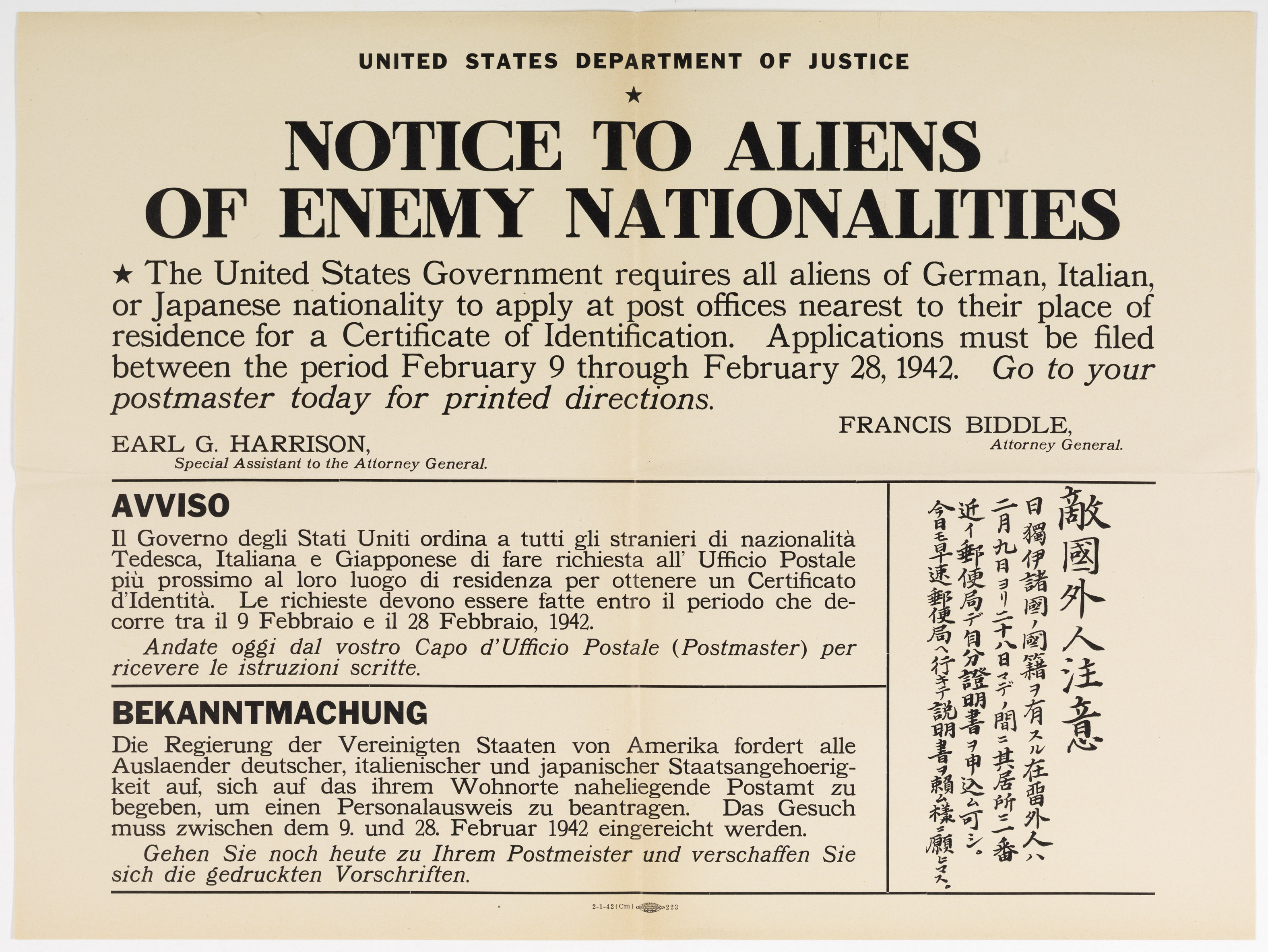
“Notice to Aliens of Enemy Nationalities,” a poster published by the Department of Justice in World War II to inform residents of German, Japanese, and Italian descent that they were required to register with the post office.
While the experience was humiliating and often led to adverse consequences such as loss of employment, these people were not indiscriminately rounded up and imprisoned in concentration camps. Unfortunately, that was exactly what happened to Japanese Americans during World War II.
The most egregious application of the Alien Enemies Act occurred when, under the authority of the 1798 law, President Franklin D. Roosevelt signed Proclamation 2525 on December 7, 1941, granting the government the authority to arrest, control, and remove suspected Japanese immigrants deemed dangerous to the safety of the United States. Many of these individuals were community and religious leaders. The following day, another proclamation targeted suspected German and Italian immigrants. By February 16, 1942, the Department of Justice had initially arrested 2,192 Japanese, 1,393 German, and 264 Italian nationals. More arrests would soon follow.
Tragically, the term alien enemies was eventually and tacitly applied to the entire Japanese American community on the West Coast, including the Issei (first-generation immigrants who were ineligible for American citizenship because of earlier exclusionary legislation) and the Nisei (second-generation Japanese Americans who held birthright citizenship). On February 19, 1942, President Roosevelt issued Executive Order 9066, which authorized the evacuation and imprisonment of 120,000 individuals of Japanese ancestry—two-thirds of whom were American citizens—in ten concentration camps in some of the most desolate and isolated areas of the country. These Japanese Americans were presumptively suspected of disloyalty to the United States and collectively punished for it. The fact that German Americans and Italian Americans never faced the same fate strongly suggests that Japanese Americans were perceived as enemy aliens primarily because of their race. In other words, racism made Japanese Americans members of an “enemy race.”
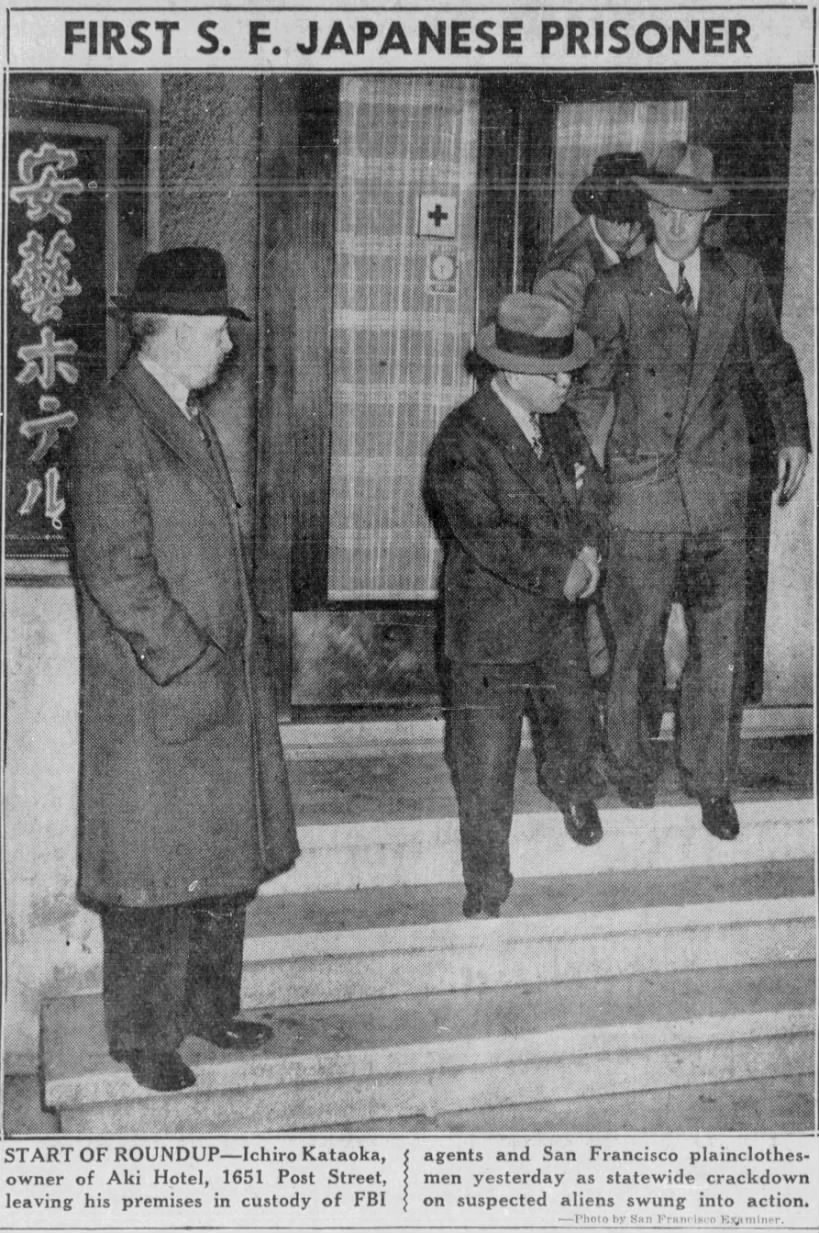
San Francisco Hotel Owner Ichiro Kataoka, pictured here being led away in handcuffs by FBI agents, was one of the first people arrested for being of Japanese ancestry after the bombing of Pearl Harbor.
What exacerbated this tragic chapter of American history was the fact that the government knew the Japanese American community posed no threat. Intelligence from the FBI and the Office of Naval Intelligence confirmed there was minimal risk of any Japanese American “fifth column” engaging in sabotage. A White House investigation (the Munson Report), submitted weeks before the attack on Pearl Harbor, also concluded that Japanese Americans presented no threat to national security. Nevertheless, the government imprisoned them as a political expedient to assuage the fears of Americans who believed the Imperial Japanese Army would invade the United States and would be supported by the Japanese American community.
What did indeed pose a threat to the country was the government’s actions against the Japanese American community. The imprisonment of Japanese Americans in concentration camps undermined the security of the United States by diverting essential resources toward building the camps and deploying soldiers to guard them instead of fighting the real enemy overseas. For instance, Amache, the concentration camp in southeastern Colorado, cost four million dollars, even with the help of the inmates in building it. It was a tremendous waste. Furthermore, it supported the enemy’s propaganda campaign by portraying Americans as racists, an impression the government’s own propaganda and explanations for imprisoning Japanese Americans only served to reinforce.
Today, many historians join Americans broadly in regarding the imprisonment of Japanese Americans in concentration camps as the worst mass violation of the civil liberties of American citizens in our nation’s history. The US Congress eventually acknowledged that the incarceration of Japanese and Japanese Americans was driven primarily by “racial prejudice, wartime hysteria, and a failure of political leadership,” and President Ronald Reagan formally apologized for the injustice of their internment.
With President Reagan's formal apology, Americans should have understood the lesson from this tragic violation of civil rights. Even in times of fear and crisis, this history shows us that it is fundamentally wrong and counterproductive to imprison or strip basic rights from individuals labeled as dangerous solely because of their nationality, ethnicity, or race. This situation is particularly unacceptable when these individuals have a history of being stereotyped as inherently threatening, such as Asian immigrants who have been stigmatized as a “Yellow Peril” endangering the nation, or Haitian, African, and Salvadoran immigrants who have more recently been derided as inherently inferior.
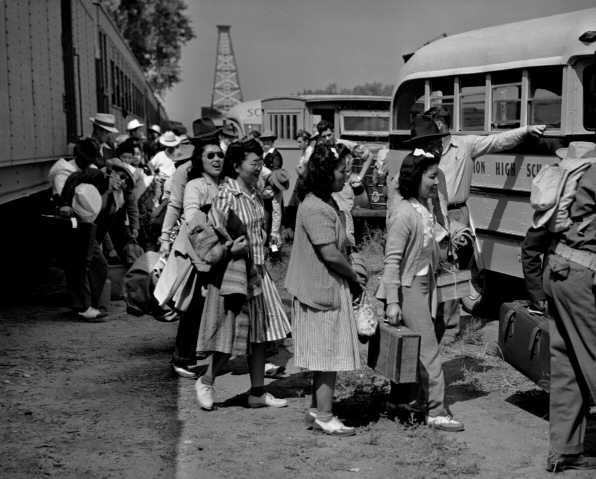
New arrivals disembarking from the train onto school buses waiting to take them to Amache.
The most evident lesson of the history of the Alien Enemies Act is that it is a wartime authority. It applies only during a war declared by the United States against another sovereign nation that has either invaded or threatened to invade the country. It was not invoked when it was originally passed because the conflict with France never boiled over into a formally declared war. When it was used during the War of 1812, World War I, and World War II, those conflicts provided the legal rationale. Political rhetoric claiming that undocumented immigrants represent an invasion or predatory incursion does not justify invoking the Alien Enemies Act. Absent a declared state of war, using the Alien Enemies Act as a pretext to detain and deport immigrants currently living in the United States ignores this history. It bypasses protections for immigrants, including their right to seek asylum. It risks trampling upon fundamental principles, including the commitment to the rule of law, that have held the nation together for nearly 250 years.
Invoking the Alien Enemies Act outside of wartime and in defiance of its history will, as it has in the past, infringe upon the rights of immigrants and harm the soul of the nation. What distinguishes the United States from other nations is its core value of protecting innocent individuals from harm and injustice—a principle deeply rooted in its founding documents. The Declaration of Independence asserts that individuals possess inherent rights to life, liberty, and the pursuit of happiness. The U.S. Constitution and its Bill of Rights safeguard various individual freedoms, including freedom of speech, the right to a fair trial, and protections against unreasonable searches and seizures. Americans’ commitment to pursuing the ideals expressed in those founding documents in ways that protect people and promote a more equitable society is at the core of our national identity. It is in doing so that we seek to realize the American Dream of a “more perfect union.”