
 Membership
 Donate
 Shop
Shop



















When the Czar’s Son Dazzled Denver
The story of a Russian prince in the Queen City.
What do you do after finishing a few days of intense hunting? If you’re the Grand Duke of Russia, rest and relaxation is out of the question. Instead, you take a tour of local industry and follow it up with a grand ball in your honor at the poshest hotel in Denver.
We’re talking about Alexei Alexandrovich Romanov of Russia, often known in English as Grand Duke Alexis, fourth son of Czar Alexander II (yes, the emperor who’d sold Alaska to the United States for only a mere $7.2 million, or two cents an acre). By some accounts, the Grand Duke’s life reads like a script from a torrid royal soap opera of forbidden love. His young adulthood has all the makings of a film, opera, or musical (in fact he has been portrayed in movies and TV westerns).
In 1871, Grand Duke Alexis was sent to the United States by the Czar on a goodwill tour, protracted and carefully negotiated by the two countries, ostensibly to bolster relations between them. The three-and-a-half month North American tour was eventually expanded, resulting in a two-year round-the-world voyage to a number of countries.
It was said the tour and long voyage was ordered by Alexis because the Czar was upset about his twenty-one-year-old son’s affair with Alexandra Vasilievna Zhukovskaya, who was eight years older than the prince. Alexandra was the daughter of a famous poet who had also been a long-time tutor in the royal family. To keep her away from the lovestruck son, Alexandra was exiled abroad. By forcing a long separation from the object of his affection, it was hoped the fires of love would cool and he would come to his senses.
Marriage between royals and persons of lower rank (called a morganatic marriage), whether commoner or minor nobility, was strictly prohibited not just in Russia but in other traditional monarchies. Punishment could be as severe as banishment from the royal’s country and stripping of all titles and privileges. Alexis’s youngest brother Grand Duke Paul suffered those consequences after he married, so such a fate would be entirely conceivable for Alexis if he defied his father. It was widely believed that, in fact, the Grand Duke secretly married Alexandra (a belief shared today by his descendants). Several months after Alexis’s departure from Russia, she gave birth to his son. Perhaps the compulsory round-the-world trip for Alexis was a temporary banishment of sorts, a warning and taste of what awaited him if he did not comply with the Czar’s wishes.
Shortly after he arrived in New York, America became consumed with “Alexismania.” He was the first Russian of such prominence to visit America. The Grand Duke became nonstop front-page news everywhere he stayed during his three-and-a-half-month stay in America; newspapers reported what he wore, what he ate and drank, and every other imaginable detail of his visits. The residue of the mania would show itself in letters, diaries, memoirs, and with children and even cows named after Alexis, and obituaries mentioning that the dearly departed had once danced with the Duke.
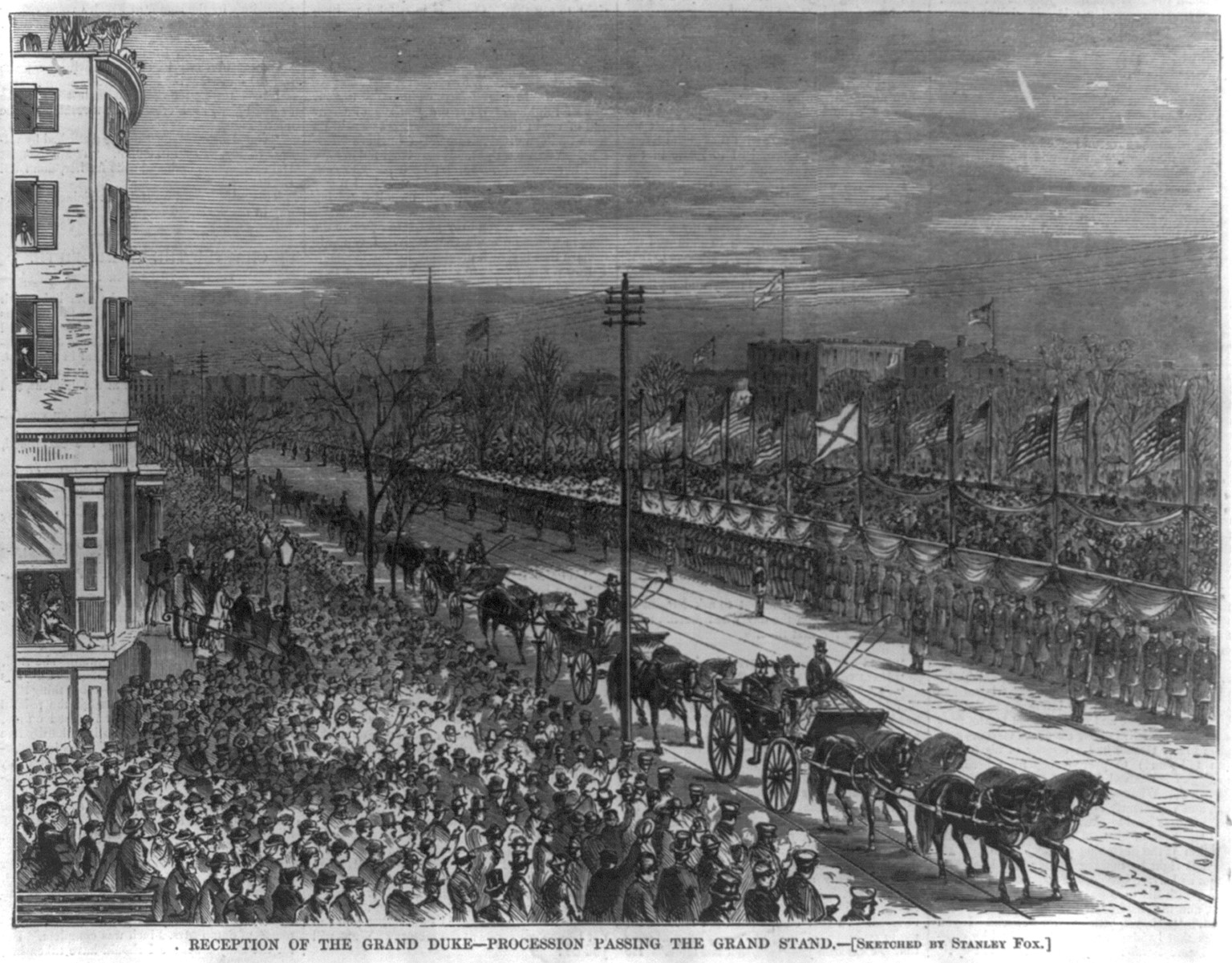
A newspaper illustration depicting the grand reception of Grand Duke Alexis at New York City, his first stop in the United States.
After leaving New York Alexis traveled south to visit President Grant at the White House. From there, Alexis and his party visited the major cities in the east and midwest, with a brief detour to Canada, traveling on special ducal trains outfitted like a luxury hotel, provided by the railroad companies. He was hosted and toasted everywhere he went, met with enthusiastic crowds with speeches, parades, twenty-one-gun salutes, performances of the Russian national anthem, banquets and balls, and tours of various sights.
Along with the President, he met with some of the most famous and important names of the United States at the time, including many mayors and governors. His visits were marked with expensive exchanges of gifts with his hosts, and the Grand Duke often reciprocated this generosity. In Chicago he donated $5,000 (equivalent to a quarter million dollars today) for those left homeless by the Great Chicago Fire, which had occurred only a few months earlier.
The Royal Buffalo Hunt
Planning for a hunting trip was assigned to the US military, which began the exhaustive preparations to accommodate the Grand Duke with the limited resources of the new state of Nebraska and the young Colorado Territory.
After touring the East and Midwest, the Grand Duke took a special train westward to Omaha, and on to North Platte, Nebraska. From there, escorted by soldiers of the Second Cavalry, the party took an eight-hour trip by a cavalcade of carriages and wagons to a large assemblage of plushly-carpeted and stove-equipped tents they named Camp Alexis. There, he was welcomed by Generals Joel Palmer and George Sheridan.
Although Alexis was an experienced hunter, he was a greenhorn when it came to the American bison―but Sheridan provided him with experienced (and infamous) instructors. He invited Major General George A. Custer, still five years away from the Battle of the Greasy Grass (or the Battle of the Little Bighorn), and a young William “Buffalo Bill” Cody to act as the Grand Duke’s escorts and guides. Cody was already well-known worldwide for his buffalo hunts, which had earned him his nickname only a few years earlier. He had been contracted to hunt buffalo as part of a widespread campaign to force Colorado’s Native peoples from their lands by robbing them of their sustenance. Cody allegedly killed over four-thousand of them between 1867 and 1868, earning him the controversial (even at the time) title of “champion buffalo-killer of the Great Plains.”
The Duke’s “Great Royal Buffalo Hunt,” as it came to be known, began on January 14, 1872, his twenty-second birthday. It took place on the southwestern plains of Nebraska, a few dozen miles from the border of the Colorado Territory. If His Imperial Highness was looking for a real adventure, he may have got an unexpected dose of it when he was (allegedly) charged by a wounded buffalo and forced to climb a telegraph pole.
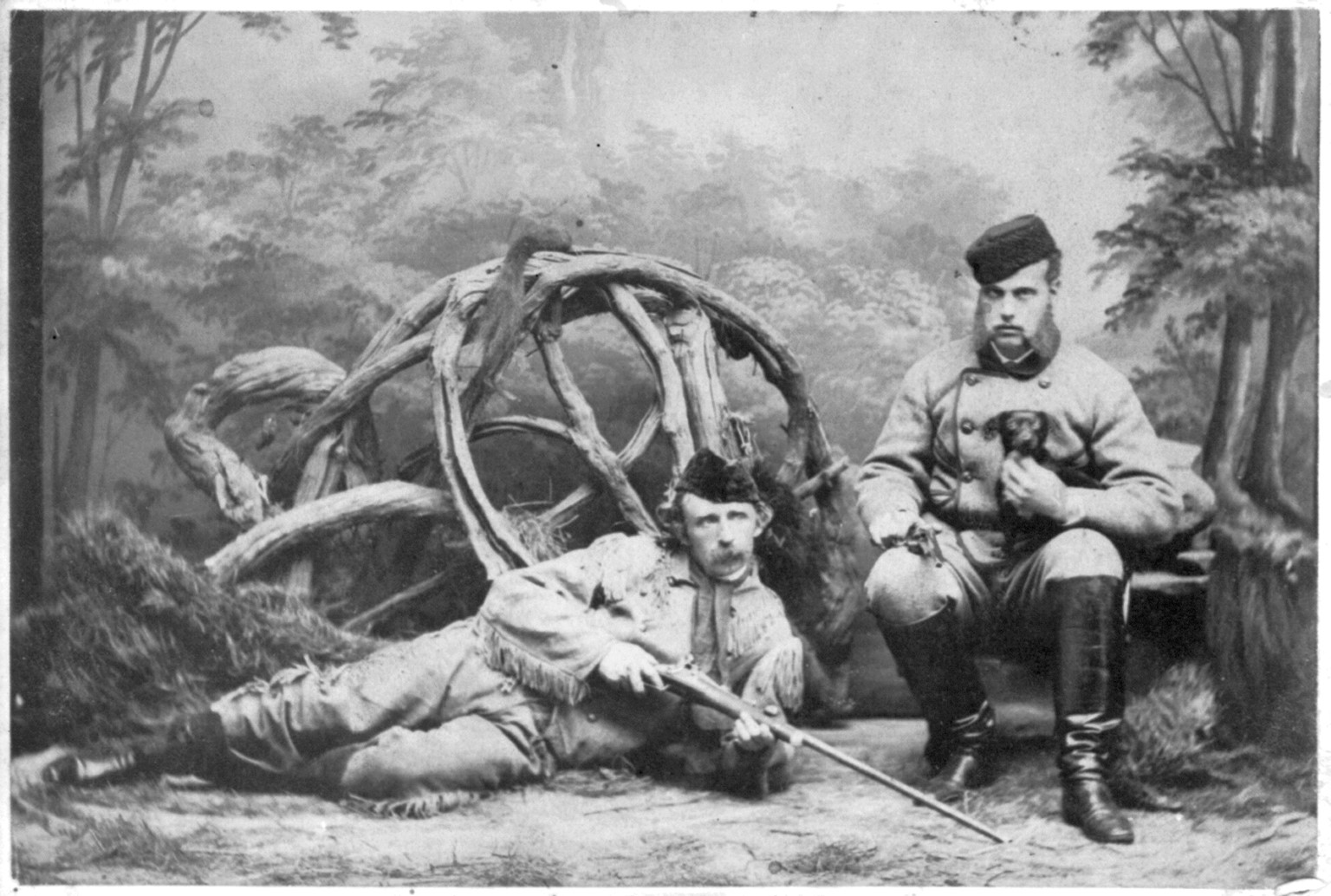
Grand Duke Alexis (right) posing for a photo with a puppy while dressed in hunting uniform, while General Custer (left) lounges with a rifle. This studio photo was likely taken shortly after the “Great Royal Buffalo hunt” in western Kansas, January 1872.
By the end of the hunt, Alexis had shot at least two bison, though Buffalo Bill Cody would later claim the Duke had shot eight. Alexis sent a messenger to the nearest telegraph office to inform his father, the Czar, in St. Petersburg, of his feats. The success of the hunt was celebrated in the camp with a basket of champagne brought out by the Duke’s entourage. The buffalo hunt received more press coverage than any other part of Alexis’s trip, and was reportedly the Grand Duke’s favorite part of the grand tour. After the hunt the party was back on its private royal train, which chugged on to Cheyenne, Wyoming, where they met a delegation which included Colorado’s Territorial Governor Edward McCook, former Governor John Evans, then-Legislator and future Denver Mayor Joseph Bates, and other prominent politicians and citizens.
The Grand Duke’s next stop would be a three-day visit to Denver, “the Queen City of the Plains.”
The Grand Duke in the Queen City
Denver was abuzz about the anticipated arrival of the Grand Duke. A reporter for Pueblo’s Colorado Chieftain observed a curious juxtaposition of the citizens’ enthusiasm for the visit despite the fact that Americans “are down on monarchies” and “hate lords and titled ladies.” Instead of indifference and antagonism, the day before the Grand Duke’s arrival “we found the town in a regular roar and hullaballoo of excitement… The popular pulse was at fever heat.”
It was reported further in the newspaper that people had been standing for hours in the ankle-deep snow to get a peek at the Grand Duke, waiting for him to arrive on the train―not just any train, but a “glittering train,” the special cross-country ducal train of five “palatial cars.” The journalists were clearly also impressed, as another reporter wrote, “The train of itself is one of unequaled magnificence… The cars are furnished in regal style and are fully fitted for the reception of any monarch of earth.”
The Duke finally arrived in Denver on January 17 at five o’clock at the Denver Pacific Depot. It was Denver’s first train station, completed two years before in 1870, and was located at Twenty-First and Wazee Streets, in the middle of what is now Coors Field.
The Grand Duke himself finally emerged. According to The Rocky Mountain News:
“The grand duke put a finishing touch upon his pearl-colored gloves, buttoned his great coat, lit a cigarette, and stepped upon the platform… [He] advanced with a military air, gazing neither to the right nor left, apparently oblivious of the fact that he had stepped into the edge [of] a crowd of staring westerners.”
At the time, the city of Denver was relatively obscure, unimportant, and underdeveloped, so it had never before hosted such a grand party of foreign dignitaries. The arriving party included an impressive list of titles: a Russian admiral, a consul general, a count, a lieutenant of the Imperial Navy, and a “councillor of state.” The less exotic members of the party included Union Pacific officials and a reporter from The New York Herald. They, and five servants of the Duke, were ushered into elegant horse-drawn carriages and “driven hastily to the American.”
This was the American House, the largest and finest hotel in Denver at the time. With 200 rooms, it was deemed the city’s “first modern hotel.” Denver’s western welcome did not end at the depot, but had flooded into the hotel:
“Arriving at the hotel the ducal party came near being swallowed up in the hungry maw of the immense crowd. They overflowed into the halls, parlors and stairways and dodged every footstep with wonderful pertinacity.”
It goes without saying the Alexis party was provided with the hotel’s finest, most-luxurious rooms, which—according to a “peculiar fad” of the Grand Duke’s, recalled by the hotel proprietor’s son many years later—were furnished with entirely new furniture which had never been used before.
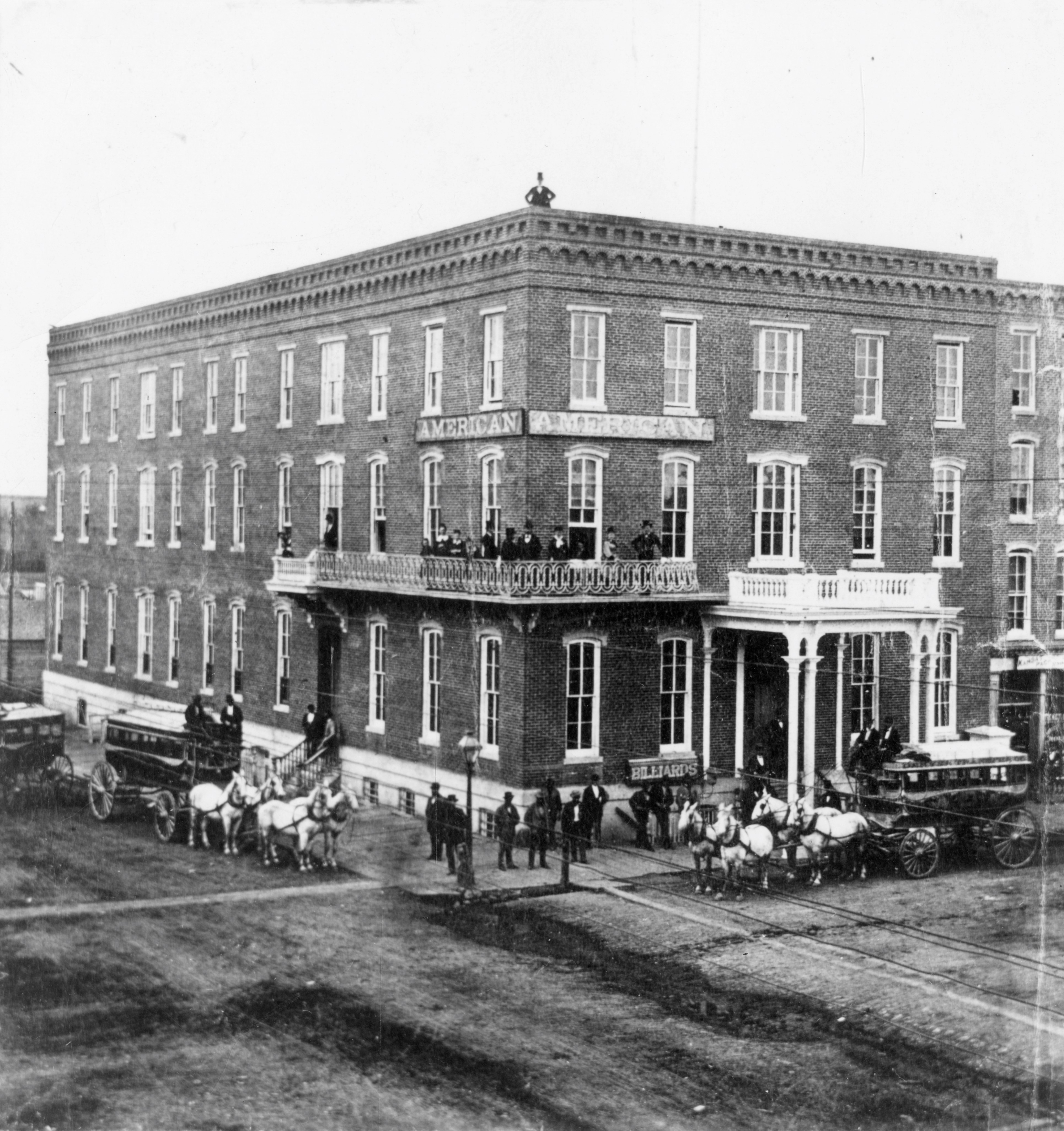
The exterior of the American House, the hotel where Grand Duke Alexis stayed, circa 1920. Fifty years earlier it had been the grandest hotel in Denver.
On January 18, his second day in Denver, Alexis slept in, had breakfast around noon, and was rested and ready for a planned afternoon of Denver sightseeing, including a jaunt south to catch a view of Pikes Peak in the distance.
After admiring the splendid scenery, the party was driven to the Denver Ale Company, on “the west side of Denver.” Alexis, who had been popping the corks off the finest French champagne on his buffalo hunts, was now invited to quaff Denver’s local beer.
All this sight-seeing aside, the grand duke’s tour was not all for his own pleasure. Alexis and his entourage seemed to be genuinely interested in seeing the inner workings of the success of the United States. The duke and his fellow dignitaries were keen to visit state-of-the-art factories, meat packing plants, grain elevators, steelworks, and even prisons.
He toured the city’s recently-built waterworks―the most advanced waterworks system of its kind west of Illinois, and that evening attended a ball (likely more humble than what he was used to, but a party nonetheless) organized by the Pioneer Club, in honor of both the duke and General Sheridan. The ball was held at the American House, and before the dance the “squarest meal ever eaten in Colorado” was served.
After the dinner, the party moved to a ballroom “not too elaborately decorated,” in which a single American flag and a Russian flag were displayed side-by-side. The dance was apparently wilder than some of the guests were used to, with the New York reporter describing a “jovial carnival nature” which was “peculiar to festive gatherings in this section of the country.”
Alexis entered the ballroom with the First Lady of Colorado, Governor McCook’s wife leaning on his arm, followed by a host of dignitaries, including legislators, and their escorts. Once the dancing began, the Duke’s time on the floor was not all smooth. He apparently stumbled during the opening dance (a “plain quadrille”) and was somewhat flummoxed by an American-style square dance. The Rocky Mountain News reported that the Grand Duke “assured his partner during the dance that he much preferred the waltz.” However, the Chieftain reported (almost certainly satirically) that he “only swore once during the evening” when someone stepped on his foot.
The dancing went on long into the night, growing wilder and less organized as it went on. The Rocky Mountain News reported: “The crash became general, the squeeze unbearable, the whirl was softened into a surge, and this was continued until 2 o’clock, when the festivities were concluded….”
The party was apparently well-remembered for decades by those who had attended. In 1901, Jerome Smiley, author of History of Denver, wrote that “more than one Denver dame [...] cherishes among the brilliant and delightful episodes of her social career the remembrance of her dances with the Russian Grand Duke at that locally famous ball at the American House.”
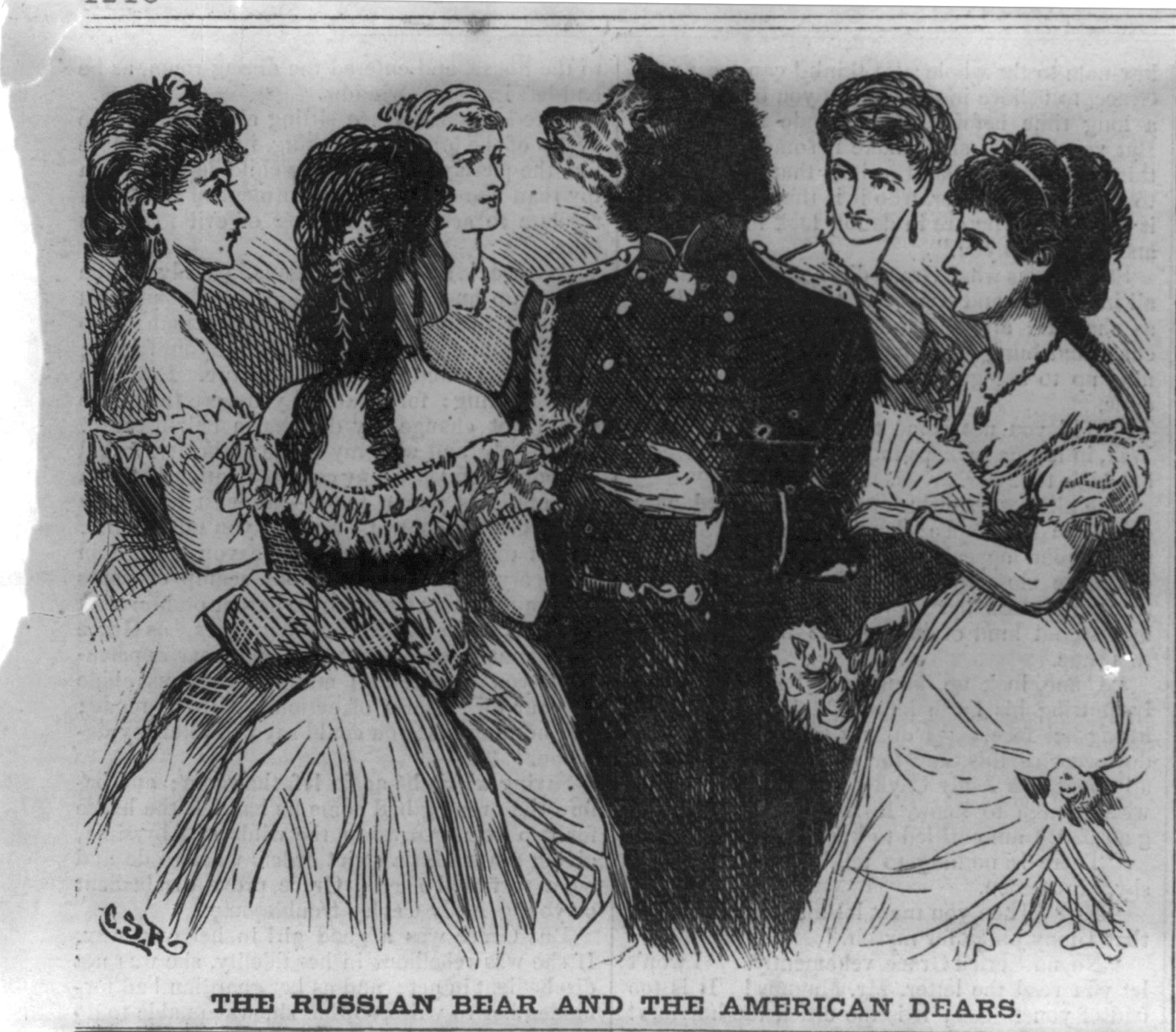
This political cartoon depicts Grand Duke Alexis as “the Russian Bear”, surrounded by young women. This is in reference to the celebrity Alexis enjoyed during his tour of the United States.
Rocky Mountain Excursion and One Last Hunt
Colorado was on the Duke’s itinerary for good reason. The Pikes Peak Gold Rush of 1859 had been internationally famous, and while the initial frenzy had waned by 1872, Colorado was still an alluring center of gold and silver mining.
So, on the third and last day of the Grand Duke’s stay in Denver, the Colorado Central Railroad Company invited the royal party to take a special train to Golden. It was a great piece of publicity for the railroad, which would shortly extend its line as a narrow gauge up Clear Creek Canyon to Central City and the other mining centers.
Soon afterwards, the party went to inspect a nearby coal mine. While Alexis did not descend into the mine to watch the miners work, some of his entourage did and were apparently impressed by what they saw.
After a couple of hours spent in Golden, the party was taken in carriages up the narrow, winding, boulder-strewn Clear Creek Canyon west of Denver. As it was still mid-January, and apparently it was very cold in those high mountain passes, with some of the attending reporters experiencing “frostbitten ears and uncomfortable feet.” The Russian was apparently more acclimated to the cold, and praised the weather as “one of the most charming and inviting of the season.” The party made several stops to gaze at the “enchanting scenes” surrounding them and admire the natural beauty of the Rocky Mountains.
It was noted that Alexis was clearly enthralled with the scenery, and it was with some reluctance that he had to pull away from all the Rocky Mountain beauty, the Russian party returning back to Denver at about five in the evening. It was to be their final night in Denver.
At the Denver ball, Custer had heard boasting about a buffalo herd near the Beeson ranch near Kit Carson, east of Colorado Springs. Alexis had become enamored with buffalo hunting and was eager for more. With General Sheridan’s approval, a second hunt was arranged immediately after they left the city.
The Alexis party left Denver on the Kansas Pacific Railroad for St. Louis, stopping at Kit Carson, where horses and a camp were waiting for them. Although the whole town turned out to see the Grand Duke, the hunting party did not want to waste time on “idle ceremonies” and hurried off to the hunting grounds.
The hunt lasted two days and wasn’t without its escapades. Some of the party narrowly escaped a charge by a pack of buffalo enraged by the shooting, and some sources (of uncertain reliability) report that the group ordered a keg of whiskey from Kit Carson. The grand duke was said to have killed up to five buffalo, and several dozen more were killed by other members of the party.
Having spent five days enjoying Colorado and its unique attractions, the Grand Duke finally met back up with his ducal train and headed back east. However, the hunting wasn’t quite over yet. The plentiful bison of Kansas were easy targets from the moving train, and in a display of the callous attitudes at the time towards the bison and the Native North American people who depended on them, the Grand Duke killed at least six, and his compatriots even more, on their journey.
Alexis’ visit to North America continued for another month, during which time he toured the southern states and even attended Mardi Gras in New Orleans. In late-February the Russian fleet rendezvoused with the Grand Duke at Pensacola, Florida, and he sailed off for the next leg in his round-the-world excursion.
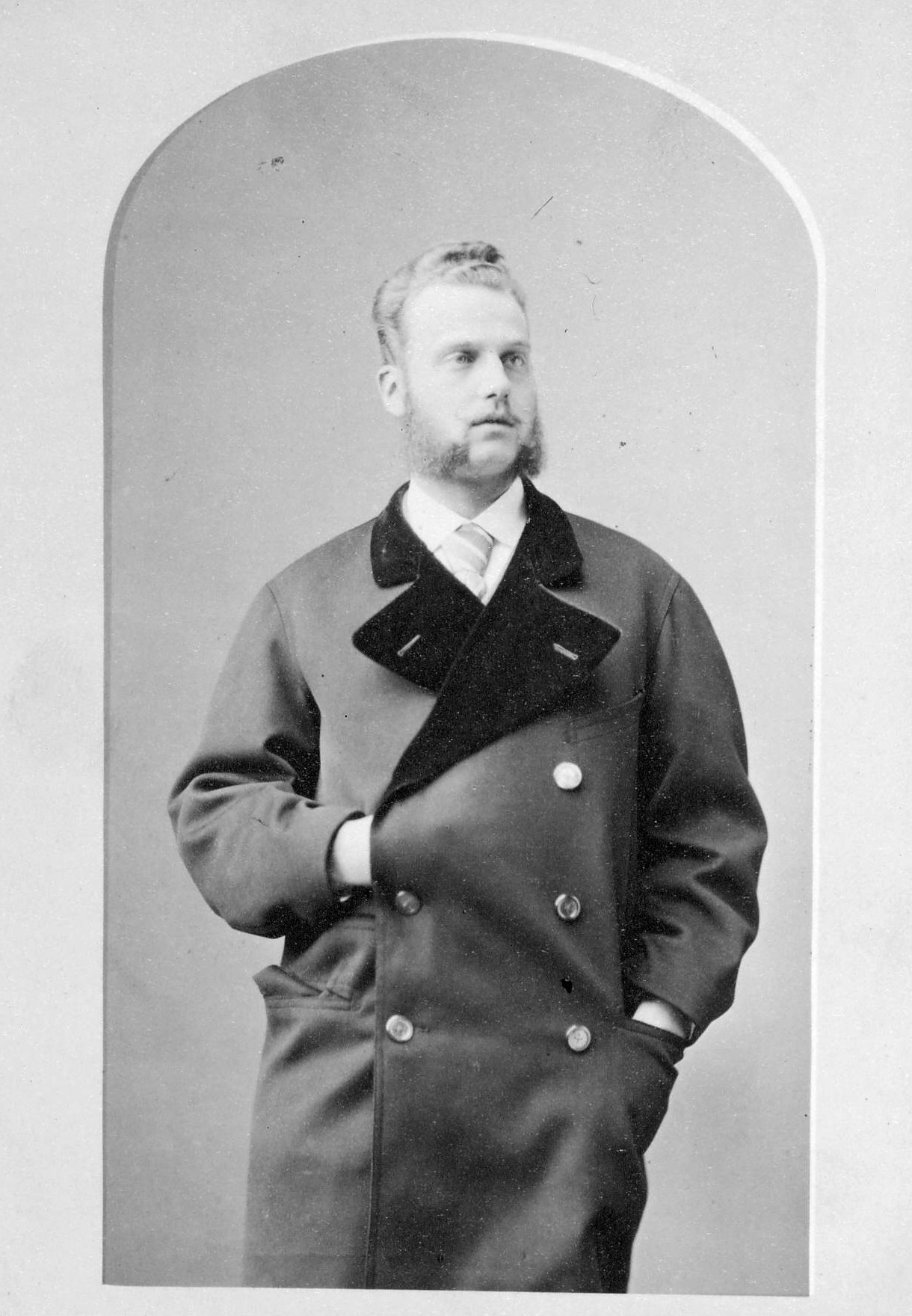
A portrait of the young Grand Duke Alexis, taken somewhere in the United States in late 1871. From a compilation booklet about his visit, published in 1872.
Legacy of the Grand Duke
Alexis’ trip garnered quite a bit of backlash. There were many who continued to disapprove of the “Alexismania” that had apparently spread in some cities, viewing it as an embarrassment for a democratic republic to fawn over foreign nobility. Even his trip to Colorado, which was seemingly more humble than his visits to the great cities of the East, drew quite a bit of controversy. His heavily-publicized buffalo hunts helped draw attention to the widespread slaughter of the American bison. Some press commentators decried the hunts as wasteful, and such unexpected attention sparked some of the earliest backlash against the overhunting of the animals, though it failed to spark similar concerns for tribes like the Cheyenne, Arapaho, and many others who depended on the bison and whose homelands Anglo-American settlers had invaded.
Some newspapers even reported that the Grand Duke, with a reputation for womanizing thanks to his long-standing (though seemingly monogamous) affair with a commoner, was behaving flirtatiously with some women. Likely worried about his parents’ reaction to such rumors, Alexis was sure to write to his mother dismissing these stories:
“Regarding my success with American ladies about which so much is written in the newspapers, I can openly say, that this is complete nonsense. They looked on me from the beginning as they would look on a wild animal, as on a crocodile or other unusual beast.”
Like famous foreign tourists such as the Marquis de Lafayette before him and the Beatles long after, Grand Duke Alexis was followed everywhere by exuberant fans. Some even traveled from state to state, following along the Duke’s itinerary to always be in his wake—an early example of groupies. Newspapers were especially fond of reporting (and exaggerating) the attention Alexis received from his female fans, going into great detail about alleged mobs of women driven into a frenzy by the sight of him, or requesting articles of his clothing as souvenirs.
While he is an obscure figure today, Grand Duke Alexis left a remarkable impact on the culture of the time. His visit to the United States was commemorated in popular songs, stageplays, and works of art. His travels and encounters were widely reported across the country for the entire duration of his trip, accurately and otherwise, and he became one of the first great celebrities of American culture.