
 Membership
 Donate
 Shop
Shop


















Healing Injustice on the Plains
Pause and Reflection at Amache and Sand Creek
A first-hand account of two communities in southeastern Colorado which came together to demonstrate their resilience as they commemorate the past.
Although only mid-May and at an elevation of nearly 3500 feet, the forecast temperature for southeast Colorado was ninety-one degrees. People from around the state and around the country would gather for a 3:00 P.M. ceremony to mark the dedication and formal ribbon cutting of the newest addition to the National Park system, the Amache National Historic Site. Most of the more than 300 attendees had made the three-and-a-half hour drive through the prairie from Denver, passing through small towns, towns that often smelled of manure from the stockyards nearby.
Turning off US Highway 50, my car traveled the same dirt road that had confronted the first arrivals when they reached the site in 1942. Gone were the barracks of the Military Police (MPs). The grassy area that remains now acts as a parking area for visitors, and I accordingly guided my rental car into an open space. No gate to the camp remains, but when I explored the roads that mark the boundaries, I found barbed wire still stretched along the edges of the former camp. Were it not for the information kiosks identifying some of the locations of former buildings, it would be nearly impossible to imagine that this one-square-mile plot of arid land was once Colorado’s tenth largest city, home to thousands of people. Only the grid of dirt roads, concrete foundations, and some of the trees and bushes planted by the inmates remain as visible testaments to what existed here.
As the temperature rose, many gathered under tents set up by the Park Service to shelter the attendees. A stiff breeze blew from the southwest, the same wind that blew sand through the cracks in the barrack walls when the camp was active. A line of flags representing the participating entities backed the speakers’ platform, facing a line of cameras from local, regional, and national media that recorded the proceedings. Introductory comments were offered by Chuck Sams, Director of the National Park Service (NPS), newly confirmed as caretaker of the property. The presence of some on that stage, including US Senators Cory Gardner (former) and Michael Bennett (current) who supported preservation legislation for Amache, helped to convey the US government’s regret over the decision to imprison its own citizens merely for their ethnic background. Others, like Reggie Wassana, governor of the Cheyenne and Arapaho Tribes, spoke in solidarity, representing other communities which had also suffered greatly from unjust government actions, while Marcie Moore Gantz gave greetings on behalf of Colorado Lieutenant Governor Dianne Primavera and History Colorado. A unique perspective on the site was given by Antonio Huerta, a former Granada High School student member of the Amache Preservation Society, and now the southern regional director for Senator John Hickenlooper, himself an active supporter of site preservation who could not attend.
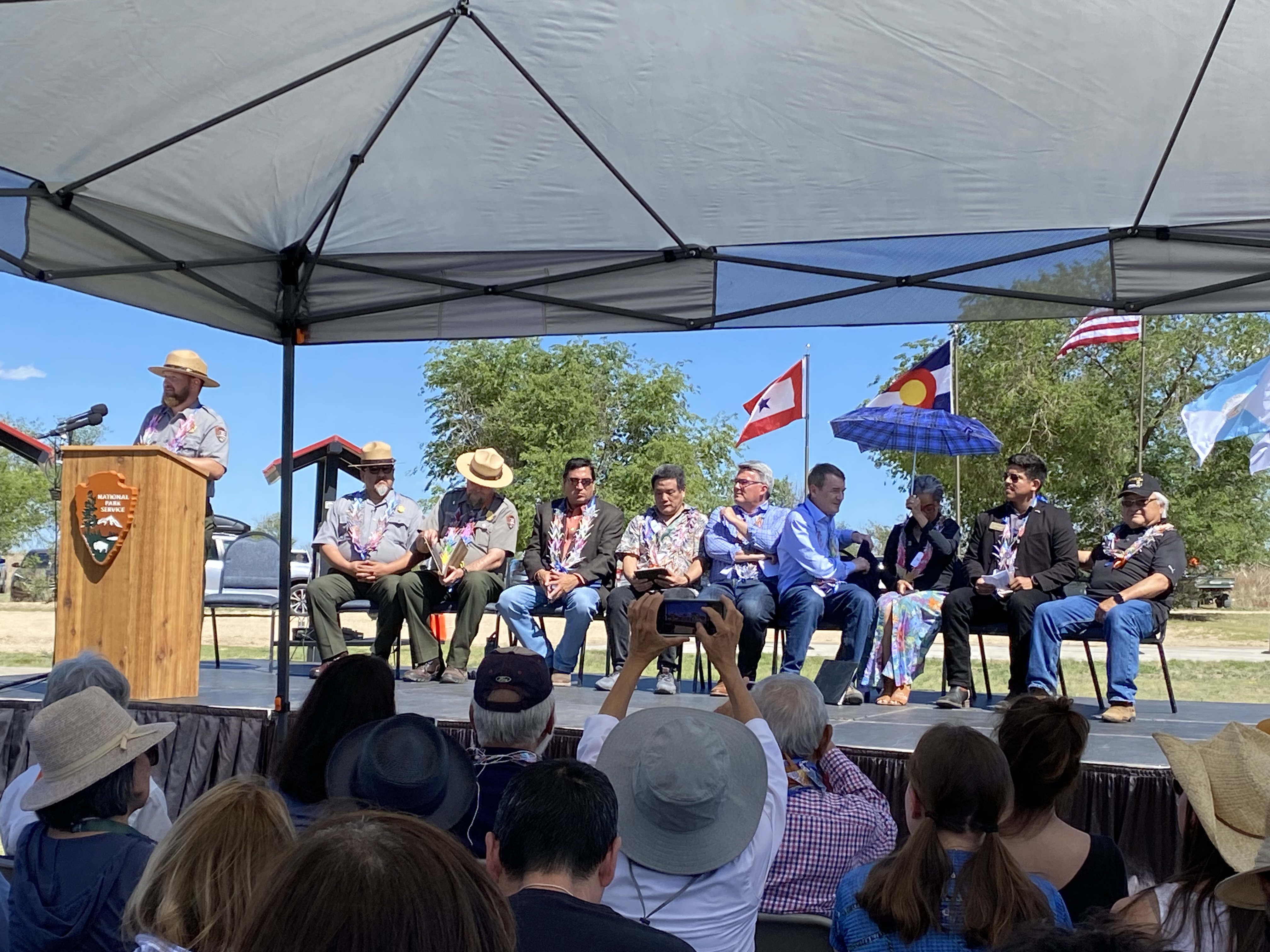
Speakers at the ribbon cutting for Amache National Historic Site.
But the most meaningful messages were spoken by those who knew from personal experience the impact of the Amache internment. John Tonai, whose father Minoru (Min) Tonai was president of the Amache Historical Society and died in 2023, spoke not only about the injustice suffered by the more than 10,000 people incarcerated over the years at Amache, but the legacy of heartbreak that they carried throughout the remainder of their lives. His comments were joined by those of Mike Honda, former US Representative from California, who was interned at Amache as a small child between 1942 and 1945.
Once each of the eight people on the platform had spoken, they all stood for the ceremonial cutting of the ribbon. The crowd applauded and rose to mingle, chat, and thank the speakers. Visits by van to barrack sites were announced, but a trip along the dusty roads to stand in the hot sun was clearly not appealing to most. I sat down next to an older Japanese American woman and a young man who turned out to be her grandson.
By way of conversation I asked, “What’s your relationship to Amache?” I figured she must be a descendant, since she appeared far too young to have been in a camp that closed nearly eighty years ago.
“I was born here,” she answered simply. She had brought her grandson to learn about the camp and to see where his grandmother had been born. Meeting someone who was born in Amache was not something I had expected, so it was only later that I thought of questions I might have asked. For a child born just before or after the incarceration, it must have been possible for parents to bypass discussion of the camp experience (as many apparently did), but when a child was actually born in the camp, the fact was evident whenever one submitted a birthdate. Incredibly, 412 babies were born in the Amache camp during the approximately three years the camp was in operation. “Did you feel different or special growing up because of where you were born,” I wish I could have asked. “Does it help that recognition of the injustice of Amache and other ‘relocation’ camps is becoming something much more widely known among the American public?”
My contact for the weekend was the energetic octogenarian Carlene Tanigoshi Tinker, who had been held at Amache as a little girl. Carlene is a passionate, erudite, and fearless public speaker, and had spent much of the day in on-camera interviews for ABC’s long-running news show, Nightline. I caught her after the ceremony, and she was exhausted. Even so, she made sure to let me know that I should plan to attend the evening presentation at the Granada School in town, preceded by an informal sandwich buffet supper pulled together by community supporters of Amache preservation and veteran attendees of the yearly pilgrimage.
Found on the eastern edge of the small town, Granada School is a clean and modern building with excellent facilities. When I got there, food was arriving sporadically, but there were only a couple of volunteers to set up the tables and arrange food. Wanting to contribute, I pitched in. I met Joyce and Art Woods, who had flown their plane from Albuquerque. Soon the table was filled with makings for sandwiches, as well as chips, Mexican food, and fried chicken, just as people began to arrive in their dozens. After the “snack,” as it was listed in the schedule, people filled the auditorium for presentations by a number of speakers.
Because of Amache’s upgraded NPS status, this year’s gathering included more people than in the past. It also marked the formal implementation of a couple of new initiatives; hence, there was a rather large number of presenters. NPS representatives and archaeologists spoke about plans for preservation and research, and descendants of both Amache and the Sand Creek Massacre discussed the site’s namesake, the Southern Cheyenne woman Amache (Ameohtse'e) Ochinee Prowers, and how the descendant community works together to preserve the history of the site. To conclude the program, Amache Alliance volunteer and PhD student Julia Shizuyo Popham played a beautiful violin rendition of “Auld Lang Syne,” the song that was played over loudspeakers as that last train chugged away from the station, leaving sunny California and heading across the arid Southwest toward Amache.
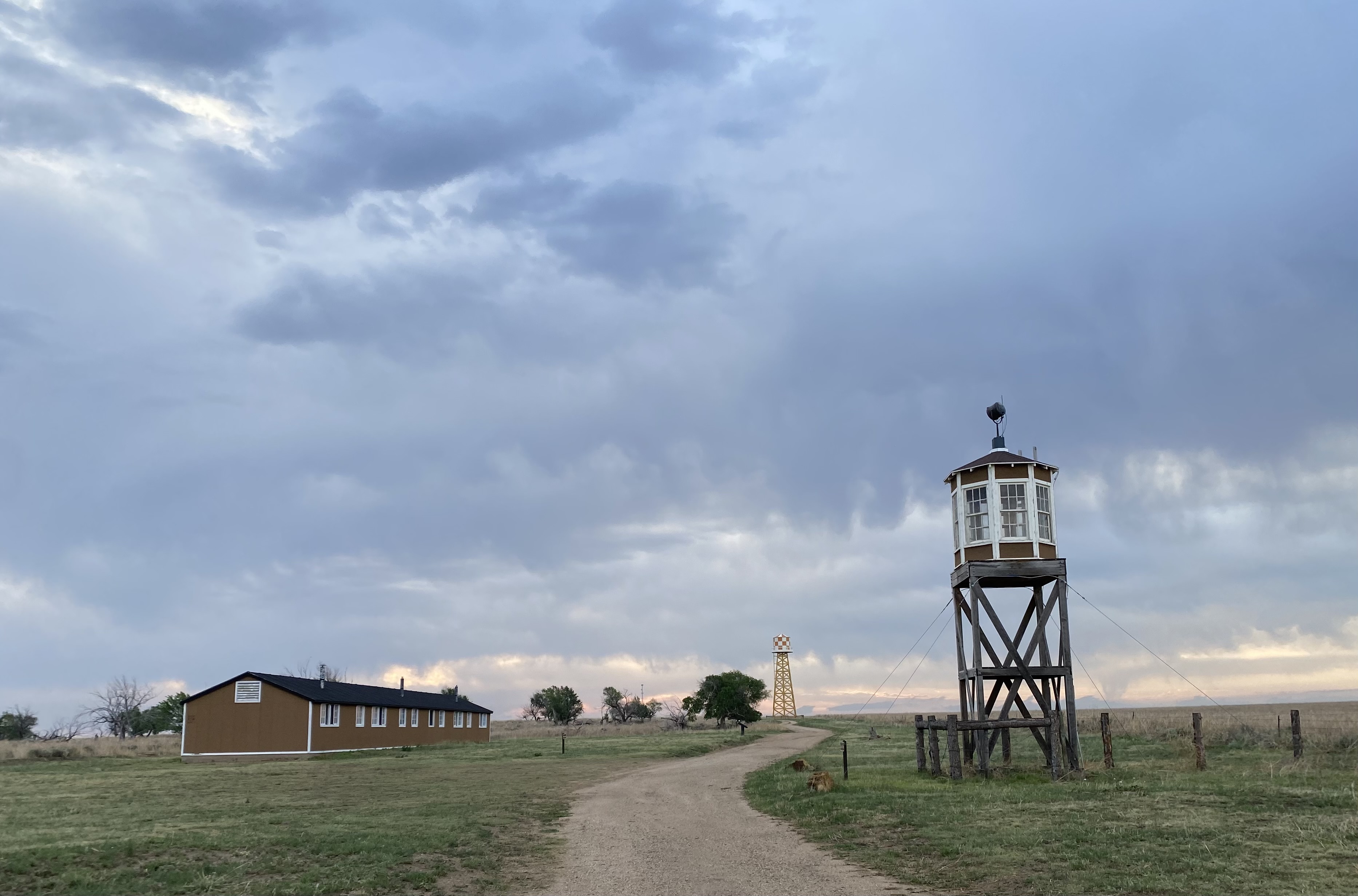
Barracks, guard tower, and water tower at Amache today.
The Pilgrimage
I stayed in a lovely bed and breakfast in Coolidge, Kansas, just over the state border, and woke up early to run the perimeter of what was once known as Camp Amache, originally named the Granada Relocation Center. During the weekend I heard someone take exception to the use of the word “camp” to describe these sites, since it can give the impression that they were places for recreation or relaxation. What I saw on my run would never make the cover of a travel brochure, and the dry, dusty roads and scrubby desert plants certainly did not create an environment conducive to enjoyable camping. As I headed southward up the incline toward the back of the site, I also pondered the terms used for the people who had once occupied the space around me. Official documents of the 1940s frequently used the word “evacuees”—as if the US citizens and legal immigrants sent there were being saved from a dangerous situation like a natural disaster. The US National Archives contains hundreds of files using the term to refer to Japanese Americans forced from their homes during WWII. Clearly, the choice of this word was designed to obscure the fact that American citizens were being confined under duress, in violation of the US Constitution. More recently, the term “internees” has been widely used, but many in the Japanese American community now prefer the word “incarcerees” as a more accurate description of their status.
Moreover, when they were active in the 1940s, these places of incarceration were euphemistically called “Relocation Centers.” Institutions like Amache, one of eleven such locations west of the Mississippi River, can rightly be considered “concentration camps,” since people there were forcibly concentrated into a small area with others like themselves. Given that all of the buildings were only a single story, squeezing more than 7,000 people at once into just one square mile created a very dense community indeed. In addition to the 348 barrack buildings (divided among twenty-nine blocks), within that square mile were shower and toilet facilities, communal kitchens and mess halls, common spaces for meeting and recreation, ball fields, warehouses, a hospital, a fire department, a water tower and a rainwater storage facility, three churches, a post office, a newspaper, a silkscreen printing workshop, administrative offices for both incarceree and War Relocation Administration (WRA) governance, lodgings for WRA employees, barracks for the MPs, and a motor pool. Amache was its own, self-contained little city, even including a co-op with retail shops that made it independently operational.
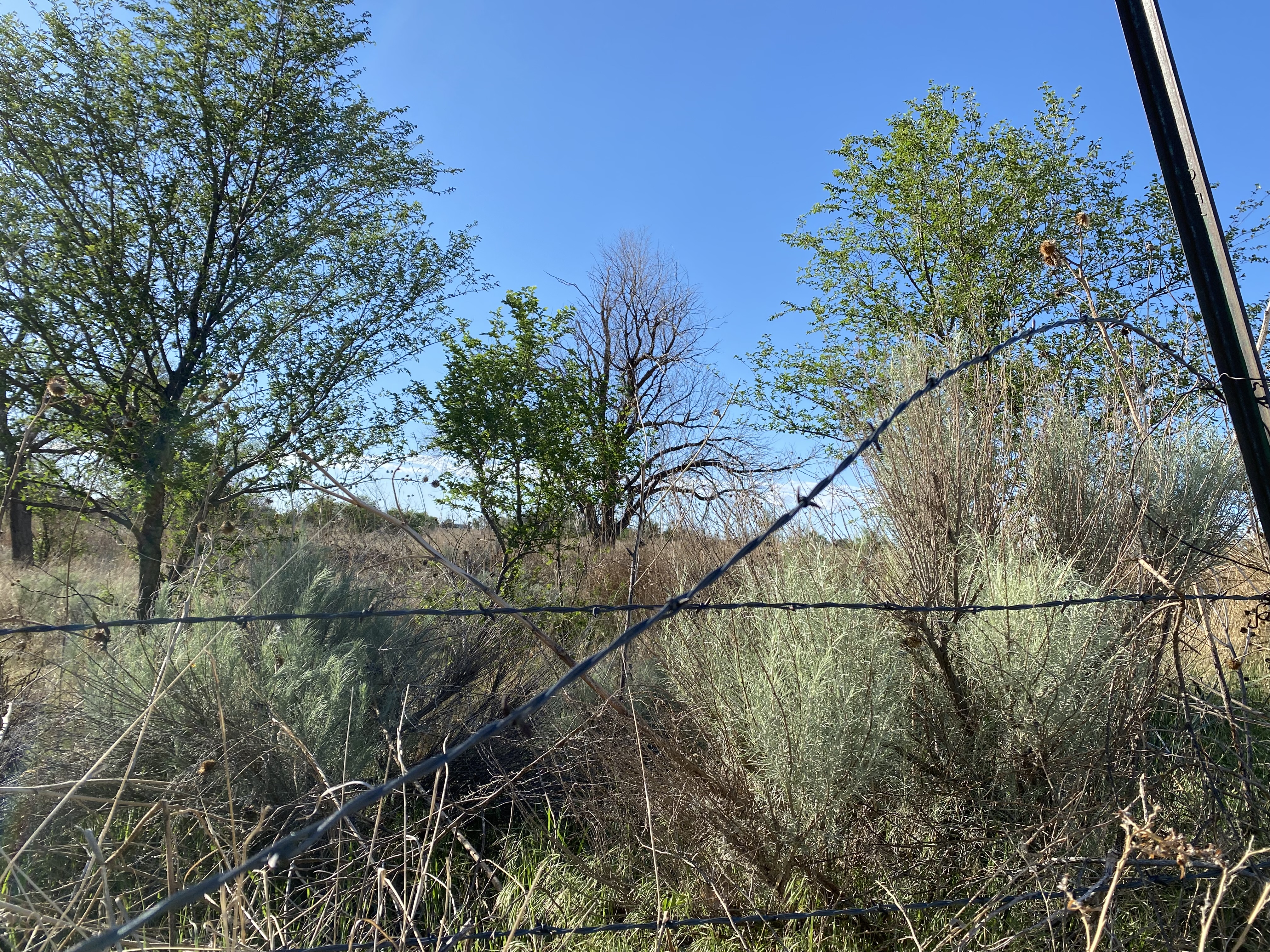
Barbed wire still visible at Amache.
Today, it is all but impossible for visitors to envision what was once here. On my early morning run, I found only quiet dirt roads, some scraggly trees, and overgrown concrete foundations marked with small signs indicating the block designation assigned when the camp was built: 6E, 8G, 12H, etc. Birds chirped, and a Burlington Northern Santa Fe line train rumbled as it passed through Granada, a little more than a mile away. Eighty-two years ago, Japanese Americans from California arrived via trains on that same line, exhausted by three days of travel and apprehensive of their life ahead.
I watched as the sun rose behind the old water tower—back in its original location after spending over fifty years in the shed of an area farmer. That water tower, along with the reconstructed guard tower and barracks, and a relocated recreation hall are the only buildings now found on this site that was once crammed with structures inhabited and used by thousands of people.
One of the places I wanted to be sure to visit was the cemetery. Located near the site’s southwest corner, the small plot lies outside the camp boundary. Did incarcerees need permission to visit it, I wondered? Photos taken more than a decade ago show the grave markers among the same desert scrub that covers unirrigated land throughout the region. The cemetery in its present state, however, is a lush oasis, with green grass shaded by pine trees. This transformation is the result of over a quarter century of efforts by Granada High School principal John Hopper and his volunteers in the Amache Preservation Society who have worked hard to preserve and enhance the site since the mid-1990s.
At the entrance to the cemetery stands a stone memorial to incarcerees who volunteered for service in the United States Armed Forces. These were men and women whose families had been imprisoned by the government, yet they still wanted to serve in order to prove their loyalty. Nearly one thousand Japanese Americans from Amache joined the US military, a higher percentage than any other relocation camp. Thirty-one of those lost their lives, and their names are inscribed on the memorial.
There are only a few headstones remaining to represent the 107 people who died while at Amache. The remains of most have been transferred to locations closer to loved ones. Of those still there, several are particularly moving. One simply reads “Matsuda Baby, Dec. 25, 1944.” What sadness must have been felt by the Matsuda family, to lose their little one while unjustly incarcerated, on a day when many people were celebrating. A number of children died at Amache during the three years of internment, including four who succumbed to an outbreak of smallpox earlier in 1944. Their graves, like most of the others, were moved from Amache by their families.
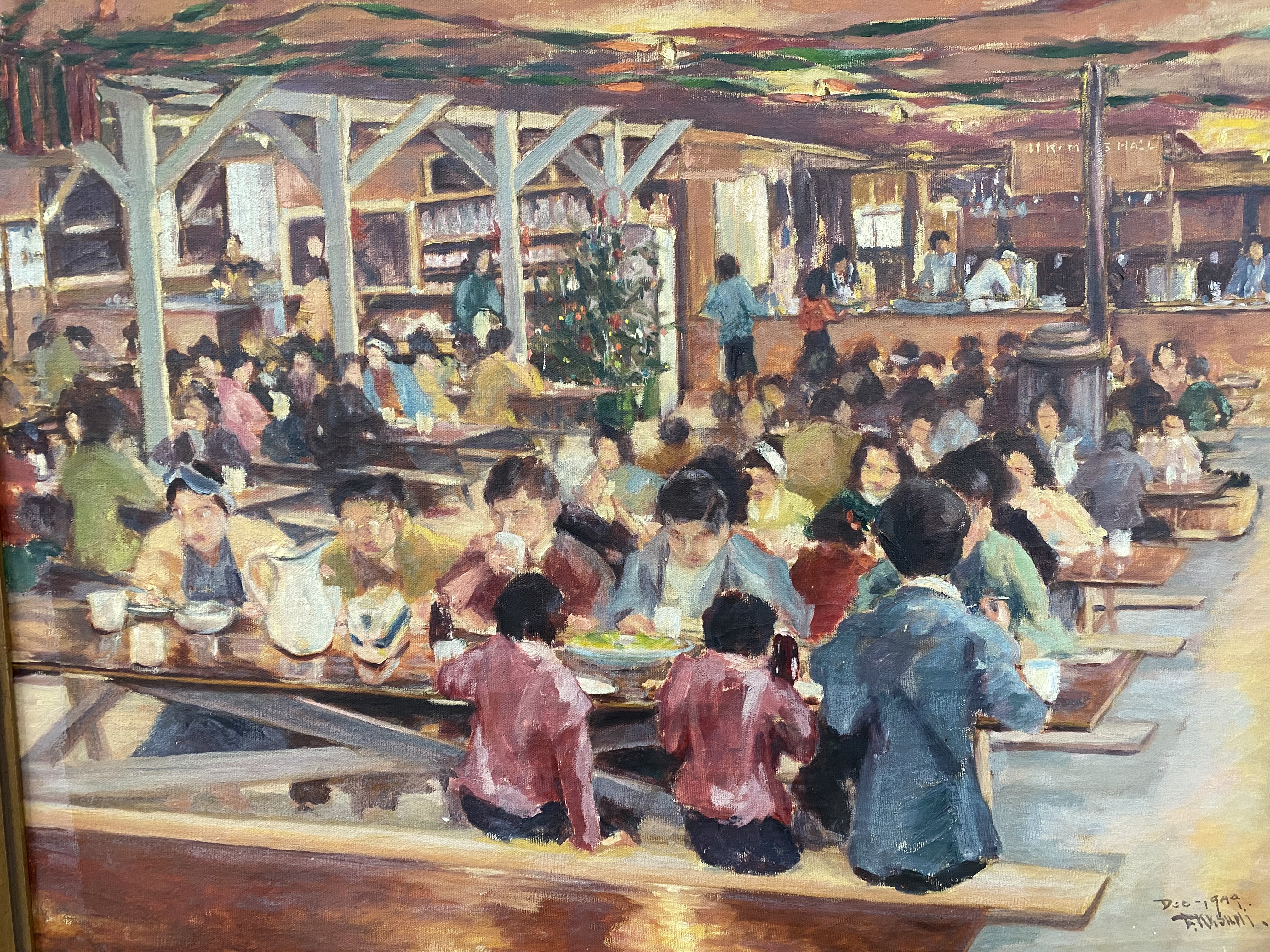
Amache Mess Hall, by Fukunosuke Kusumi (1894–1973), watercolor on paper.
I stepped over to another marker nestled in the green grass. It read, “Tomiko Kamimoto, Aug. 31, 1945,” and belonged to a girl or woman who passed away in Amache just after the war had ended. Records indicate that the last residents of Amache exited in October 1945, but many had already left for new homes and jobs around the state and around the country. How must it have felt to remain in the camp while others steadily departed for fresh lives elsewhere? We don’t know the age or circumstances of Tomiko Kamimoto, but it is sad to think of her life ending on the Colorado plains, her grave joining a few others surrounded by prairie grasses at the edge of an abandoned encampment.
In a little brick building adjacent to the graves is another stone marker, inscribed only in Japanese. It bears the word Ireitō (Cenotaph) and the date September, 1945, along with “Erected by Japanese Residents of the Amachi (Amache) Relocation Camp.” According to surviving photographs, at the time of its dedication, a wooden signboard inscribed in ink with the names of all who died was installed, but vandalism ultimately prompted its removal. It now survives in damaged form on loan to the Japanese American National Museum in Los Angeles. The stone cenotaph itself bears scars of bullets fired by callous thugs who broke in after the camp was dismantled.
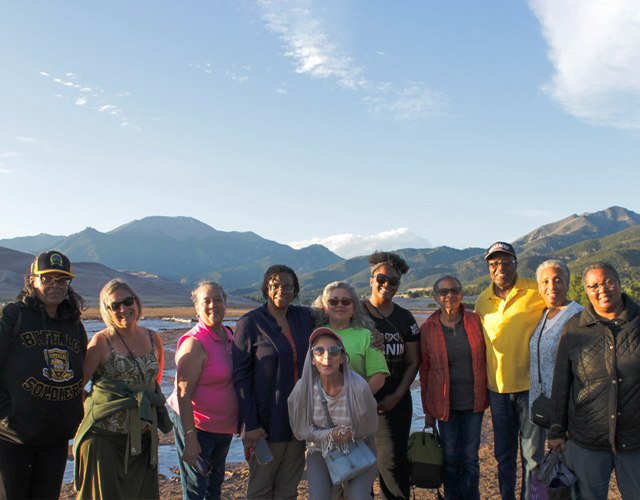
I met one car as I ran back out the dirt road from the cemetery. The driver waved, and I waved back. Today was the annual Pilgrimage, the day when survivors and descendants come together to visit the site, pay respects at the cemetery, meet old friends, and receive updates on preserving Amache. I hustled back to my car and returned to the B&B to shower, eat breakfast, and check out.
The online schedule for the day listed tours to the block sites for survivors and descendant families for the morning. A bus of Pilgrimage participants from Denver was scheduled to arrive by 11:00 for a memorial ceremony at the cemetery. Since I had already paid my respects in the morning and did not wish to intrude on the ceremony, I again helped to lay out food, this time for the potluck luncheon.
There was so much food to bring in from the Denver bus! Soon, the line of tables was loaded, and there was still more food waiting to replenish what was piled onto the plates of attendees. The line stretched down the hallway and doubled back again. Those with food took their plates into the adjacent gymnasium, where they sat at cafeteria tables set up for the occasion. Once everyone was served, the gymnasium was almost full.
Informal and inexpensive, a potluck seems an appropriate choice for the main Pilgrimage meal for other reasons as well. Amache camp incarcerees ate communally in mess halls since barracks had no food preparation facilities. Mealtime was a chance for relaxation and exchange of news, and that tradition continues with today’s Pilgrimage.
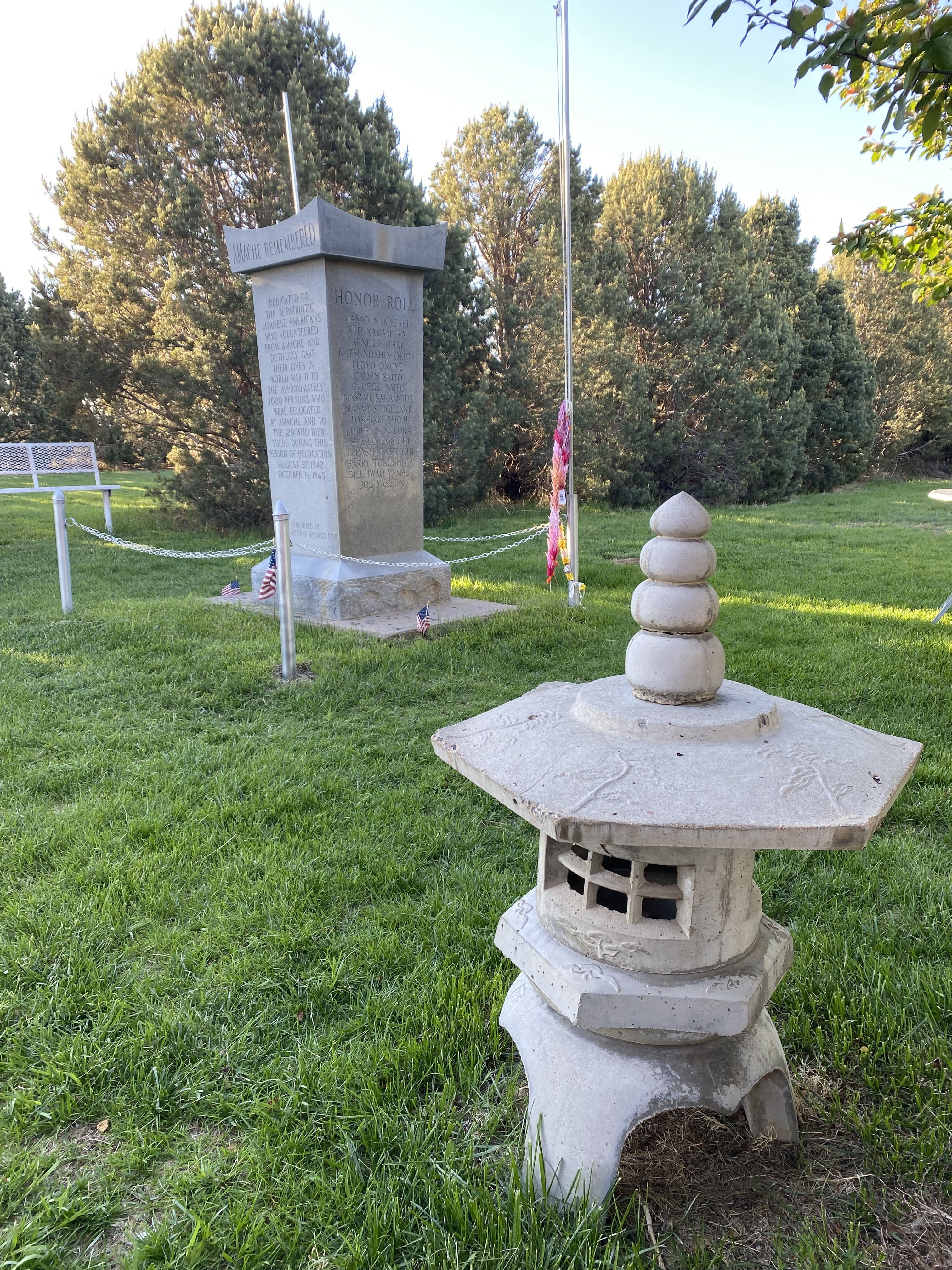
World War II monument with the names of Amache servicemen killed in action.
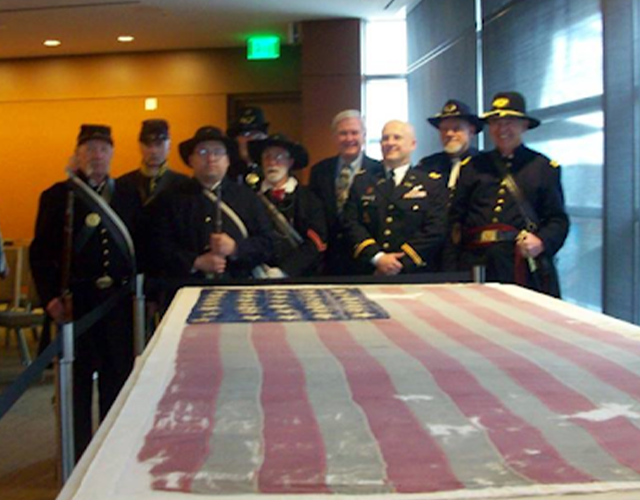
During lunch, Judge Johnny Cepeda Gogo of the California Superior Court was honored for his project to provide forty-eight-star American flags for Japanese American internment camp survivors to sign. The 48-star flag was the version that flew over the internment camps and the project provided an opportunity for those interned (and their descendants) to tangibly affirm their loyalty to the United States and to unambiguously deny any reason for the camps in the first place. The award, presented by Carlene Tinker, praised Judge Gogo for his dedication to supporting the rights of all Americans, including those of Japanese descent, and for creating the project to spread understanding of this historical injustice while empowering those who were irreparably harmed. The first to sign the original flag was none other than former US Representative Mike Honda, speaker at the previous day’s ceremony, who had been incarcerated at Amache as a child. One of the signed flags was to be given to the Amache Museum, and another was on hand for pilgrimage attendees to sign.
After lunch I walked a few blocks through the dry heat to the Amache Museum, along the main road through town. Founded in a former bank branch building, the museum has transformed the lobby into a gallery, while other rooms are used as meeting, storage, and breakroom spaces, and there is a small library/reading area.
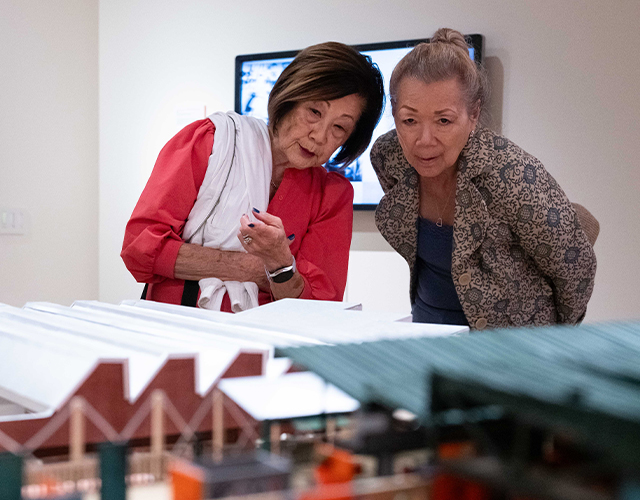
A scale model of the camp as it appeared while occupied is located near the glass-door entrance. The model and many other displays throughout the museum were created and installed by student members of the Amache Preservation Society, who also act as docents for visitors.
The full-size recreation of a barracks lodging is a truly compelling display. It is amazing to observe what tiny living spaces these families were required to occupy—and why kids spent very little time in the barracks, returning from playing outside only to sleep. There was not much room to do anything, and no privacy. The incarceration camps were fashioned after military camps, but the accommodations were not so different from those for prisoners of war. In fact, people designated as “enemy combatants” during World War II (such as first-generation Japanese at the Kooskia camp in Idaho) received the protections of the Geneva Convention, while American citizens at Amache and other internment camps did not.
Amache itself had several professional artists in camp, including Tokio Ueyama (1889–1954), Koichi Nomiyama (1900–1984), and Fukunosuke Kusumi (1893/4–1973, see illustration), all born in Japan and trained in California. They ran an art studio for other incarcerees and created works that give a vivid view of what life was like at Amache. Not far away, the Amache silkscreen shop churned out posters, stickers, and cards, which in only two years totaled several hundred thousand copies. Most of these were ordered by the US Navy for recruitment and informational purposes. The Amache Preservation Society, the umbrella organization for the Amache Museum, maintains a collection of some of these items. With the new status of the camp as a National Historic Site, grant funding will be available to continue crucial support for the site by storing, protecting, and presenting these precious artifacts related to Amache.
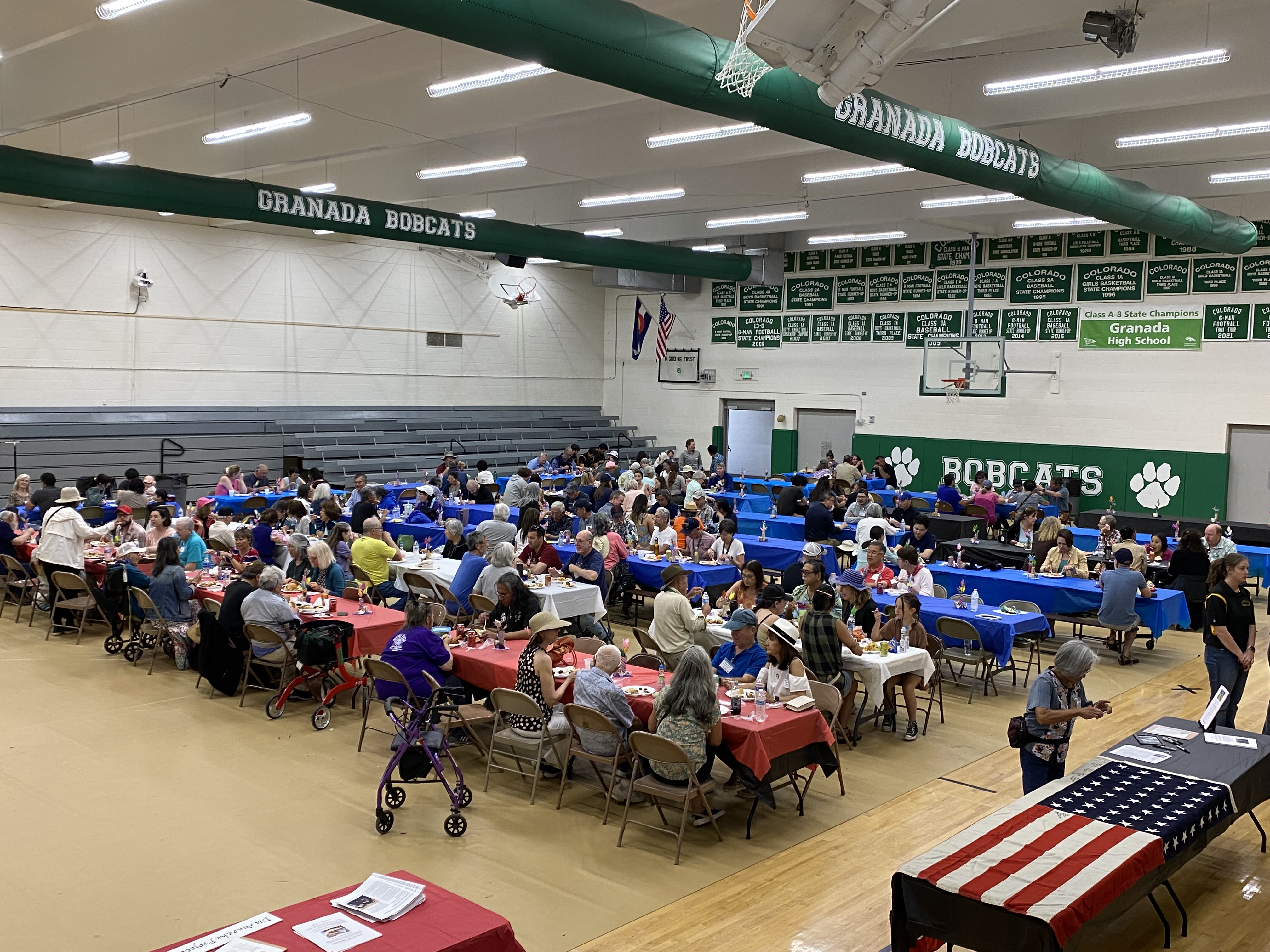
Attendees at the annual Amache Pilgrimage share a meal at Granada School, and sign a commemorative 48-star flag.
The museum had an array of t-shirts, hats, and books for sale, so I picked out a few items as gifts and for reference. In the process, I had a chance to talk to several people about their connections to Amache and the items on display. I struck up a conversation with Mitch Honma, and we found we had an unexpected connection through our shared family backgrounds in the Baptist Church. He was interested to know that I had been an exchange student at Baptist-founded Seinan Gakuin University in Japan, while I was fascinated to learn that he had grandparents (with the family name of Wada) who had been Baptist missionaries not only in Japan and the US, but in other countries in Asia as well, before World War II.
I also visited with some of the people who have participated in archaeological excavations at the Amache site that have been going on since 2008. One of them was my friend Carlene Tinker, who revealed that her specialty is “screening”—sifting artifact fragments out of loose dirt using a tray with a screen for a bottom. As a specialist in historical ceramics, I was interested in both the insights that the digs provided into life at the Amache camp, and the reasons that these folks chose to be involved in a process that required hours of working in the heat during mid-summer.
Archaeological “field schools” give students and sometimes amateur volunteers the opportunity to participate in hands-on work at an active archaeological site. Most importantly, they serve as training grounds for the next generation of archaeological anthropologists. Carlene introduced me to Salvador Valdez-Ono, who has been taking part in the Amache field schools since 2014. Salvador’s grandfather, Gary Ono, was at Amache as a little boy and acquainted Sal with the site by taking him on a trip to camp among the remains of the barracks he once occupied. Today, Valdez-Ono is pursuing a doctoral degree in anthropology focusing on Amache as it exists both physically and in the perceptions of survivors, descendants, and the broader community.
Soon after lunch was over, the Denver bus headed for home and those who remained at dinnertime were all people staying overnight in the area, mostly in Lamar, a larger town about twenty miles away. Another buffet-style meal was planned, this time in the building that during the war had housed Newman’s Drug Store, beloved by younger incarcerees for its soda fountain and popcorn machine. People in the camp were allowed passes once a month to shop in Granada or even make the trip to Lamar, where there were many more stores. I heard a moving story from the previous year’s Pilgrimage of two women in their eighties who visited the drug store building for the first time since they were in camp. They found the corner where they had huddled with their simple treats as little girls, held each other, and wept.
Shorty’s Cafe, a Mexican American restaurant located across the street, catered the food for this occasion. But there was still a lot that needed to be set up for the meal, so I pitched in again for a bit with Joyce and Art. The building no longer operated as a drug store and had been gutted many years before, so the space was rather cavernous and lacking in ambiance. Nevertheless, the food was good and filling, and everyone seemed to enjoy it.
After dinner, people gathered outside to say farewell to those returning home and to strategize transportation to the weekend’s final events, held at the Sand Creek Massacre National Historic Site the next day (Sunday).
Healing in Two Communities
Although located only in the adjacent county, the Sand Creek Massacre site was a 45-minute drive away. Beginning in 2023, Amache survivor families joined Sand Creek descendants from the Cheyenne and Arapaho Tribes to commemorate their members affected by the tragedy and injustice and to explore ways to bring greater purpose to those historical episodes. Despite being one of the greatest atrocities carried out on US soil, the Sand Creek Massacre is unknown to most Americans and is only now beginning to be taught systematically in Colorado schools.
We arrived at the site of the NPS Visitor Contact Station which is located on the homestead of the former landowner’s house (now removed). The day was cool following thunderstorms the night before, and there was shade from a few tall trees. Among the trees a tipi had been erected. Our group was greeted by Otto Braided Hair and Greg Spottedbird-Lamebull, prominent members of Cheyenne and Arapaho Tribes in Montana and Oklahoma. Otto Braided Hair began by offering a prayer for the occasion, followed by an introduction to the site by Greg Spottedbird-Lamebull, who captivated us with his recounting of the terrible facts of the massacre.
At daybreak on November 29, 1864, 675 US cavalry soldiers under Colonel John M. Chivington attacked an encampment of about 750 Cheyenne and Arapaho, mostly women, children, and the elderly. Among them were senior chiefs who had attended a peace conference at Fort Weld in Denver only two months earlier. Despite the fact that an American flag with a white flag below it was raised over the camp as mandated for safety by the Colorado authorities only months earlier, Chivington gave the order to fire. Two of his officers refused to allow their troops to join the attack, but others proceeded as ordered, swooping into the campsite on horseback to kill as many of the stunned inhabitants as possible. As those who were able sought to escape, howitzer artillery that had been placed on the ridge opened up and slaughtered many running for their lives.
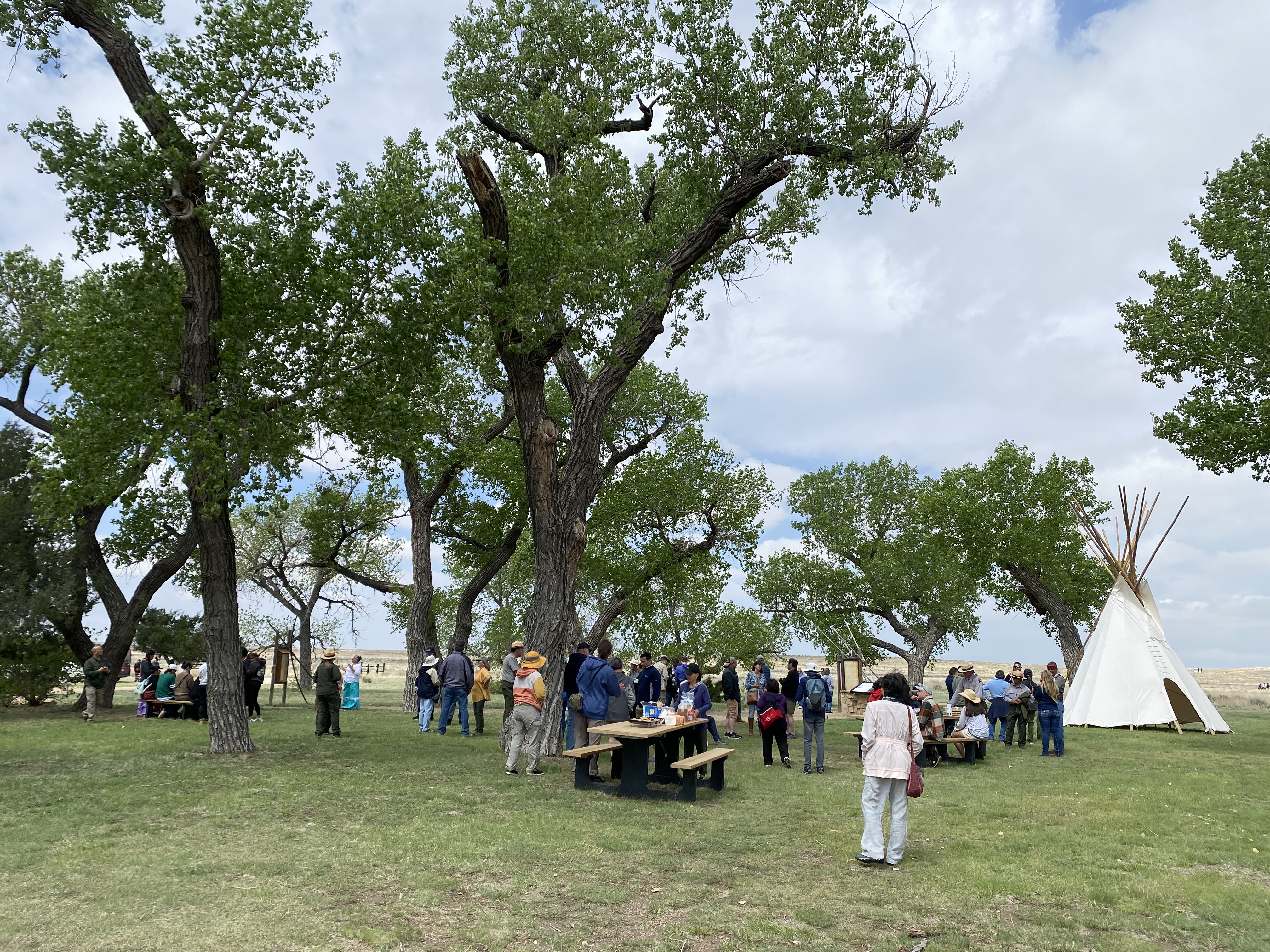
At the Sand Creek National Historic Site.
The death toll of those in the village reached 230 before the day was done. As Lamebull heard it as a child, those who were able to escape into the brush or rocky outcroppings had to hide for hours in the freezing cold of late November, listening to the screams of their family members as the soldiers continued to hunt them down. Many of these survivors were injured. Before departing, the white cavalrymen mutilated the bodies of the dead, taking scalps, genitalia, and other body parts of both men and women as trophies. These were carried back to Denver, where they were traded among the soldiers, given as souvenirs, and even displayed in public.
“When we were first able to access this place twenty years ago, there was a spiritual heaviness here,” says Lamebull, who is a Tribal spiritual leader as well as a clan headman. “After we were able to recover and bury some of what was so violently taken from us and hold ceremonies to comfort those who were killed, things have begun to feel much lighter recently.” When they held a ceremony at the site in which they read the names of the chiefs who were present at the attack, he said “the wind came up and blew down the American flag” that was raised overhead.
One of the events held annually to honor the dead is a Spiritual Healing Run which follows the route to Denver taken by US troops as they withdrew after the massacre. Held in November each year, the runners ceremonially sweep the path to purify it from the defilement that occurred when the mutilated remains of innocent Cheyenne and Arapaho people were carried away along it 160 years ago.
This year, young descendants of Amache incarcerees are slated to join the Spiritual Healing Run as part of a recently-launched program called “Youth Ambassador Experience.” This program was put together by Dr. Annie Danis of California State Polytechnic University, who directs field programs for the University of Denver Amache Project. A funding application was submitted to the Colorado Outdoor Equity Grant program in coordination with the nonprofit organizations Amache Alliance and the Sand Creek Massacre Foundation. The YAE program’s aim is to enable young people from Amache and Sand Creek descendant communities to interact with each other and with a student representative from each of the nearby towns of Granada and Eads, Colorado. It is hoped that together, they will build coalitions to inform future interpretation, transmission, and stewardship of these sites and their histories. Their cooperation had already achieved at least one tangible result: Greg Spottedbird-Lamebull told the group that the young people had been the ones to raise the tipi the day before. “Not a bad job,” he grinned.
To prepare visitors for walking the trail that overlooks the massacre site, Sand Creek descendants burned handfuls of sweetgrass, purifying the walkers with the smoke. It reminded me of Buddhist rituals I have seen in Japan.
As I trekked up the gravel road to the ridge that overlooks the massacre site, I thought about the awful legacy of the mistreatment of these two groups: Japanese Americans and Native Americans. Growing up in Colorado, in school I learned about neither of these terrible injustices. And it was not as if these communities were far away and unfamiliar. For years I delivered newspapers to a Japanese American family who lived just around the corner, but it was only decades later that I found out the father had been held at Manzanar in California during the war. With me on my first basketball team at age eight was a little Diné (Navajo) boy who was very quiet, and a good player. Although I didn’t realize it at the time, I suspect now that he had already experienced teasing because he looked different from the other kids in our very white suburb of Denver. I wish that as a child I had been taught more about the backgrounds and challenges of people who were not like me.
I returned to the gathering on the old homestead to find sandwich fixings and drinks laid out on the picnic tables beneath the trees. The Amache and Native American kids were sprawled out on the ground with their food. A few were in traditional dress. I found Annie Danis talking to Charlene and Aya, both Amache descendants. I asked the two what they felt was being achieved by the Youth Ambassador program in which they were taking part.
The young ladies offered that it was a really great chance to get to know each other and hear each other’s stories. It was clear that the Cheyenne and Arapaho young people not only had their own perspectives on the experience of marginalization as a culture, but also the burden of carrying what their ancestors experienced in the past. The challenge, as they saw it, is for both groups to move forward together to bring purpose and meaning to these National Historic Sites now that they are on more people’s radar.
The two also felt that education is an important part of what is needed for the future. It’s fine, they thought, to preserve these locations simply because of what occurred a long time ago, but it’s more important to use them to teach lessons about what can happen when people choose to ignore the principles our country was founded on. Trampling on the right of other people to live and be free can lead to the sort of tragedies that were carried out against Native Americans and Japanese Americans, they said. It has happened before, and it can happen again to others if we’re not careful.
As I drove back across the high plains of my home state, the rolling hills and open vistas provided a meditative backdrop to my thoughts. Terrible things indeed happened in this part of the country, and too many people remain unaware. Nevertheless, the establishment of National Historic Sites at Amache and Sand Creek provide tangible evidence that the ongoing efforts of people like those I met during this weekend are beginning to bear fruit.