
 Membership
 Donate
 Shop
Shop

















Colorado’s Collector of the West
A peek into Fred Mazzulla's collection of a lifetime.
Salida was once a popular hub for miners and railroad workers at the turn of the century. The town bustled with blue-collar workers and their families, hoping to cash in on the American dream. Despite the buzz, it could only provide so much entertainment for local children. Finding creative solutions to their boredom often fell upon the shoulders of a young Fred Mazzulla, who created his own form of entertainment—often at the cost of the local workers. The plan was for Fred and his group of ornery friends to harass and heckle the engineers and firemen on the trains passing through the town. With enough torment from the side of the tracks, the engineers and firemen would throw lumps of coal out of frustration. Once the trains were gone, the kids collected the pieces of coal that were hurled at them, and then sold them for a profit to the local so-called “bawdy ladies” (a euphemism for sex workers). Later, after a hard honest day of work, the kids often treated themselves to a movie and a piece of candy.
Born to a family of southern Italian immigrants who moved to Colorado in 1899, Fred Mazzula grew up in the booming industrial town of Trinidad where his father worked as a miner. Later the Mazzulla family relocated to Salida, where Fred would concoct his coal money scheme. After turning eighteen years old, Fred found respectable employment at the Salida Post Office with the intention of saving enough money to enroll himself in Harvard University. Despite being successful in his efforts to get into Harvard, Fred eventually returned back to his home state and enrolled in Denver University. By 1938 Fred was accepted to the Colorado Bar Association, and began his long career in law as an attorney.
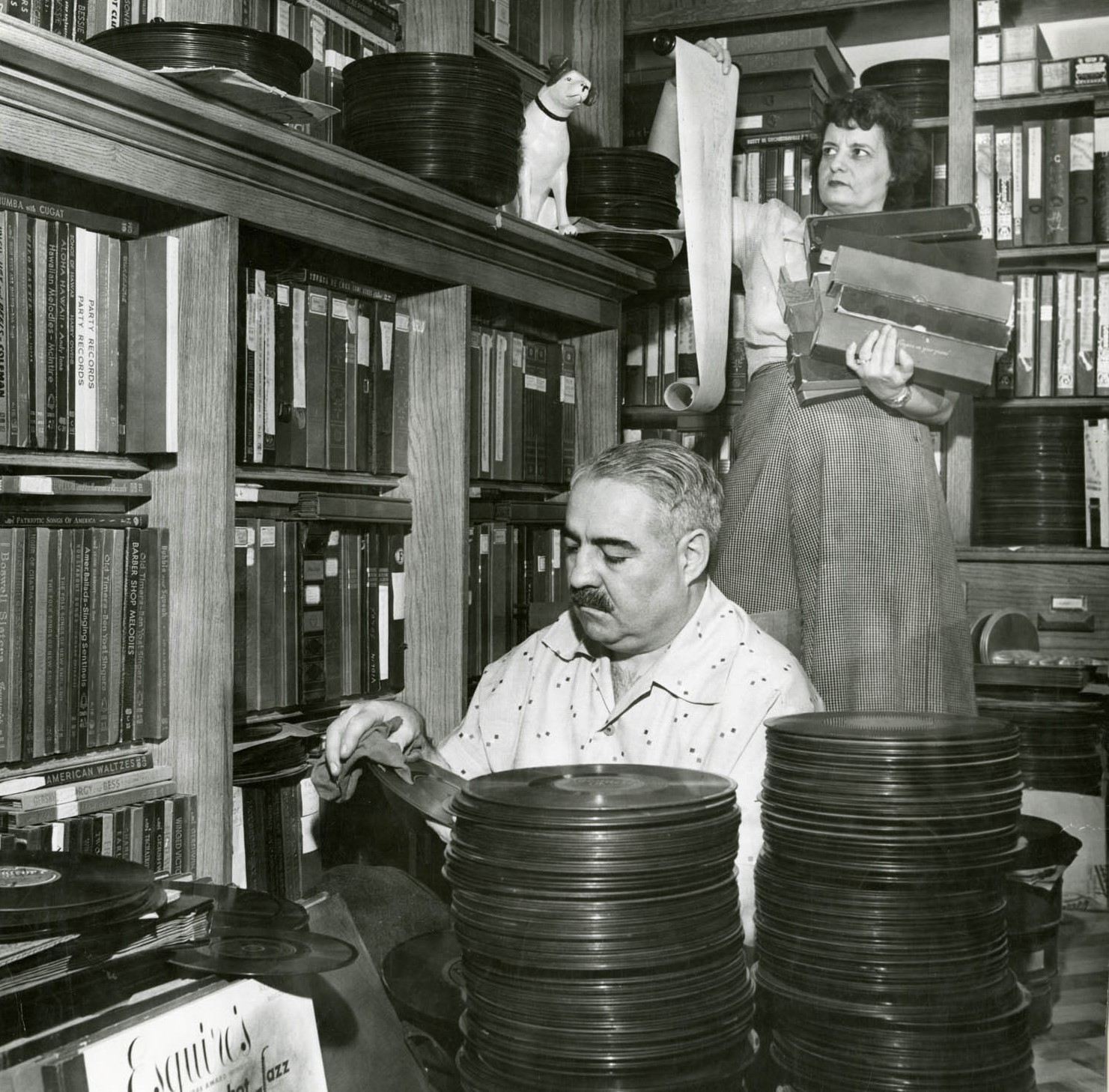
Fred and Jo Mazzulla among their music collection, 1954.
Fred and his second wife, Jo, spent their lives collecting and preserving the things they were passionate about. Together they amassed a large collection of photographs, oral histories, and ephemera that documented the American West between the late nineteenth to the mid-twentieth centuries. The pair collected materials by purchasing them from individuals, estate sales, antique dealers, and documenting modern day events themselves. In addition to photographs, the Mazzullas took the initiative to record over 500 hours of oral histories, with infamous Western figures such as “Wild” Bill Carlisle, Laura Evans, Governor Ralph Carr, Phillip S. Van Cise, George Morrison, and Lillian Powers.
The Mazzullas’ massive and constantly growing collection was originally stored in the basement of their home in Denver, Colorado. The collection became so large that they had to expand their basement in order to make room for their shared passion. Not including the physical items stored within it, the basement was unique on its own. Western artist Herndon Davis, a personal friend of the Mazzullas, painted 158 portraits of prominent Colorado historical figures along the walls of the basement. In addition he also painted a portrait of Jo on the floor in homage to his famous painting in Central City, The Face on the Barroom Floor.
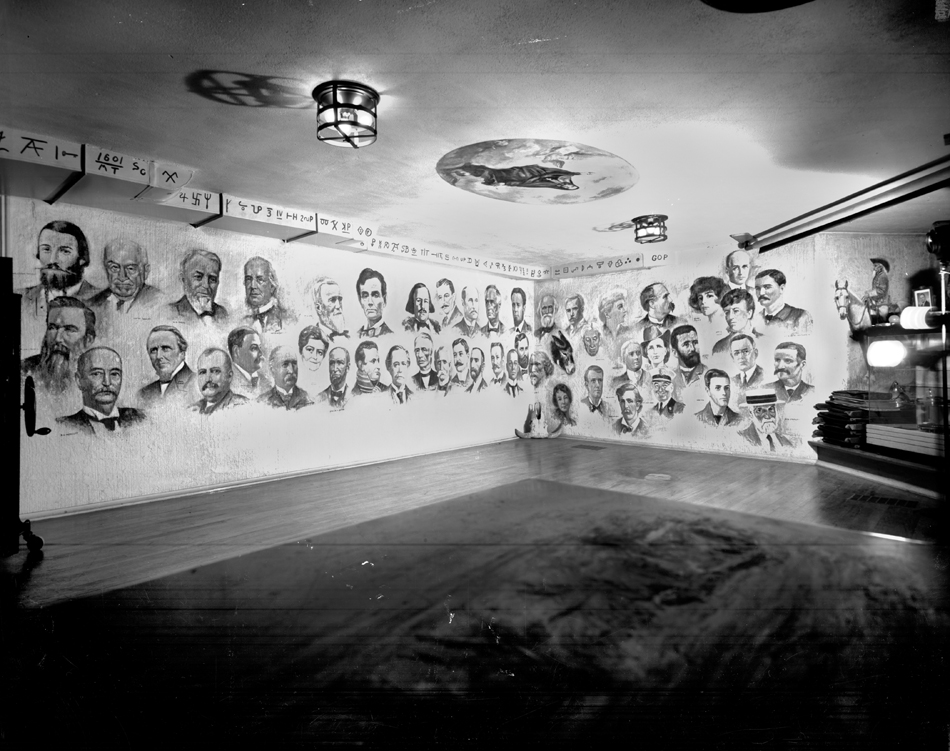
Herndon Davis murals in the Mazzulla basement.
Their collection eventually became widely known by local historians, history enthusiasts, collectors, authors, and researchers alike. The Mazzullas self-published four booklets on Colorado history including Al Packer: A Colorado Cannibal, Brass Checks and Red Lights, Outlaw Album, and The First 100 Years Celebrating Colorado’s Centennial Cripple Creek. They also contributed to written works such as Holladay Street by Max Miller, Alfred Packer: The True Story of the Man Eater by Robert Wesley Fenwick, Colorado’s Century of Cities by Don and Jean Griswold, and Mountain Charley; Or, the Adventures of Mrs. E.J. Guerin, Who Was Thirteen Years in Male Attire by E.J. Guerin. Through the collection, photography, written works, and his overall passion for history, Fred became known as Denver’s “Collector of Sight and Sound.” In 1959, Fred became the Sheriff (President) of the Denver Posee of The Westerners, and provided images for the TV series “Expedition Colorado.”
Over the years, Fred established himself as a distinctive Denver character, and as the collections specialist whose job it is to digitize this expansive collection, I have come to be intrigued with the man behind it. Fred Mazzulla was certainly a complicated character, and during his life he garnered quite the reputation. It was said that he was either liked or incredibly disliked, a sentiment that continues today. Others in the historical field often questioned his integrity as a collector and historian.
Nonetheless, the fact remains that Fred and Jo amassed a collection depicting a growing Centennial State and bustling American West the likes of few others. And thanks to a generous grant from the National Historical Publications and Records Commission (NHPRC) to fund digitizing his collection we, too, can peer into twentieth-century Colorado in a way we would be unable to do otherwise.
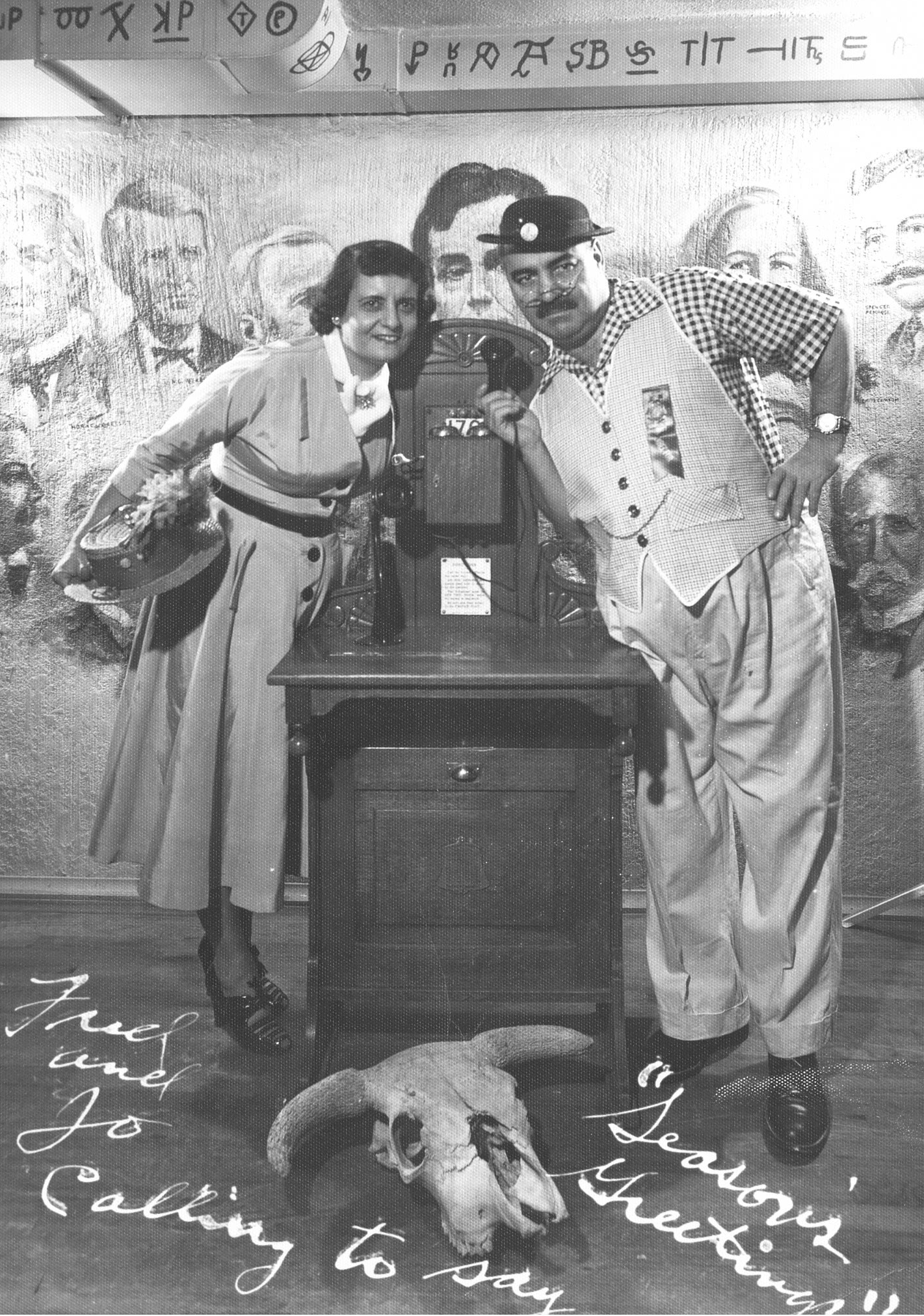
Fred and Jo Mazzulla in their basement posing with Laura Evans’ payphone.
Fred’s Impact on Photography
Fred was a passionate photographer, who originally picked up photography in order to keep himself busy. His hobby eventually turned into a full-blown passion. Notably, in 1955 Fred was the first photographer to take an image of President Eisenhower after he survived a heart attack in Denver. Despite being barred from Fitzsimmons Army Hospital, where Eisenhower was being treated, Fred strategically positioned himself and his telescopic lens outside of the hospital where he patiently waited for the President to step out onto the hospital balcony. At this moment Fred was able to capture an image of President Eisenhower waving from the rooftop. The photograph was quickly distributed around by magazines, newspapers, and news stations, such as the Denver Post, to show that the President was in good health.
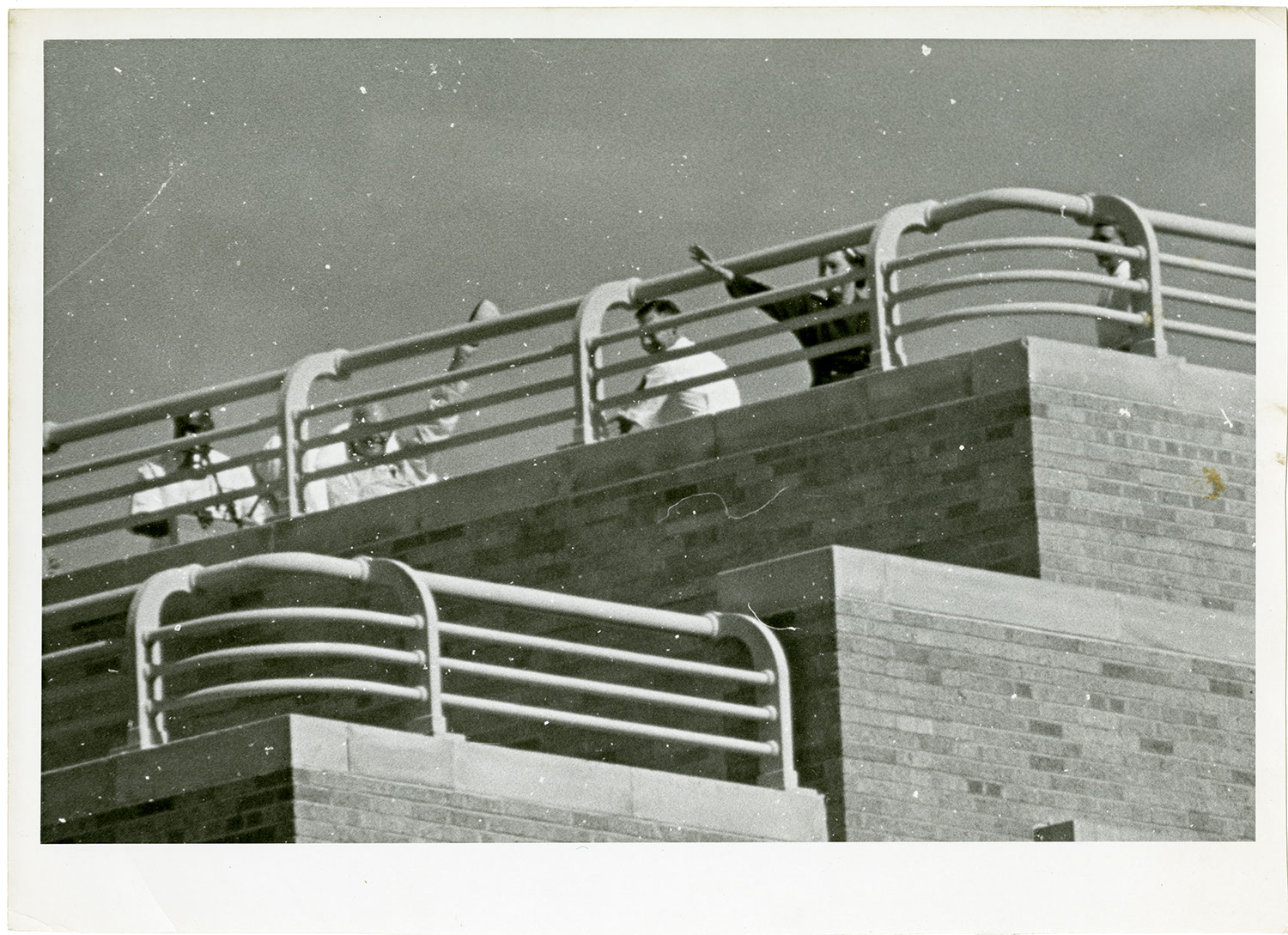
Mazzulla’s photograph of Dwight D. Eisenhower waving from the roof of Fitzsimons Hospital, 1955.
Photography has not always been allowed in courtrooms for hearings and trials. Fred’s passion for photography and his profession as an attorney made him the ideal candidate to advocate for courtroom photography. In 1956, Fred represented the National Press Photographers Association (NPPA) during the hearing for the revision of Canon 35 with the Colorado Supreme Court. Canon 35 was one of the Canons of Judicial Ethics of Colorado that contended that courtroom photography and radio and television broadcasting interfered with the administration of justice. The hearing in 1956 was an effort to revise and allow the broadcasting and photography of courtroom cases. These efforts resulted in the Colorado Supreme Court adopting a rule allowing judges to permit courtroom photography and broadcasting at their personal discretion. This ruling was a fundamental win for the documentation of courtroom proceedings. For his representation, Fred was later credited as a champion for courtroom photography and, according to a chairman of the NPPA, was the deciding factor in the case ruling.
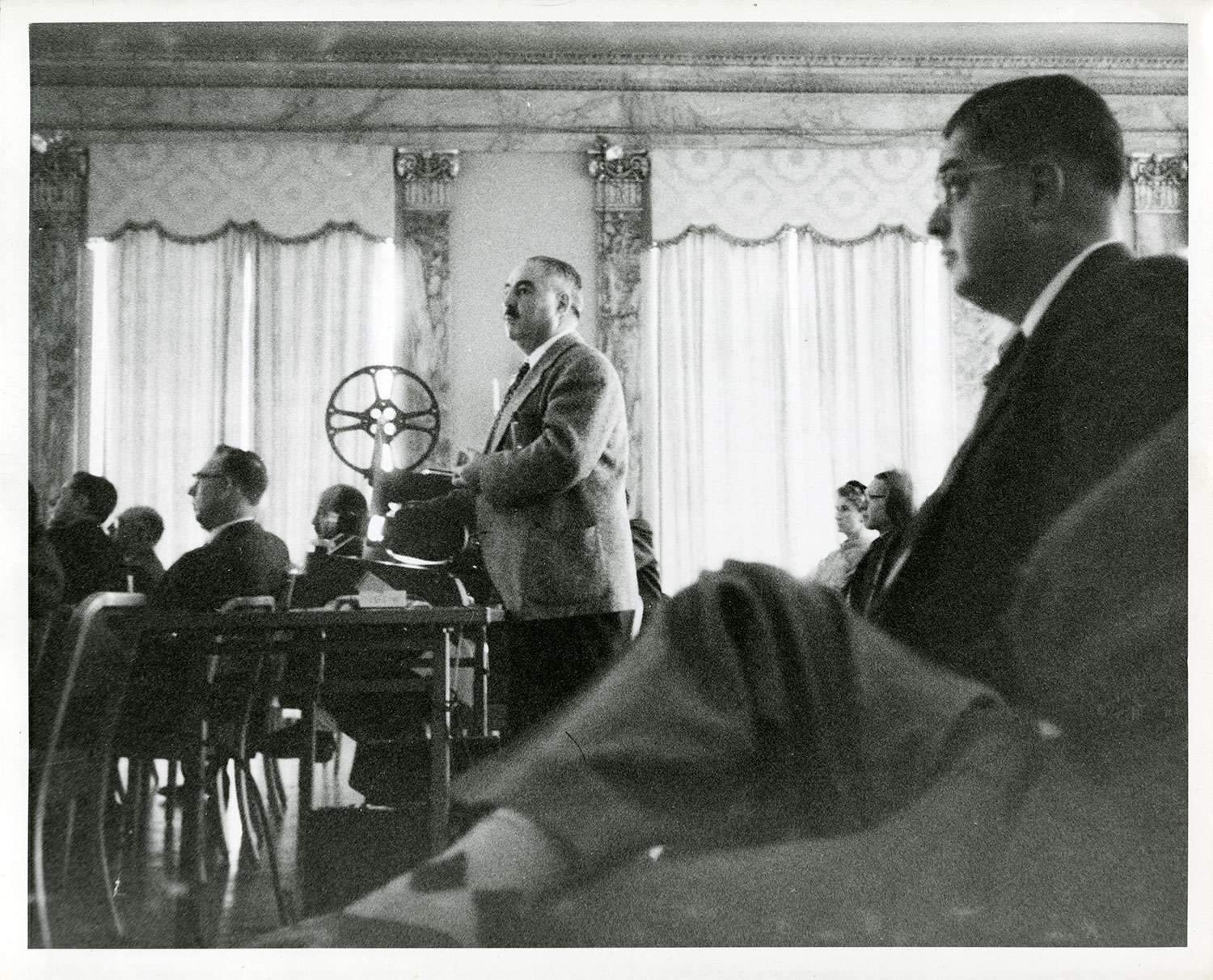
Fred Mazzulla standing at a projector during the trial of John Gilbert Graham in 1956.
Rubbing Shoulders with the Greats
As passionate as the Mazzullas were about history and photography, they were also avid Jazz fans. Their music collection boasted over 10,000 records ranging from ragtime jazz to more modern styles. Fred was a firm believer that jazz had originated in the cemetery roads of Central City, Colorado in the 1870s. He often argued that Italian musicians in Central City would “jazz up” their funeral songs in the local saloons after a somber funeral procession. This argument was supported by jazz musician W.C. Handy, who stated in a letter to Fred, that he picked up the themes for his own songs, “St. Louis” and “Memphis Blues,” when he was playing in Denver for the Festival of Mountain and Plain in 1896 and 1897. Despite his argument, most historians today agree that jazz had its roots in ragtime, and originated in the African-American communities of the South.
The Mazzulla’s strong interest and passion for Jazz allowed them to meet and befriend notable musicians such as George Morrison, William Randolph “Cozy” Cole, and even Louis Armstrong. The Mazzulla’s knew Armstrong well enough that he sent them a novelty postcard in 1950. Along with this postcard are an assortment of pictures, including original images Fred took of Armstrong, Morrison, Cole, and other artists performing on stage.
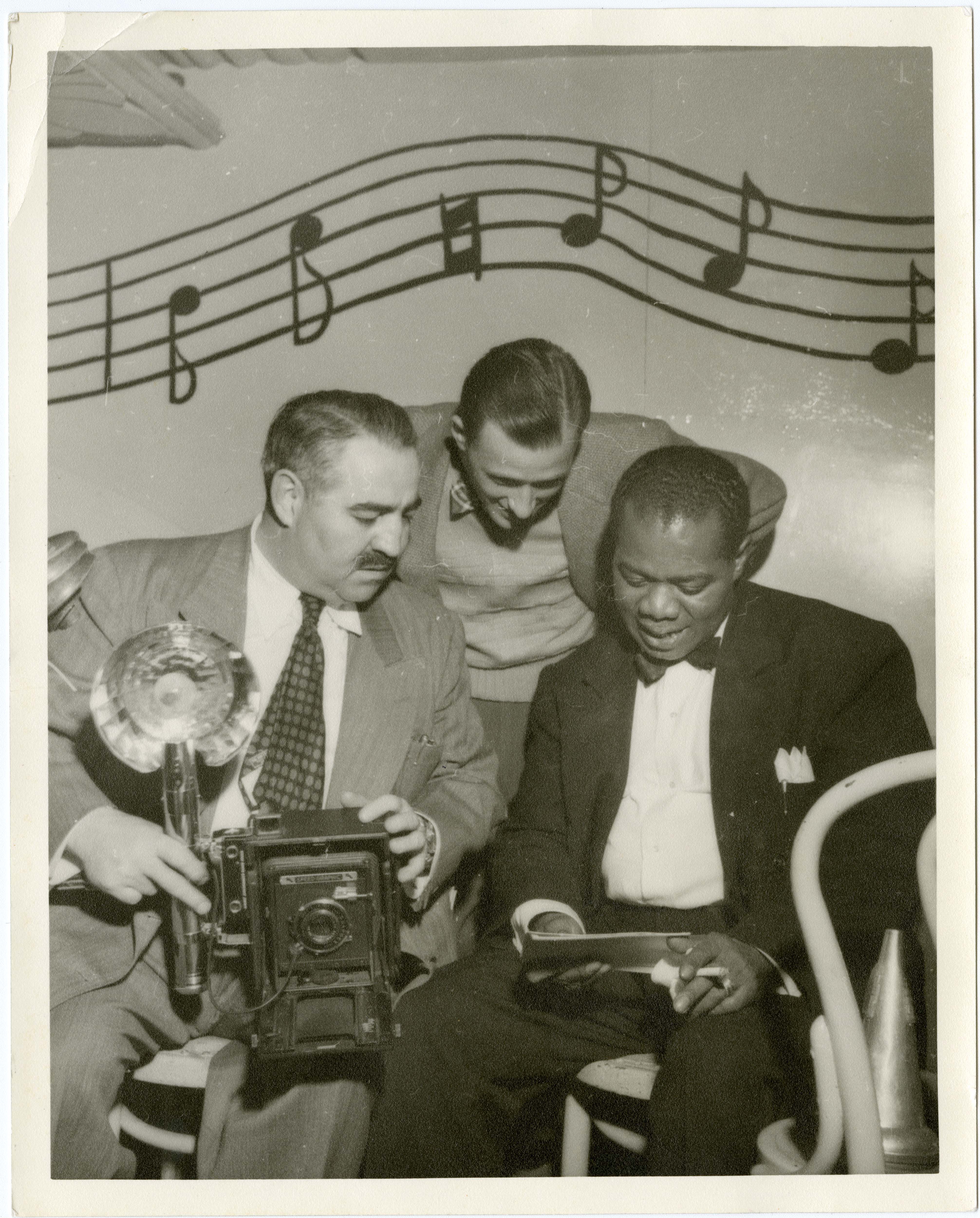
Fred M. Mazzulla (left), Louis Armstrong (right), and another man look at photographs together.
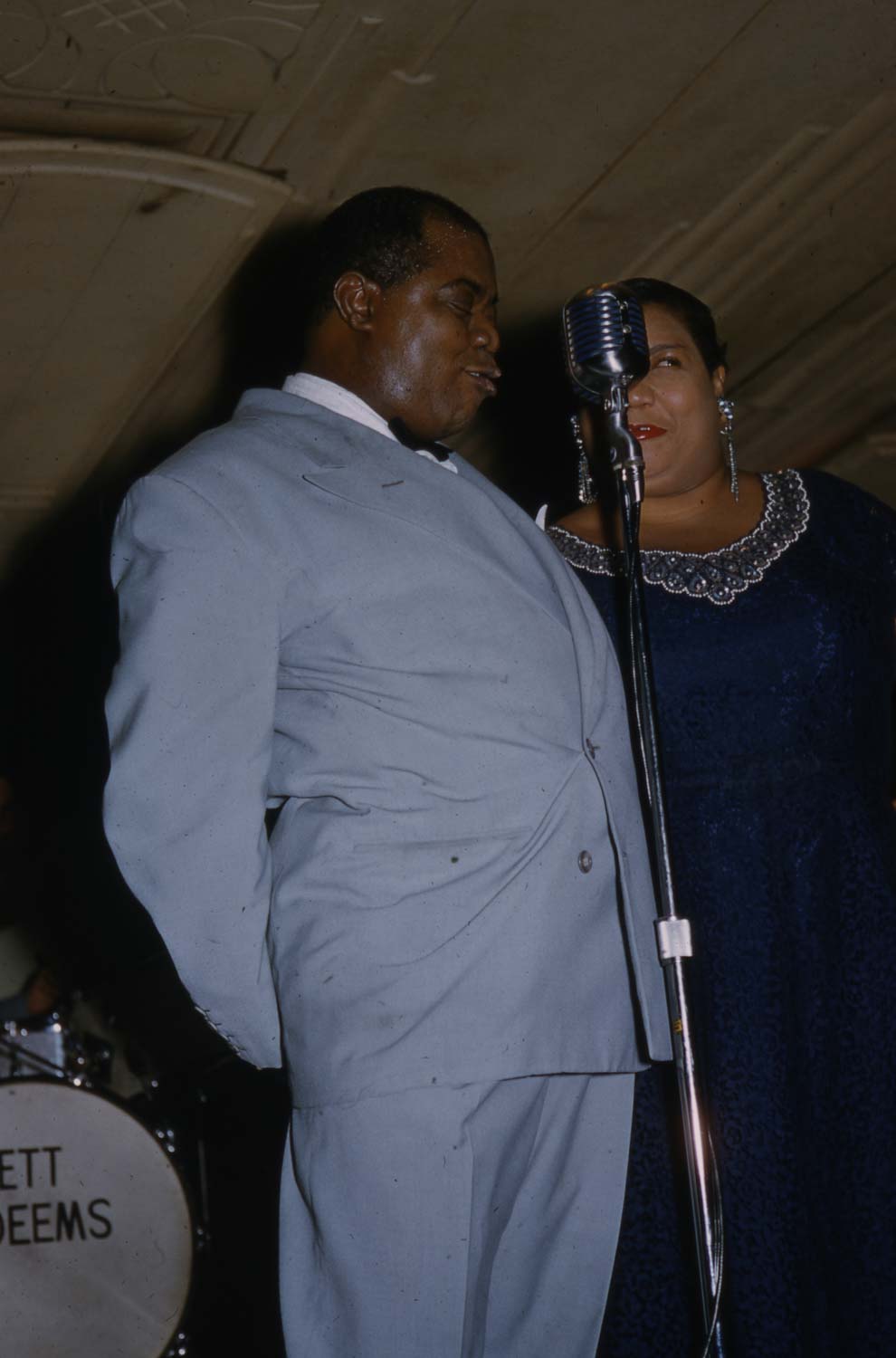
Louis Armstrong singing into a standing microphone in Denver, Colorado.
Their connections to prominent figures, politicians, socialites, and celebrities expanded as the Mazzullas made themselves known within Colorado and the historical community. . One of Fred’s closest friends was Colorado Governor Ralph L. Carr, who shared Fred’s love for law and history. These personal connections meant that they were often gifted intriguing items by the people they knew, enabling them to expand their collection. Salida madam Laura Evans donated her clothing, scrapbooks, papers, and photographs to the Mazzullas, as did others including “Wild” Bill Carlisle, Ralph L. Carr, Herndon Davis, and Lillian Powers.
After a lifetime of collecting, Jo Mazzulla passed away in 1971, and in 1973 Fred sold the majority of their collection to the Amon Carter Museum in Fort Worth, Texas. Fred would later pass away in 1981 in Reno, Nevada. The collection was cared for by the Amon Carter Museum for twenty-six years until 1999, when History Colorado acquired the collection via exchange with Amon Carter. Additional materials were donated to History Colorado by Fred’s daughters, Arlene and Juli, in 1986.
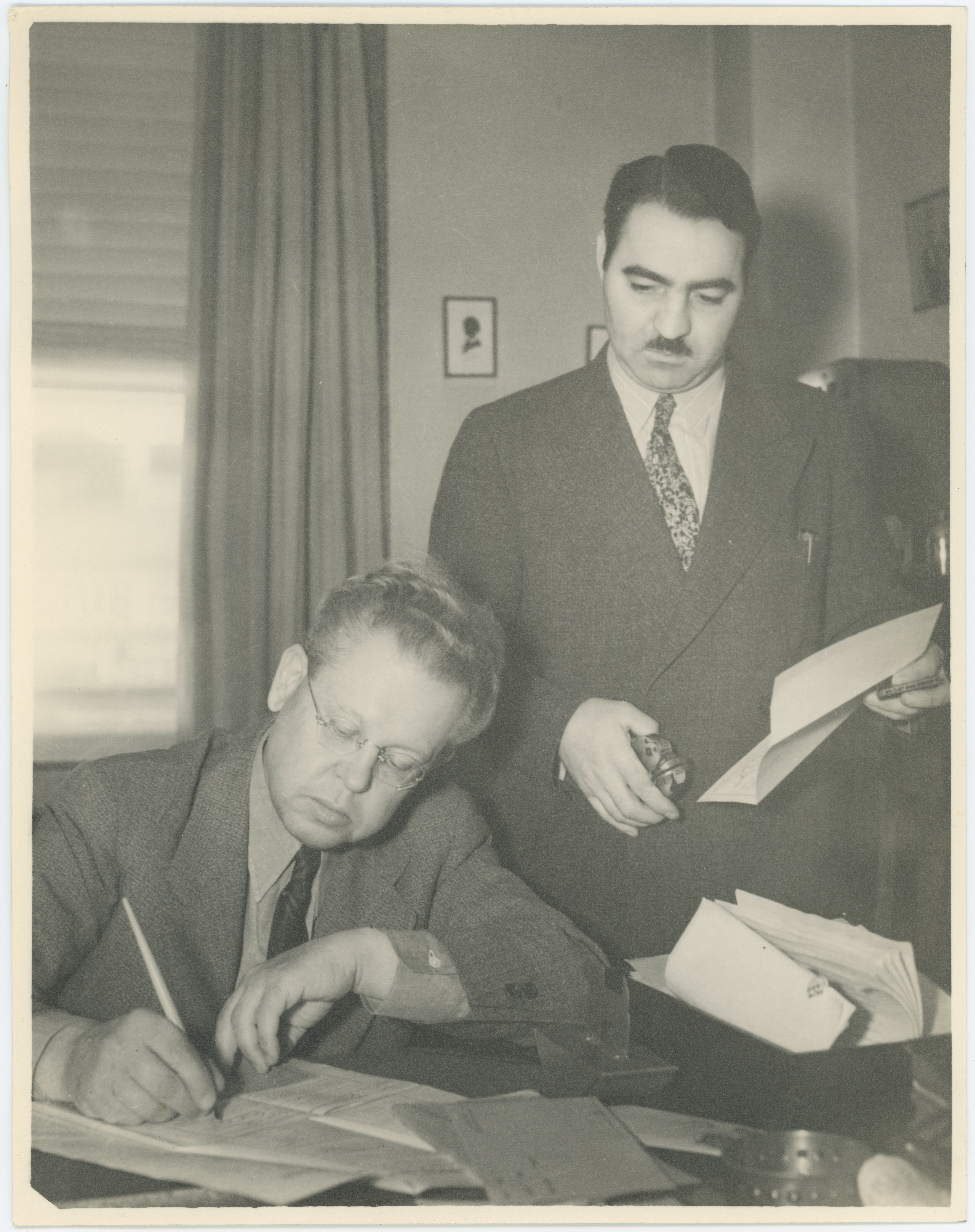
Governor Ralph Carr signing a ballot as Mazzulla watches behind him, circa 1939.
Today, the Mazzulla Collection contains approximately 107,000 items and 250,000 photographs. The photographs are inclusive of varying topics ranging from Colorado mining towns to prominent political figures, crime scene photographs, personal scrapbooks, and correspondence with prominent figures of the old West. The collection continues to ignite interest in the history of the American West, ensuring that Fred and Jo’s contagious passion endures the test of time.
Hidden Treasures from the Collection
One of the first surprises unearthed was a portrait of American folk hero, Wild Bill Hickock. Though the portrait itself isn’t what made this discovery exciting. When turning over the image it was revealed that it was inscribed and signed by Hickock himself. The back of the image was inscribed to Fred E. Sutton and reads, “To my boy frand [sic] Fred Sutton my photo. James Butler (Wild Bill) Hickok.” Fred E. Sutton was a frontiersman of the American West and actively participated in the forced settlement of Native Territory. His memoirs were later published in 1927, in which he recounted meeting legendary figures such as Hickock, the Wild Bunch, and Bat Masterson. Perhaps even more interesting than who the photo is inscribed to, is that the inscription date is roughly eight months before Hickock’s ill-fated murder in Deadwood, South Dakota, where he was shot while playing a game of poker.
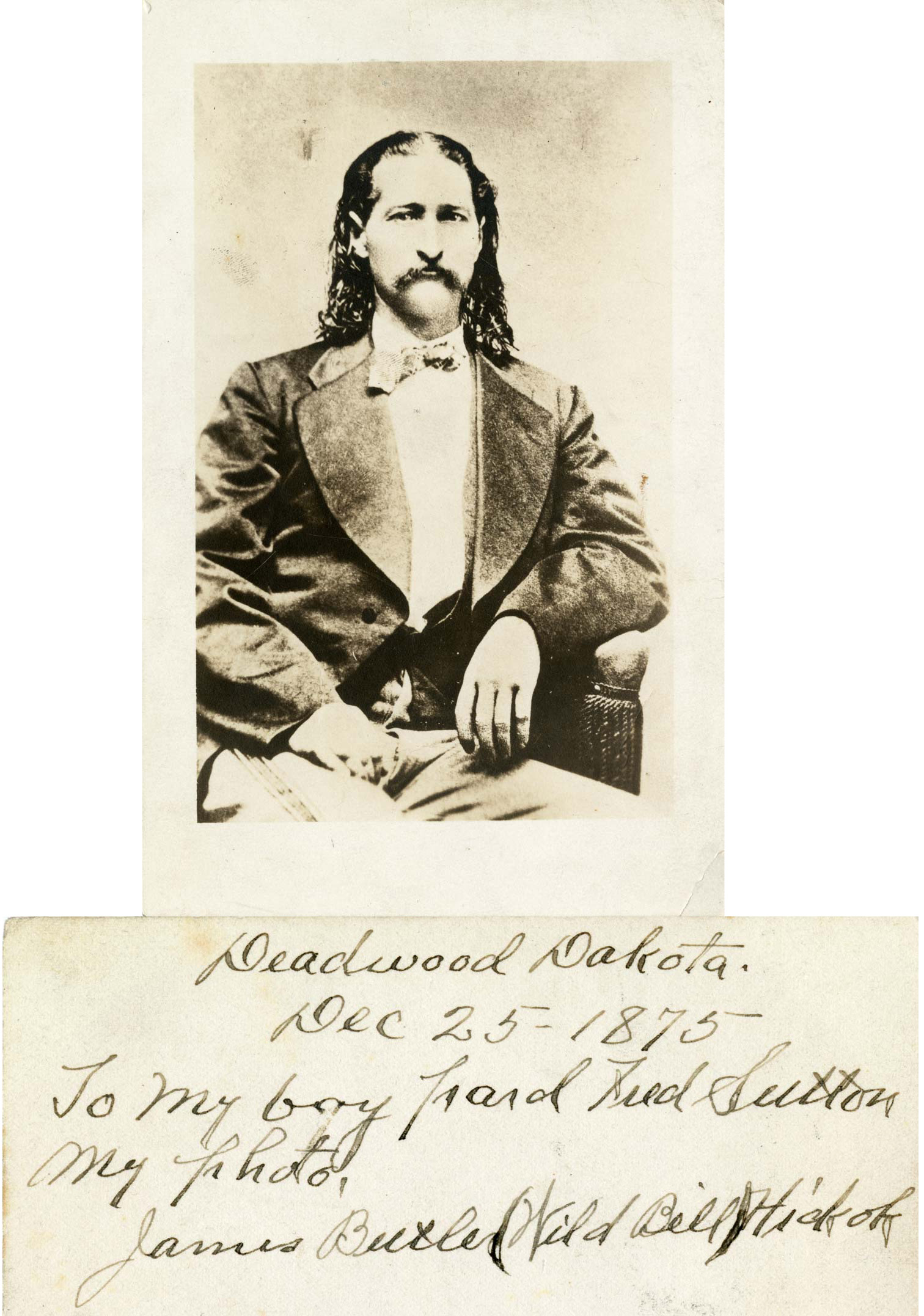
The front and back of the inscribed photograph of Wild Bill Hickock, found in the Mazzulla Collection.
Vice and Crime
Violence, crime, and other illegal activities are common themes within the Mazzulla collection. You often find photographs and documents related to train robbers, horse thieves, safe blowers, murders, sex workers, and all other imaginable topics. A popular piece of the collection are the five large Denver Crime Ledgers from the Denver Police Department that document arrests made within Denver County. These ledgers feature the arrest records (with the accompanying mugshot) for any individual arrested in Denver dating back to 1895. The books paint a vivid and rough picture of early Denver Colorado, showcasing the gritty and violent nature of the early West, often charming anyone who looks through them.
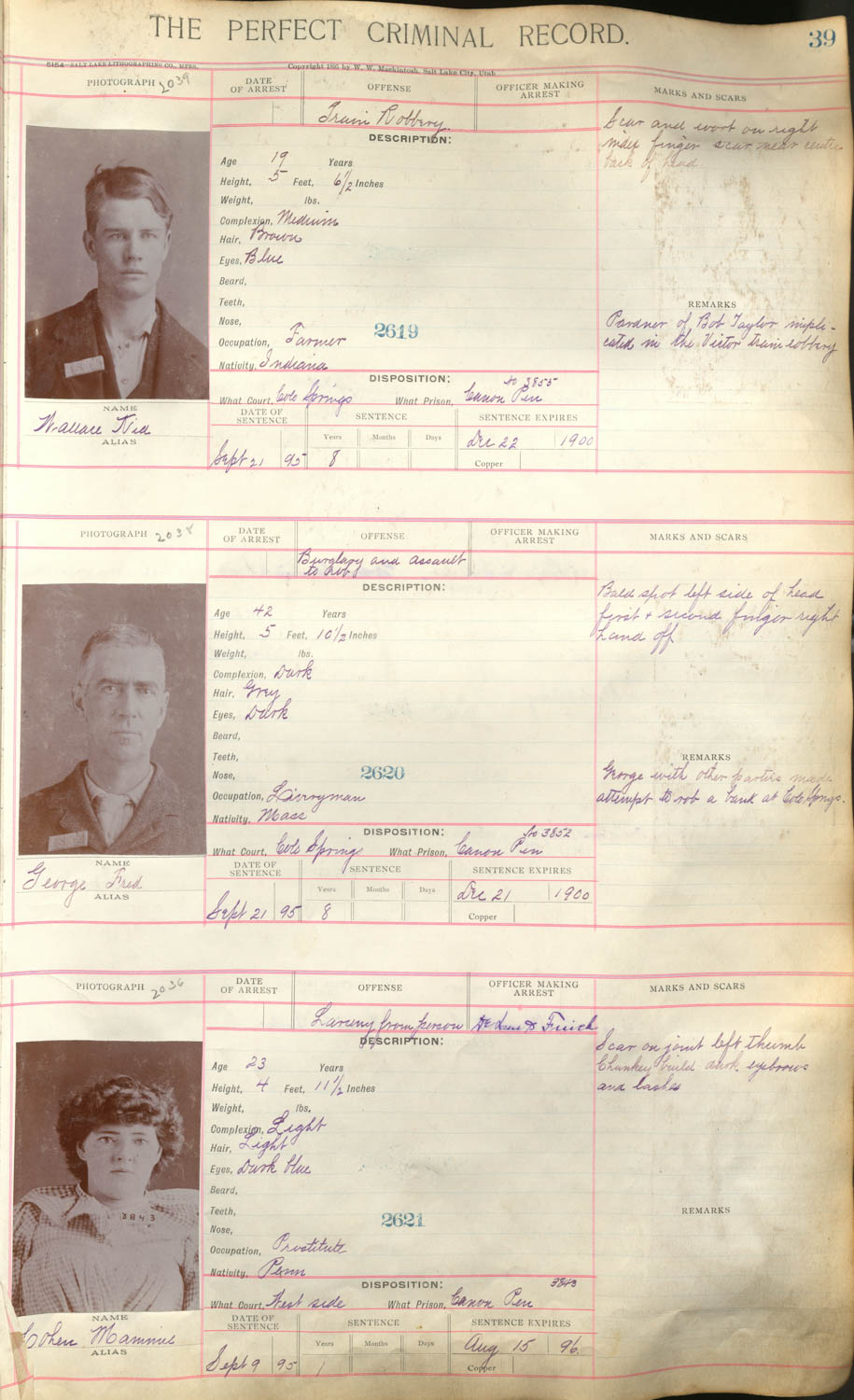
Page 39 from the Denver City and County Criminal Record Book number 1.
“Wild” Bill Carlisle
Known as one of the last train robbers of the American West, and nicknamed the “Robin Hood of the Rails”, the “White-Masked Bandit”, and the “Gentleman Trainrobber,” “Wild” Bill Carlisle was another associate and friend of the Mazzulla’s. Fred was an active member and Sheriff of the Denver Posse of Westerners, a Denver club of history enthusiasts, which invited Carlisle to visit the club and discuss the time he spent as a bandit. Fred and Carlisle developed a close friendship, and due to this friendship the collection includes many photographs of Carlisle ranging from when he was younger to near the end of his life. The collection also contains oral histories recorded with Carlisle where he describes his criminal past, and escape from prison in 1919. (These oral histories are available to listen to on our Sound Cloud at https://soundcloud.com/historycolorado.)
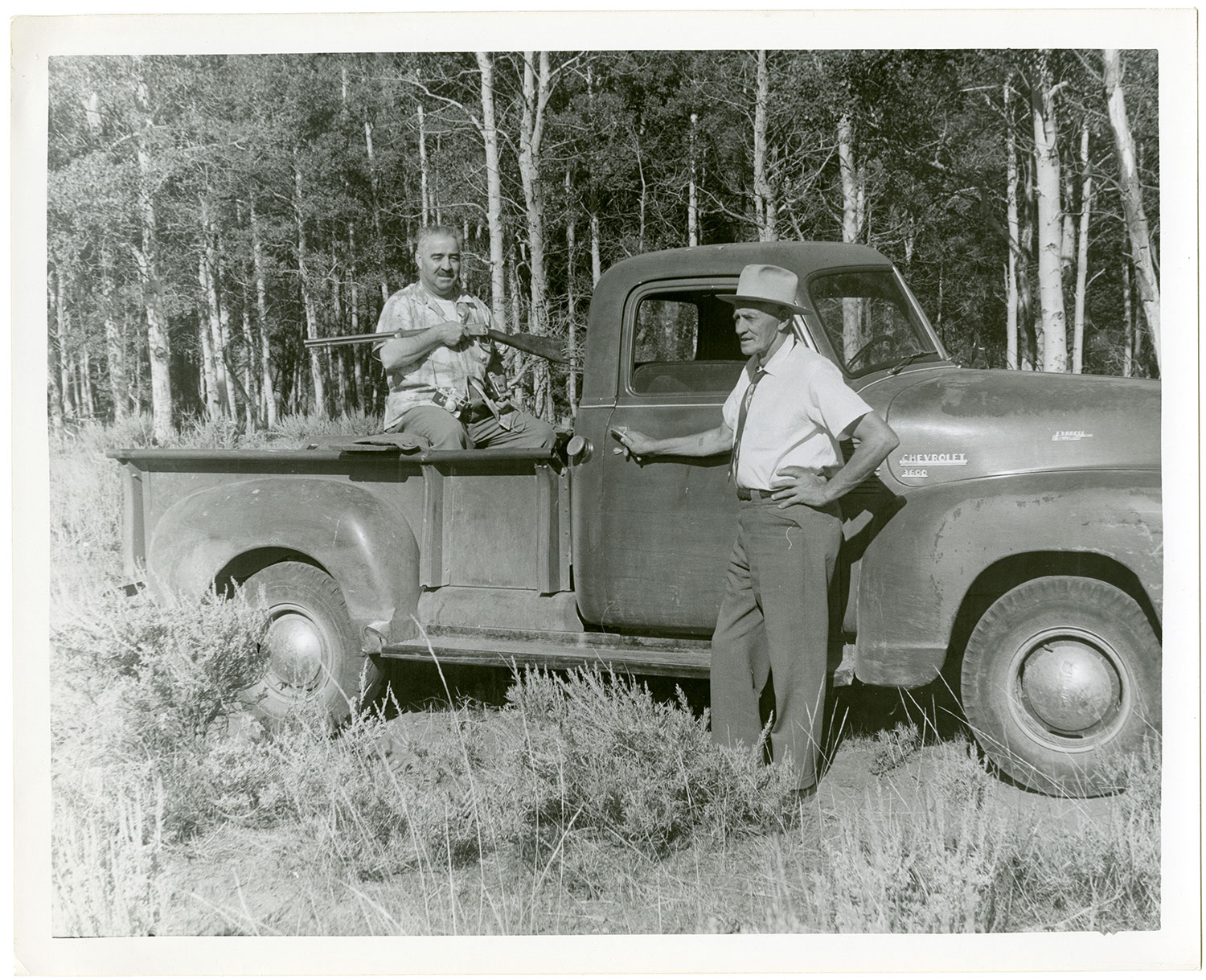
Fred Mazzulla (left) sitting in a truck bed and holding a rifle while Bill Carlisle (right) stands next to the truck.
Gunnison Jail Record
In addition to the Denver County crime ledgers, the Mazzulla Collection features an invaluable jail record from the Gunnison County Jail from 1844 to 1934. This jail record features the original intake records for two prominent Colorado cases; the arrest of the infamous Colorado Cannibal Alferd Packer, and the arrest of four train robbers by C.W. “Doc” Shores in 1888.
After his arrest and initial trial for cannibalism, Packer was transferred to the Gunnison County Jail in 1884. His original murder charge would eventually be overturned in 1885, and he would later face a second trial in Gunnison the same year.
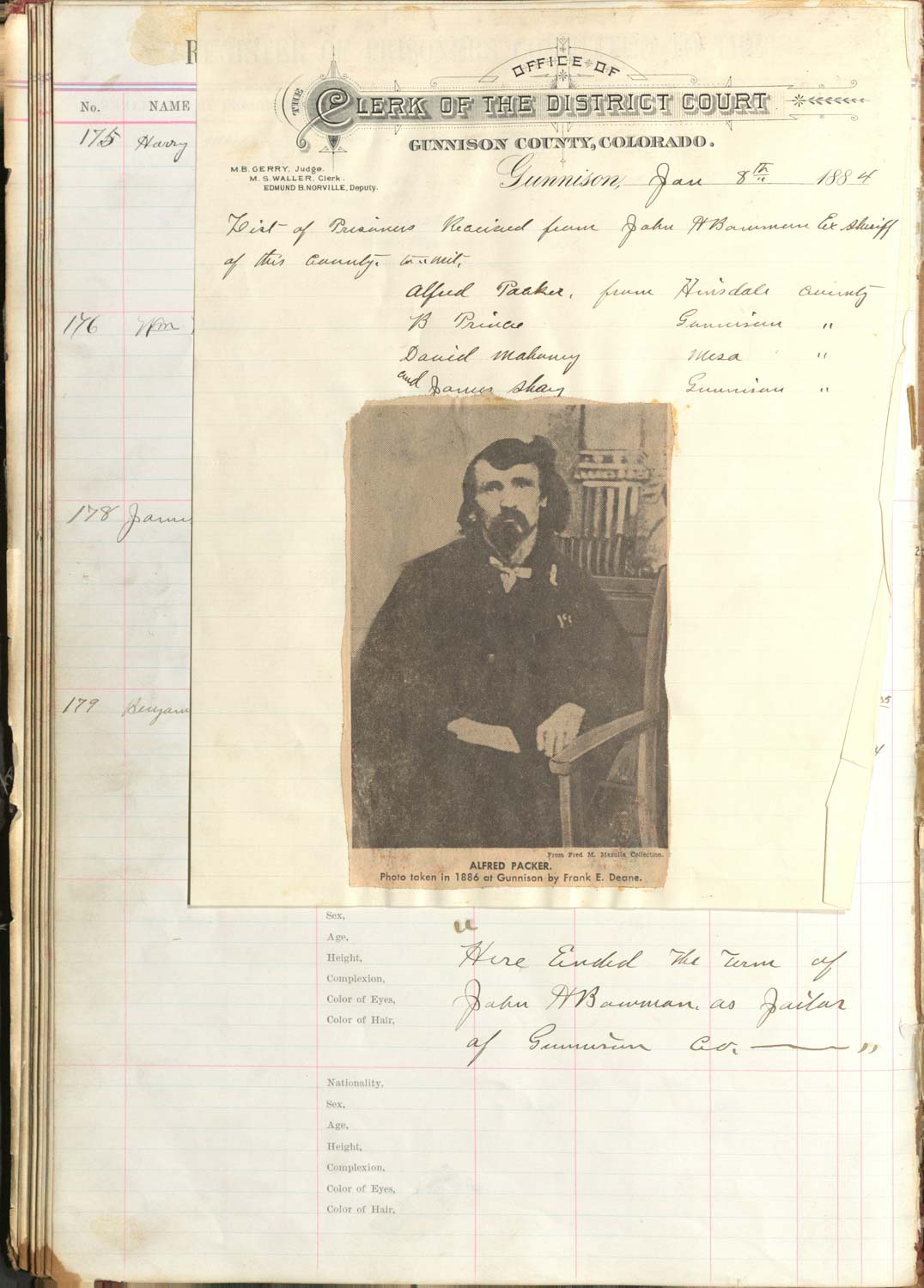
Page 51 of the Gunnison County Jail Record showing the intake of Colorado Cannibal Alferd Packer in 1884.
C.W. “Doc” Shores, was the sheriff and U.S. Deputy Marshal for Gunnison County until 1891. Later in life he worked as a special investigator for the Denver and Rio Grande Express Company. In 1887, four men robbed a Denver & Rio Grande train near Grand Junction. A posse was formed to arrest these men, but quickly gave up the chase after two days. Unlike the others, Shores refused to turn in his hat and continued to track these train robbers for three months across multiple state lines. By January of 1888 Shores had arrested all four bandits, Ed Rhodes, Bob Boyd, Bob Smith, and Jack Smith. After his arrest, Ed Rhodes famously said to Shores, “You’re the damnedest bloodhound I ever seen.” The Gunnison Jail Record includes the intake records of these four train robbers, initialed by Shores himself.
Pullman Porters
Another surprising find from the collection includes a family scrapbook belonging to the Green Family. It was uncovered in the manuscript portion of the collection and revealed an invaluable look into the lives of Colorado Pullman Porters in the 1920’s and 1930’s. The occupation of a porter was one of the best available jobs for African Americans in the United States post Civil War through the 1960’s, and contributed to the creation of the black middle class in America. The album includes snapshots of porters working inside and outside of the train cars, as well as casual family photographs. Giving us a window into the reality of African Americans in Colorado during the twenties.
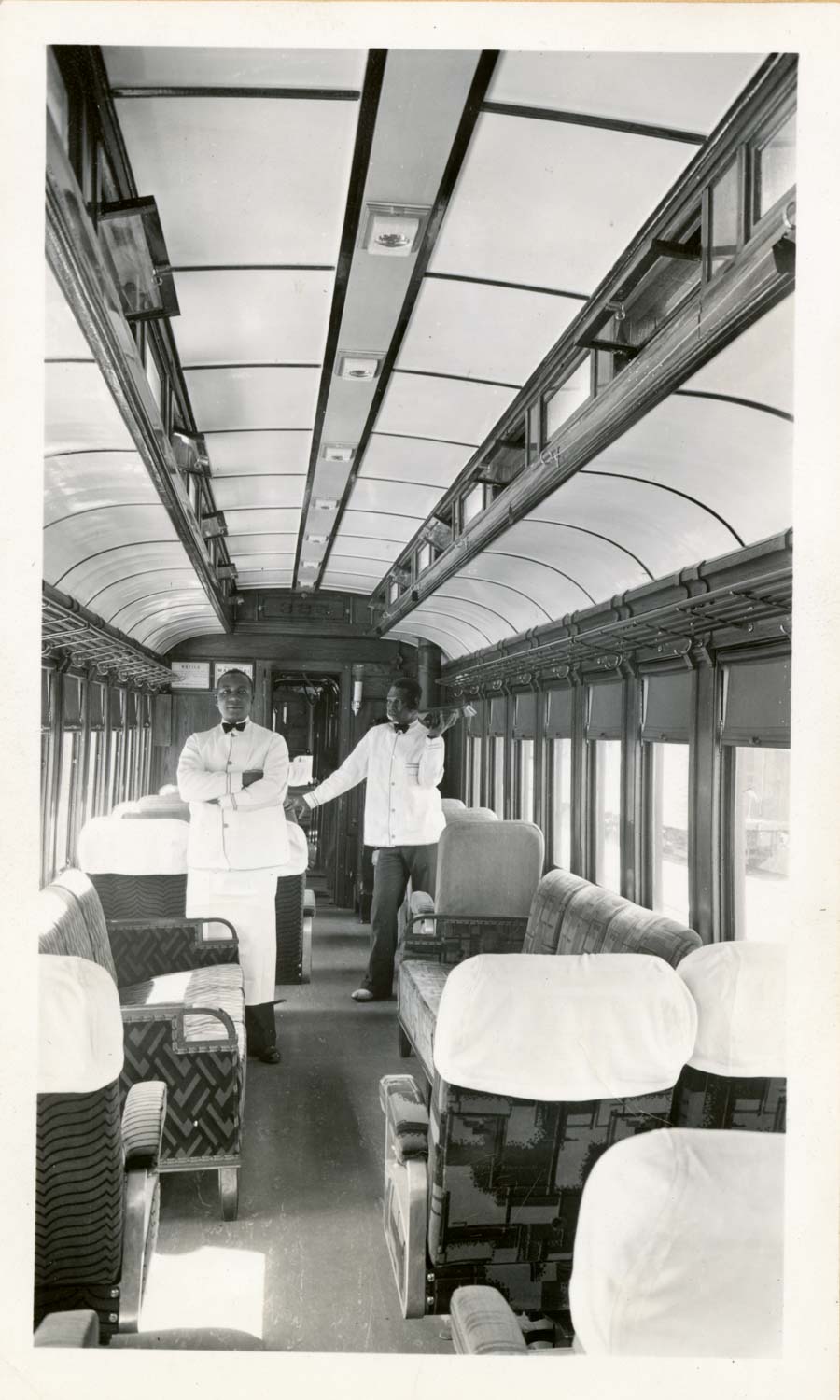
Pullman Porters aboard a train car.
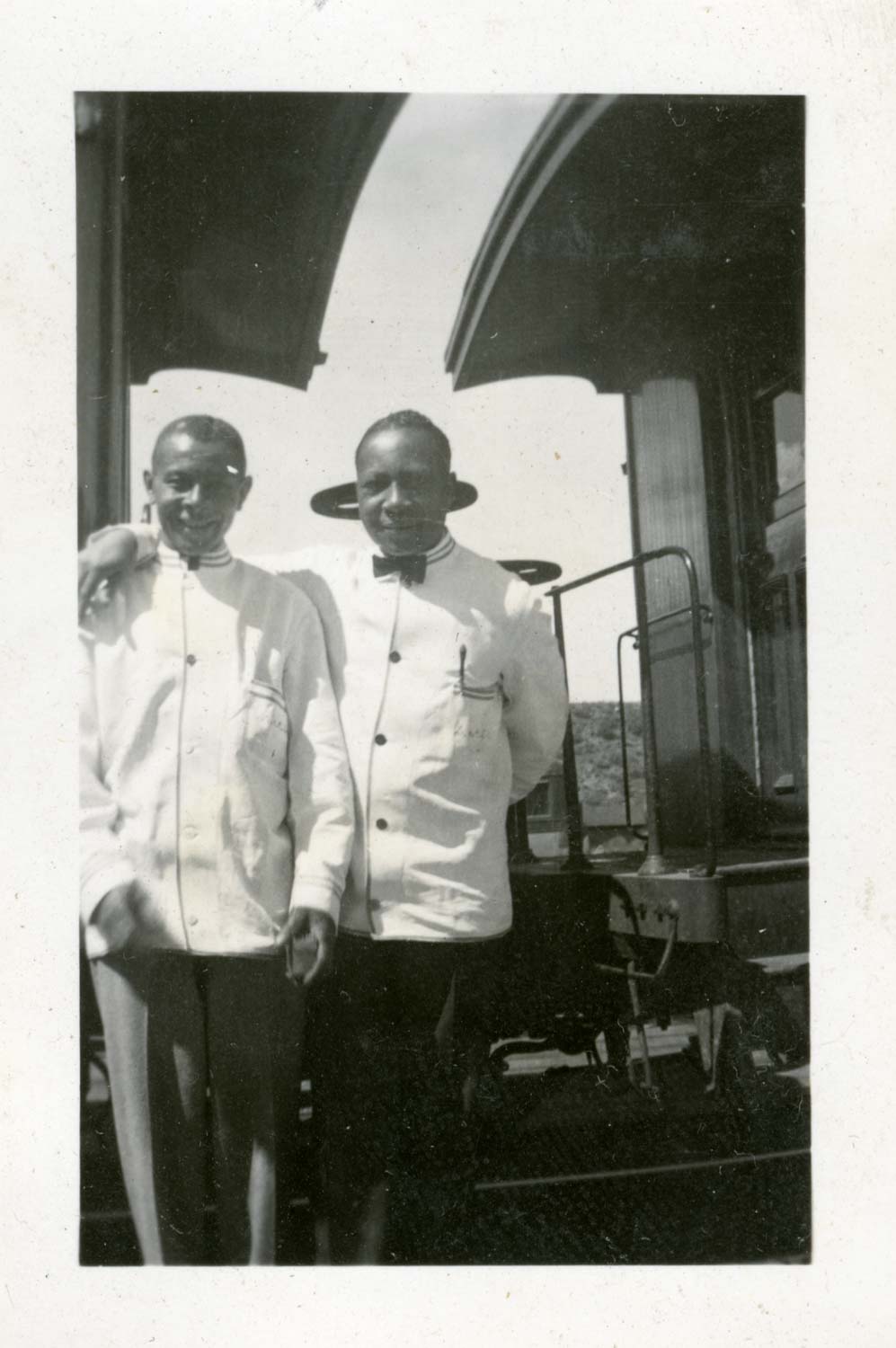
J. Armstrong and a fellow porter standing outside of two train cars in their porter uniforms.
Ed Tangen
Ed Tangen was a photographer and self taught crime scene analyst from Boulder, Colorado. He was an eccentric man from Norway who resided in Boulder, Colorado in the backyard of his friend’s house in a fabric tent. He ran a portrait and frame studio in downtown Boulder, which doubled as his personal laboratory. Tangen’s photographs captured scenes of Colorado nature, the University of Colorado, the Rocky Mountain Climbers Club, and the city of Boulder. By the 1920’s he began taking photographs for the Boulder County Sheriff’s Department, soon after he taught himself crime scene and ballistic analysis. After his death in 1951, Fred Mazzulla purchased ledgers, negatives, stereographs, and prints from Tangen’s estate sale. The Tangen images primarily feature slice of life scenes, school groups, hiking groups, animals, and scenes of Boulder. Due to Tangen’s profession the images also feature the less digestible, crime scene photography. Of course, it wouldn’t be the Fred M. Mazzulla Collection without some crime and vice.
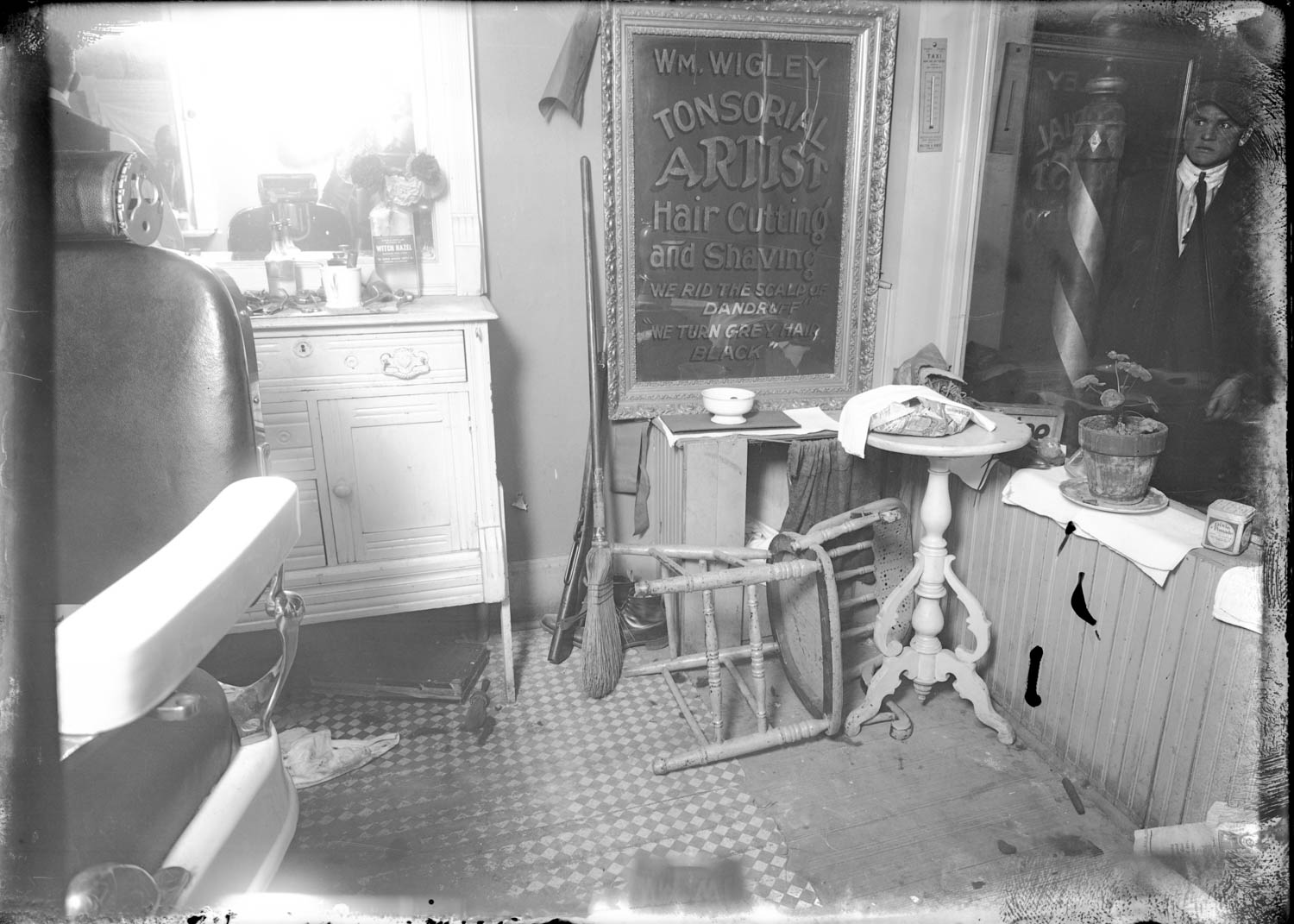
William Wigley Barber shop crime scene, where William Wigley was shot three times, by Ed Tangen circa 1922.
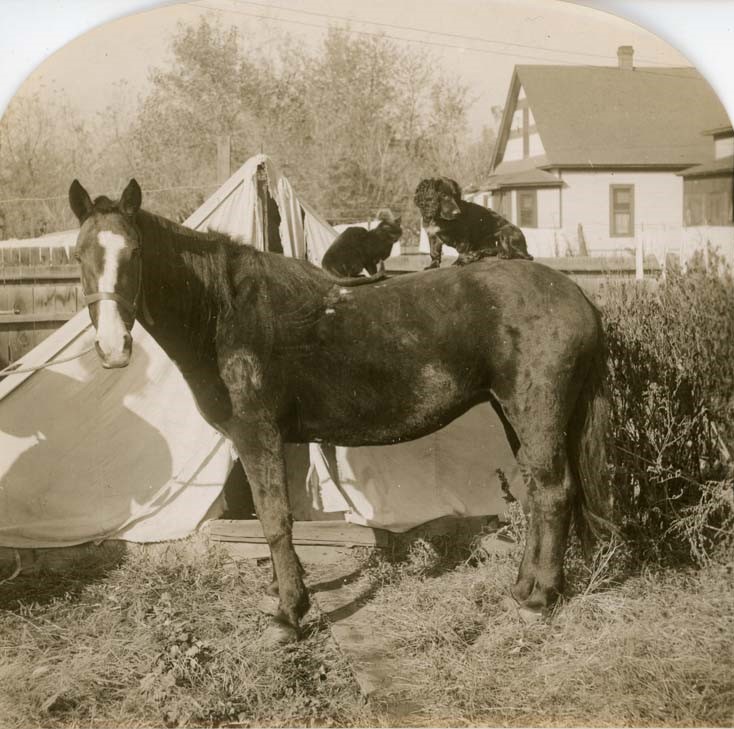
A stereograph of a cat and dog sitting on top of a horse's back in front of Tangen’s tent, by Ed Tangen.