 Membership
 Donate
 Shop
Shop


















Miguel Sisneros | SPMDTU
In this episode of reFRAMED: Preservation for a New Day, Colorado's State Historic Preservation Officer Dawn DiPrince sits down with Miguel Sisneros to explore the 126-year history of the Sociedad Protección Mutua de Trabajadores Unidos (SPMDTU) and the building that has housed it for more than a century. Join them as they discuss everything from Colorado's Latino civil rights history to Miguel's personal family connection to the SPMDTU, and the grassroots restoration of its historic building. It's preservation for a new day, and a reminder of how often a community's pride can be rooted in the places that preserve its past.
Episode Transcript
Speaker 1 [00:00:01] Welcome to another edition of ReFramed, Preservation for a New Day, where beloved old spaces are re-imagined. We take a deep dive into the preservation of an amazing historic space. What did it used to be? What is it now? And how did it happen? It's adaptive reuse and heritage for all, brought to you by History Colorado and hosted by me, Dawn DePrince, Colorado State Historic Preservation Officer. Today, I am joined here with Miguel Cisneros from Conejos County, Colorado. And we are delighted to chat about one of my favorite historic properties in the entire state, what we lovingly call SPMDTU, which stands for I Am Not Good with the complete Spanish. Description of the acronym S-P-M-D-T-U, but it gets at the Society of the Mutual Protection of the Travederos Unidos, United Workers, which, you know, I think we are very proud that Gustavo Arellano called this in the LA Times, the oldest Latino civil rights organization in the nation. And the original headquarters is the building we are talking about and it is located in Antonito, Colorado. Miguel, welcome. We're so honored that you are able to join us here today and we would love for you to talk a little bit about the history of this building and what it means to personally and to your community.
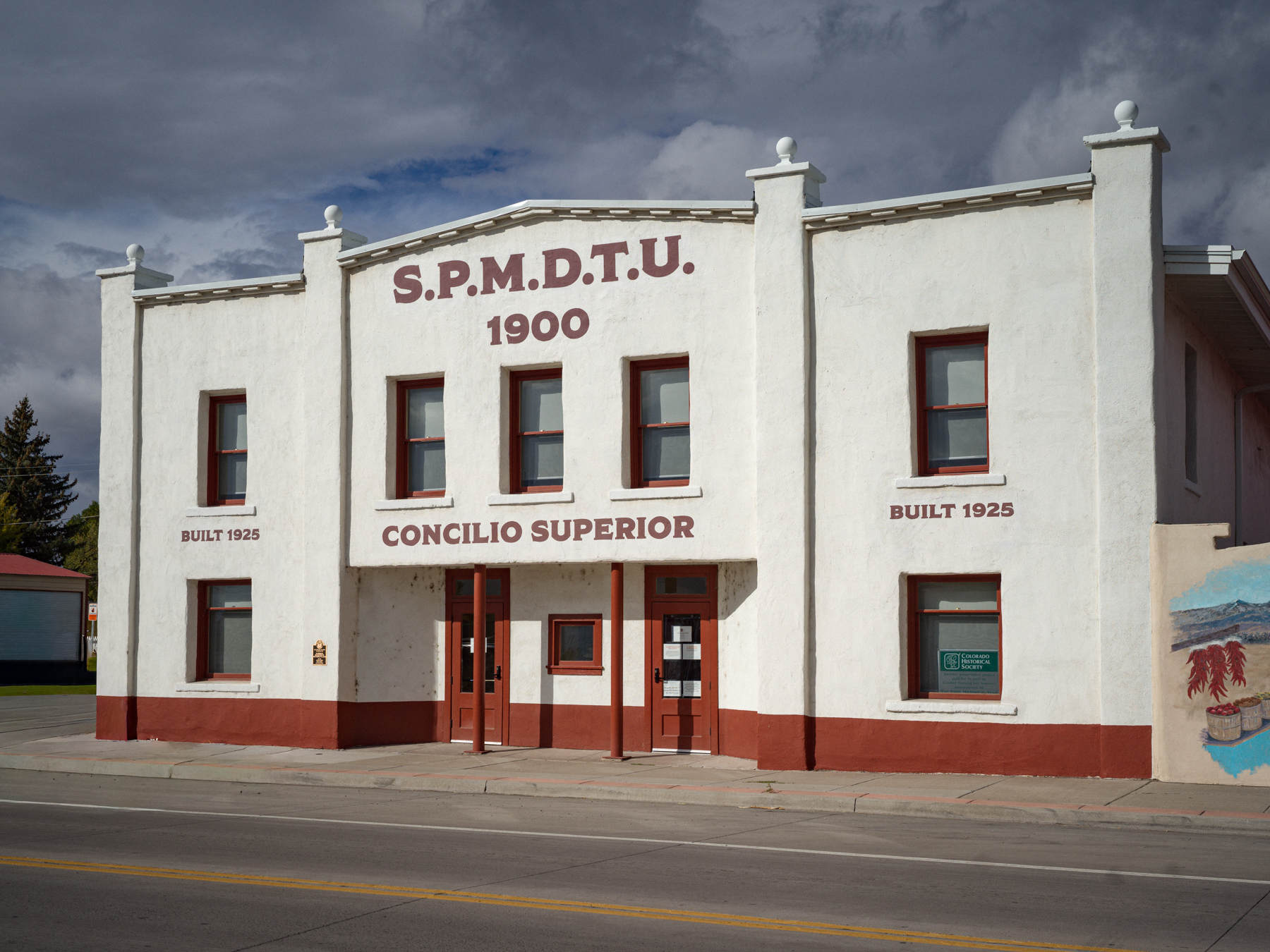
Speaker 2 [00:01:56] Awesome. Well, thank you for the opportunity, Don. It's always a pleasure to have the opportunity to speak about the SPMDTU. The acronym is La Sociedad Protección Mutuas de Trabajadores Unidos. So exactly what you said, the organization, the United Organization for the Protection of workers mutually, and that was founded in Antonito in the year 1900, November of 1900. In Antonito, Colorado, by a gentleman by the name of San Antonio Mondragon. So he was one that saw the need at the time to unite the Hispanic people in southern Colorado, in northern New Mexico. At that time, I believe Don San Antonio was seeing a lot of encroachment on land, water. And he found it important to unite people from Antunito in northern New Mexico to start to protect that. I myself am one that grew up in Antunita having not known very much about it, Don. When I was a kid, I remember seeing the insignia of the hands clasped together, shaking hands and I would see that insignia all over my grandparents home. Being a nosy little kid, if I will, you know, looking in drawers where I shouldn't be looking, you know. Grandpa's nightstand and so on and so forth, the guest bedroom, you know, look into all things. I would see that insignia and I always wondered, what was that about? You know, and my grandfather on my mother's side, Max Rabal, Moximiliano Rivas. He was never a member, but I would ask him. Grandpa, what is the SPM DTU? What is that? And it was always kind of described to me as like, maybe not his words, but mine, kind of like an insurance company, like an old man's club, if you will, not trying to be disrespectful to anyone, because I bet that is not what it is at all. But I remember seeing that. And I just kind of said, Hmm, what is that, and I remember walking into town as a kid in And you would see that building but I was never able to go in there. I just always heard like grand stories from my grandparents who were born in the middle thirties about how when they were kids, they used to go in there and watch movies or maybe go roller skating. I remember I hear from family and friends that they used to have like a boxing club in there, and didn't really know much about it. It was kind of like the society that was like cloaked in secrecy. If you will, so naturally just kind of sparked my interest in, as a teenager, I kind of like forgot about it, went off to college and forgot about, and it wasn't until a family friend who has been the Superior Council President, his name is Rogelio Briones, he was an educator in the community of San Luis, and he was my wife's art and social studies and math teacher and just lo and behold his wife. And my mother, they were classmates and best of friends. So I just hooked up with this guy and he goes, you should join the SPMDTU. So it was in the year 2010 that I joined. I've been an active member now for 16 years now. Wow, gosh, it's been a long time. For me, it has been a path of self-discovery. I started getting really involved in the SPMBTU, starting to do a lot of research in it. And I was given a book. That was written in the 50s about the history of the SPMDTU and I'm sorry I don't have it with me. I got to reading it and I read the preamble and I read there in the preambles I saw the signers of the preample and I saw the name Elichiel Ruivan and I was like wow I was like that is my grandfather's grandpa so that would be my mother's great-grandfather and my great-great-grand father who I never knew. But he was somebody prominent in the SPMDTU. And it was just, I don't know, I was just overcome with emotion. Like it almost kind of felt like it was meant to be done. And so I joined and I've been a loyal member since 2010 and now I am the vice president of the Concilio Superior and I'm also gladly and proudly the local concilio. And Antonito, I'm the local president for that chapter. The SPMDT was founded in 1900 and people say, does it still work? I'll use my family as an example. In the mid-1850s, the signer to the preamble, Elijo Ruival, who I've shared with you is my great-great-grandfather. His father came up, he came from Spain, it's documented, and he settled in... Acona, New Mexico, which is in the Poaque area, the Poque area. He settled there and he made his way up to what is now Conejos County. It wasn't Conejo County then in the mid 1850s. And he founded the village of Las Mesitas, Colorado. Last year, 2025 was 170 years that my Rabaul family has still lived on the same. Piece of property that he homesteaded, his house is still there. The house where my mom and dad live now, there was his son, Elijo Rabal, he had a house there. My mom, that was her inheritance. This one's thing, she knocked that house down to put the house that they live in now. We didn't know that then. That's just where she put her house. But it's oriented the same way that was important to my mom and my dad to orient it the same way that that original long house was. But that house is still there. We're still there, the Revolve family, and there's a bunch of us. It's not just my mom's family. And Michio had a bunch kids, you know, I have cousins I haven't even met yet. But the Revolve family is still there. That same piece of property that our patriarch Juan de Dios Rebal, who own-stated that area, we still have it and we still the water rights 170 years later. So if people ask, does the SPMDTU work? You're looking at it. We still have. You know what I mean? All thanks. All thanks in part to our patriarch's son, Elijo Rebal joining the SPMBTU.
Speaker 1 [00:08:51] Yeah, it's incredible. Both your personal history and the history of the organization. There's something so spectacular about this building. It has a presence to it. When you drive in to Antonito, you just can't deny the strength it portrays. Can you share a little bit out how the building itself feels tied to the history and the meaning of the organization.
Speaker 2 [00:09:22] Most definitely, I don't want to speak for any of my community members, I don't feel right in doing that. But to me, other than the old, Antunito in Cornejos County is a place of firsts, if you will, we have the oldest church in the state of Colorado there. They're in a Cornejo's, we had the first mutual aid society protecting and benefiting the Hispanic peoples in the County. So, to me, I feel that the SPMDTU, and I think a lot of people in the community see it as a sense of the word in Spanish would be orgullo, which means pride. I think there's a lot sense of pride there. That building was refurbished recently and I just find it... I guess heartwarming would be a poor choice of words, but I find that others in the community, they may not be members of the SPMDTU, Don, but they have a sense of community pride in that building. If you take a look at it, there's no trash or the windows aren't broken. People don't loiter in front of the building. Nobody has went and tagged it up or anything like that. So I think that building has a lot of sense of local pride because if you get to talking to some of the older families in Antonito, those that are multi-generational like my family, most almost everyone you speak to has an aunt or an, I'm sorry, an uncle or a grandparent or a parent that was a member. And I did take the word aunt back purposely because it wasn't, I believe, until the convention in 1970. We need to fact check that. But it wasn't until the 1970s that women were allowed to join the organization. So maybe there are some people there in Antionito now that, you know, have had an aunt or a grandmother that has been a member forward from 1970. But I guess to sum it up, You know, Acomito in Conejos County, it is a place of bursts. Some of the original families that settled the San Luis Valley are from that that area. We tip our hat to Costilla County and San Luis with them being the first, but it was maybe a short four or five years later that Antonito came to be with the train. But a community of firsts that the SPMDTU, it is the most prominent building in Main Street Antonito. You can't miss it. It's a sense of community pride, I would like to say, at least for myself.
Speaker 1 [00:11:52] Yes, it's beautiful. I'm curious, you mentioned that it has recently been refurbished, you know, maybe in the last few years and I was able to see it like mid-construction. What do you know about this restoration work? And I know, you, know, state historic funds dollars from our own office were part of the investment that went towards that. There were other grants, I believe, from the state as well. Just curious about all of the effort that the community put forward. In getting this restoration work done.
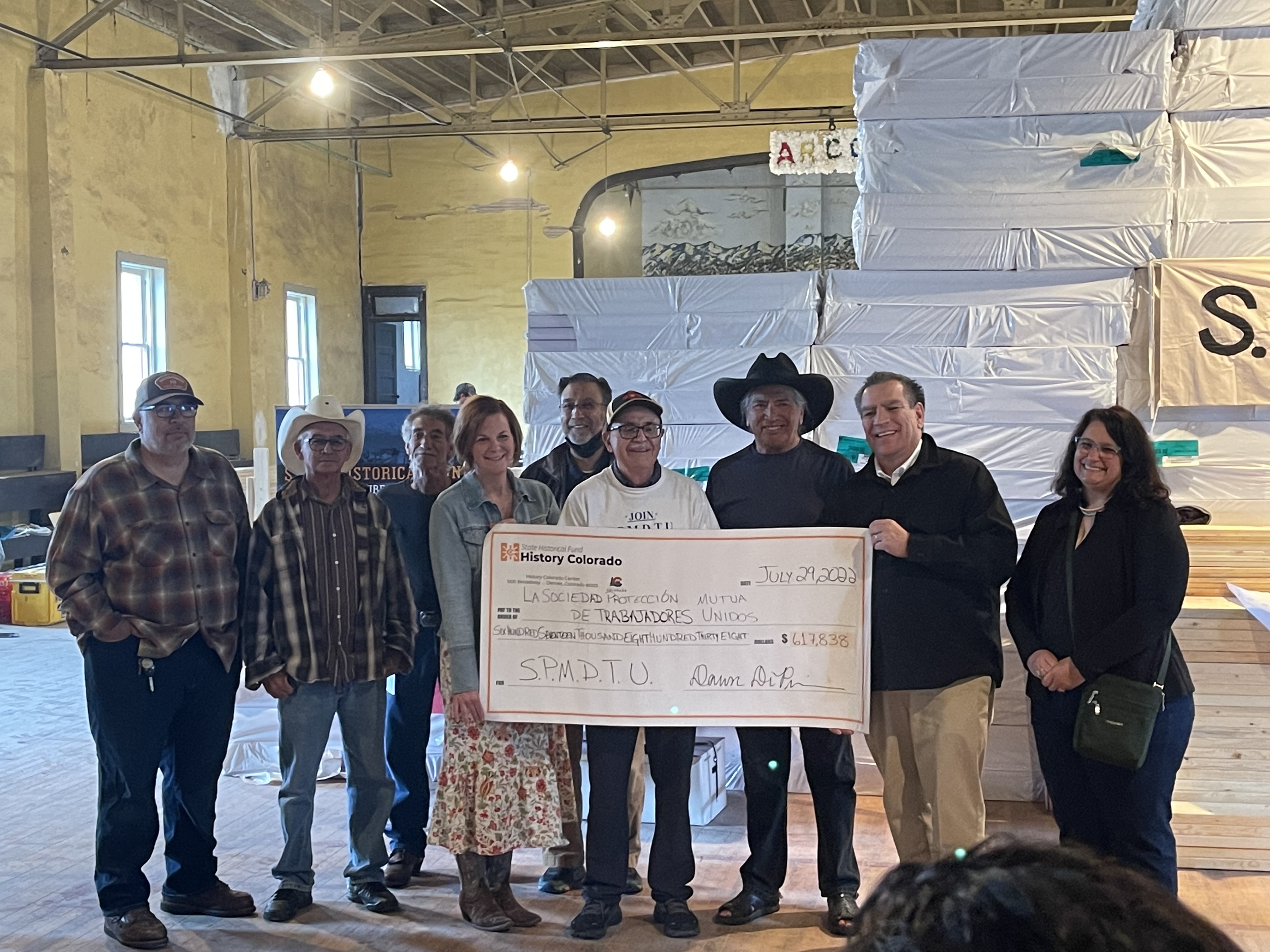
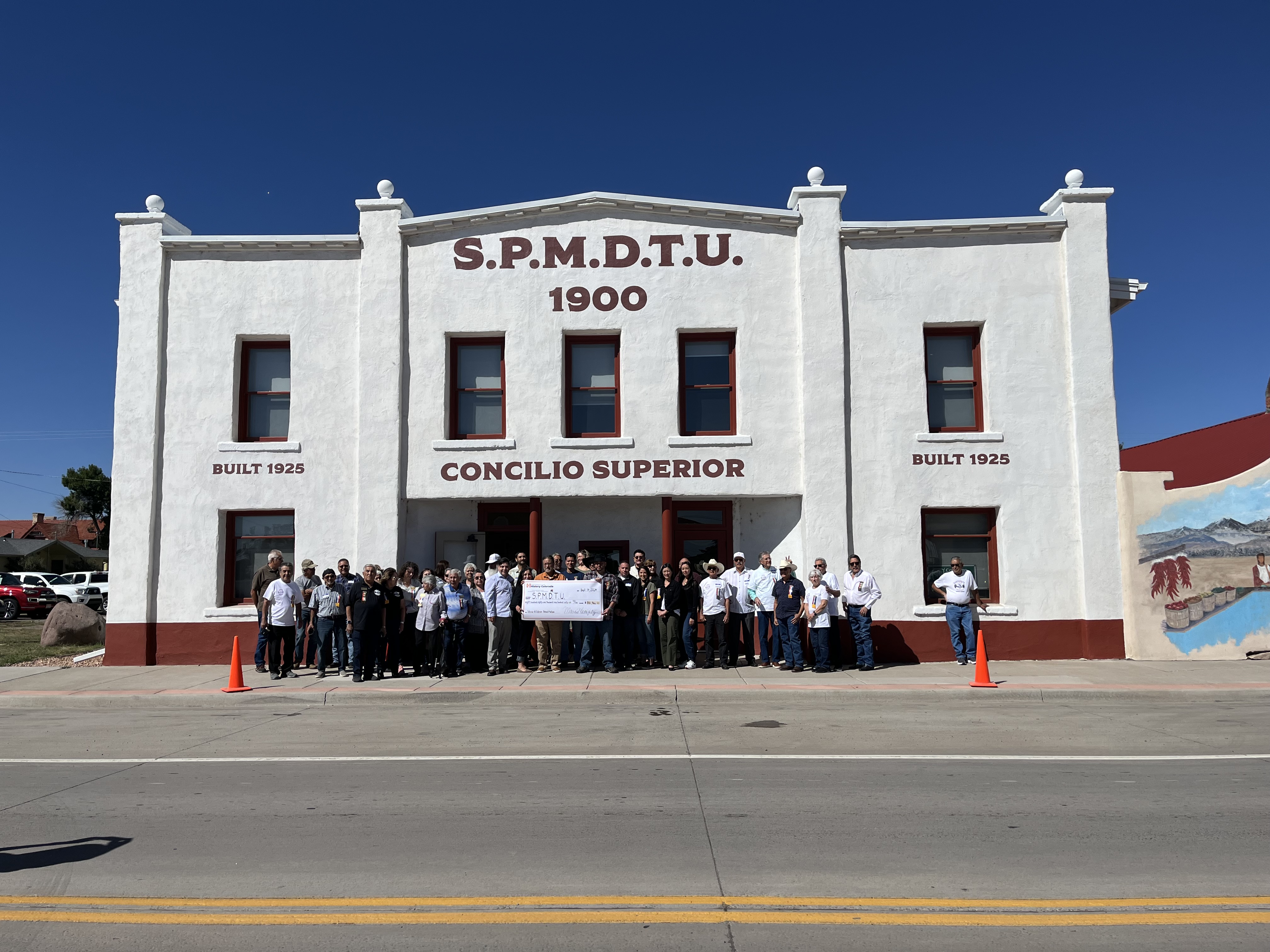
History Colorado Board Members and Executive Director Dawn DiPrince present a check to the S.P.M.D.T.U., Conejos County.
Speaker 2 [00:12:29] If I had a hat, I would take it off to my hermano in the SPMDTU. He is our Concilio Superior Secretario. He is the secretary. Dr. Antonio Esquivel, professor emeritus of Metro State University. It was him and him alone that sought out those grants. Initially, I can't speak to who all was involved in that grant process. There was a lot of people that were involved in that process. I personally was not one that was involved in that, but I do know Dr. Esquibel, hermano Antonio, as we address him, we are forever gonna be indebted to that gentleman because the energy. The time, the passion that he had for that project, to see it to its completion. Thank you to History Colorado, your staff and yours that believed in this dream and this vision that we had to have it get to where it is today. We'll be eternally grateful for that. But kind of going back, I recall, it was probably in the early 20 teens. If I could put it that way. I remember, um, Hermano Antonio, Dr. Esquivel, he was talking to the Consiglio Superior about us, you know, refurbishing this building. And to a lot of us, we're like, yeah, that would be nice, but where's the coin, how are we going to do this? How is this going to happen? You know, for me, I can't speak for anybody else, but for me it was just kind of like a pie in the sky. Like it would be. I recall, um. It all started. I remember he came to a meeting and he started with a simple, it wasn't even HD. You were probably like 360, 360 P the lowest resolution you could get on YouTube of a simple like one or two minute video about a go fund me. And it started off real modest, you know, started with a couple hundred bucks, you. And it just ballooned from there. I recall um... He just passed away, and in fact, he was the lieutenant governor of the state of New Mexico, Roberto Mondragón, who recently passed away. But amongst other things, being a politician, an actor, a recording artist, I recall we had a get together there in August in like the mid-20 teens. And I recall he literally took off his Western hat. And he said, I'm going to pass the hat. I'm gonna sing some songs. I want to see running bathrooms up there on that stage. You know, what are we going to do? We don't even have somewhere to use the restroom. Luckily, our neighbor next door, which was Cabez Southwest Market, Donald Chavez, it's no longer that. It's Cactus Hill Farms. It is a store called Cactus Hill Farming, I believe. I may have that wrong. But he was generous and let us use his So I would call it a monolog. Roberto Mondragón passing the hat and he says, the next time I come to Antonio, I want to see running bathrooms. And I don't know if that's Antonio's experience. I don't know if that was the genesis for him wanting to start that project, but it all started real humble like that. It was all a dream, you know, and it just, Hermano Antonio came back next meeting later. Hey, guess what, guys, I got a grant for this. Okay, that's great. Hey, guess what guys? I got a grant for this like, wow, this is great. And then some of those brands, you have to come up with matching funds. And then that's where we found partners like the Sangre de Crisco National Heritage Area, History Colorado, who had that same vision and dream as us. And it just manifested into something great and beautiful that it is today. I wish I could give you the particulars and all the steps. I wasn't really involved in that, you know. But Hermano Antonio, if it weren't for Him, Don. We wouldn't be where we're at today. If it weren't for history Colorado, if it weren't for the Sanga de Cristo National Heritage Area for believing in us and our dream and helping us out, in my opinion, I don't think we would be where we're today. A beautiful refurbished building. That benefits the SPMD to you, but also we have visions for it benefiting the community as well. Currently now, you know, the Lonejos County court system, they had a horrible fire that happened there recently and they were displaced and we were honored to work with them and rent a building to them for the youth, for that youth. So it's not just a building that we wanna just keep onto ourselves. We wanna have the community benefit from it as well
Speaker 1 [00:17:09] Yeah, continue that tradition of mutual aid, right?
Speaker 2 [00:17:13] Correct. I agree with you. That's very important to all of the members in the SPMDTU.
Speaker 1 [00:17:19] And what I appreciate about your story about these kind of like humble beginnings of this, you know, preservation journey is really, you know, sometimes people don't know how to begin a big preservation process. But it's, it's very inspiring to hear this idea of like literally passing the hat around as a as a place to begin.
Speaker 2 [00:17:45] That really happened. I don't know if the hermano Antonio was there, but some of the hermanos that were there that day, they could say, do you know what? Miguelito telling the truth. It really was passed around. I can't say whether or not that was the genesis of. The building restoration project but I do remember the hat being passed around and if you've ever seen the movie the milagro bean field war uh towards the end the gentleman there that's leading the the community party if you will the fiesta hermano roberto mondragón he was there you know with his guitar and he literally took off his hat and i want to see running bathrooms you know what i mean and for me i could say that was probably the genesis of that project. In my own words, I probably think others would disagree with me. And they're probably right. But for me, when people ask me, I go, it started with a hat being passed around. Yes.
Speaker 1 [00:18:38] Yeah, you know, sometimes people, it can feel daunting to take on a big project like this, but I think it is inspiring for people to hear that sometimes, you know, just the desire to get something like this done, you believe in it so much that getting started is where you got to begin, right? You just start putting, putting the money together and start getting the work done. I'm curious, you mentioned uh, bathrooms. So what are the kinds of things that the building needed in this restoration project?
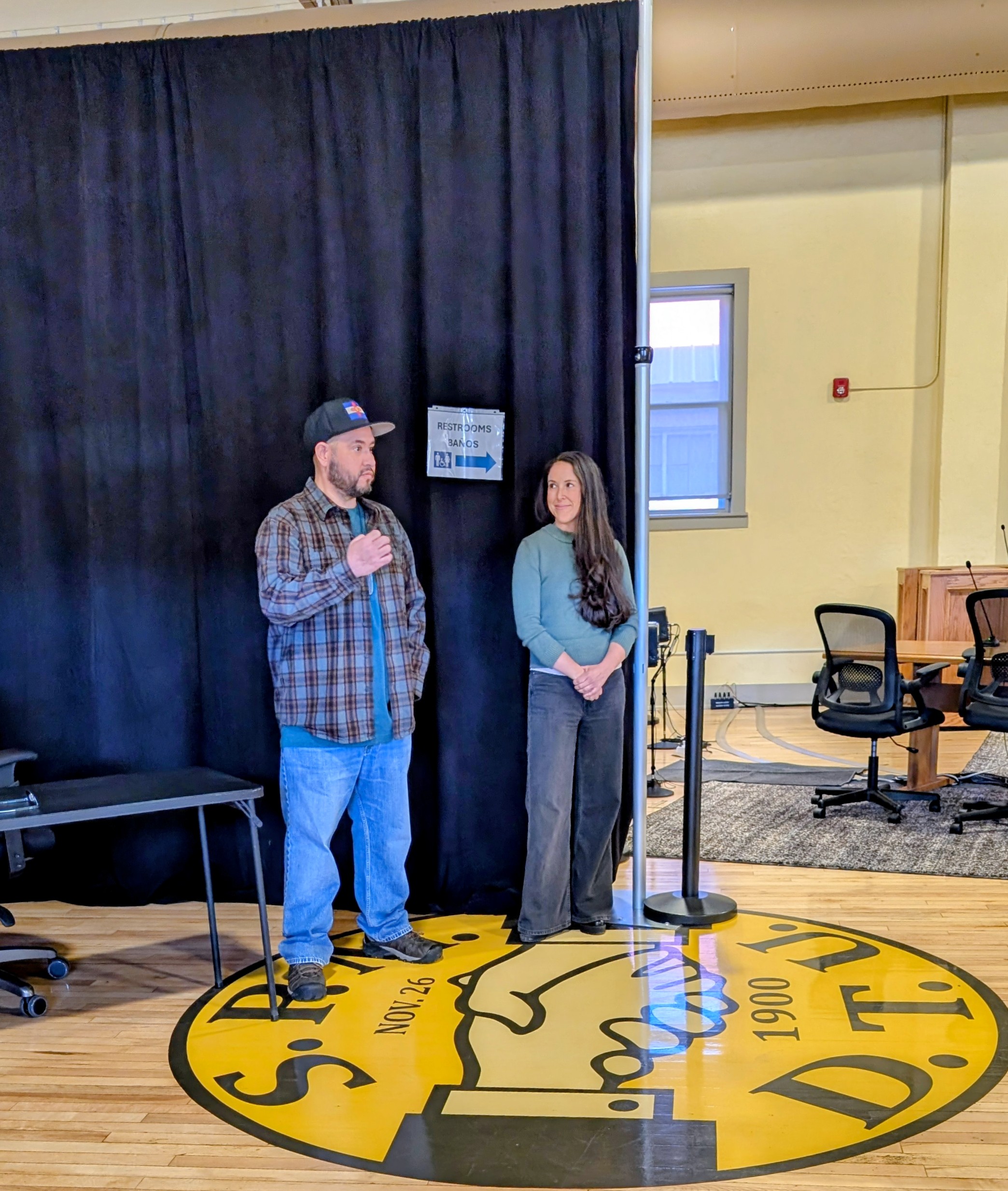
Speaker 2 [00:19:16] In my opinion, everything, everything I believe, and I'm probably wrong and incorrect, but it started with a roof at first, hermano Antonio was able to write some grants and we were able to get the roof done. I recall hermano Rogelio Briones, who was our Consiglio Superior president for a length of time. He tells me that, um, I wasn't a member yet, but I heard a story that why he was the Presidente Superior, our secretary at the time, his name was Hermano Tomas Romero. And again, I, wasn't remember yet, but, um. The amount of Rogelio tells me I was at school. I think if I have the story, right. I was that school. He's an educator in San Luis and he got an urgent phone call. I think I have a story, right. And, um that amount of Tomas tells the amount of Helio. The south wall, the southwest corner just fell in. What are we going to do? You know, so I think back then I wasn't a member then yet, but I do know that they were able to come up with some funds and some some monies to get that wall supported. And then it was just that building just needed a lot. When I when I started coming around there, there was I recall in the little office now that the court has their has their little office in now, their administrative office in. There was a bathroom back there that worked if there was a bucket of water there. And if you use the toilet, you would have to pour the water in there and it would flush. And so just really humble beginnings. It just needed everything. There's a really neat documentary on PBS. Her name is Katie Perdonis. She used to work for Rocky Mountain PBS. And she did a video of it before it was in the current restored. The state that it's in now. But I kid you not, you go upstairs to our now where we have a small apartment for a caretaker, I believe is what they have that earmarked for. That used to be the old loft where they have the reel to reel projector. They used to show movies in that building once upon a time, and I believe 30s, 40s, 50s around that time. But you would go up there and there was dust paint up there, dead pigeons that were already like mummified. And that building just needed a lot. To see it in today's state, man, for me, and I've only been a member for 16 years, but when I got to see it for the first time, I recall getting in my vehicle and driving to Las Mesita to go say hi to my parents. I got emotional on the way going up there. I was like, I really have to be completely 100% honest. I knew in my mind, the amount of money it would cost to get that building to its current state. And I just kind of said, not in my lifetime. And that's horrible to say that, me being the vice president. But I have to be honest with myself and others, I really thought, you know, that would be great. But one of these days, probably, you you know and it happens in Spanish, the word would be devil. I'm like quick, you it happened quick. And if it weren't for the gusto, if it for the animal that that Hermano Antonio had in the building committee. He didn't do it alone. He had a really strong building committee and partners like yourself in the Sangre de Cristo National Heritage Area. They came together quick. For me, it's just a sense of pride. When I drive by there on my way up to Las Masicas to go to the family ranch and home, I... I take a look at it and I just kind of like tap my heart and go like that. And like, yes, right on. You know what I mean? That is a huge win, not just for the SPMD to you, but for the community and town of Antonio Conejos County. You know, Conejo County being one of the most socio economic depressed areas in the state, you know what, I mean, to say that something good like that happened in Antonio, that is huge. That is huge that that's. I mean, it's one of the coolest things that I've seen in my 45 years of being alive. You know, I think it's just amazing that there's new life in Antonito. People are proud. People are happy to see that building. It's amazing how Being from Antonito, a lot of people are anxious to want to see the building, to want to rent it, to wanna use it. This time of the year, we're getting close to graduation season, the prom, you know, the community wants to use it and we were very proud. I want to think our maiden voyage was the town of Antonito. The young, the senior class, they said, we know it might not be ready yet, but we would really love to have our prom there. They wanted to rent from us and we said, no, no no. We're going to let you use that for free. And just the young kids and the teachers there, how they came together, they were like so careful with everything. They didn't want to scratch anything. They didn't want to break anything. It was, it was just neat to see that others in the community are proud of that building too. So, I mean, the stage was refurbished, that that floor was refurbished, a beautiful, our logo right in the middle of the floor. Beautifully painted and restored the office space, which we have hopes of being a museum that was refurbished in brand new, brand new ADA accessible bathrooms, a living quarters upstairs for a caretaker. One of these days, it's just a modern. 21St century building. In Antonito, Don, in Antonito. That's something that you would see like in Denver, you know what I mean? Somewhere in Springs or Pueblo or going south to our neighbors in Albuquerque or Santa Fe. You know what i mean? Just to have that in Antoniito. Yay! That's amazing.
Speaker 1 [00:25:21] Yeah, it is spectacular and like it is this, I mean, I can't even imagine what you're describing. It's like previous state because right now it is like sturdy, spectacular, glistening building, beautiful wooden floor. I love the ceiling as well, you know. So the idea that it was like caved in and dead birds and all of that is hard to imagine. When you see its current, uh state That's going that's oh, yeah, that's terrible
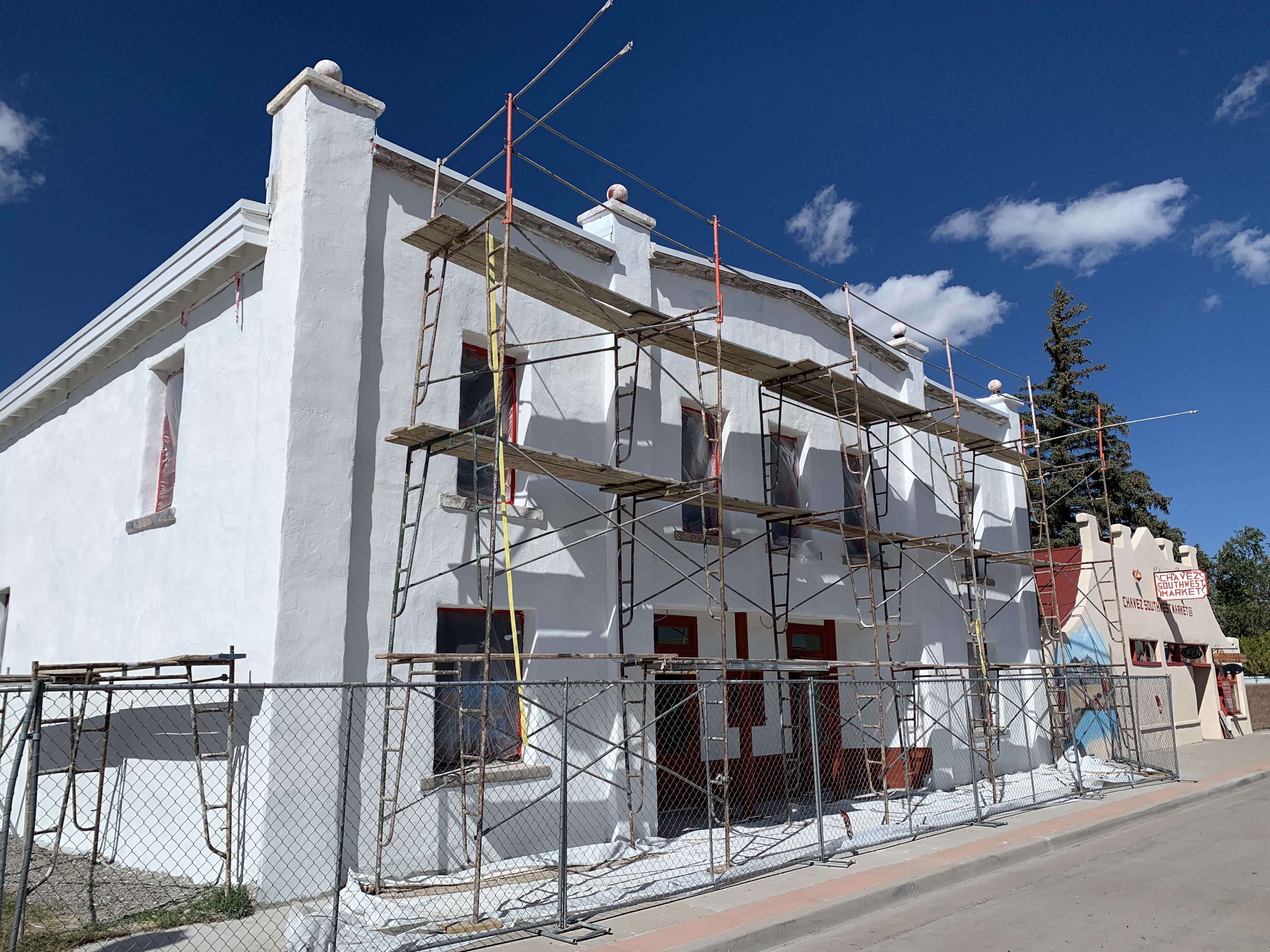
Speaker 2 [00:25:57] I think I have a picture on my phone, but I remember I was leaning up against the stage one time kind of all nonchalant, just leaning back being cool, if you will, and I saw something through my periphery kind of moving, and where the stage is now, there was that moss rock, if we will, that moss rock and they had put it there beneath the stage and I saw something in my periphery moving and I looked over and I'm like. That's a fat, and I was kind of like immediately in my head. I thought, Ooh, baby's gross. That building needed everything. We used it. I forget what we used it for one time. While it was for that community gathering, we had a barbecue at the end of summer before it was refurbished. We swept that building and we swept it again and we were still getting dust off of that floor. There wasn't enough Murphy's oil soap to bring that floor back, but we used. It was ours to see from what it turned into in a short amount of time. Oh man, it just takes your breath away.
Speaker 1 [00:27:09] Yeah, the transformation is incredible, but it still retains all of that like original character and history and spirit of those who built it.
Speaker 2 [00:27:22] You know what, sometimes I've been in that building by myself and I oftentimes personalized it, which isn't right because there's a lot of people that have come through those halls of the SPMD to you, but I oftentimes personalized it and I think, wow, what would my great grandfather, Elijo Ruyval, what was he think? What would our founder, uh, Celedonio Mondragon, I could just I don't know if you're spiritual, I don't know if people believe in that, but let's just say they're looking down upon us. We'll leave it like that. For them to say, our founder, Celedonio Mondragón, our treasurer, Billy Perea, that's his grandson. That's my grandson in a brand new building. Hermano, our president, Hermano Ralph Maestas, I believe that's is grandfather as well too. But that's my grandson who's the president in a brand new building. My great, great grandfather, who was the signer to the preamble. That's my great, great grandson and he's the vice president of that in a brand new building. And the SPMDTU is still relevant and it's still alive and well today. I like to think this building being refurbished. In the state that it's in now, it's a 126 year old building this year. November will be 126 years. The building may be not 126 your years old, but the, the organization itself with this building being refurbished and with the new members that are joining the concilio and Alamosa this past Monday, they just in their concilium number 19, they initiated two new members. So I feel comfortable in saying in another hundred years. The building most definitely will be there and hopefully we're still there as an organization as well too and I have full faith that we will.
Speaker 1 [00:29:19] Yeah, I do too.
Speaker 2 [00:29:21] Do you know what else it preserved to? I alluded to this earlier, a sense of community pride. Yes. Do you, when I was a kid, again, I like to qualify my statements, but when I was a child, nothing we ever heard came good for Montanito. All I heard, I graduated in 1999, but, when I was growing up, I just remember people saying jokingly, maybe it was half true, but oh, you're from Montanico. You guys are fighters. Oh, you are from Montonico. You're a drinker. Oh you're from Antonito, hide your wallet, you know what I mean? Nothing good comes from Antoniito. I made to differ. I made it out of Antonito. You know what i mean? The SPMDT, you made it out of antonito. Celedonio Mondragon made it, out of Antonito, we have a lot of people from Conejos County, not just Antonito that came from there, but I think it being socially and economically depressed for so long, you just kind of become a product of your environment and that people tend to accept you live in those dole drums. Focus on the negative. Nothing's ever good, you know, like that Eeyore mentality, if you will. I'm just from Montonito and I know me. I used to say that I'm from Montenito and I would make jokes. I was like, I'm for Monteniko better hide your wallet. You know what I mean? I don't know anybody else that did that. I did that, but we just come to some people just accepted that, you know, but now there's a lot to be proud of. You know, I I'm trying to teach my daughters. You have a lot. To be proud. Your mom is from the community of San Luis. You're one of the original families from the state of Colorado. Your dad is from Antonito, you know, next to San Luis, we're the second oldest community in the state of we're the founding communities. You are what Colorado looks like. You know, you, you are what Colorado looks. And I think that building preserved a sense of pride, Don. It brought it back, you. Once upon a time, people were proud to be from Antonito. A lot of people, we still are. But when one of the poorest places in the State of Colorado in This new building just instilled a new sense of life in our community. And, you know, speaking for myself, I'm proud of it, you know, I like to go home. I like after the meetings, you know, we all leave and shake hands and sometimes I like to hang around and just hold up the wall, if you will, you know, just hang outside the building and watch people drive by and wave, you what I mean? It's cause I'm out of that building, you know what I mean? And not just because I'm from to me to the whole community. Is proud of that too you know so I think you said it preserved the building but it yeah so much more community pride yes
Speaker 1 [00:32:06] That's right.
Speaker 2 [00:32:06] That's something good. A lot of times you hear only negative things about the valley, you know, I recall when shootings happened, like that happened in coffee lean, that made Denver News, like when Salman all like it, it the the water system in Alamosa and I don't need to, but you hear about those things oftentimes, you're learning. This is a you know what I mean? And it just, I don't know, just gave us that sense of pride back, you I don't know, it just gives me so much. Hope for the future. It gives me so much again, you keep hearing this word over and over over pride that people in the community that aren't even members, they're proud of it too. If you look, there's not one bit of graffiti on that building. There is not one broken window in that building, people are proud of you know, and they they take care of it. So I think That's amazing.
Speaker 1 [00:33:01] Yeah, wholeheartedly. I mean, I feel like you've really given us a really powerful lesson in how preservation can be about bricks and mortar, but it is about so much more. It helps remind us who we are, where we come from, and why that matters. You know, it's Colorado's 150th birthday this So it is incredible to think about that even more. This year, this reminder of our beginnings and how we are rooted in this place. The work that communities like yours have done to preserve important places like the SPM DTU, I think are something that we are all proud of. If we could be so bold to join you in that collective pride. I think you've also helped us to understand that a project can look overwhelming and impossible, but sometimes you just have to pass the hat and get started. And amazing things can happen.
Speaker 2 [00:34:10] We'll end with this. It was two years ago this time. We always wanted to recapture some of the old meeting minutes. So a gentleman by the name of Dr. Herman Martinez, whose father was a member of the SPMDTU, he had a briefcase of old meeting-minutes, Don. And Herman, he gave it to old suitcase or these old meeting minutes. In Spanish, beautifully written, man. Talk about penmanship. Those gentlemen got an A plus in penmanship, but anyway, they said, find the day that was 100 years ago. Talk about fate, if you will. So we flip back to the meeting minutes. 100 years ago to that day, they read the meeting minutes. That day, 100 years back, was the day. That my great-great-grandfather, the signer to the preamble, Emichio Rivan, was voted in to the SPMDTU, the chapter that was in Mogote, Colorado, no longer is a chapter there anymore. But that day, 100 years ago, he was, we met that day 100 years, so 100 years he was sat, he was initiated with the SPMBTU. That same day, a hundred years, I was seated as the vice president. Of the SPMDTU. I cried. I was like, how, how could that serendipity, whatever you want to call it, Dawn, I mean, but 100 years to the day, my grandfather was initiated into the SPMB to you. It had been 100 years of him being a member in that day too. I was seated as the vice president of the Consiglio Superior and I was just like, wow. Wherever the energy, the spirit, the aura of my great-great-grandfather is today, he's sitting there smiling and he's proud. I like to believe in my heart of hearts. That's a very personal anecdote and story for you.
Speaker 1 [00:36:16] It's incredible. Yeah, the connection to the ancestors and all of the ways that this work makes that possible and just the power of mutual aid. I appreciate the story. Of the power of mutual aid and what that means for your family's 170 year old connection to the to the land. It's hard to put into words what that kind of legacy really means as a very powerful family story. Thank you for sharing that.
Speaker 2 [00:36:47] You're welcome. And we're still there. We're open to the public. We want people to come. We want to come and see the SPMD to you. We wanna bring them in. We wanted to tell them a little bit about who we are. We don't want to be cloaked in secrecy. We wanna be out there. We wanna be public. So if you're ever in the Antuneto area, get in touch with us. Go to our webpage, spmdtu.org. There's contact information there. Get ahold of We're more than welcome to show our building. We we're proud of it. We don't want it just to be closed and only for us. It's for the community. It is for everybody. We want people to feel welcome there to come and see it and check it out. We couldn't have done this without the hard work of Dr. Esquivel, Hermano Antonio, the persons, our other hermanos that sat on the building committee. I don't want to name names because I don t want to leave anybody out, but those of our hermanos who sat on the building community, if I had a hat off to you hermanos, you did a lot of work. Our president, hermano Ralph Maestas, he took on this project to see it to its completion, sitting as the president. He sat in on dozens of hours, if not more, of Zoom calls, of meetings. So... Thank you to him, you know, thank you to the Sangre de Cristo National Heritage Area for believing us, believing in us. And thank you, to you, Don, in History Colorado for believing in us and helping our dream come through. We couldn't have done it alone. And if it weren't for partners like yourselves, believers in our dream, then we would still be sitting there in the dusty building with pigeons dead upstairs, hoping and wishing that one day we'll This is building but it's fixed. It's there, I couldn't be more proud.
Speaker 1 [00:38:32] Well, thank you. Yeah. Thank you, Miguel. I just feel like you made my preservation heart here double in size. So thank you for all that you have done, both cultural preservation, this kind of physical preservation work, and all that you continue to do with your leadership and your work in Antonito and Conehouse County. We just appreciate your incredible storytelling and you're a great, great spokesperson for the power of preservation.
Speaker 2 [00:39:07] Thank you, thank you for the opportunity. And this little boy from Montanito from Conejos County once upon a time. Yes. I never thought that the SPMGTU would. What would be the focus of attention? It's amazing. It's great. We've done videos on Rocky Mountain PBS. We're now doing this podcast, The Alley Times. Wow, this is just amazing. It all started with one man's vision, Selegoño Mondragon organizing mutual aid. It's just something that just a snowball effect, if you will, if the vibes are good and things are positive, these things just with hard work and determination, they can't help but come to fruition.
Speaker 1 [00:40:00] Completely, completely, and these are always good lessons, you know, whether 100 years ago, 126 years ago or today. So thank you. This has really been incredible, inspiring. To be honest, maybe a little bit emotional for this Southern Colorado girl over here, hearing you talk. So I just really appreciate your time, Miguel. Thank you so much. To see photos from this edition, visit historycolorado.org slash podcasts. ReFramed, Preservation for a New Day is presented by History Colorado, offering 11 beautiful, inspiring museums and historic sites that ignite imagination of all ages. Join us to discover your past and build a better future for all people in Colorado. Home to a free public research center, Colorado's Office of Archeology and Historic Preservation, and the Colorado State Historical Fund, the nation's largest preservation fund of its kind. Learn more at historycolorado.org. This episode was produced by Sam Bach and Sarah Cappell, edited by Callie Mejia and directed by Julie Jackson of Julie Spear Productions and Truce Media Collective. Follow History Colorado on all social media platforms to stay in the know on all things history in Colorado.