
 Membership
 Donate
 Shop
Shop
















Reframed
Brad Rowland | Emergent Campus
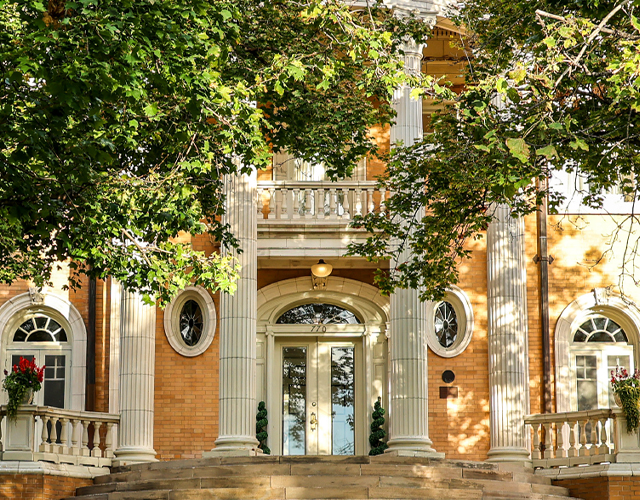
What do you get when you cross a tech hub and a historic high school? In Florence, Colorado, the answer is Emergent Campus, a multi-award-winning rural business incubator! When Florence students moved into their new schools in 2019, Brad and his colleagues at Emergent Campus figured the historic school could be reborn as a place that would draw remote workers to beautiful parts of Colorado, just far enough away from the costly and busy co-working spaces of the urban Front Range. The community got a great tech hub and to hang on to its historic high school all while creating an attraction that will continue drawing economic development for years to come. It's adaptive reuse and preservation for a new day in Florence!
Episode Transcript
Speaker 1 [00:00:01] Welcome to another edition of ReFramed, Preservation for a New Day, where beloved old spaces are re-imagined. We take a deep dive into the preservation of an amazing historic space. What did it used to be? What is it now? And how did it happen? It's adaptive reuse and heritage for all, brought to you by History Colorado and hosted by me, Dawn DePrince, Colorado State Historic Preservation Officer. Well, we are delighted to be here today with Brad Rowland. Brad, can you introduce yourself and share a little bit about the project you're gonna be sharing with us today?
Speaker 2 [00:00:45] Yeah, thanks. My name is Brad Roland. I'm a partner and general manager of Emergent Campus at the historic Florence High School. So we're in Florence, Colorado and Fremont County, about two hours south of Denver.
Speaker 1 [00:00:57] Yes, and this is a spectacular structure. How big is the old Florence High School?
Speaker 2 [00:01:05] So the campus is three to four buildings, depending on how you count them, and it's about 75,000 square feet total, so it is enormous.
Speaker 1 [00:01:15] Wow, so what are all the buildings that are on the campus?
Speaker 2 [00:01:18] So actually, when we went through the research project for getting the building on the National Register, we thought that the main front building, so when you look up Emergent Campus, you see the beautiful front building. We thought that was the first building built. There's actually a smaller building in the back that was a standalone administrative building for the school district in some time before 1920. We don't have the exact date. And then the main building was built in 1921. And then they came back in the 50s and built kind of a smaller building behind it called the Annex building, and then built a very large gym, which is beautiful. If you've seen the inside of it, beautiful wood arches. Yeah, it's a pretty amazing place.
Speaker 1 [00:02:01] So where are high school students in Florence going to school now?
Speaker 2 [00:02:07] So in 2019, the school district sold us the building and moved the students up to their new high school buildings. So they had already moved, my understanding is they had already moved the high school students up there and they had the junior high still left in this building. So as soon as their new building was finished, the construction was finished. They moved the rest of the students up there. And literally about a month later, we moved it.
Speaker 1 [00:02:32] Wow, wow. So tell us about the emergent campus because I think this is not at all what people would imagine is happening in a rural high school in Colorado.
Speaker 2 [00:02:48] Yeah, so a little more background on the project. So sometime around 2016, 2017, there was a group of volunteers in the county. We were just working with our economic development group. Most of us were full-time tech people, so we were either remote tech or we had businesses down here in Fremont County. And we were just working to figure out how we could get more remote techs down here. You know, if you don't need to be in a metro area and you're looking for a community that you might enjoy, how do you create awareness for these rural communities where, you know, people can have a much different kind of work-life balance than they might've had like when they lived in a big city. So we were recruiting remote tech people, remote professionals. We were helping kind of build a business ecosystem. That whole project got... Our county, our region recognized by the state is Colorado State's second tech sector partnership, which is pretty interesting. The first one's Denver Metro and the third one is Boulder. So we don't have any aspirations to grow to that size, but the recognition is we're building a group of business owners and community members that wanna right size tech for our community. And then as we would do that, we kept running out of space to put the businesses in because there's literally, there might be one office building in Fremont County that you just never had the 1980s, 1990s, two-story brick office buildings did not make it to Fremunt County. So you have a lot of people trying to start a business out of their house or out of a 120-year-old retail storefront on Main Street or something like that, not really fit for purpose. And I wouldn't say we were looking for 75,000 square feet. I think we were maybe 10,000, 15,000. We had had some other buildings before and we just really felt like if we didn't kind of own the building, it was just gonna be hard to use it for economic development purposes. So when the school district reached out, they were aware of our projects through some high school internship programs that we had started in Fremont County. Which won the Colorado Technology Association Talent Champion of the Year in 2019 and also the state's first rural P-TECH grant, which allowed our students to get two years of free community college if they did a STEM-based learning track and interned with a tech company and most rural communities don't have tech companies. So we've done a lot of work with the school district. They knew that they would be moving off of this campus. And they had a couple of concerns about just putting it up for sale. And I think probably the first concern was buildings like this, if they're not immediately occupied and managed, can fall into disrepair pretty, pretty quickly when I think we've all seen that with some other buildings and it's, it's not an easy building to find a buyer for, right? It's 75,000 square feet of classroom space and gym space and really large hallways and then the other concern was maybe if someone from outside the area bought it. What would they do with it? Were they going to turn it into apartments or something that just wasn't a good fit for the community? So there was kind of, I think, a mutual hope that it would be a good that we'd be able to kind of move into the space and put businesses in here, but also be able do high school internships and community college apprenticeships and things like that. So even if it couldn't continue to be the beloved school that it had been for 100 years, it would still be. Kind of a center of commerce and have students here who were part of the high school programs.
Speaker 1 [00:06:16] So first of all, I'm curious, are you from Fremont County originally or are you a transplant?
Speaker 2 [00:06:23] Uh, we moved here, my wife and I moved here in 2013 from kind of South San Francisco Bay area, and I've lived all over the country growing up. She was mainly from Texas. And then we moved to California for work in 2000 and her parents had retired up here, kind of up in the mountains, um, outside of Canyon city. And we would come out to visit and just kind of marvel that anyone still lives in small towns like this. How quaint it is and we could never imagine living here. And then about four years into it, we moved here as well. And there was no Starbucks or Whole Foods at the time. So we weren't sure how we would survive, but we figured it out.
Speaker 1 [00:07:02] So you were coming from like big city, Bay area tech environment to Florence, to Fremont County. So you know a little something about the kind of people you're trying to recruit to this tech hub.
Speaker 2 [00:07:18] Yeah, and in larger metro areas, if you're starting a business in a metro area and you go raise some investment money, you don't necessarily want to spend all of your money on labor in the metro area. Labor is going to be one of your highest, largest expenses. So almost all metro areas have these communities that are a couple of hours outside the community where you can find level one, level two call center support to do marketing or sales or tech support. And we just kept thinking, you know, as a volunteer group. We're only an hour outside of Colorado Springs. And we're two hours south of Denver, you know, three hours from Boulder. And the I-25 corridor is like in the top 15 communities for investment dollars across the United States. Like, why hadn't it already happened? And we kind of went through the list of, you know maybe it's broadband. No, great broadband. We've got some, you know beautiful buildings. There are people who were here who were already in tech who were actually commuting up to DTC a couple times a week. And you know, that's quite a drive, right? So the people are here. And then we looked into workforce development at the community college and Pueblo Community College who we partner with for workforce development now along with Trinidad State College has an amazing tech training programs that are super highly rated. They were very tightly. Partnered with industry partners. So they were very relevant current types of courseware. And we said, well, where are these students going when they graduate? Well, they moved to Denver. And we just thought that was kind of tragic, that people who might want to stay in their community and bring money back into the community and help rebuild the economy didn't have an opportunity to do that. So with pulling some business people together and a building and. Getting a couple of projects going. That was kind of the genesis for starting, right? And it turned into, you know, immersion campus at the historic Florence High School. So that brings us here to today. And I could go through probably countless projects, but a recent one was our ag robotics startup here called Barn Owl Precision Ag. And last year they beat somewhere around 400 ag tech startups around the country and they won the. American Farm Bureau AgTech competition that had Bear Crop Science as a sponsor. And they've raised probably close to $3 million in traditional VC. And they have a goal to revolutionize how ag works in the future using robotics. And that is a business that we're very proud to host here in the building that we couldn't be able to host without a space, you know, and they, they love it. They, uh, they grew up in rural communities. They were living in the Springs, but relocated. Here to get that business up and going. So when you think about beautiful rural historic buildings filled with a thriving ecosystem of businesses pouring back into the community, it gives us a lot of hope. It's a super fun environment to be working out of.
Speaker 1 [00:10:21] It's amazing. And one of the questions I had as somebody who comes from small town Colorado is just questions about the broadband and the internet connectivity. But you felt like this was good enough to be able to pull this off.
Speaker 2 [00:10:42] It was actually better than we could get in our residential neighborhood when we lived in the Bay Area, which was very surprising. There's a company, I think they're based out of La Junta called CECOM, S-E-C-O-M, and they provide fiber internet. I think, they have thousands of miles of fiber internet going through the communities. So when we were looking for our first space to start the project before we bought this building, we were in downtown Main Street in Canyon. And I was asking the realtor who was helping us find space. I said, what's the broadband look like? And they said, oh, I don't know. They've got some, what is it called? Fiber internet. Have you heard of that? I said we have fiber internet in Canyon City. Yeah, it's amazing. And for some of our businesses, they need multiple fiber vendors. So they can't just have one internet connection in their contract. They have to have multiple sources of fiber and not just two different. Different vendors, but two different paths, sources of fiber. And at this building, we actually have three plus coax. So it's actually pretty robust. It's not at every location in the community, but it's at this location. It's in a larger and growing number of spaces.
Speaker 1 [00:11:56] Amazing. Yeah, that feels like that would have been my top concern because I think this is one of the dreams actually of the modern world that the technology should exist that enables you to work in the places that you would want to work like beautiful rural Colorado and it sounds like you've been able to. To find the structure and the technology to create the ecosystem that is enabling all of that for you.
Speaker 2 [00:12:30] Yeah, I think if you look at, uh, you know, even state of Colorado workforce development and the universities and all of the businesses, then like one of the top problems that everyone has is workforce development. They're just not going to have enough employees for the kinds of rules that they need to fill. And then you look across Colorado and the United States and 20% of the population lives in rural communities. So if we can enable that workforce through modern technology. Those are people who would love to have these kinds of jobs. They're certainly capable of doing these kinds of jobs if we can provide workforce development and training and what an amazing fit to help them create jobs so they can stay in those communities and bring income to preserve buildings like this and communities and other assets in rural America.
Speaker 1 [00:13:18] Yeah, so did you need to do anything to the building or was it pretty move-in ready?
Speaker 2 [00:13:25] It was move-in ready, but we joked that it was a 100-year-old building with 150 years of deferred maintenance, because it's just amazing that the school district was able to keep the building up and going. Every school district is facing limited funding, certainly in smaller rural school districts. So overall, it was in amazing shape. We had to do some new roof repair and do some basic maintenance, spoiler maintenance, and things like that. We have tenants who are in a, you know, leasing a classroom that's exactly the same as it was when the school moved out all the way up to fully redone commercial spaces that some of the tech companies have done or we've done. So we've got kind of everything, everything in between. The last time the building had a big remodel was in 1978 and that was its energy efficiency upgrade. So although it was state of the art in 1978, We feel like we have a big opportunity to bring in some modernization there and are looking at some CPACE program and some other grants to help facilitate that. Otherwise, it was fairly move-in ready.
Speaker 1 [00:14:33] Did you make improvements as like the core operators of the building, or was that something that tenants did on their own?
Speaker 2 [00:14:42] Well, so the first thing that happened was we bought the building about three months before the pandemic. So I would recommend not doing that in the future if people are looking at their long-term business plans. So we had some very different plans, you know, from our what our original plan was to buy the building and move in and start to do some improvements. We probably spent most of our startup capital just kind of keeping the keeping paying our bills during the pandemic for the first year or two. So then the recovery was to start to get businesses in just to help offset the costs and pay rent and then look at doing improvements as we go. So it's been, I'd say it's a combination of tenants helping if they wanted to maybe improve their suite faster than we were able to do it, or our team doing it. Some of the spaces are, I think, really pretty spectacular. The space that I'm sitting in now is the space. For a tech company that's based out of Denver. This was their first satellite office. They now have 17 satellite offices globally, but in 2020, this was their their first one. It's a very beautiful space. We've got in one of the back buildings, we've got a group that does therapy and works on behavior modification with spectrum kids. They've pretty much kept them classrooms, cleaned them up as classrooms because that is the perfect space for what they needed as a business. And really everything in between. We've got a 5,000 square foot call center looking space that does level one and level two tech support for the federal government, can't say who, but very surprising thing to see in Fremont County. And it's been one of the challenges of having the project here is that it's a high school. So if you're not in here. In the building, seeing what's happening, it's really hard to know what's going on with 18 or 20 different businesses. So as much as we keep up Facebook pages and put out newsletters and all that, having local community groups and citizens come through for tours as frequently as possible, this was something that we wanted to do for the community, but the community if you're not in one of these businesses or you're are not actively involved here, it's hard to see what's coming on. So we try to do a lot of community. Engagement and get people in here seeing, look at these amazing businesses that are growing and flourishing in the community. Tech Support Center for the Federal Government, an award-winning ag tech business, a $2 billion software company based out of Denver, and this was just with a small group of volunteers when it started. So. You know, let's think bigger about our potential as a community. What can we do? What can we do together? And there's so many other communities like this across the state with beautiful, historic, underutilized assets, just kind of waiting to be activated to kind of find their new their new chapter.
Speaker 1 [00:17:39] So did the pandemic help people see that maybe they could be living outside of these big, big cities, these big kind of, you know, normal places where people were doing this work?
Speaker 2 [00:17:52] So we had two kind of unexpected outcomes. One was when we started, a lot of the companies in kind of the I-25 corridor said that they wouldn't put jobs down here without a physical space before the pandemic, especially, you know, doing tech support for federal government, things like that. You had to be in a specific type of facility. You couldn't work from home. That became very relaxed. So for the first time in history, tech companies went to like a remote first model. You could work from home, come into the office one or two days a month, maybe, or one or days a week. So we had both. We had businesses who previously had required physical space have kind of loosened up on that. And people who thought they had to stay in the metro for their career have now kind of had a couple of years of freedom to go do that. And I think businesses are really looking to see what's the right model for their type of business. And you can look at two businesses that look identical from the outside to you and I, but one may be better remote, one may better with everybody in person, it may be based on your role at the company, it may based on you experience level. But I think that's a great discussion to start to have, right? If you don't need to be in an office five days a week, what's right cadence or what's the right models for your business? What is remote hybrid work like, and maybe if you don't need to be in a metro area, how about be within 30 miles of a satellite office, right? So you're plugged into your team, you can come in a couple of days a month and be part of something instead of just, you know, working from home, because we all love working from home. It's lots of fun. But we are also humans and need to around people. And there are certain things that we can only learn working together. But I think it's a great, you know, my entire career before that, I had to be in an office in a suit for 25 years and commute for an hour each way, right? So it's great problem to try to work through for the next, uh, next part of our work history. And I think that really opened up a lot of doors for dialog about what we're doing down here. It wasn't just a satellite office with some remote employees. It was, uh, how do we want to look at structuring? The physical presence of our businesses going forward and including a much broader view of what can be included in that.
Speaker 1 [00:20:09] Well, and that makes me think about, I'm super curious about the energy on the campus of how you all are interacting with each other. I mean, you know, people think of tech as a science, which it is, but I think of Tech also is a creative field and can benefit from these kinds of creative encounters with each others. And it seems like this kind of campus structure that you've designed. Would catalyze and facilitate those kinds of interactions.
Speaker 2 [00:20:43] This campus was built for hundreds and hundreds of people, so I think even on our best day when we're totally full, it doesn't feel quite full. So we've still got some work to do there, but we've got very large quarterly meetups, monthly meetups weekly meetups for exactly that reason, right? Get everybody all together in the same space. We have, we call them creative collisions, so people who are very smart, very adept at their their area of business. But you get them in a room with other similar people and new business ideas come out of it or someone's stuck on a problem that they get an idea on how to fix. So seeing that, or just the mutual inspiration, watching somebody build a business and now you get to decide you're gonna finally restart the business that you wanted to start. We have quite a few stories like that. I was trying to think of one of the events that we did recently, but we had probably about 60 people down from Denver. We had a lot of local people in the community who weren't in tech, but they just come to the events. And we did five businesses came up and did a three minute speed pitch competition, which is like, you know, high intensity training of pitching. No one can pitch their business in three minutes. So it's just funny to see people try, but we had, you an agrobotics company, right? That's raised $3 million, but. Is in an enormous space. We had another dental tech company that's developing a product that's a $9 billion underserved industry. We had a fitness shoe company that probably nobody in the area knew we had here. We had meditation phone app company. You know, there were people that said, oh, that's interesting. Is that a hobby? Oh, that it's actually a $4 billion industry with some pretty big companies. And if we had, you don't have to be number one or number two. If we had number 50 thriving in our community. Here are the types of jobs that would create, right? Because not a lot of people here grew up in tech or have even had their own business. So just getting them involved in, this is not an exclusionary effort, right, this is a community building. So how do we get people excited and get them participating, supporting, maybe starting their own businesses for the first time, which is, you know, a super exciting thing to see.
Speaker 1 [00:23:01] So I'm also very curious what you are using the gym for.
Speaker 2 [00:23:07] Great question. So for the first five years, it was still a gym, the high school needed to use it for the students while they were finishing out their new space. And, you know, that was another pandemic situation. We got some very lovely notes from the students that if they didn't have that space, they would have had to, you know, cut their volleyball team in half or not be able to have certain types of sports. We had arranged with the high school to have a certain number of times per year that they could use it. And I think they used triple that and, you know, it was just, we wanted to make sure that the high school and the students could have the space and especially during the pandemic when so many of their program activities were cut, what could we do to just kind of keep them going? So just recently, it's no longer officially a gym for the high school. We're not sure what we're going to do with it yet. We have a lot of really crazy ideas. It could stay a gym. We don't have a lot of gym space down here. Could be a gym slash event space. We had someone make a proposal that it would be a good tasting room for a distillery, which, you know, on the surface sounds amazing, but I think we're still open to suggestions, so.
Speaker 1 [00:24:20] Yeah, yeah. Well, I just keep thinking about these like Silicon Valley work environments where they would have a gym, right? For people to kind of like work out when they need to or go shoot hoops when they needed to. So just curious if it's being used in that way.
Speaker 2 [00:24:37] We have a lot of people who go shoot hoops. We did have one of the startups do a serious proposal about turning into a roller skating rink, which was interesting, probably not the direction that we're gonna go, but time will tell. Watch this space. Check back.
Speaker 1 [00:24:53] Yeah, yeah. Well, and I believe you're already working on replicating this model in Trinidad, is that correct?
Speaker 2 [00:25:02] That is correct. So we had a couple of different connections with Trinidad. One was through the BOCES organization who was doing some meetings here with some of the rural school districts to brainstorm about how do they maybe look at doing education a little differently by connecting with workforce like we did here in Fremont County. So we'd connected with Trineted school district through that program. And then I believe Dana Crawford's son Duke Crawford had come up here, had heard about what we were doing and came up for the One of the days that we had a quarterly meetup and I did not recognize him. He was, I think he kind of came a little bit incognito to see what we're doing. And by the end of the day, he started talking to us about Trinidad and some of the projects that Dana was working on down there and got a group of us to come down and kind of meet their team. Because it's such a beautiful community with beautiful historic buildings and probably very far ahead of some of the other rural communities in terms of the arts and investments that they're making there. But another rural community that's had reliance on large mono industries and just really looking at what we did in Fremont, how do we start to replicate that there? So we're renting space from one of the high school buildings that started emerging campus Trinidad. And we've got some business incubation stuff going on down there. I think their last tech night meetup, they had 35 people. They have Startup Colorado coming down in the middle of April to do part of Startup, Colorado's road show. So they're gonna have, you know, business assistance and how to do a business plan and find funding and all that. And then as we grow the region together, we'll be working on, I think Startup Colorado is going to include us in one of the pitch competition events coming up. So, that's a great example of. You know, and in between us and Trinidad, I think there's 10 very rural counties that all could be doing the same thing or participating with us as part of a larger region. So that's the emerging campus vision. So we have emerging campus Florence at the historic Florence High School building and now emerging campus Trinadad at the Trinidad High School right across the street from the amazing Trinodad State College, which is a beautiful campus. And that campus will be doing traditional tech, but also focused now on advanced manufacturing technology.
Speaker 1 [00:27:29] Wow. And what would you say was your initial investment in the Florence High School to kind of get this ball rolling?
Speaker 2 [00:27:39] I think the building sold for $550, and we've probably put close to a million dollars in, and it probably appraises for a little less than that.
Speaker 1 [00:27:51] Well, I think part of what is so thrilling to me about this project is I think it is such a tangible example of something I'm always trying to explain to people, which is that preservation isn't just about a building. It is about so much more. And what you're demonstrating through the campus here is that preservation is about Workforce development, which preserves a community by making sure that young people, young talented people can stay in the community that they grew up in, that they love. That is a preservation. Of community that goes beyond buildings. It is a preservation of community by diversifying economic development, by creating this kind of economic vision that others did not have and a space for that creative economy to emerge. So this is just a really, like I said, tangible example that articulates exactly the point I keep trying to make about preservation. That it is more than a building. It is really thinking more holistically about a community and making sure that in our rural Colorado communities, which I, as somebody who grew up in small town Colorado, worry about all the time, we want talented young people to not have to leave. And this like workforce development connection and the connection to community college and connection to the high schools. Feels like a really crucial investment into some of these rural places.
Speaker 2 [00:29:36] Well, it's a great point because the building wasn't built in a vacuum in 1920. We still have the newspaper, front page newspaper of when it was dedicated. And at the top, it says the finest high school and equipment in the state of Colorado. And for anybody that's been to Florence recently, it is not really your first impression. You know, Florence has gone through some pretty challenging economic times, but it was built because Florence was flourishing economically at the time. And it was really the hopes and the dreams of the people who lived here. For their next generation of students and business owners and families and commerce leaders that they would be trained here in this school. It was really a vital integral part of the community. And when we first moved in, there were some signs that had been repainted. The high school has some of the originals. We had some copies and some damaged signs, but they were like football championship painted signs and they had the names of all the football team members. And it was like surnames from around the world, right? And these were mining communities, they were immigrant communities. And they were, you know, people would live in their little kind of little neighborhood of where their community of origin from, but they all met together at the high school. And, they all went and played football together, and they were all working on businesses together. And you know, I didn't grow up in a town like this. So, we knew that people loved the building, but I don't think I understood until we got into it and started meeting with the community. How much this building meant to the community. You know, you had three or four generations of current family members who had gone to school here, right? And in fact, last year we did a 100th birthday tour for a retired gentleman who had been on, like primary maintenance guy here. And we walked him through the building and obviously he's 100 years old. His hearing and his vision is not what it used to be. But as we walked them through, he would ask me to describe the room that he was in and heat. Go up and point things out and tell me about when they put these boilers in and when this wall went in and you know those were those were huge things for the for the community to have those kinds of improvements made to the building because of the kinds of training that the school was able to provide and it was tied to the years that they won championship football games and to be able to preserve the building in a way that the community can still interact in, whether it's through a startup business or. Or commercial office space, or an apprenticeship program, we would love for it to continue to be kind of tied into the center of commerce going forward. All of the buildings were built for some reason, right? What was the reason that it made sense for the community at the time? Why was it so important to them to have that space? And The number of people that I meet today who come through here, who's, you know, I went to school here or my parents went to school or somebody else went to school and they just want to come through and see it from that, from that lens that this was part of kind of the humble beginnings of somebody in their family and see how it's being used today. So it's really quite an honor to be stewarding a property like this that I don't think we really had any idea when we started that that was a piece of what, you know, it was a cool old building. But it's so much more than that to the community. And we have an opportunity to help it continue to be that. Its history doesn't end when the school moved out, right? It's still going. Got a whole another chapter coming up.
Speaker 1 [00:33:01] Yeah, and while like at first blush, this feels very different than its original purpose. I think when you get down to the essentials, this you you've like drilled into what the essential original purpose for the building was and what you are using it for today feels very much the same. And I found that preservation projects that do exactly that are the ones that are most successful.
Speaker 2 [00:33:30] Well, I know it's fuel and iron, love going to that one. I've got my favorites in the state and I hope this gets on people's list too. We'd love to have visitors.
Speaker 1 [00:33:40] I cannot wait actually to come and visit you all. This is very inspiring work. I, yes, I will admit, I'm like an emotional person. I just have to admit that, but this is like making me emotional as a, like I said, you know, as a small town Colorado girl, this is exactly the kind of like vision, imagination, investment, creative thinking. That I think can really make a difference, not just in Fremont County, but in counties across the state. So I applaud you. Thank you.
Speaker 2 [00:34:12] Oh, thank you. It's community, community effort. We have a trophy case downstairs that got, it's filled with trophies from the project has won awards, businesses have won awards. And I think my favorite is when we had administrator Jovita Carranza, who I believe was the 26th administrator of the small business administration. We had kind of gotten tipped off that we were getting an award from the SBA, but we literally did not know that Administrator Carranza was flying in from DC and spent two days in Colorado, and I think she spent the whole first day here, and talked to every business. She has a pretty deep business experience and went around talking to all of the businesses, and then they presented us with the SVA Rural Innovation Excellence Award, which I'm pretty confident they invented for the trip. But that's recognition for the community. And communities like this that have been hit hard economically for decades, it's hard to get out of. It's hard, to get positive and see the potential and the opportunity. But when you have that kind of external recognition come in to see what you're doing, we just love that this place can be kind of a magnet and just a center for that in the community to kind of help. You know, and if you think we've done a lot now... I can't wait to see it in five years.
Speaker 1 [00:35:32] Yeah, me either, me, either. Well, I am so delighted that you are spending time with us today sharing this incredible story. And I now need to absolutely come and visit campus. So I will I will send you an email the next time I'm headed that direction and hopefully can stop in for a visit.
Speaker 2 [00:35:54] We are looking forward to it. Please bring the whole team. Can't wait to see it.
Speaker 1 [00:35:59] Absolutely. Well, thank you very much, Brad. We appreciate it.
Speaker 2 [00:36:02] Yeah, thank you.
Speaker 1 [00:36:05] To see photos from this edition, visit historycolorado.org forward slash podcast. Major funding for ReFramed Preservation for a New Day is provided by the Sturm Family Foundation and History Colorado, offering 11 beautiful, inspiring museums and historic sites that ignite imagination of all ages. Join us to discover your past and build a better future for all people in Colorado. Home to a free public research center. Colorado's Office of Archeology and Historic Preservation, and the History Colorado State Historical Fund, the nation's largest preservation program of its kind. Learn more at historycolorado.org. This episode was produced by Annie Levinsky and Sam Bach, edited by Callie Mejia, and directed by Julie Jackson of Julie Spear Productions with support from Truce Media Collective. Follow History Colorado on all social media platforms. To stay in the know on all things history in Colorado.
For more information and other episodes, visit reFRAMED: Preservation for a New Day