
 Membership
 Donate
 Shop
Shop
















Strings of Stone
How Fort Collins and the rest of Colorado were shaped by Freemasonry, with new research from within the Fort Collins Lodge.
Editor's note: This article was adapted by the author for The Colorado Magazine from an essay submitted to the Emerging Historians Contest.
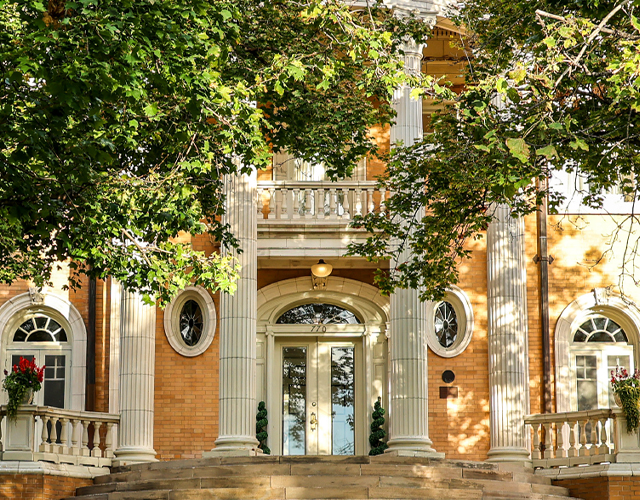
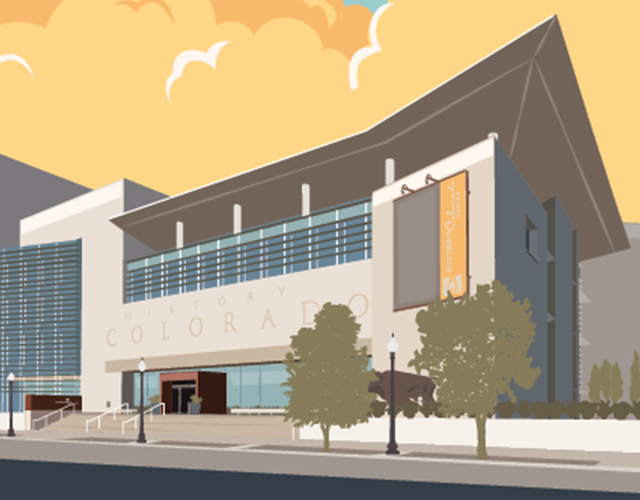
In the heart of Fort Collins, Colorado, lies a castle of stone and mystery. Emblazoned above the six, two-story-tall Tuscan columns that line the front of the building are the words “Masonic Temple,” and above those, the symbol of Masonry: the square and compasses, framing the letter “G.”
The four-story, 29,000-square-foot Masonic lodge sits at the intersection of Oak and Howes Streets, its classical revival stonework looming over the landscape in a similar fashion to a medieval fortification or ancient temple. A building of such grandeur suggests the presence of an organization with significant local influence. By 1927, when the lodge was completed, Freemasonry had spent more than sixty years establishing itself as a prominent and respected institution in Fort Collins.
Although Freemasonry is often regarded as a secret society, its presence is far more visible than many realize. More than one hundred Masonic lodges are scattered across Colorado, and Masonic symbols and cornerstones appear on hundreds—if not thousands—of public buildings, including libraries, government offices, schools, and university structures.
A large plaque engraved with the square and compass infamously is displayed next to the south security checkpoint at Denver International Airport, a feature that has contributed to the wide range of conspiracy theories surrounding the airport. Across from the Colorado State Capitol, a prominent building houses Denver’s Scottish Rite, one of Freemasonry’s major branches.
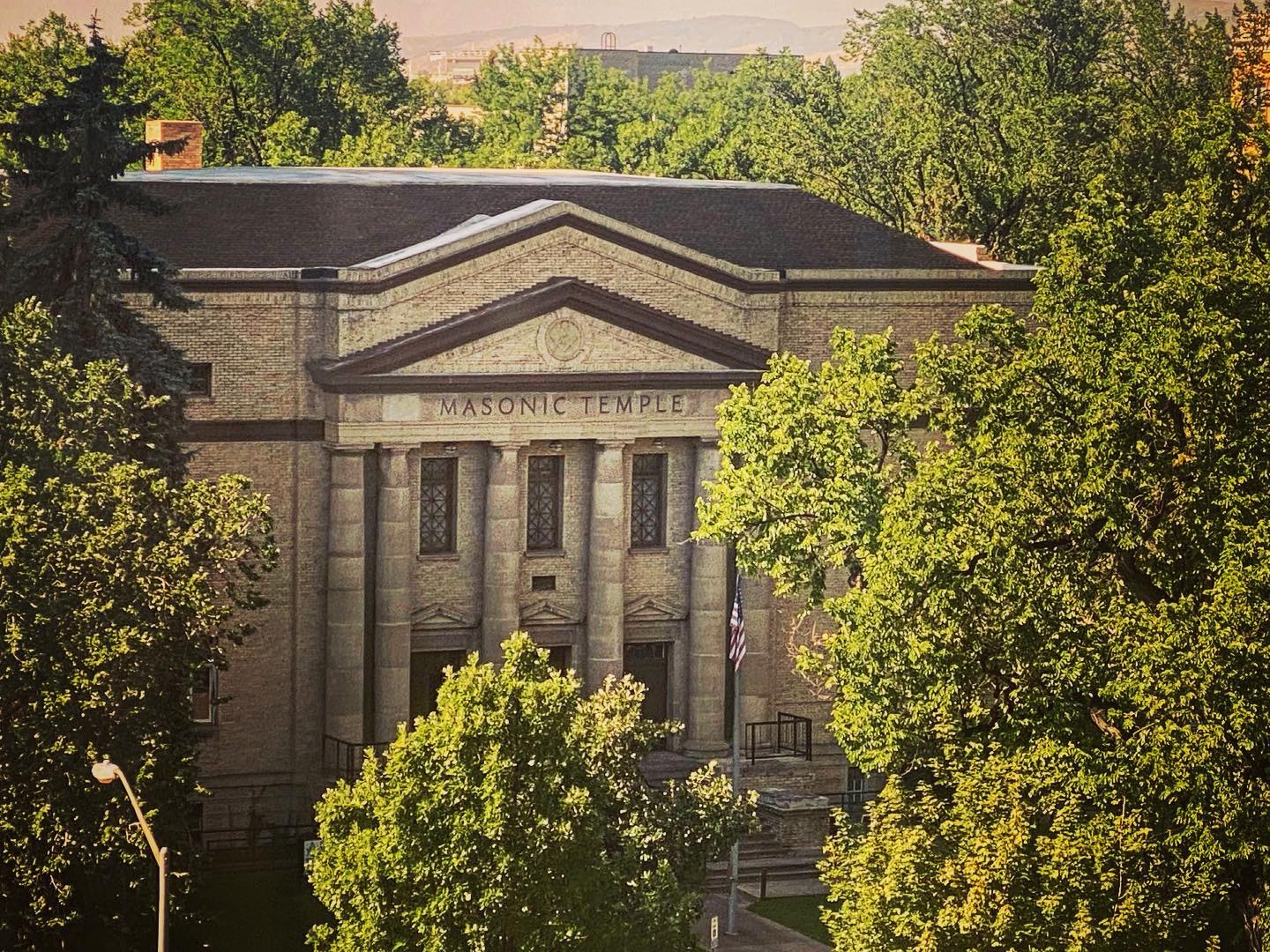
Exterior of the Fort Collins temple.
Masons also participate in parades, sponsor charitable events, and contribute to civic celebrations. While these present-day appearances may appear incidental, they point to a longer history of civic involvement—especially in places, and at times, where institutional life was still being formed.
What began as a military outpost called Camp Collins in 1862 was, by the 1870s, developing into a permanent settlement. However, like many frontier communities, Fort Collins lacked the stable civic infrastructure that more established towns took for granted. In that setting, fraternal organizations such as the Freemasons found traction. Not only did they provide an established social network for new settlers, they presented themselves as institutions capable of providing social cohesion and civic structure.
Masonic involvement in the development of western towns was widespread, a pattern clearly visible in Fort Collins. The fraternity’s influence in Fort Collins came in multiple ways. The sense of community it provided for its members, the encouragement of philanthropy and community building, and the physical lodge building itself, which functioned as a physical space for expression amongst the members, all contributed. Finally, and perhaps most significantly, were the actions of individual Masons in their personal and public lives. Taken together, the presence of Masons in the growing town was instrumental in the development of Fort Collins during the latter third of the nineteenth century.
Laying a Foundation
There has been limited scholarly work done on the history of Freemasonry, particularly in the American West. Most mentions of the fraternity are brief, either in large historical works, personal journals, or books concerning masculinity and manhood. Many individual Masons are history enthusiasts, and there are a handful of trained historians who hold membership in the fraternity but seldom write books on Masonry. This creates a gap in the scholarship that needs to be filled.
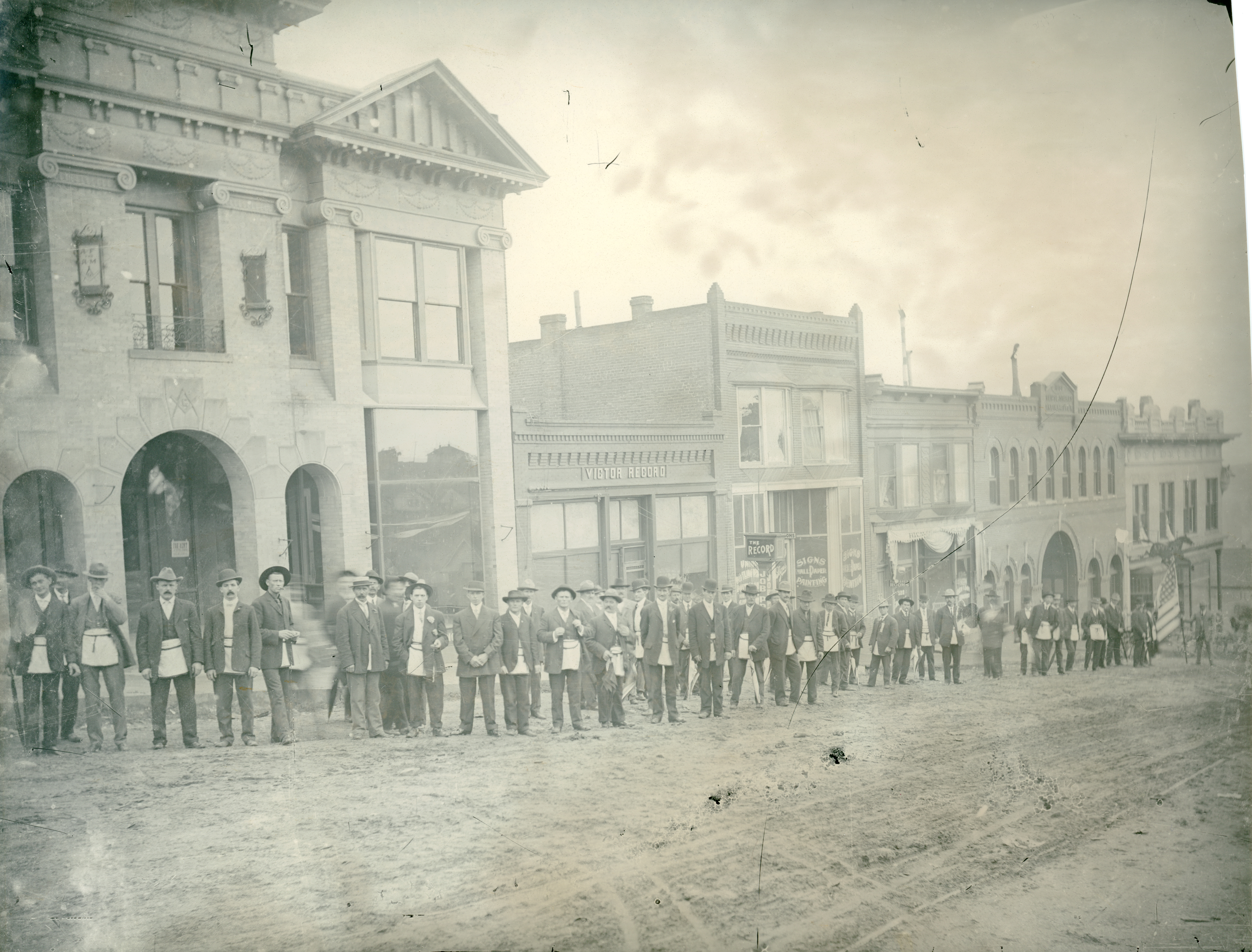
A group of about forty Freemasons wearing their regalia on 4th Street in Victor, Colorado, between 1890 and 1910.
The exact origins of Freemasonry remain debated, but the formation of the Grand Lodge of England in the early 1700s was a turning point towards a global presence. British imperial troops brought Masonry across the world. Nearly every regiment hosted its own lodge, and civilian lodges emerged in port cities, colonial capitals, and frontier towns.
Masonry arrived in the American colonies by 1733, when the first lodge in the Americas was chartered in Boston, Massachusetts. From that point forward, the fraternity’s organizational model—built on ritual, mutual aid, and moral instruction—became interwoven with the colonial and national fabric of the United States. Nowhere was this affiliation more visible than on the late morning of September 18, 1793, when George Washington laid the cornerstone of the US Capitol, clad in full Masonic regalia.
Over the next two centuries, the fraternity’s membership ebbed and flowed, drawing in a curious blend of the powerful, the visionary, and the everyman. While the Founding Fathers often dominate the conversation, many others have passed through the lodge room doors. Since the humble beginnings of American Masonry in the 1700s, Masons have sworn oaths beneath chandeliers and starlight alike. Fifteen have taken the presidential oath. Astronauts like Alan Shepard, Edwin “Buzz” Aldrin, and John Glenn carried their compasses into orbit. Frontier legends like William “Buffalo Bill” Cody and Kit Carson brought the square and compasses to the West.
For all the headline names, however, the heart of the fraternity has always been built by millions of men of no particular fame who found in its rituals and lodge halls a sense of purpose and brotherhood.
But while the Freemasons as an organization have been very visible across our nation’s history, researching the group presents particular challenges. Many members elected not to advertise their affiliation. Many Masonic lodges are protective of their internal records. While most of the archival materials available are rather mundane, such as minute books and treasurer’s reports, others like ritual books and correspondences are reserved for initiated members. As a result, access to lodge records is often restricted, and requests from outside researchers are frequently met with hesitancy and skepticism.
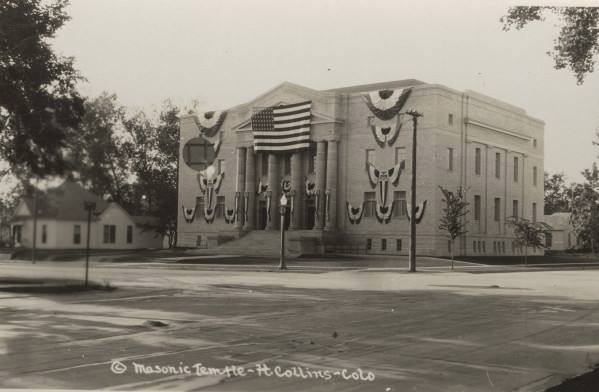
Historical photo of the Fort Collins temple.
I grew up in a Masonic family, the seventh consecutive generation to be a member of the fraternity, so it is no mystery why the inner workings of the Order captivated my imagination from a young age. Upon being made a Mason shortly after my eighteenth birthday, I set about learning as much as I could. As my studies progressed, both academically and Masonically, I began to notice an interesting trend: Freemasonry appeared everywhere in American history. During my first semester at Colorado State University, I recall being assigned The Journal of Mollie Dorsey Sanford in Nebraska and Colorado Territories, 1857–1866, a delightfully written journal of an early pioneer woman. There were a few overt mentions of Masonry throughout, but on page 155, she makes a passing remark: “By will take the first degree.” By, short for Byron, was her husband. Many readers would likely just pass over this sentence, not realizing that it was a record of her husband being initiated into the first degree of Freemasonry. This was my first realization that my familiarity with Masonic terms and phrases gave me a rare lens through which to view elements of the past. In addition, my own membership in the fraternity granted me relatively unique access to the records of Collins Lodge No. 19 and the archives of the Grand Lodge of Colorado.
With permission to consult internal documents, I created a dataset of every member of Collins Lodge between 1870 and 1900, using original member ledgers preserved by the lodge. This dataset includes the names, occupations, ages, and dates of advancement through Masonic degrees for more than 270 individuals. To complement this material, I incorporated the yearly reports submitted by the lodge secretary to the Grand Lodge of Colorado, which record every active member at the close of each Masonic year. These reports helped me track changes in membership, and allowed me to search for the names of influential Fort Collins men during this time period, revealing patterns in the membership and shifts over time as the town grew from a frontier outpost to one of the largest communities in Colorado.
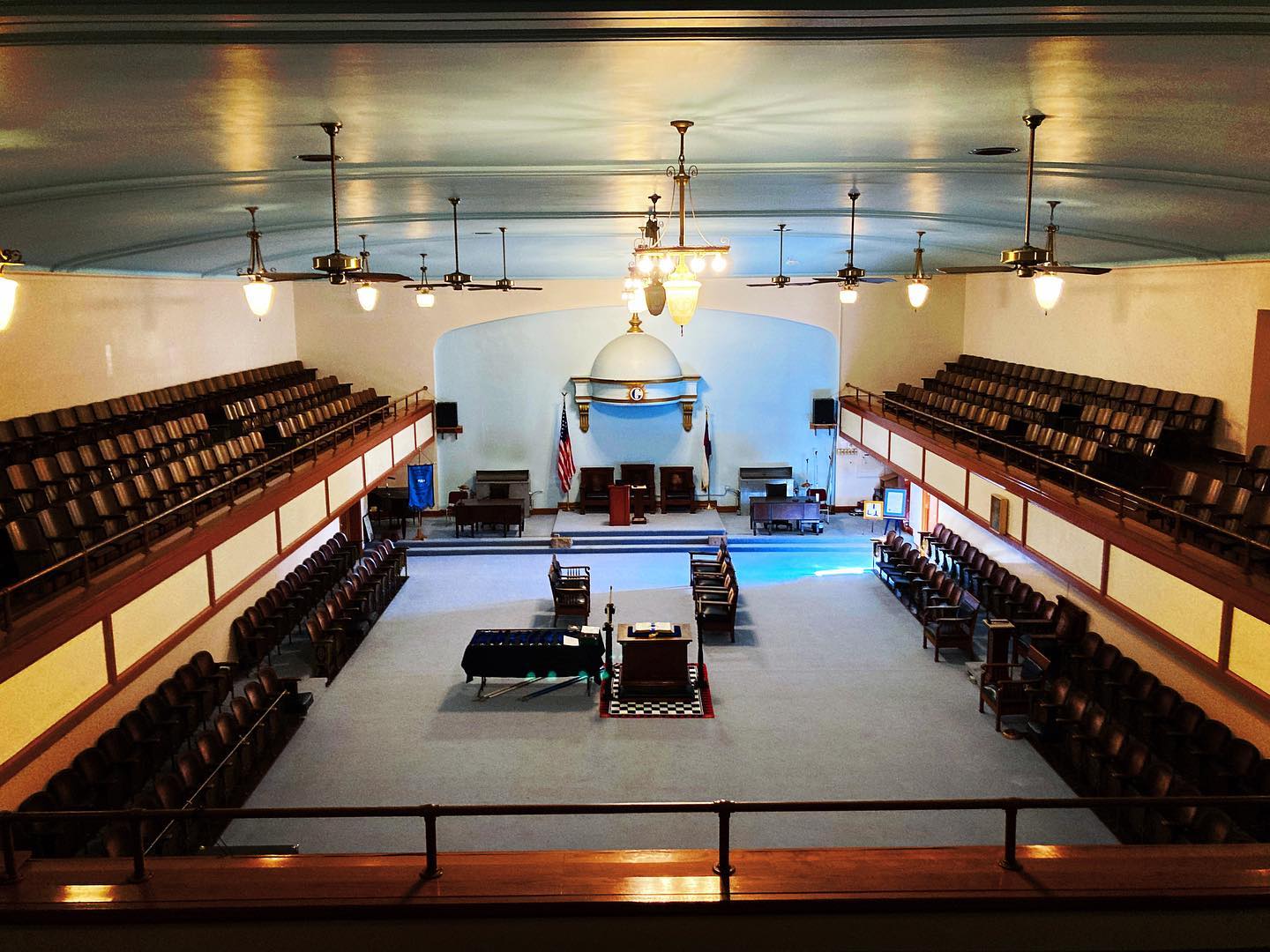
A large meeting room inside the Masonic Temple at Fort Collins.
Lofty Ideals & Westward Expansion
As Americans pushed westward in the nineteenth century, Freemasonry followed, carried by settlers who sought land and opportunity. The structure of the fraternity was mobile, replicable, rooted in enlightenment ideas, and supportive of community building. As a result, Masonry offered a sense of order on the frontier during a time when institutions were sparse and communities were still in the early stages of their formation.
When gold was discovered in 1859 near modern-day Idaho Springs, Colorado, people flocked to the region. Lodges quickly appeared alongside mining camps, rail depots, and burgeoning urban centers. Colorado became a territory in late February 1861, and less than six months later, the Grand Lodge of Colorado was formed.
In northern Colorado, the Army established Camp Collins as a military post in 1862 to guard the Cherokee Trail and the Overland Stage Line. After a flood in 1864, Camp Collins was relocated to roughly the present location of Fort Collins, based on the advice of Joseph Mason, a Freemason and one of the area’s early settlers. When the last soldiers left in 1866, a permanent settlement began to take shape. The subsequent rise of Collins Lodge No. 19 placed Freemasonry at the heart of Fort Collins, not just as a social club but as an institution and cornerstone of community.
Chartered in 1870, three years before the town was incorporated, Collins Lodge No. 19 was the result of a handful of enterprising men who helped lay both the literal and civic foundation of the future municipality. Foremost among these men was Henry Clay Peterson, an Ohio Mason drawn to Colorado by the promise of gold in 1859 and to whom the early organization of Masonry in Fort Collins is credited. Years before Fort Collins took shape as a town, Peterson hosted informal Masonic meetings in his workshop, which local historians referred to as the “cradle of Masonry in Fort Collins.” Peterson may have been the first white civilian settler at the military fort, and his imprint on the town’s development is hard to overstate.
An illustration of Camp Collins, which later became Fort Collins, as it appeared in the 1860s.
By the very nature of the Masonic institution, its principles are often obfuscated, either by means of ciphers or simply by restricted communication. Consequently, obtaining a public statement concerning Masonic ideology can be challenging. However, there are occasional instances where members deliver speeches that offer a window into Masonic morality.
One such instance occurred on the cold night of December 27, 1893. Standing before a crowd of nearly 300 Masons and their families, Edward N. Garbutt, who had served as Master of Collins Lodge No. 19 from 1881 to 1886, delivered a speech on the “Origin and Aims of Masonry.” The “historical” portion of the speech is unequivocally wrong, as it cites Masonic origins in the mystery cults of the Ancient Greeks and Egyptians, and even suggests that Freemasons were present at the construction of the Tower of Babel. While certainly an aged fraternity, Masonry’s fourteenth-century origins are a far cry from Biblical. However, the later portion of the speech concerned the practices and teachings of Masonic morality, presenting an exclusive look into the principles of the fraternity in the waning years of the nineteenth century.
That speech illustrated not only the moral lessons of Freemasonry, but also how, when, and why members should practice such teachings. Garbutt emphasized that Masonic values must extend beyond ritual and lodge meetings, calling on members to embody Masonic teachings in their everyday lives. He emphasized the fraternity’s notions of moral duty, stating that “our religion is to feed the hungry, clothe the naked, comfort the sick, relieve the distressed, and provide for the widow and orphan.”
Garbutt presented a heavily idealized view of Masonic morality, but this is unsurprising. The ideals of Masonry proclaimed in his speech are emblematic of the broader tendency of Masonry at the time to mirror Victorian America’s moral culture. Masonic leaders in the late nineteenth century were hyperaware of the “quality” of their membership, often barring or expelling those whom they saw as “notoriously profligate” or “profane.” The positive public image of the organization and its membership was of the utmost importance to both Grand Lodge officers and local lodge leaders.
Garbutt’s speech demonstrates this through his encouragement of the members to “practice outside the lodge room the fraternal love and charity” taught to them in the lodge. Despite the overwhelming promotion of tolerance, the fraternity remained predominantly white, Protestant, and, obviously, male.
Although the speech idealized Masonry, this philosophy often pushed lodge members to be active in their community in ways that lived up to the fraternity's lofty principles. They truly believed that if they acted according to this philosophy at home and in public as well as in the lodge, Fort Collins would be better for it.
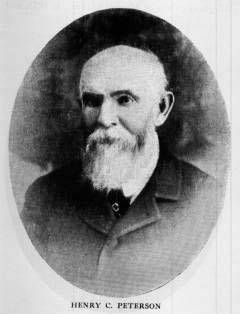
Photo portrait of Henry Clay Peterson around the early 1900s, as published in the 1911 book History of Larimer County.
While many Freemasons were amiable members of their communities, not every Mason was virtuous. Some were capable of great atrocities. The many social and business advantages that Masonry offered its members could be taken advantage of for selfish gain, and this attracted men who saw the fraternity as an avenue to power. And in the history of the settlement of the western United States by European Americans, it’s clear many Freemasons of the time did not believe the moral duties of their order extended to everyone equally—including and especially the Indigenous peoples of the region now called Colorado.
Perhaps the most famous Freemason in early Colorado history was Colonel John M. Chivington. For many, Chivington’s name is synonymous with the Sand Creek Massacre, an atrocity committed by Chivington and his troops in 1864 whereby at least 230 peace-seeking Cheyenne and Arapaho people, including women, children, and spiritual leaders, were murdered while under a flag of truce. Chivington was the epitome of the ambitious mid-century man: a Methodist minister who traveled the West, won military glory at the Battle of Glorieta Pass, curried favor with the political elite, and leveraged his Masonic membership to great advantage. He was far from an average member, as he was in fact the first Grand Master of Masons in the Colorado Territory in 1861.
In the aftermath of Chivington’s actions at Sand Creek, the fraternity suspended his membership while a federal investigation took place, but he was reinstated within a few years. There are no records indicating if Territorial Governor and fellow Mason, John Evans, faced any Masonic charges for the part he played in the affair. Indeed, the only lasting effect on Chivington that the Colorado Masons enacted was the renaming of a lodge from “Chivington Lodge No. 6” to “Central Lodge No. 6” in the years after Sand Creek. This is not to say that Masonry as a whole supported acts like the Sand Creek Massacre—which was controversial and fiercely divisive for all Coloradans, including those who were Masons. Its membership was made up of thousands of men who erred, and several committed atrocities that modern sensibilities soundly condemn.
Putting in the Work
Masons rarely called attention to their charities, making them hard to track with external documents. Unfortunately, the minute book of the first several decades of Collins Lodge No. 19, which would have recorded specific acts by lodge members, was seriously damaged many years ago, rendering much of the text illegible. Some contributions are preserved in the lodge’s one-hundred-year anniversary book compiled by lodge historian Lloyd Hagen in 1970. Others are alluded to in the historic newspaper collections.
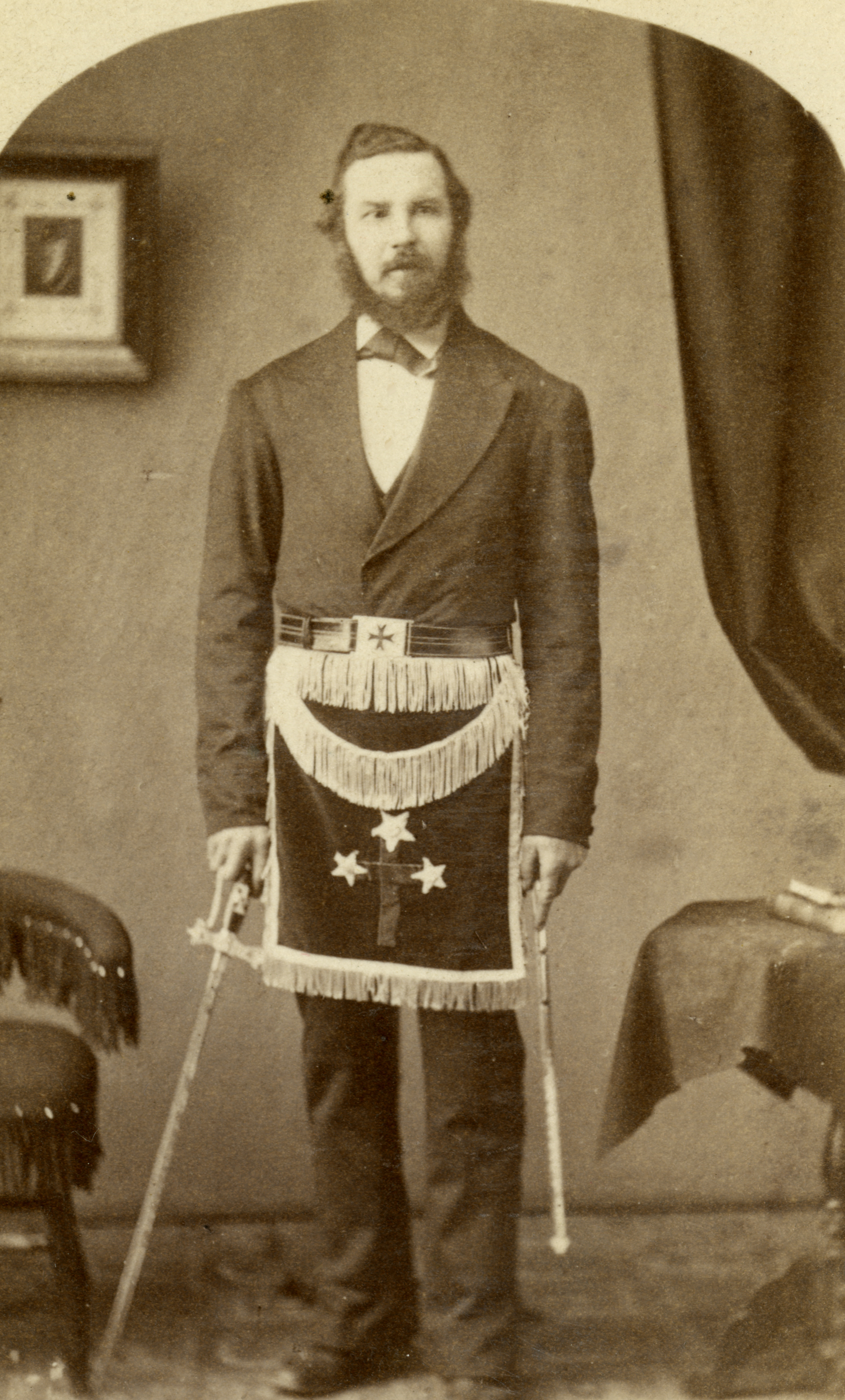
L. McLean of Central City, Colorado photographed this unknown man in ceremonial Masonic regalia, about 1882.
Of course, fiscal contributions from Masons to their lodge brothers were not uncommon, such as the donation given to Brother William Stewart—a Mason from Crystal, Michigan—who was “sick and in want” in 1871. Whenever a member died, it was the lodge’s obligation to look after the deceased’s wife and children.
Hagen asserted that the first thirty years of the lodge, “must be called the really serious years, because ninety percent of [the lodge’s] activity was concerned with the ritual and extending relief to the poor and distressed.” It is a shame that further details of the lodge’s charitable endeavors have not been preserved. Still, given the lodge’s consistent emphasis on charity, the intentionally understated nature of its relief work, and the surviving examples that reflect those ideals in practice, it is reasonable to conclude that Collins Lodge No. 19 engaged in many more acts of charity than the historical record now reveals.
Individual members, often acting outside of their capacity as Masons, took part in the creation of the Fort Collins community. They involved themselves in local politics, education, infrastructure, and civic celebration, often reflecting the values imparted within the lodge. The recurring presence of Masons in nearly every aspect of civic life speaks to the fraternity’s cultural influence in this frontier town.
Foremost among them was Henry Clay Peterson, who had helped found the lodge. He is often given credit for “much of the early construction of Fort Collins.” His contributions to the development of Fort Collins include constructing the first boarding house, co-founding the local flour mill, and opening a brick kiln that supplied material for many of the town’s earliest buildings—including its first brick home, which he constructed for himself. Peterson also helped establish and construct the town’s first schoolhouse in 1871 and its first church in 1876, and served on the inaugural school board.
Peterson was, by every measure, a civic-minded man whose work straddled both public service and Masonic ideals. Just as Washington united the young nation with the fraternity through the capitol’s cornerstone ceremony, he similarly cemented Fort Collins and Freemasonry. Most early Masons in the area were farmers, but as the city grew, membership expanded to include tradesmen, merchants, bankers, clerks, judges, lawyers, doctors, and more. Following Peterson’s example, later members of Collins Lodge No. 19 often served in leading roles in the community, exemplifying leadership, another Masonic principle touted in lodge rooms across the nation. From 1873, when the town’s first mayor was elected, to the turn of the century, eight out of thirteen mayors were Masons. Lodge members also served as judges, clerks, postmasters, and county assessors, suggesting that lodge membership was often a launching point for public leadership.
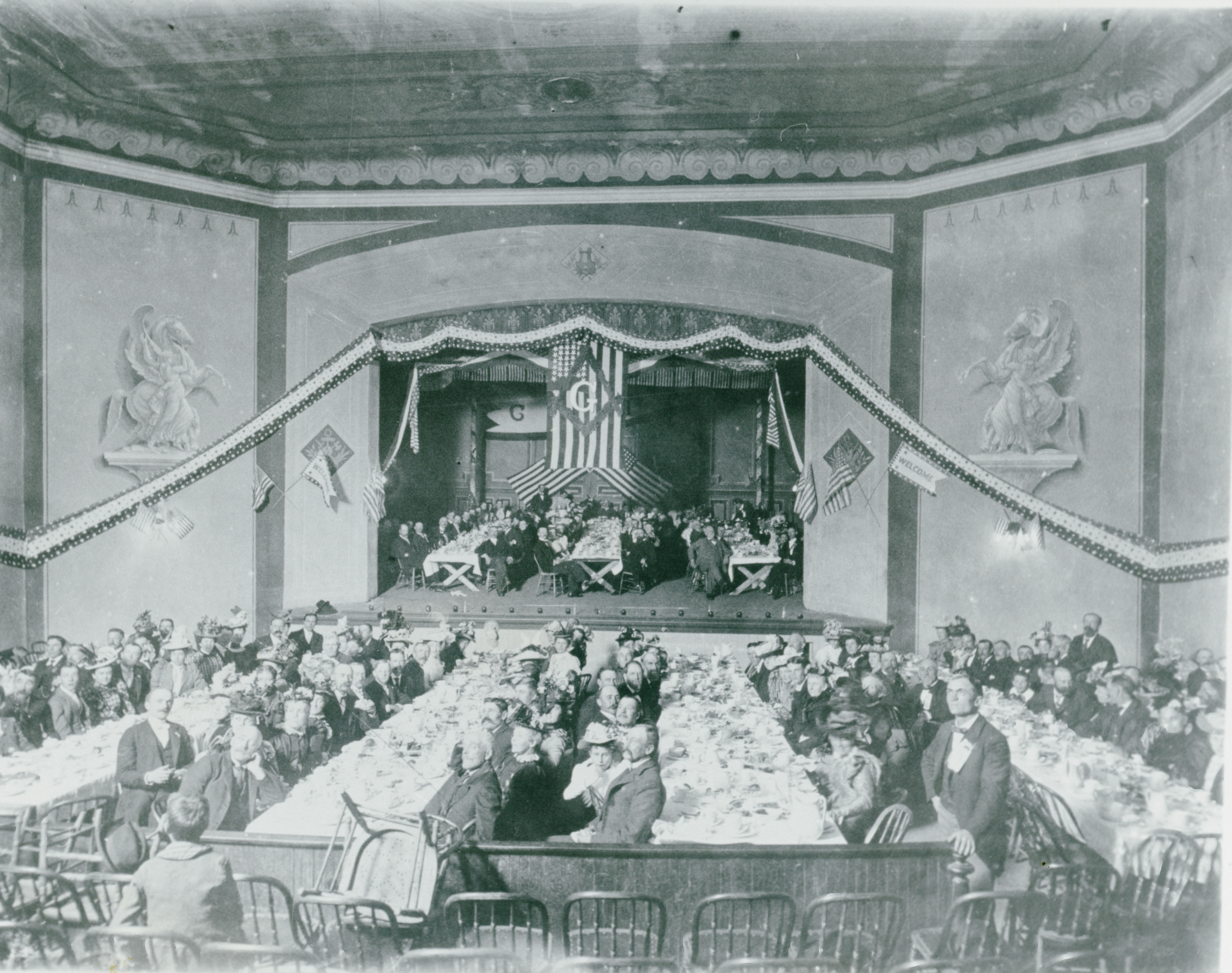
A Masonic dinner held in the Central City Opera House around the 1890s.
Masons were also influential in the city’s signature institution, Colorado State University. Historian Ansel Watrous recorded that “[I]t was through the generosity and public spirit of [John C. Matthews], Arthur H. Patterson, Joseph Mason and Henry C. Peterson, each of whom made a free gift to the state of land, that the friends of the college were able to secure the location of that institution in Fort Collins.” All but Patterson were members of Collins Lodge No. 19.
It is no coincidence that the principles of “generosity and public spirit” that Watrous assigned to these men could just as easily have a feature of E.N. Garbutt’s 1893 speech on the principles of Masonry. Beyond the physical placement of the university, the leadership of the institution was also spearheaded by Masons. From 1879, when the university first opened as Colorado Agricultural College, until 1940 when Charles A. Lory finally stepped down as president, a Mason was in charge of CSU for all but twelve years.
The influence of Masons in Fort Collins is subtly reflected in the built environment as well. On the CSU Fort Collins campus, the student center and at least four dorm halls and academic buildings bear the names of past members of the fraternity who engaged with the university in a wide variety of ways, and thirteen buildings are adorned with Masonic cornerstones. From the infrastructure to the community spirit, Masonic influence in Fort Collins is woven into the very fabric of the town. So whether it is the prominent throughway of Mason Street (named after Thomas Mason) or the historic Loomis District (named after Abner Loomis), the names of Masons appear everywhere in Fort Collins.
Constructing Masculinity
But during this period when the lodge was most involved in developing the community, the town’s Masons lacked a building of their own.
The first regular meeting space was the second floor of the Old Grout Building, located at the southwest corner of Linden and Jefferson streets in what is now Old Town. The building’s ground floor housed the area’s first mercantile business, while the upper level served a range of functions over the years.
By the mid-1870s, the lodge relocated across the intersection to the second floor of the Stover & Tomlin General Store. Membership grew rapidly, reaching seventy-nine by 1880 and 150 by 1890. To accommodate, the lodge moved a second time, this time to the third floor of the Loomis Block at Linden and Walnut, where it remained until 1903. Members began advocating for a dedicated hall, and that year the lodge finally acquired their own building.
The Masonic lodge hosted numerous community events, ranging from banquets and dances to professional workshops and meetings of other fraternal orders like the Odd Fellows and the Knights of Pythias. Historic newspapers highlighted the Masons’ hospitality, noting their penchant for organizing enjoyable and well-attended events. This physical space became a local venue for art exhibitions, professional gatherings, and various social orders, demonstrating the wide range of groups that contributed to Fort Collins’s growth. These events not only bolstered the town’s cultural and professional life, but also exemplified how the Masons’ physical spaces empowered local organizations and fostered a sense of community. In this way, the lodge functioned not only as a masculine and moral institution, but also as a civic cornerstone—one shaped by, and in turn shaping, the men who passed through its doors.
No matter the form it took, the Masonic lodge served as more than just a meeting place—it functioned as a civic hub that reinforced Masonic influence in Fort Collins. It provided a space where men could cultivate and express ideals of masculinity through ritual, and simultaneously provide the broader community with a physical space to hold events or meetings, creating opportunities for engagement and connection.
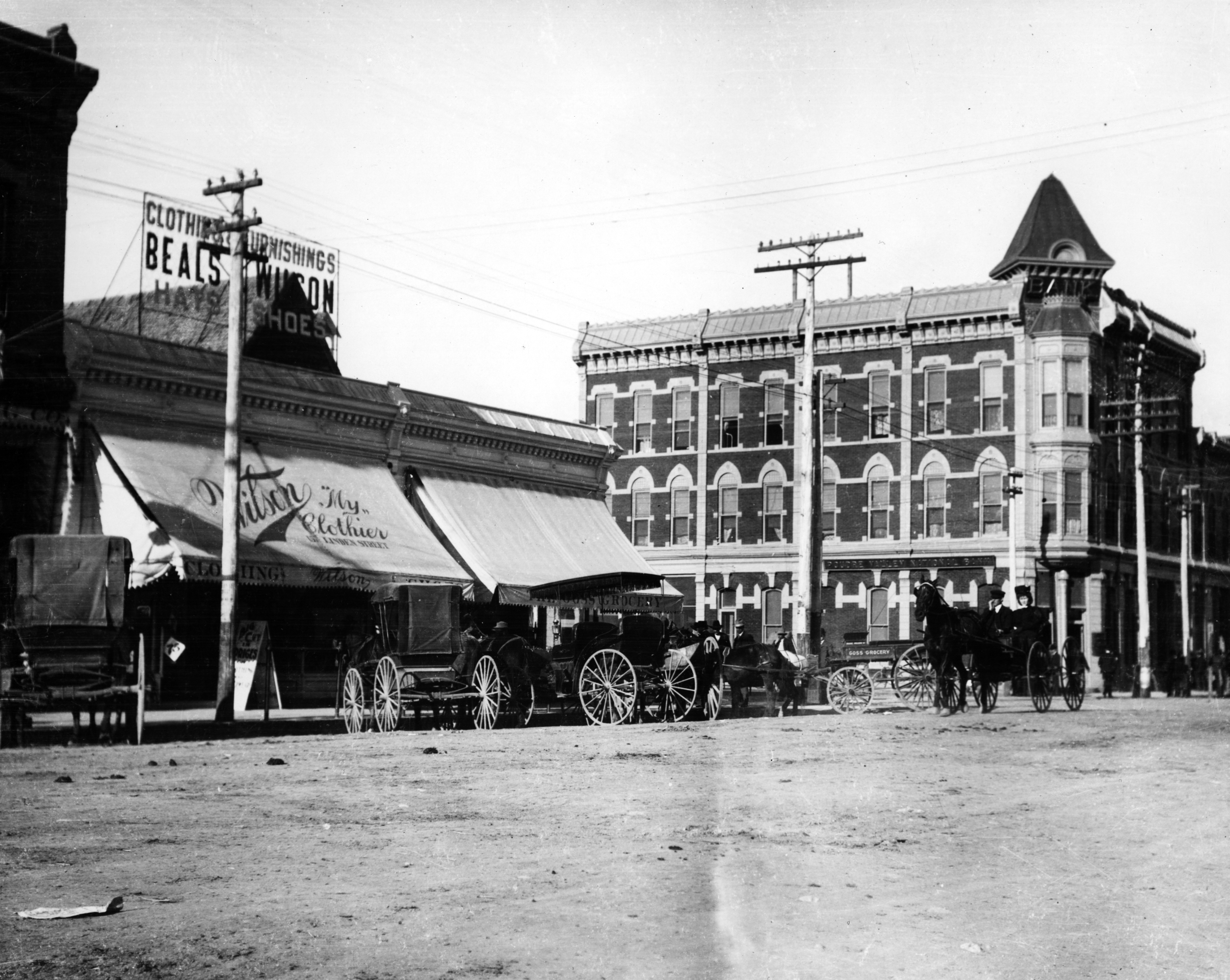
Businesses in central Fort Collins in the late 1800s.
In the early development of western settlements, many of the first buildings to be constructed were heavily gendered spaces, like saloons, inns, and brothels. Lodges, often one of the first community organizations to form in new towns, usually met in a business or in a member’s house (as in the case of Henry C. Peterson). Lodges offered an alternative to the martial masculinity of saloons and brothels—sites of competition, sexual prowess, and even violence. Instead, lodges promoted ideals more aligned with Victorian notions of “restrained masculinity.”
Lodges were a focal point in the social battle for how nineteenth-century men believed their masculinity should be expressed. This was displayed through the lodge members’ internal promotion of “harmony and justice,” the requirement for fine dress during meetings, and the creation of grievance committees established to help ease internal strife within the lodge.
These Victorian ideas of masculinity, especially in the context of voluntary associations, were complex and deeply tied to ritual, discipline, and moral instruction. As historian Mark Carnes observes, fraternal ritual “provided solace and psychological guidance during young men’s troubled passage to manhood in Victorian America.” Initiation rites acted as symbolic thresholds which marked the transition from youth to maturity, offering a communal way to establish order and purpose at a time when many young men were increasingly detached from traditional family structures and communal obligations.
The proliferation of fraternal organizations during this period was no accident. They “grew like weeds,” in the words of historian E. Anthony Rotundo, precisely because they offered stability, moral guidance, and a sense of social belonging during periods of personal and societal flux. By the mid-nineteenth century, older men were founding youth-focused lodges to promote Victorian notions of virtue and self-control among younger initiates. This effort aligned with shifting generational dynamics. The American ideal of the self-made man complicated traditional father-son relationships. Independence became a virtue, and young men were expected to make their way without paternal guidance. Masonic lodges, and other fraternal orders, filled that gap. They provided mentorship and a model of manhood built on discipline, restraint, and fraternity.
As young men moved west and left behind their community connections, organizations like Masonic Lodges often served as a surrogate family. They even called their fellow members brothers. The lodges were not merely symbolic or performative—they were deeply formative, shaping how members understood themselves and their place in society.
Far from being a simple meeting hall, the various homes of Collins Lodge No. 19 served as sites where men created networks, engaged in ritual, and found their place in the larger societal framework of the West. As the organization evolved and adapted to meet the shifting needs of its members, it provided locations for identity formation. It presented itself as a space for social acceptance and the moral guidance necessary to navigate an increasingly complex world. When Masons weren’t holding their own regular meetings, their buildings were rented or loaned to other local organizations, each of which played its own role in the development of Fort Collins.
The Collins Lodge was not unique in this. A preliminary review of records from roughly a dozen other lodges in Colorado reveals similar patterns. From Denver to Pueblo and Leadville to Kiowa, records indicate that Masonry and its members acted as instrumental agents in the development of Colorado as a territory and a state.
There is good reason to believe, then, that the role of Masonry in Fort Collins reflects a broader trend across Colorado and the American West. In the mid- and late-nineteenth-century West, where social, political, and economic structures were often still in formation, fraternal and voluntary orders took root with vigor.
As Fort Collins grew and the Masonic membership approached 600 by 1920, it became obvious that the lodge would need a newer, larger space. In May of 1925, construction began on the colossal 29,000-square-foot lodge, officially opening on June 27, 1927. This building, a hidden castle in the heart of Fort Collins, has been the home of local Freemasonry ever since. Today the Masons continue to host community events here, contributing to communal growth just as they did in the early days of the town’s development.
The Masonic legacy is inscribed in the cornerstones of courthouses, in the names etched on public buildings, and in the civic traditions that still define many of our communities. While modern sensibilities may find the rituals and secrecy of Masonry archaic, the influence of its shared ideals—charity, fraternity, duty—remains embedded in public life. Exploring that legacy reveals how communities across Colorado grew from fragile settlements into functioning civic entities. The Masons were never the only force at work, but they were often among the first to help lay the groundwork.