
 Membership
 Donate
 Shop
Shop






















Los Mocochetes Talk History and Music
We caught up with Los Mocochetes, a Denver-based Chicano Funk band that weaves history into their lyrics.
For the last decade, Los Mocochetes have been performing a unique blend of music. They call their style Chicano Funk, but even the bandmembers admit that doesn’t quite capture their sound, which incorporates everything from punk, hard rock, funk, reggae, ranchero, mariachi, and more. But the one thing that unites all their music is a message about the history of Latino cultures—past, present, and future.
We caught up with three bandmembers, Jozer Guerrero, Elias Garcia, and Jon Rubio, to talk about their music and how history shapes their art.
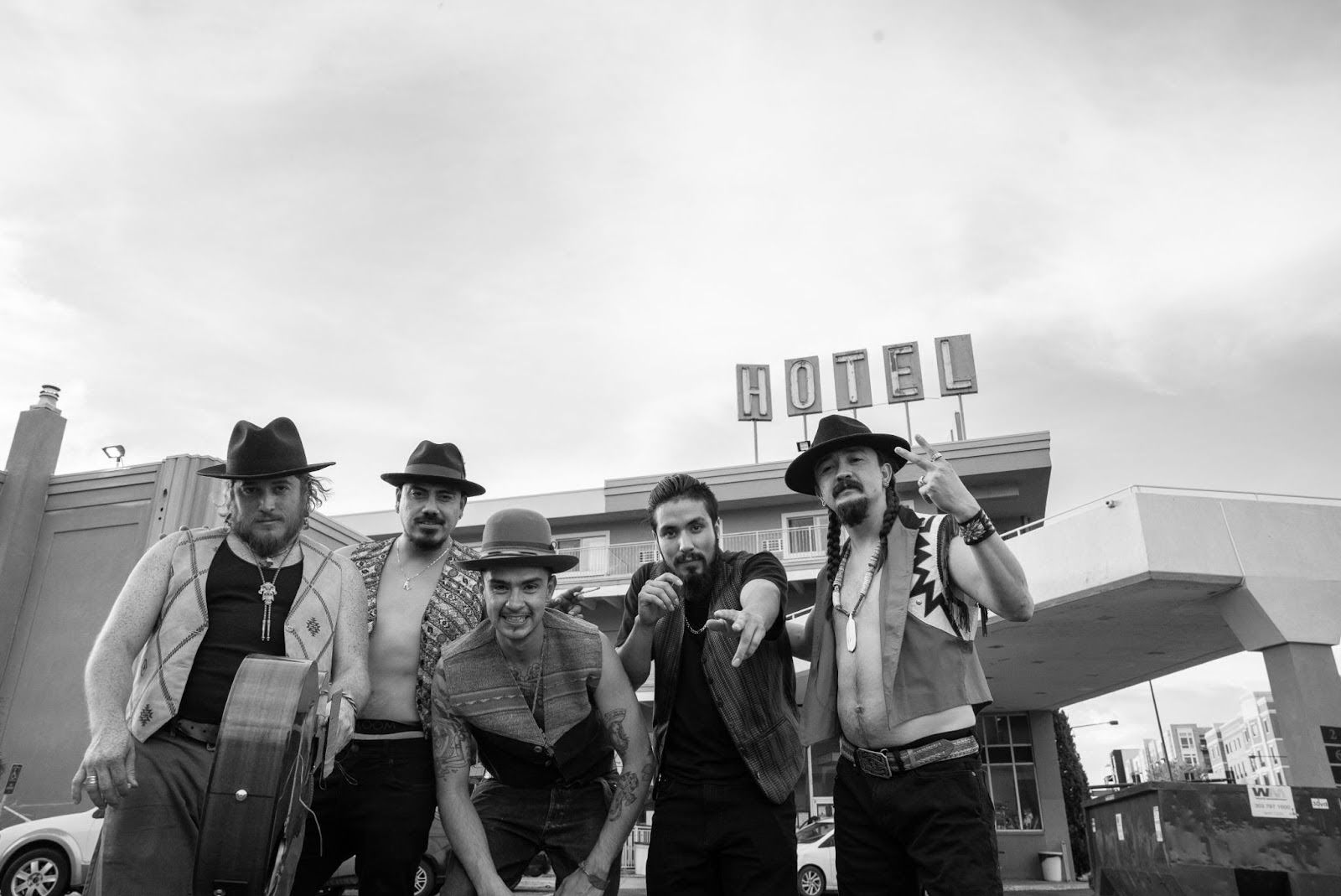
Members of Los Mocochetes, from left to right: Elias Garcia, Jozer Guerrero, Diego Florez, Jon Rubio, Joshua Randy Abeyta.
What is Los Mocochetes, as a group?
Jozer: Los Mocochetes a fusion of sound and culture. It’s a movement, it’s an effort to engage folks in political conversations through music. It’s a musical revolution in a way. We’re historians trying to capture what we’re living through in song and leave a trace of what we experience for our children and for future generations as well.
Can you tell us when and how you first were drawn to music?
Elias: I think all of us got drawn to music from a young age. It’s part of the cultures we grew up in, here in Denver. There’s always been a lot of fantastic artists who paved the way for what we do these days.
Can you tell us about your childhoods? Did you grow up in the Chicano Movement?
Jon: It just depends on what movement we’re talking about. I’m a first-generation Mexican American here. My parents are from Mexico, but they grew up in Los Angeles. It’s a little different from the Denver culture. Growing up we weren’t connected to the [Chicano] Movement. The Movement’s so powerful because people from the same community aren’t always in the Movement. We don’t cater to a particular audience, the message can spread to anybody and everybody, and it’s for everybody.
Jozer: The music has always been such a central part of the Movement. Whether it’s providing energy and more ganas, or morale, for the folks out there protesting, but also capturing and spreading that message. I grew up listening to Chunky, such a powerful musician in the Chicano Movement. Every single place he played he was basically having a Chicano rally. Fools are talking about, how can we make this Facebook or Instagram post more efficient, reach more people. Back then, it was the music. We’re just trying to follow that, and fill the shoes of musicians like Chunky who were doing that work.
What was the beginning of Los Mocochetes?
Jozer: At some point, we all knew each other. We were friends in the community, or knew another fool in the band. At some point, Diego and Joshua started jamming together. It became a communal thing.
Elias: Diego and I were longtime friends. We lived here in the Northside, we rode our bikes throughout this whole city, worked at multiple different cool spots, sub shops or whatever. We connected with Johnny through the MSU campus, because I was going to school through the Auraria Campus and so was Johnny. The first “tour” we did, we just went down to Las Vegas and came back. We wrote our first song in Diego’s pop’s garage right here in the Northside.
Tell me about the name, “Los Mocochetes.” What does it mean?
Jozer: On this troop [to New Mexico], these fools, they’re helping Elias and his grandfather clear the acequias. This was basically just a homie trip to go help. They were all musicians so they made it a “tour” but really it was just brothers helping each other out. At some point they’re at a store, they have a machete, and everybody is all mocoso (snotty) because it’s springtime. So they stocked up on some toilet paper, and Diego said, “What are you gonna do with that machete, mocoso?” And somebody just had a spark. Los Mocochetes. It’s a play on words, but it’s also a hybrid. The machete is the metaphor, it’s a tool to farm, to clear whatever, it can be used as a tool or it can be used as a weapon. Being a Mocochete is that conscious decision to take that young, reckless energy as machetes, to use it to help instead of harm.
Can you tell me about your sound, and its roots?
Jon: All of us have a unique sound. When I met Elias I was studying jazz drum performance at Metro [MSU]. That’s my background as a musician. I’m also a rapper, I’m really into jazz, hip hop, I’m super heavy into metal as well. The Latino style of music, I really wasn’t used to playing at first. I’d see Elias on campus playing his guitar. He’d just be sitting in the field, playing rancheras and different traditional Latino American music. Cumbias, rancheras, corridos, Mexican-style. [...] We all bring our own musical taste to the band, to create what we call Chicano Funk. It’s that mixture. “Chicano Funk” is the best way to describe our music.
Elias: We use the message and the lyrics to justify what the vibe is. When we write, we use the genre as a message. Each song to the next is going to have its own flavor, its own essence.
Jozer: You can’t have one specific sound, when you have five leads in the band—and strictly speaking we could all have our own projects. It’s like Voltron coming together. It’s a unique sound that nobody can match, because it’s constantly evolving too.
Elias: Even one of our first logos is using the three faces of the Chicano. It’s like an amalgamation of all of us.
Jozer: We’re doing the work, this is how we’re living. It’s not just our logo, it’s our life.
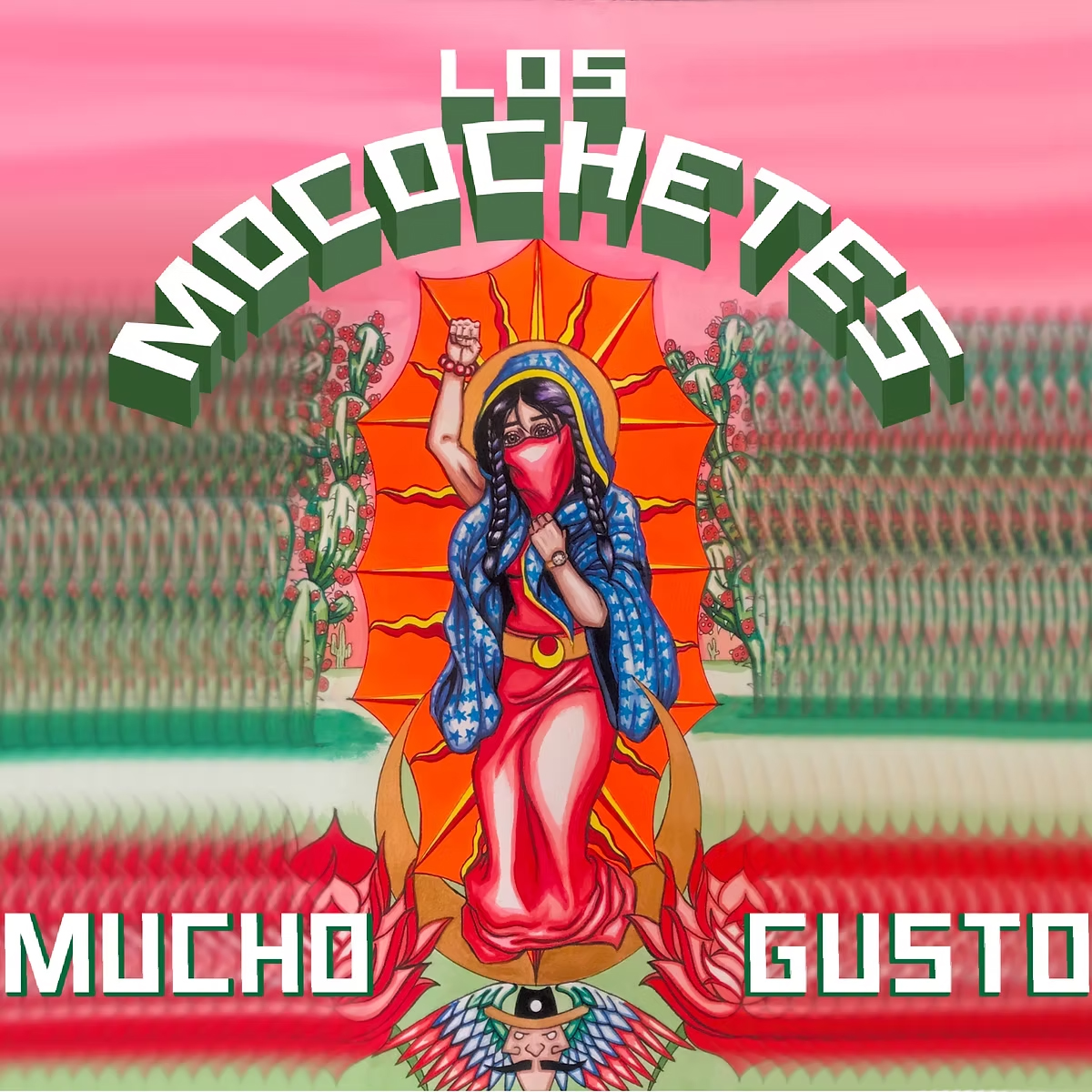
Album art of Mucho Gusto, the most recent album by Los Mocochetes.
Your music doesn’t just speak to society and activism today, it also very intentionally invokes Chicano history. Can you speak a bit more to that?
Jozer: The musician [is] not just playing the role of entertainer, but as a historian as well. We’ve always taken that pretty serious. For me as a writer, I’ve always seen it as a responsibility to write about the things my people are facing. I don’t really have the ability to write other than that. It needs to come out of us. Whether we’re writing it down for now, so people can see it in the future, or we’re reflecting, The musician becomes a person who holds folks accountable as well, who reminds people that history can repeat itself and will unless we do something about it.
Elias: Another way we use our music [is] to expand on the broader historical relationship to the past and present. One of our songs is called “Chingona.” In that song we draw a parallel between activists like Dolores Huerta and Jeanette Vizguerra. Because of the calls to action of Dolores Huerta, we have more of a history. And right now Vizguerra is in an ICE detainment facility. Our hope is that, in the future, another little mocoso kid will learn about these incredible women.
Jozer: I think ultimately the goal [of that song] is to reflect on how powerful, and how constantly our women have put themselves in front, and sacrificed themselves for their people. Oftentimes we don’t hear about those narratives. We don’t necessarily hear about Guadalupe Briseño, who led a huge protest against the Kitayama flower farm. These stories oftentimes will get brushed under the carpet if we don’t discuss them and highlight and show love for them.
Johnny: That’s another thing our lyrics do, sparking the question of where we come from. Like, what even is a Mexican, what even is a Chicano, a Latino? Looking at the three faces [artwork], we are a combination of our ancestors. We are Indigenous but we’re also Spanish, and others are a lot of other things.
What occurs at that intersection of history and art?
Elias: Right now, the people are going to decide what our future is. Regardless of what happens, our people and our history will still be here. Right now we need a lot more unity. It’s incredibly difficult, we all have to pay rent, pay bills. But when it comes to what’s happening right now, we’re going to keep writing songs.
Jozer: Ultimately we feel extremely privileged to do this, and hopefully at some point some of our work leaves a little bit of a trace that someone can tap into later on. Forget a Grammy bro, that’s what I want!