
 Membership
 Donate
 Shop
Shop
























The Shattered Tombstone: Doc Holliday and the Paupers’ Field
Musings on life and legacy from the purported grave of America’s most famous dentist.
I recently took a road trip through the Colorado High Country, with the goal of visiting some mountain towns and picturesque passes I’d never seen before. As a history nerd, I was looking forward to visiting the lingering echoes of times long past—ghost towns, historic sites, old mines, the works.
But as I wound my way along the serpentine highways up and down mountainsides, an unexpected theme kept rolling back and forth in my mind: death.
Not in the sense of the fear of death, or of mourning. But I kept coming back to two sites I had visited in the first days of my trip, and what they said about how we, as a society, handle our dead. The legacy they leave. What, and who, we choose to remember.
When I visited Glenwood Springs, I knew I had to visit Doc Holliday. Aside from the titular mineral springs, the fabled gunslinger was what made the town a destination. If you look up Glenwood Springs, Doc Holliday’s Grave and the Doc Holliday Museum are featured prominently on the list of attractions.
It makes sense. The dentist-turned-gunslinger is practically synonymous with some of the most famous pieces of “Wild West” Americana. He’s portrayed in dozens of books and films, sometimes as the star of the show, sometimes as a sidekick to the Earp brothers. The legend of Doc Holliday was making waves in American pop culture as recently as the 1993 blockbuster Tombstone in which he was played by the late Val Kilmer.
So when I rolled into that little riverside city, that very afternoon I made for the Doc Holliday Museum. What I found was enjoyable, but not exactly informative. It was less an exhibit about the man John Henry Holliday, than a shrine to his legend. Memorabilia and movie posters lined the walls.
It reminded me of the time I visited Graceland.
Not long after, I made my way to the edge of town where, at the foot of Lookout Hill, a series of signs directed me to the “Doc Holliday Grave Trailhead.” From there it was a short hike up a snaking gravel path, rimmed on either side by high-desert scrub and gnarled pines, to the historic Linwood Cemetery.
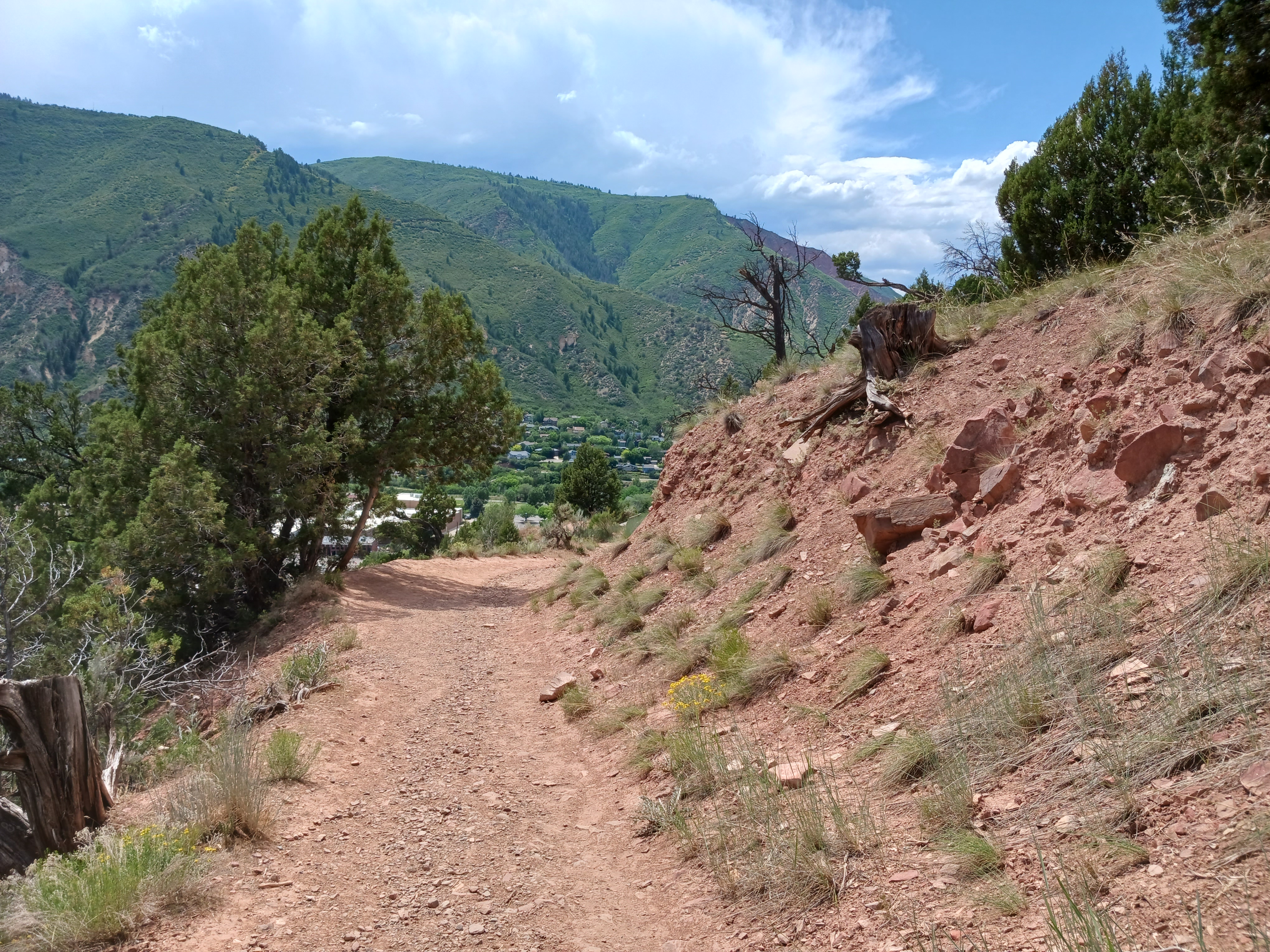
The gravel trail winding up the side of Lookout Hill, leading to Glenwood’s Linwood Cemetery.
What I found at the top of the trail was pretty typical for a historic pioneer cemetery—worn, cracked tombstones, overgrown grass and bushes, paths that were little more than game trails. Rising out of the rustic surroundings were new, shiny signs marking a well-worn dirt path through the cemetery to the scenic lookout. And very near the edge of the cliff was the man himself: Doc Holliday.
Or so I thought. Because, as I learned from that very monument, it was not a tombstone—it was a memorial. According to the engraving Doc Holliday was buried somewhere nearby, in or around the cemetery, in a shallow and unmarked grave.
He died a pauper in 1887, driven to destitution by a lifetime of gambling, vice, and illness, and as such, had been given a pauper’s funeral. Nobody actually knows where his final resting place is. It might even be beneath the hill, under somebody’s house or in their backyard.
As I learned over my time in Glenwood Springs, John Henry “Doc” Holliday took a while to enter the public consciousness. Long after the real man, known as little more than a drunk or gambler, had passed away, and all those who knew him in life had followed him in death—that’s when the legend of Doc Holliday was reborn. With the coming of twentieth century dime novels and movies, he was resurrected as the quintessential gunslinger. And it was only then, in the decades after his fame was secured, that the Chamber of Commerce of Glenwood Springs erected a memorial to him in the old pioneer cemetery.
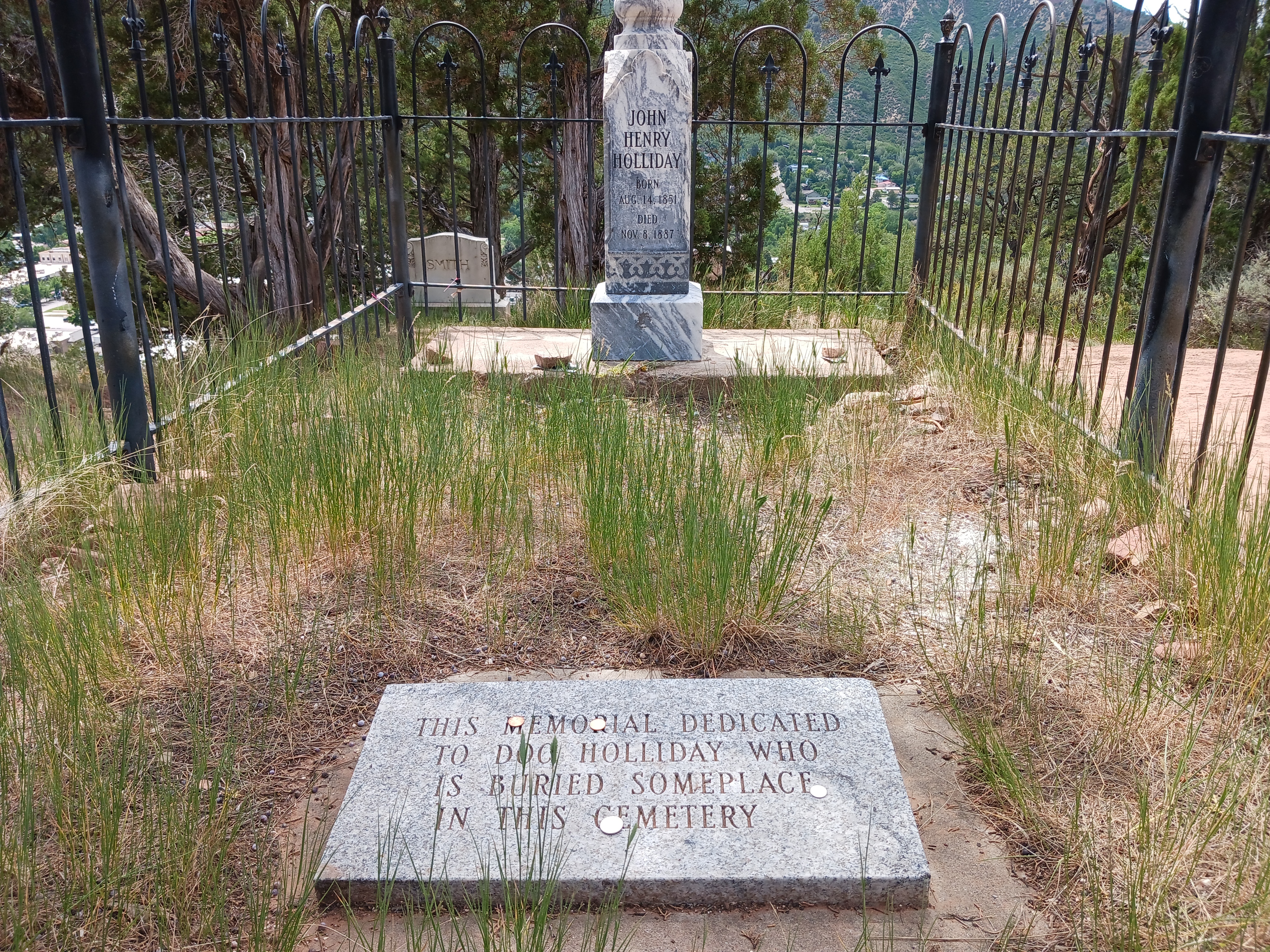
The new Doc Holliday memorial in Linwood Cemetery.
Except, it’s not really a memorial to him. It’s a memorial to his legend. Like the one-room Doc Holliday Museum, it’s a shrine to an idea, a myth that looms in American culture.
Standing amongst shattered tombstones and barely-legible markers, I was struck by the contrast. All of these other people, many of whom had surely lived lives just as rich and wild as Dr. Holliday’s, had been long forgotten. Their names worn away by the elements. But the legendary ghost—not even the specter of the real man, but an echo of silver screen portrayals—looms over all of them.
In the long, deep shadow of that legend, even the real John Henry Holliday seems forgotten. People remember “I’m your huckleberry”, but how much do we really know of the real man? What was he like? What were his hopes, and—given his life cut short by tuberculosis—his regrets?
What was it like to know him? Was it a joy, or a tragedy?
Just a day before my arrival in Glenwood Springs, I visited another graveyard: Leadville’s equally old Evergreen Cemetery, where just two years ago the Leadville Irish Miners’ Memorial had been unveiled. That memorial stands at the edge of the Catholic paupers’ field for that city, where over a thousand Irish miners and their families were laid to rest. Desperate and destitute, few of them ever had grave markers. Those that were there have long vanished.
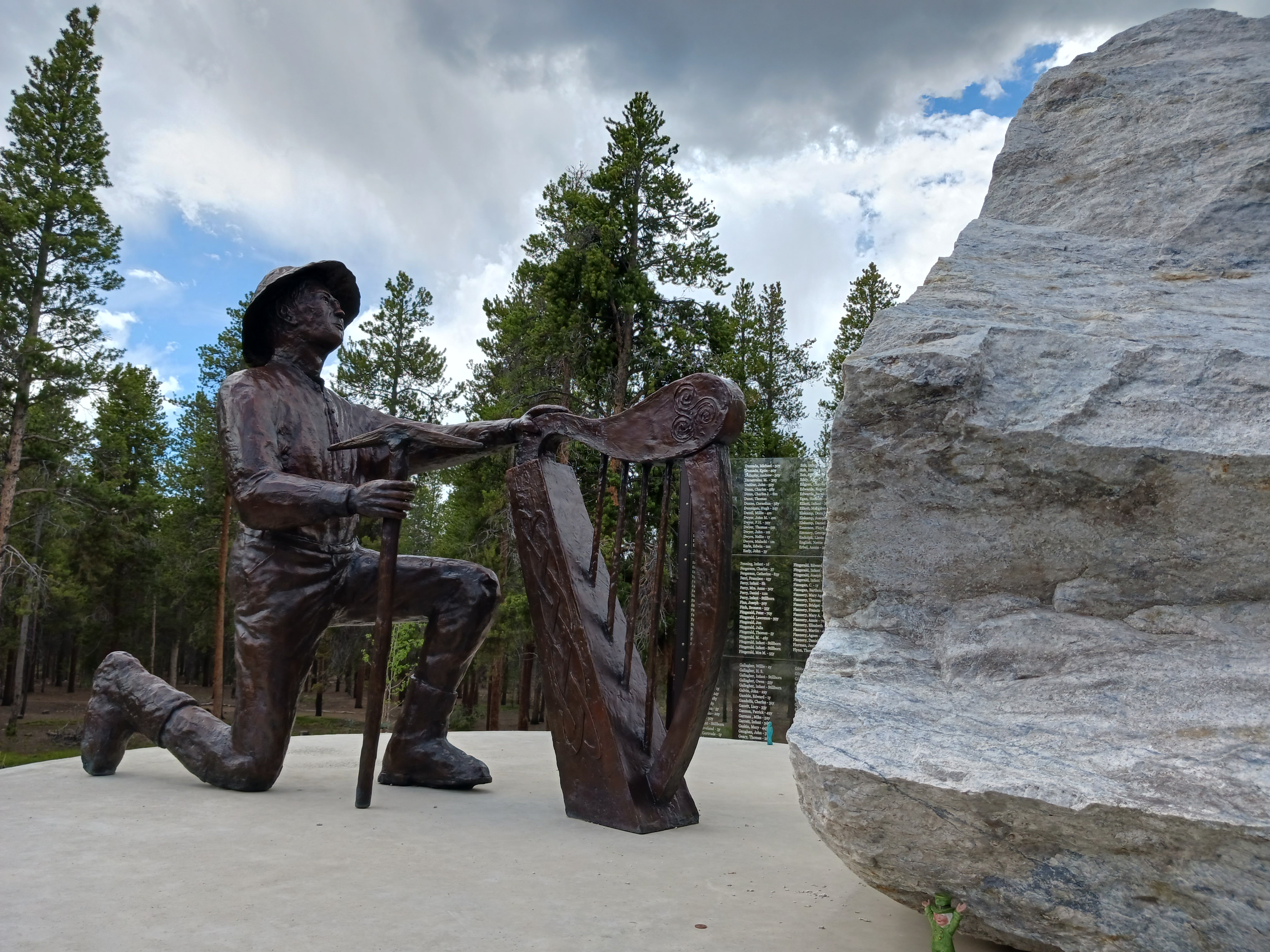
The Leadville Irish Miners Memorial, which was erected in 2024 in the memory of the over 1,200 Leadville miners and their families who are buried in the Cloud City’s paupers’ field.
Most of those impoverished people lived at the same time as Dr. Holliday. Many would have heard of him. Some might have even met him as he passed through on his way to Glenwood to die. And like him, they died impoverished, ignored by society at large and usually remembered by only a few. They lived lives just as deep, rich, and meaningful as Dr. Holliday, if not as violent or dramatic. But a century and a half later, many of us have forgotten the mothers and fathers who raised our grandparents, the miners, blacksmiths, bricklayers, and carpenters who built the world we live in today.
It’s the gunslinger whose name we know. It’s dentists we forget.
There’s no condemnation in that fact, I think. It’s just a bare statement about who we are, and a reminder of the mundane truths behind the drama of history. But even days after I left, I couldn’t shake the contrast between those two memorials—one an empty grave dedicated to a famous legend almost to the exclusion of the man whose name it bears, and the other a somber monument standing at the doorstep of an entire nameless community, resting beneath the soil only a few paces away.
It’s those thoughts that followed me all the way home, drifting along in the shadow of my little car as I wound my way back down the mountains.
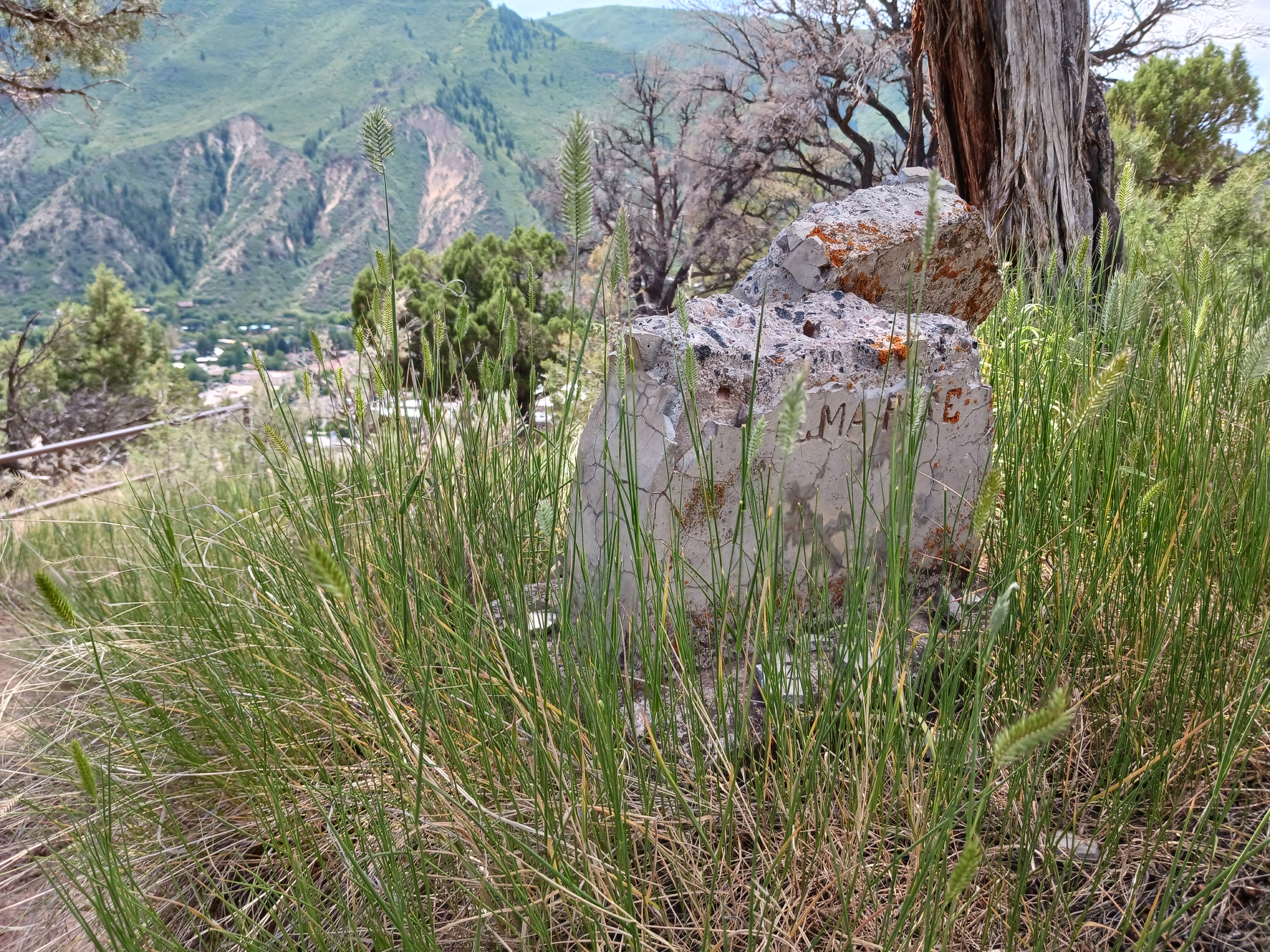
A cracked and only partially legible tombstone, choked by grass and weeds, in the Linwood cemetery.