
 Membership
 Donate
 Shop
Shop

















String Stories: Colorado's Little-Known Luthiers
Two surprising violin-maker histories resonate right under a local music historian’s nose.
You might say I am addicted to violins. I am always glad to talk about my violin or others. I love to play it, I love to listen to others play, and I love to learn about violinists and their instruments. What a surprise when I started learning about violin makers right under my nose! Not violins that had been made in Europe and brought here, but quality instruments made in Colorado, sometimes with wood sourced in our forests.
Ingenuity and Talent
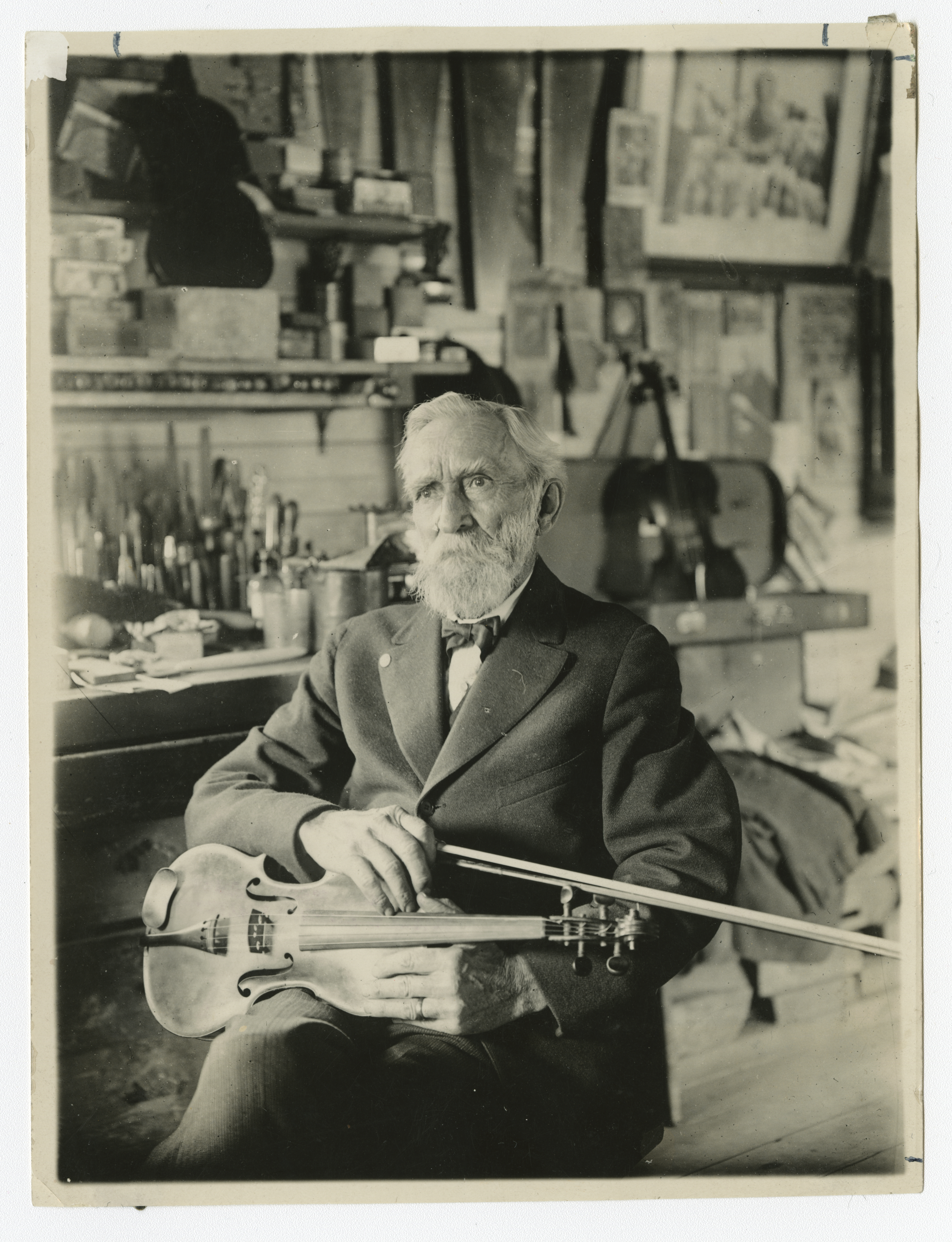
Freelan Oscar Stanley and his twin brother Francis Edgar Stanley were born in Kingfield, Maine, on June 1, 1849. At the age of nine, the twins became entrepreneurs, selling tops and pencil sets to classmates. As adults, the Stanleys became known for the steam-powered Stanley Steamer automobile as well as the Stanley Dry Plate Company, which made plates for use in photography. Both brothers learned to make violins at age eleven, taught by their uncle. Just a few years later at the age of sixteen, Freelan had finished three violins; It was a craft he continued throughout his life.
Visiting the Stanley House Museum this summer, I expected to learn about the house and about Stanley’s best-known invention, the Stanley Steamer. But I didn’t expect to learn about my personal passion, violins. F.O. Stanley, a man who never stopped learning and building and inventing, built violins.
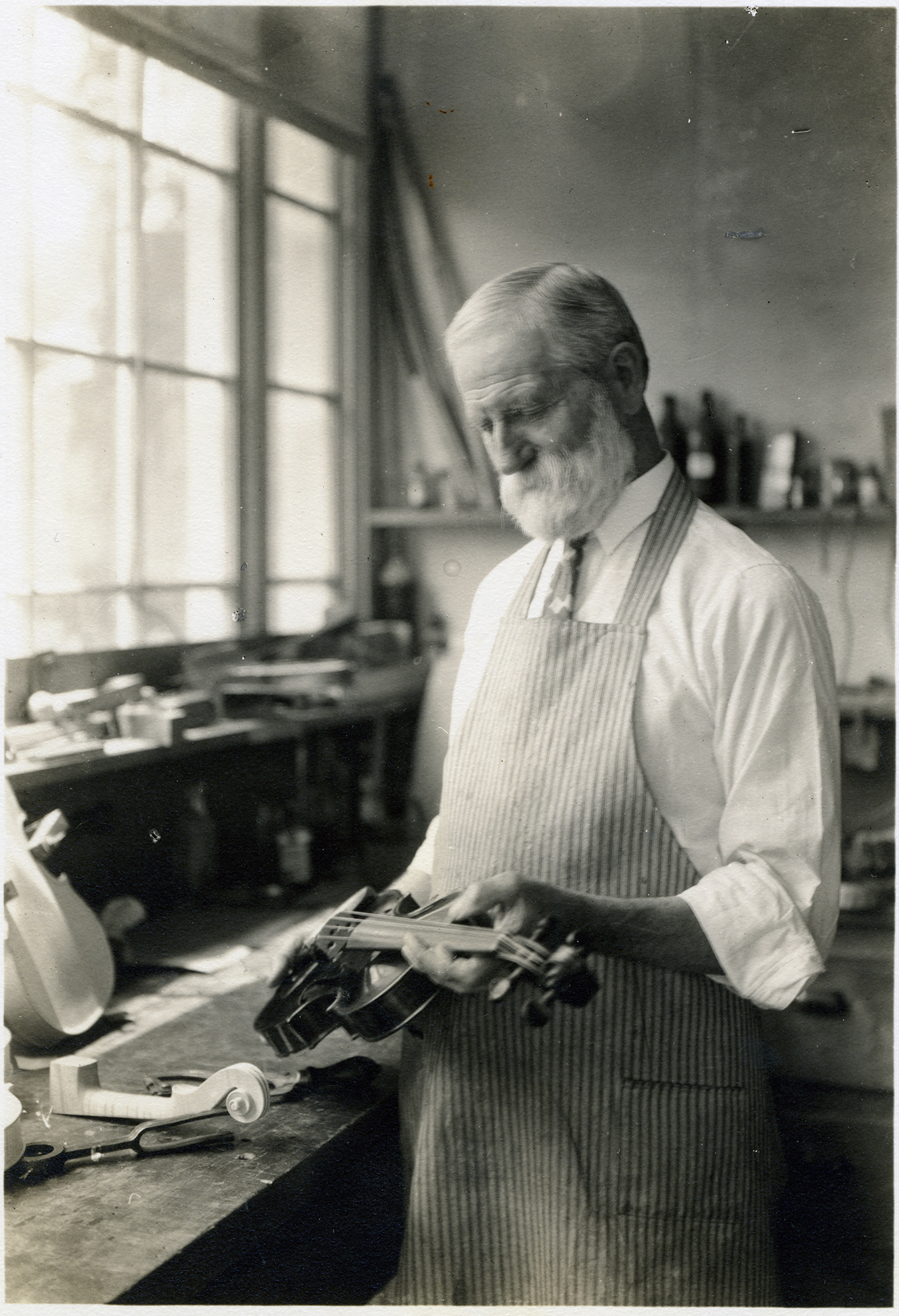
F.O. Stanley in his violin shop in Newton, Massachusetts, photographed by his sister, Chansonetta Stanley Emmons.
In 1903, F.O. Stanley was stricken with a resurgence of tuberculosis. Like others, he came to Colorado for the curative air of the Rocky Mountains. Having been told about Estes Park by his doctor, he drove his Stanley Steamer up the canyon. His health improved after a summer in the town, and he decided to build a summer home there. The house, called “Rockside,” was completed in 1904. He also built the famous Stanley Hotel, beginning in 1907. Stanley and his wife traveled frequently between their home in Newton, Massachusetts and Rockside in Estes Park. While Mr. Stanley was making steam cars and a hotel, he continued to build violins as a hobby. Searching for wood of high quality, he discovered excellent spruce near Silverton and Loch Vale in Rocky Mountain National Park. Stanley reported that “Superintendent Toll has given permission to take timber and shortly the violin bow will coax from these former wind harps of nature the songs and secrets of past ages.”
After turning 75, Stanley began experimenting with making violins on a wholesale basis, using an assembly line. He wanted to be the “Ford of violin manufacturing.” He mused, “You cannot buy a good violin now for less than 200 dollars and you will probably pay as high as 600 for one. A violin can be made by utilizing machinery for the rough work and by the application of the proper principles, skill and workmanship for fine work, a violin can be turned out just as good as Stradivarius ever made, even in his palmiest days and the cost of making it will not be more than thirty dollars.” A modern luthier recently stated, “I purchased the violin (an F.O. Stanley). It was one of the best-sounding violins I ever heard or played. And that includes many great Cremonese instruments.” The exact number of instruments made by F.O. Stanley is not known, but reporting from 2010 mentioned that in the previous fifteen years, only five had been auctioned. A 1929 Stanley violin was recently advertised for 18,000 dollars.
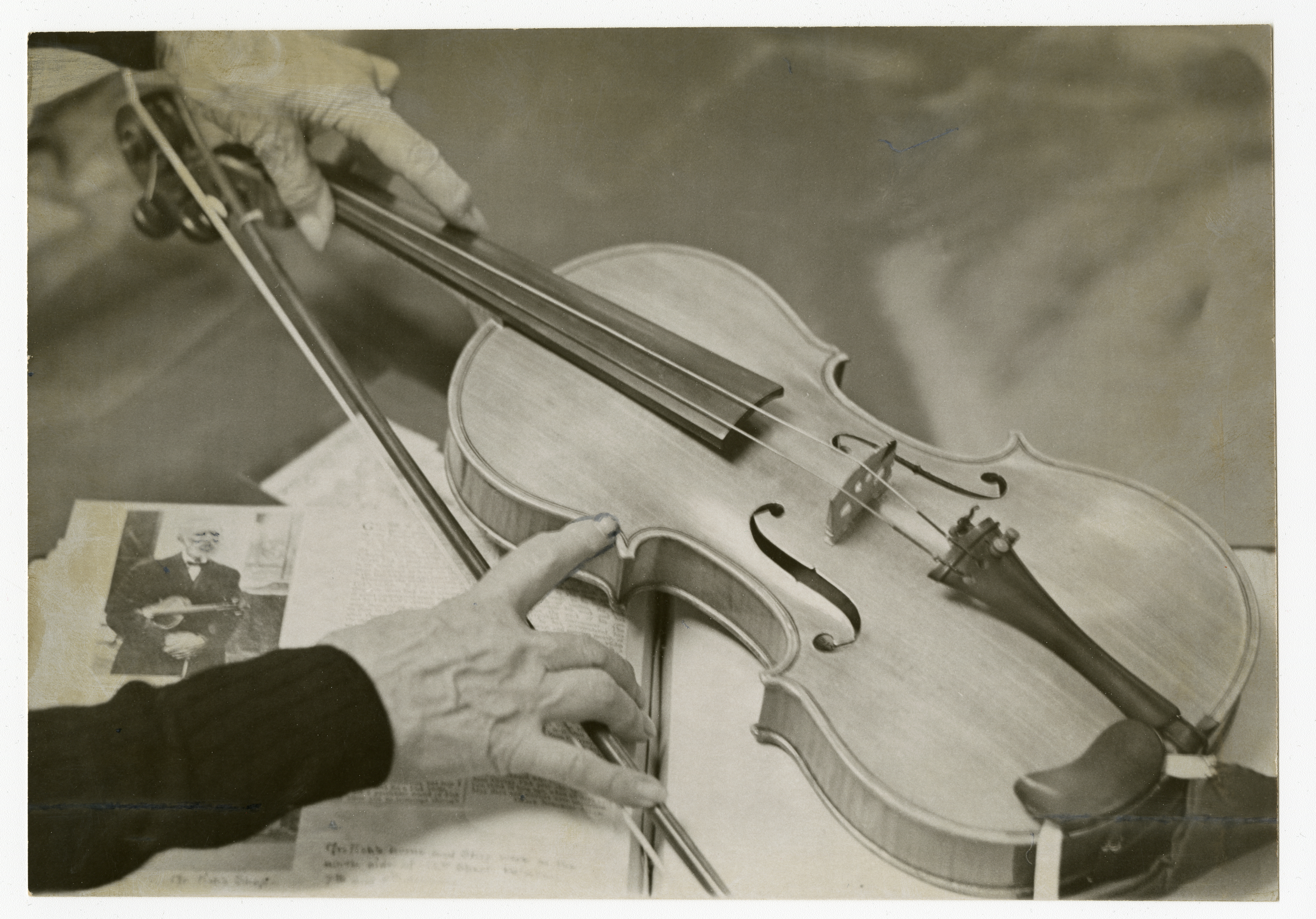
Violin made by George W. Fisk, February 16, 1972.
Pattern Play
Another surprising place in Colorado to find a violin maker is Greeley. When I began work for the museums there and toured the collection, on exhibit in the main room was a violin! According to the caption, it was made by a man named George Fisk in 1915. And there was more. A local man, Aaron Zimola, came to the museum to give a talk and play a Fisk violin. I was hooked and I needed to learn more.
Named “The Stradivarius of the West,” George Fisk received the moniker from violinist Ede Reményi, after Fisk gifted the respected musician a violin. Not a Coloradan by birth, this Western Stradivarius was born in Vermont in 1838. As a young man, he was employed by Wood and Parsons in Hoosick Falls, New York, a lumber and machinery company. At Wood and Parsons, George learned pattern making. As for being musical, he played cornet with the 2nd Vermont Volunteer Regimental Band, according to Zimola. He moved to Union Colony (established where Greeley is today) in 1870, setting up shop as a furniture maker and instrument builder. Zimola tells us that Fisk was self-taught, working without a good pattern for violins. Fisk met the Hungarian violinist, Edouard, or Ede, Reményi, in 1881 when Remenyi’s tour stopped in Greeley. Fisk showed him a violin. Reményi was not impressed; the craftsmanship was good, but the sound and form were not. However, Reményi later sent Fisk a good violin to use as a pattern. When Reményi returned to Greeley, Fisk presented him with a different violin. After that, “Edouard Reményi wrote to me that he thought I was the best violin maker in the world.”
George Fisk in his shop, date unknown.
Fisk’s obituary in the Rocky Mountain News stated that Reményi thought Fisk the best violin maker in the country and termed him the “Stradivarius of the West.” It is thought that Fisk made about 162 violins. They sold for between seventy-five and 200 dollars during his lifetime. It is unknown how many Fisk violins are extant, but the Greeley History Museum is presently home to two Fisk violins.
F.O. Stanley and George Fisk are just two of the luthiers I found in early Colorado. There were more. Baron Károly Tomasowzky de Ferenczy, for example, was convinced to come to Colorado from Budapest by several wealthy enthusiasts; the Baron built violins in Denver. Others include Eugene Carter, who taught at the Normal School in Greeley (later the University of Northern Colorado), Dr. J.R. Rowe in Cañon City, Walter Ball of Denver, and Louis Bourke of Denver and Victor. I wonder how many more Colorado violin builders are waiting to be added to the list.