
 Membership
 Donate
 Shop
Shop



















A Tree Grows in Trinidad
As it turns out, the rubber ball doesn’t bounce far from the tree after a recent visit to Trinidad reveals history coming full circle.
I had both heard and written about Trinidad, the town that sits about twenty-one miles by car north of the Colorado-New Mexico border. I’d also passed through several times on my way to destinations deeper in the American Southwest—Santa Fe, Albuquerque, Phoenix. Recently, we made a point to go and visit, this time intentionally making Trinidad the destination.
Like other travelers heading into town, we were welcomed by the “T-R-I-N-I-D-A-D” sign atop Simpson’s Rest. (I admit to being ridiculously excited to see the sign illuminated at night—eight block letters poised as friendly sentinels suspended in the darkness.) Beautiful western Victorian buildings line the downtown streets. And the streets themselves are paved in red brick—several iterations of stamps mark bricks with the town’s name, a quiet display of pride in its brick kiln heyday. The downtown streets are vibrant with public art, the friendliest of folks, and music lofting from venues of all sorts. The museums and art galleries are plentiful, giving a spotlight to so many important stories of the people of southern Colorado.
All that, and it’s also home to the largest rubber tree in Colorado.
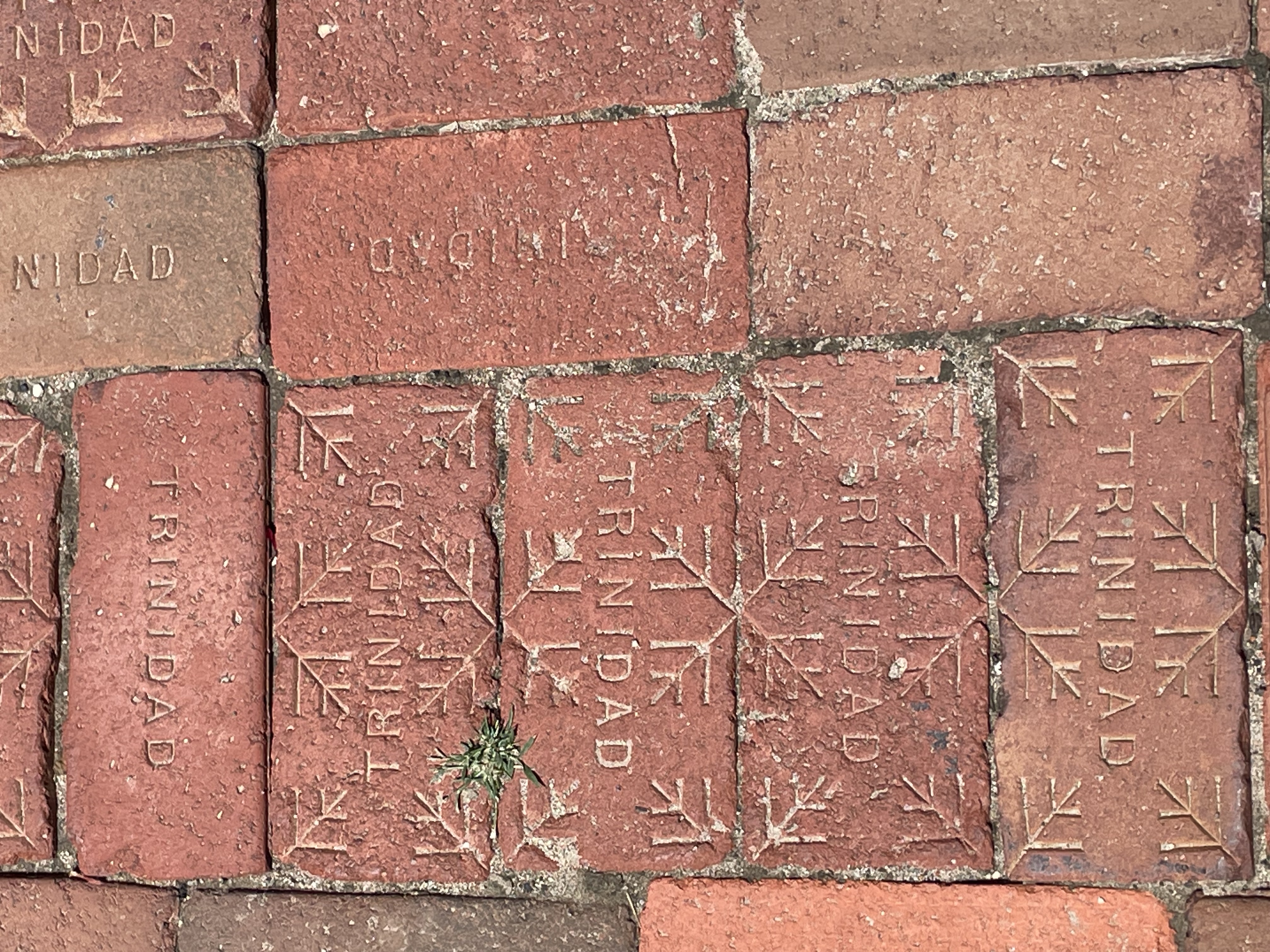
Produced by Trinidad Brick and Tile Company (in operation from 1901 to 1978), four different patterns of these iconic stamped bricks line the streets of Trinidad.
Every Picture Tells a Story
One of my favorite Trinidad stories even before our journey is that of photographer Oliver E. Aultman. When we set out, I had no idea that his legacy would grow to include a tree. Aultman was a self-taught photographer who set up shop at 319 1/2 West Main Street in 1890. He hadn’t planned to do so—in fact, it’s one of the most charming aspects of his story. He was working as a bank clerk when a customer of his took out a loan for a photography studio. When the borrower defaulted on the loan and left town with the money, an enterprising Aultman moved into the studio space and set up the Aultman Photography Studio in order to recover the financial loss. He quickly learned the craft of his fledgling business, and successfully so. His was the longest continually operated photography studio in the state. More importantly, Aultman’s body of work is one of the best historical records we have of the people of southern Colorado during the first half of the twentieth century. His portraiture embodied a broad swath of the community, telling the story of a diverse population and capturing the beauty and dignity and joy in his signature style—sometimes with a delightful touch of humor.
O.E. Aultman’s family helped with the business and his son Glenn Aultman became a photographer in his own right. After his father had a stroke and passed away, Glenn took over the studio operations and continued the family legacy until he died in 2000. History Colorado houses a collection of more than 50,000 images from the Aultman Studio, most of which are available online. The Trinidad History Museum also has an insightful exhibition of O.E. Aultman’s work, including his camera and a reproduction of one of his iconic studio backdrops that happens to make for a fun selfie.
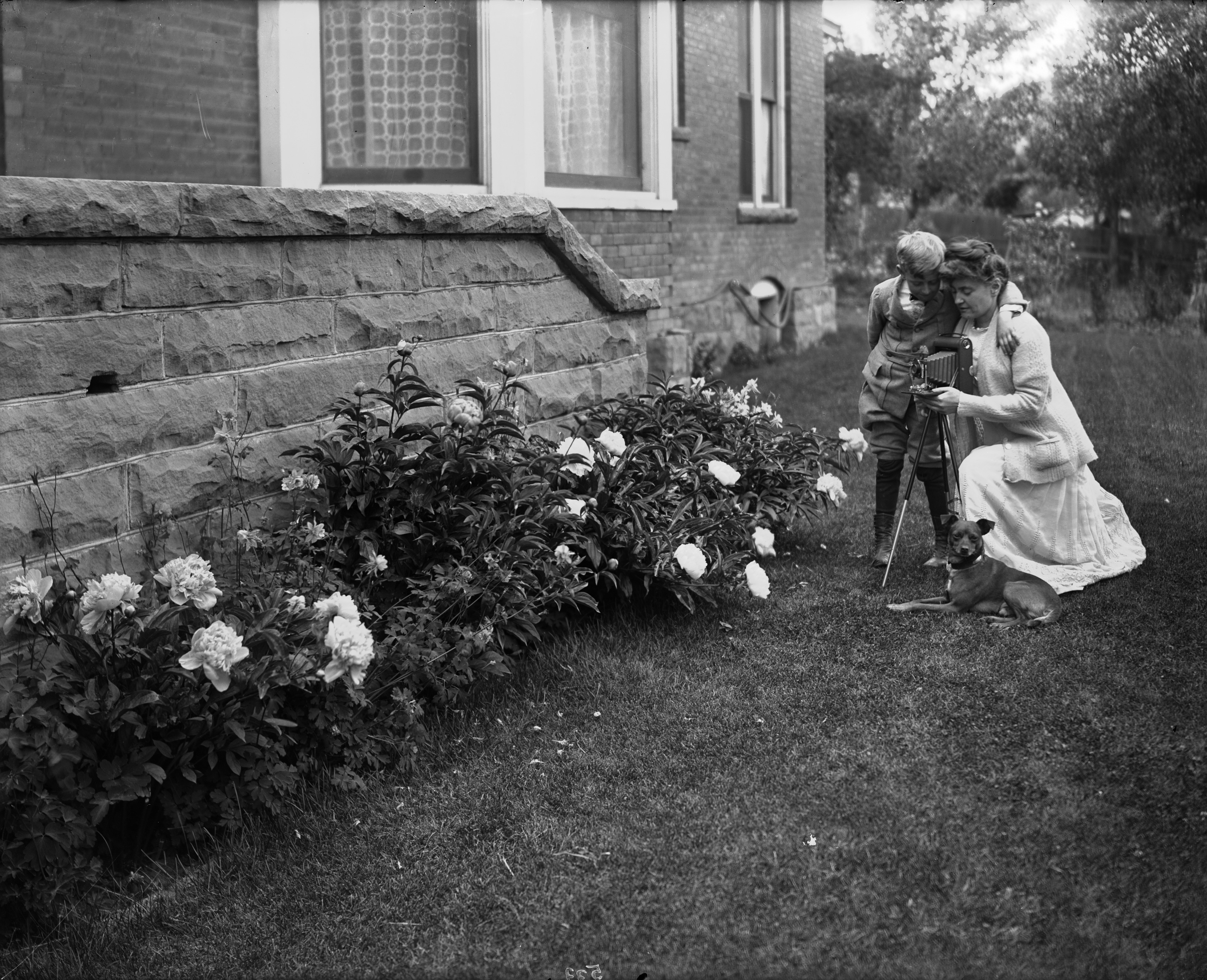
Jennie Aultman and her son Glenn pose with a camera outside of their home in Trinidad. Photo by Oliver E. Aultman, about 1912–1914.
Beneath the Canopy
But back to that rubber tree. While looking for a place to eat dinner and escape from a late-summer cloudburst, we stumbled upon The Bell Block building—the fascinating construction and preservation history of which is spelled out on a sign hanging on the wall inside the front doors. We walked around, marveling at the 1970s-era office building interior that seems to be in a symbiotic relationship with a massive—I mean really, really tall—tree, winding its way around the split staircase and stretching up to touch the skylights. We admired it in awe while visitors to the restaurant on the lower level commented amongst themselves about how much it must have cost to create such a huge fake plant. The thought that it could be fake hadn’t really occurred to me, and a yellowed leaf that had fallen on the ground concurred. I walked over and bent down to pick it up. Directly in front of me when I stood again was a small wayfinding sign—a blue and white color printout on letter-sized paper—that read “RUBBER TREE / Ficus Elastica / Before you grows the largest rubber tree in Colorado.” Two photographs on the sign told more: a photo of the young tree sitting on the floor in front of a white wall, along with a photo of the tree in more recent years, climbing the white wooden staircase in its present location. I read on, and actually gasped aloud.
This tree has a Trinidad story to tell, too. As it turns out, Glenn Aultman’s mother and O.E. Aultman’s wife, Jennie, purchased the tree from a local department store for their studio in the 1930s. It kept the Aultmans and their clients company at the studio until it was transplanted to The Bell Block plantar in 1991, when it was an already-impressive twelve feet tall. Others may not find this as stupendous as I did in that moment, but as I stood before this incredible rubber tree I thought of a few things. One, I haven’t found any evidence that the tree has a name, although I think it ought to. Two, I thought of all of the people it’s seen and all of the history that it has witnessed, day after day, decade after decade, in its nearly 100-year lifetime. And then I thought of all those faces that walked past that very tree in the photography studio—Coloradans who brought richness to our state’s landscape, whose photos portrayed strength, resilience, joy—captured through the lens of the Aultmans of Trinidad.
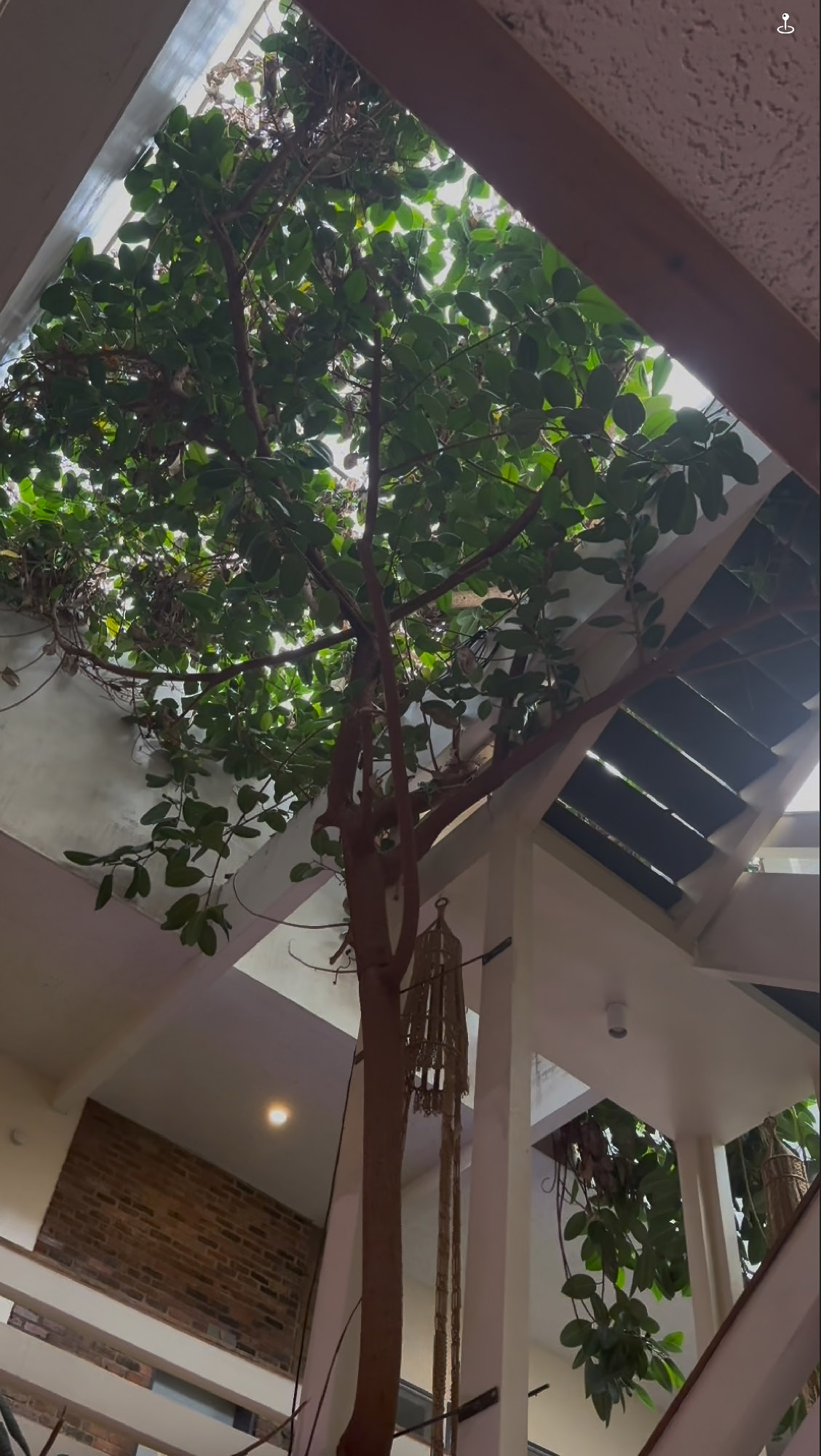
The rubber tree that once decorated the Aultman Studios now reaches for the skylight of the Bell Block building in Trinidad, August 2025.
And now here stood that tree. Celebrating restaurants and medical offices and shops, and the broader thriving Trinidad community. Unbeknownst to us, our search for shelter from the rain became a full circle connection, writing another chapter in one of my favorite Trinidad stories. A forty-five-foot tall, shiny green chapter, still supporting and beautifying the town and its people. I searched through the collection to see if I could catch a glimpse of the tree in any of the Aultmans’ photographs—maybe it had served as a prop in someone’s portrait? Although I confess that I did not search all 50,000-some images, I looked through many—sadly, to no avail.
But on the upside, it gave me an opportunity to peruse this remarkable collection once again, reflecting on the Aultmans and Trinidad and our long-overdue visit to this charming town. It’s probably much too obvious to be clever, but perhaps the tree’s name should be Serendipity?
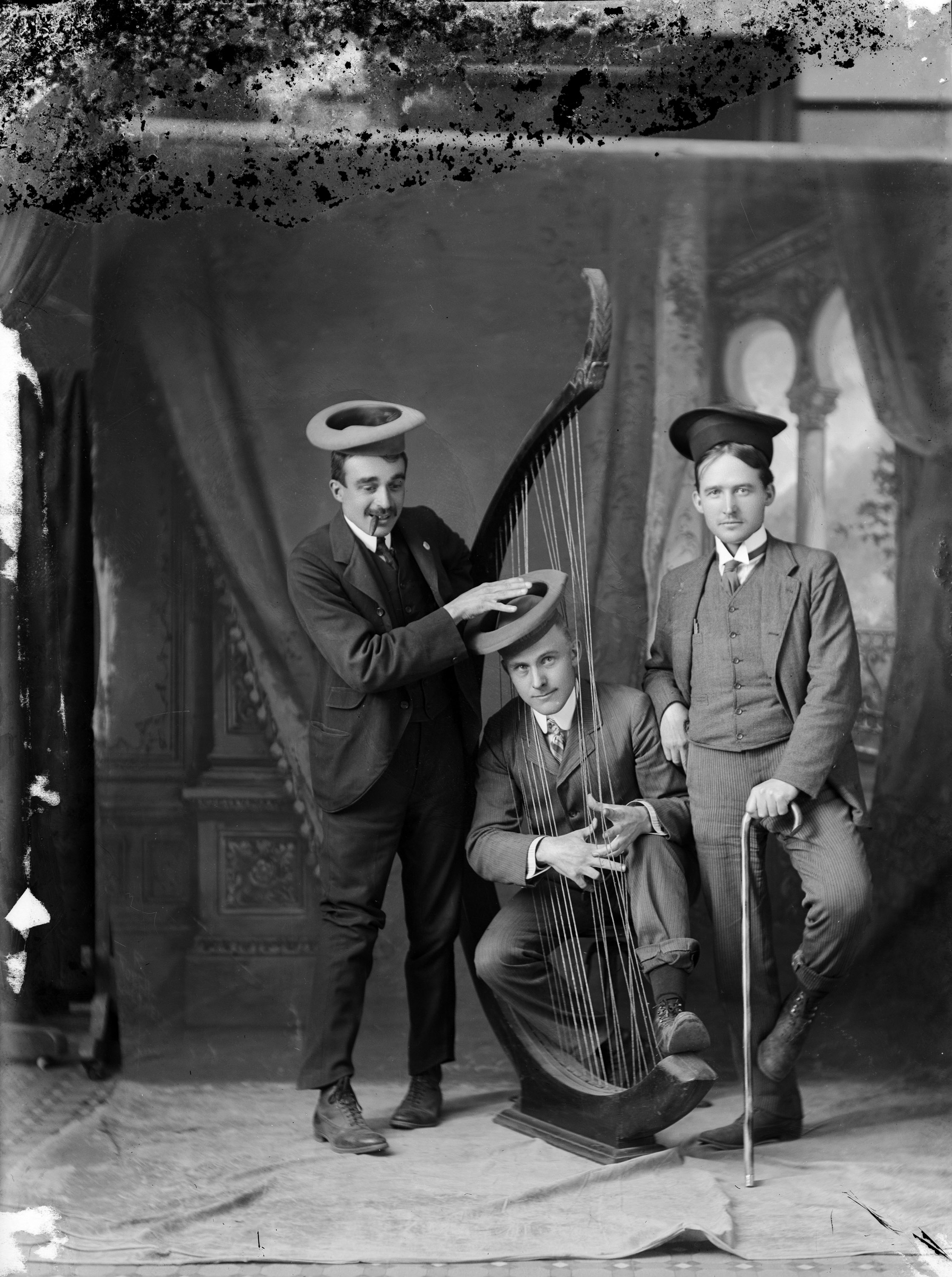
O.E. Aultman seemed to have fun with some of his subjects, like these three men photographed in 1901.