
 Membership
 Donate
 Shop
Shop


















The Society Wolf
A con artist in the early 1900s blazed a trail around the world, swindling victims—including Molly Brown—from Colorado to Japan. More than a century later, a photographic discovery in History Colorado's Collection is shedding new light on his crimes.
It’s an old adage for a reason—a picture is worth a thousand words. But when you find a picture that's a mystery, it’s like finding a treasure map!
That’s how I felt when I saw a never-before-documented photograph of Margaret (of Molly Brown fame) and J.J. Brown, taken together during a 1902 trip to Japan. Found by a research volunteer while rehousing items inside a box of manuscripts belonging to the Humphreys family in History Colorado’s Collection, this souvenir portrait immediately piqued my interest. It captures the Browns together with another fashionable couple. Dressed in traditional Japanese attire, they are all sitting on the ground. An inscription in the upper left-hand corner of the print caught my eye: “From Mr. and Mrs. J.C. Drayton to Their Esteemed Friend Mrs. C. Boettcher Yokohama.”
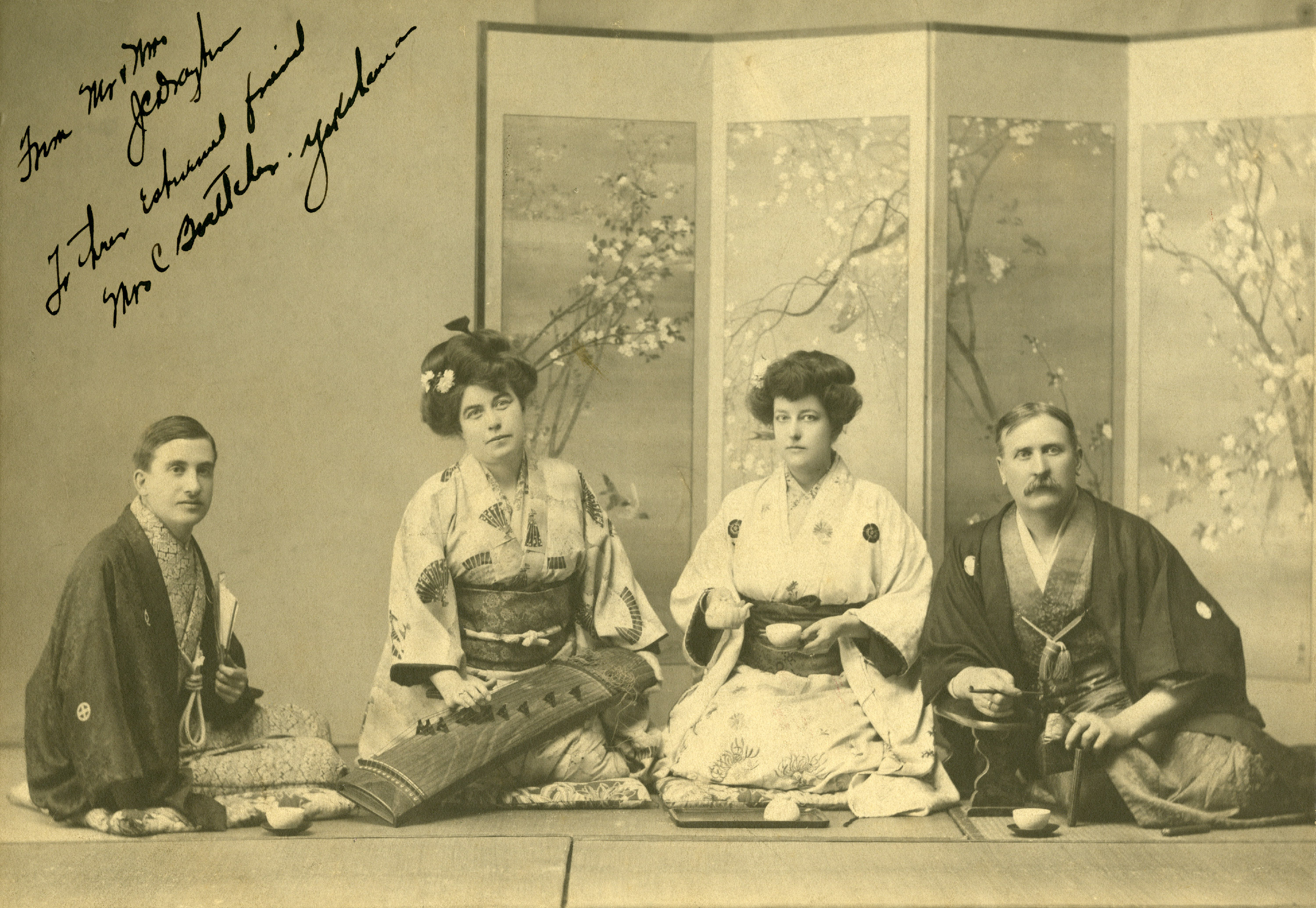
J.J. and Margaret Brown alongside Harry Silverberg and Mrs. Susette in kimonos. This photograph was the catalyst for discovering Harry’s story.
It seemed to be an ordinary souvenir photograph at first glance, only remarkable for its excellent condition and the trio of well-known people involved. Pictured there along with the Browns and the Boettchers of Denver are (supposedly) the Draytons—an old-money family connected via marriage to the fabulously wealthy Astors of New York. The photograph is certainly interesting further documentation of Margaret (Molly) Brown’s activities, offering a small glimpse into the remarkable life of one of Colorado's most famous residents before the Titanic voyage that catapulted her into celebrity. But as I went about verifying the sitters in the photograph, something felt off. The Browns and the Boettchers didn't socialize much with those outside of their sphere during this time of more defined social classes that held sway even out West. Why would this man (Drayton) feel confident that the Boettchers would want a photo of him with the Browns?
As it would turn out, this was just the first question of many I’d have to answer to get to the bottom of this mysterious photo’s story. I set about my research in the archives, figuring that the people in the photograph should be easy enough to identify. Confirming the existence and details of someone called "J.C. Drayton" wasn't too hard. James Coleman Drayton was a son-in-law of the famous Mrs. Astor of New York society, and his sons were friends with the Browns’ children. But the Drayton in the photo stood out for a few other reasons, namely his age. He appeared much younger than the Browns.
His striking features were another cause for pause. Online sleuthing turned up a verifiable photo of James Coleman Drayton from his older years, but the photo of the younger Drayton didn't look quite right. As I looked for more historic photos of the famous family, it quickly became clear the man purporting to be J.C. Drayton wasn’t who he said he was. This is where the plot thickens.
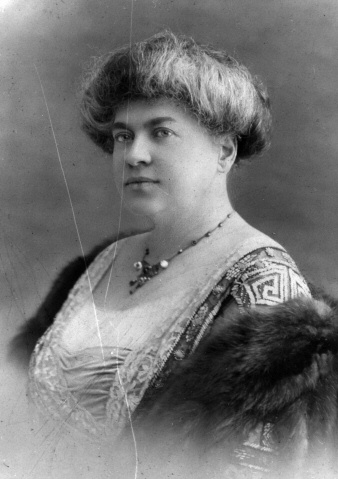
Mrs. Charles Boettcher Sr., one of the two “Mrs. C. Boettchers” to whom the photograph in question was inscribed.
Here Comes Harry
In about 1870, a man who would definitively alter the lives of the Brown family was born in Atlanta, Georgia. His name was Harry Silverberg, and by all accounts, his life was rather happy. His father, a former rabbi, made quite a fortune during the Civil War as a blockade runner, and subsequently moved his family to Arkansas where he owned a modest business empire, expanding to Missouri and Kansas. Harry was one of at least three children and, as far as childhood was concerned, he was lucky.
Beginning in Harry’s father’s lifetime, but especially after his father’s passing when Harry was just fifteen years old, he took a hand in running the business alongside his remaining family members. However, easy access to a flow of cash became, in some ways, his undoing—the beginning of a web of swindles and lies that made Harry infamous. His family tidied up the situation after he embezzled funds from the family stores to fund his gambling debts. But it seems Harry no longer wanted to make a life for himself in Arkansas and decided to journey west.
He moved to San Francisco around 1893, and became an advertising agent with a monthly salary of 100 dollars. It was a decent wage for the average person, but Harry had become accustomed to a lavish lifestyle beyond his means. After running up debts and scheming his way through the city, according to his own account, he needed to skip town and this time he ran to Chihuahua, Mexico.
The paper trail I was uncovering hinted that this was the tip of the iceberg.
As it turns out, one of his first large-scale scams took place in this new locale, where he just so happened to become friends with a telegraph operator. To carry out this well-orchestrated con, Harry would send a telegram to a “bank” and the “bank” (the telegraph operator) would respond by confirming “yes there are X dollars in this account, feel free to charge what you need for this.” He went on to spend more than $150,000 during this spree. Eventually, the operator gave up the scheme, and Harry was imprisoned in a Chihuahua jail for five weeks. According to Harry, his mother found out about his imprisonment and paid back the money Harry had stolen. However during Harry’s time behind bars, he was paroled to the Governor of the State of Chihuahua, who offered Harry a job as an American telegraph operator. After working nine months, the governor secured Harry’s release.
After his success in Mexico, Harry decided it was time to move on, heading next to Rochester, New York. Here, he became a new man—literally. He decided to go by “J.C. Davis,” and as Davis, he met and married a very wealthy young widow. He forged checks totalling 4,600 dollars and was subsequently arrested. His father-in-law got him out of jail on the condition that Harry would divorce his daughter. Harry grabbed the opportunity and decided it would be a good idea to leave America altogether.
Foreign Adventures, Part One
Here Harry’s story really started taking wild turns. It was during his first visit to Europe that Harry became known as “J. Coleman Drayton” and befriended an Austrian countess. Notably, for all the talk and gossip this relationship would have created, Harry never divulged her name—and despite my hours of searching, I was unable to confirm her identity. I did learn that the Countess divorced her Count during this time. But eventually, the money that Harry had been spending dried up, and he had to “fess up” to the Countess. She was “astonished, but came to [his] assistance.” Curiously, it was the Countess’s idea that Harry change his identity to the now former son-in-law of New York high society’s Mrs. Astor, as the real J. Coleman Drayton was recently divorced from her daughter, Charlotte Astor.
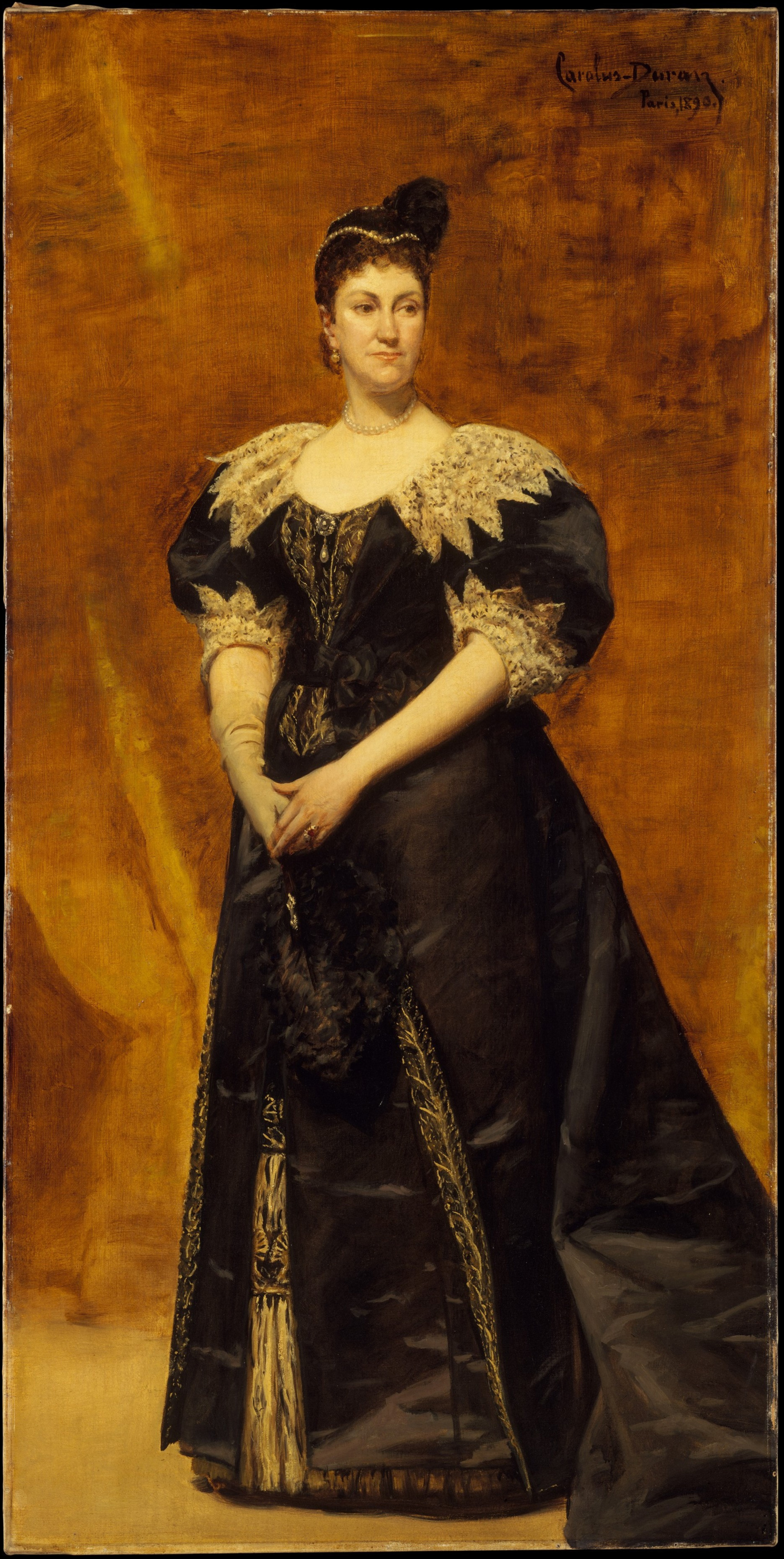
Mrs. Caroline Schermerhorn Astor, The Grand Dame of New York Society, whose social rules dictated who was “in and out” of American society. She was the one-time mother-in-law of James Coleman Drayton, who had married her daughter Charlotte. Mrs. Astor’s name and social status provided the star power to fuel Harry’s con as the fake Drayton.
After taking up Drayton’s identity, Harry found the name unlocked easy access to credit. Just about anywhere he sought loans wanted to do business with a relative of the Astors. One such jewelry store was desperate to sell to him, and the gems Harry picked out amounted to 40,000 German marks. The jewels were sent to Harry and the Countess’s hotel prior to payment, and at this point, Harry and the Countess escaped to London with the ill-gotten goods. Unfortunately for them, the real J. Coleman Drayton was also in London and Harry was quickly found out. He was arrested and sentenced to a three-year prison term in Germany, and this is where the Countess abandoned Harry and faded from the story. In Harry’s confession, he alluded to the Countess’s own transgressions when he stated that she “became the famous woman of the Dreyfus case who sold secrets to both sides.” He was deported back to America through the generosity of the American consul after falling ill in prison, and he headed back to the United States. As I worked to unravel the web of intrigue, one thing became increasingly clear: Harry was still proving rather lucky.
Settling stateside in Baltimore—just by coincidence—he met up with a former acquaintance from Baden-Baden (when he was first called Drayton), and kept up the ruse. With this assumed identity, but still in a bout of poor health from his time in the German prison, he moved to Texas for treatment. That’s where he met cattle ranch owner Clara Barklow and she married the man she knew as J. Coleman Drayton. Harry was about thirty years old at this time, and it looked like he decided that, with his change in status, he needed to forge a new path. So off the couple moved to Colorado.
Denver Society
It was in Denver that Harry, still being called J. Coleman Drayton (sources vary, but I found several indicating that this time he may have been impersonating J. Coleman Drayton, a “nephew” of the true Drayton), attempted to make a legitimate career for himself. He went back to his earlier career in advertising and was making a decent wage of 300 dollars per week. Good fortune smiled on him again, and one day following a particularly charismatic marketing pitch, it turned out that Colorado Governor Charles S. Thomas was in the audience. Impressed with Harry’s persuasiveness, the governor offered him a position as a financial agent or commissioner—in charge of raising money for a statue that would be part of a special mining display at the Paris Exhibition. Harry envisioned a statue of a little girl, made of pure gold, he called the “Golden Girl.” Still posing as Drayton, he traveled all over the state raising funds to create the statue, coaxing Coloradans out of significant sums of cash along the way. During his time campaigning for funds, he most likely met many among Denver’s high society, such as the Brown, Boettcher, Cheesman, and Humphrey families. After months of fast talking and fooling, he disappeared. It was June 1900, and Harry was seen out and about, even borrowing 50 dollars from J.W. Jackson, secretary of the commission to the Paris Exposition—only to vanish the next day. Governor Thomas, along with other prominent Denverites, realized they were victims of a wily con artist only known to them as Drayton, and every cent of the money was gone. Having uncovered what I thought were some of Harry’s most brazen steps, this latest bold theft came as little surprise to me.
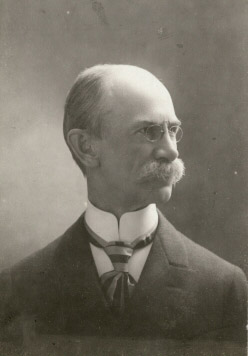
Governor Charles S. Thomas, eleventh Governor of Colorado and the man who gave Harry his position to raise funds for the Paris Exhibition, was most likely the key person who introduced him into fashionable Denver society.
On the move, Harry headed north to Butte, Montana. While his wife Clara’s whereabouts are unconfirmed during this entire time, Harry decided to change tracks once again. In Butte, he befriended Charles Clark, the son of Montana Senator William A. Clark. Clark owned the Tribune newspaper of Great Falls and gave Harry the manager role. Up to his old tricks, instead of using the money from the Paris Commission, he started writing bad checks and using his connections to the Clarks to garner credit. New debts were piling up; he needed to escape.
After fleeing to New York, Harry admitted to running up debts of $100,000. And with wife Clara Barklow nowhere in sight, he met a “Mrs. Susette” and decided to dash off to Europe once more. On July 18, 1901, on board the ocean liner St. Louis, they journeyed east.
Foreign Adventures, Part Two
Harry and Mrs. Susette travelled around Europe scheming and swindling to get rich quickly. Journeying into Asia—territory he had not yet visited—Harry found all new targets for his schemes. Among his exploits in India, he admitted to having traveled as the “head of a bogus railway company in the United States” and “purchased” fake companies in order to give them away, thereby showing off his unbelievable wealth. He was entertained by socialites in India; the likes of Lord and Lady Curzon of Kedelston (at that point the Viceroy and Vicereine of India) spent time with him. Later, the Denver Post reported in 1924 that “he entertained the King of Siam who was ‘glad to meet the richest man in America.’”
At last, I came across evidence that following his visit to Calcutta, he journeyed to Tokyo. It was in Tokyo that Harry and Mrs. Susette met his old acquaintances, Margaret and J.J. Brown, most likely having met during his days in Denver when he worked for Governor Thomas. Legal documents in the Lawrence Brown Collection at History Colorado reveal J.J. and Margaret were in Yokohama between April 6 and April 19, 1902, including J.J.'s two day-long visits to Tokyo. I was thrilled to finally uncover that during their stay in Yokohama, Harry (as Drayton) and Susette spent enough time with J.J. and Margaret that they visited the Yokohama studio to have a photograph of the four of them taken together. Still clinging to his chosen name that carried so much weight in Denver society, Harry even purchased a photograph to be sent along to his Boettcher acquaintances back in Denver. But from there the mystery only deepened: Harry happened to learn that the Browns were staying at the Metropole Hotel, after which he visited the Yokohama Specie Bank, Tokio [sic] Japan. A few days before the nineteenth of April, John F. Campion, a friend of Mr. Brown’s at Denver, received a cablegram signed “Brown,” asking for 5,000 dollars.
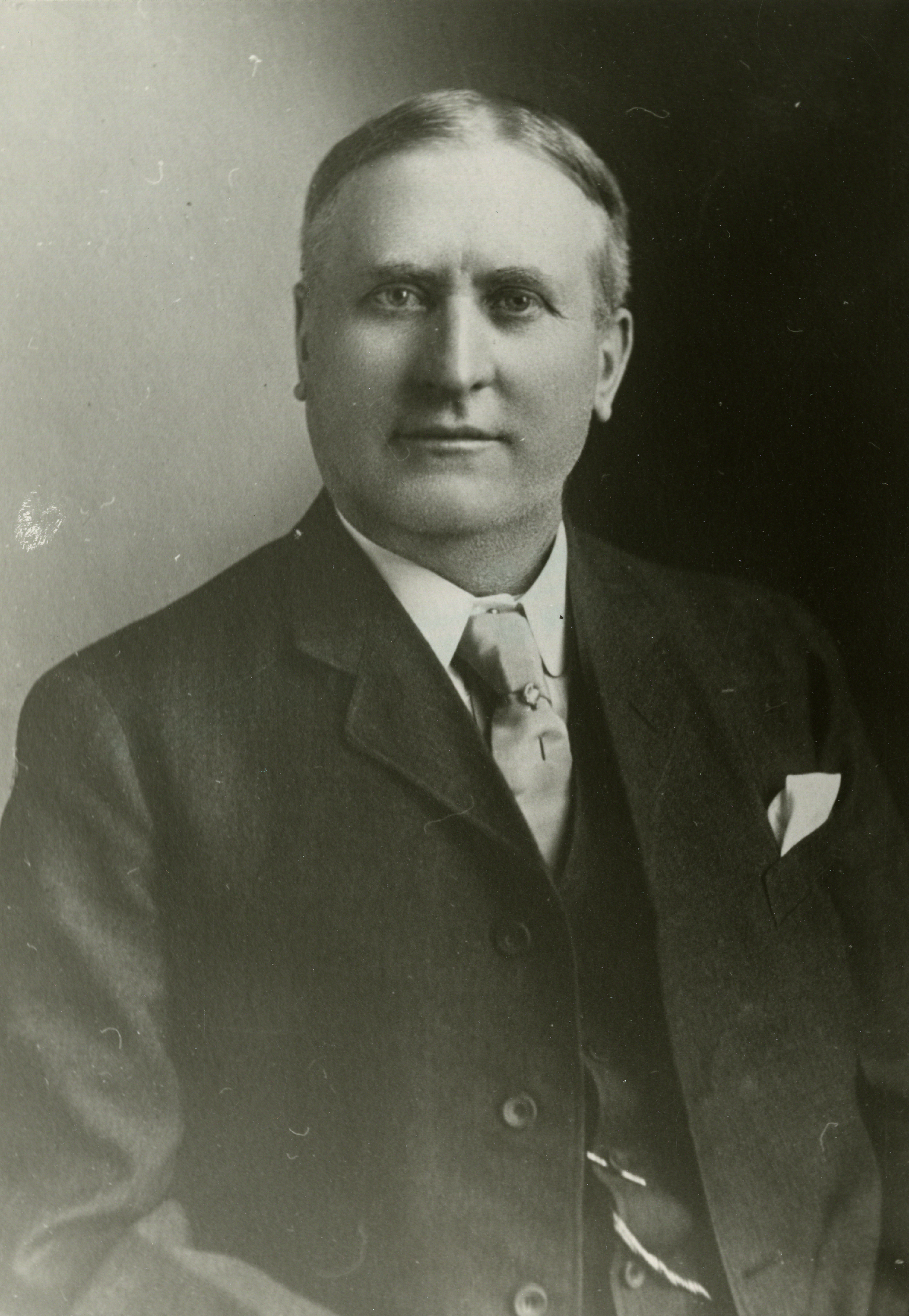
J.J. Brown, Margaret’s husband and the victim of Harry’s theft during their time in Japan.
Campion, being a friend, must have felt some hesitation at doing so and followed up. Again, from later court testimony I learned that “He took the message to the bank, which, on the nineteenth of April, telegraphed the defendants as follows: ‘Pay 5,000 dollars to Yokohama Specie Bank, Tokio, Japan, by telegram for credit of J.J. Brown, upon satisfactory identification, and attach much importance to mental condition of payee. The importance of this cannot be overestimated.’”
However, to unsuspecting J.J. Brown’s detriment, the last two lines were omitted from the telegram. The money was subsequently paid out to a “Mr. Brown” on April 25 at the Metropole Hotel. After the incident was discovered and claims were filed, J.J. Brown testified that he at no time requested a transfer of money from the Yokohama Specie Bank at Tokio in April 1902. After he was shown the request, purported to be written by himself, he again testified that “the signature was not in his hand writing, but that he recognized it as having been written by one Harry Silverberg, whom he had met in Japan under an assumed name.” During his time in Yokohama he also said that Silverberg went to Tokyo one day with him, as well as asked to borrow money from him multiple times. Harry, not getting the money by any honest means, had tried to fall back on an old trick up his sleeve: wire fraud. Not only did this create a financial headache for the Browns, it wasn't until the Supreme Court of New York ruled on the Myers v. Brown court case in February 1911, that any sort of fault was proven in wiring J.J.'s money to Harry. But to my astonishment, the story didn’t end there.
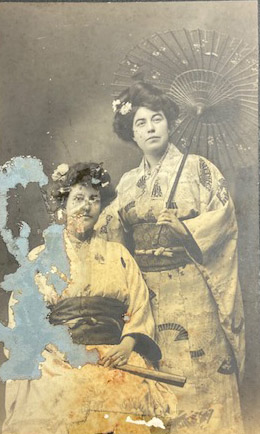
Margaret Brown and Mrs. Susette in kimonos. This photograph has been assumed to be that of Margaret and her employee Mary Mulligan, known to have travelled with the Browns on their extended holiday. The newly discovered photograph calls into question this assumption.
Drayton, Meet Drayton
Upon making his way back to the United States, Harry really landed himself in hot water. On July 8, 1902, while staying at the Annex Hotel in Chicago, Illinois, the real J. Coleman Drayton found out where his double was staying and confronted him. Exasperated, the real J. Coleman Drayton was reported to ask the con artist “Why do you impersonate me? Why do you call yourself my son, my nephew? Why do you persist? Haven’t you got enough?” Accounting for this exchange, and the fact that a Pinkerton Detective Agent was on his case for repayment of a 500 dollar draft that was two years past due, Harry promised to change his ways. Nevertheless, Harry never settled anywhere or with any companion for long—and he was already involved with a new woman, a certain Mrs. S.R. Tuck, "of Somewhere." The women in his life never seemed to stick around for long.
Around August 1903, Harry made his way to Minnesota, and shortly thereafter, an old scam on a stenographer caught up to him and he was arrested. He languished in a Minnesota prison for months, until being released in February 1904 due to ill health. Never seemingly discouraged, Harry decided once again to return to Denver for recuperation, and set about a new plan to obtain money through less-than-gentlemanly means.
April 23, 1904 was a normal day, but not for Mrs. Beulah Trimble Edwards. Unexpectedly, a man appeared on the doorstep of her home on North Tejon Street in Colorado Springs, asking to speak with her. Claiming to be a representative of “Polly Pry,” the well-known local newspaper columnist, he got straight to the purpose of his visit. According to the Colorado Springs Gazette, for a small sum of 1,000 dollars, the stranger said that he could affect her divorce suit against her husband Mr. Edwards by ensuring the readers of the paper were on her side. As Polly Pry was the society writer, what she wrote would be the version best suited to Mrs. Edwards, the man assured her. But Harry (posing as Drayton) and his blatant attempt at blackmail backfired; after her initial shock, Mrs. Edwards (who was, in fact, not seeking a divorce from her husband) showed him the door. Calmly, he took his leave and made for the train back to Denver.
Mrs. Edwards got in touch with the people associated with Polly Pry at the paper. It was confirmed that indeed, Harry, as Drayton, was employed at the paper, but in no way was he sent to Mrs. Edwards’s home, nor was Mrs. Pry even in town and was, in fact, on her way back from New York. By the time the story had unfolded in Denver, Harry had disappeared, having failed at this latest hoax.
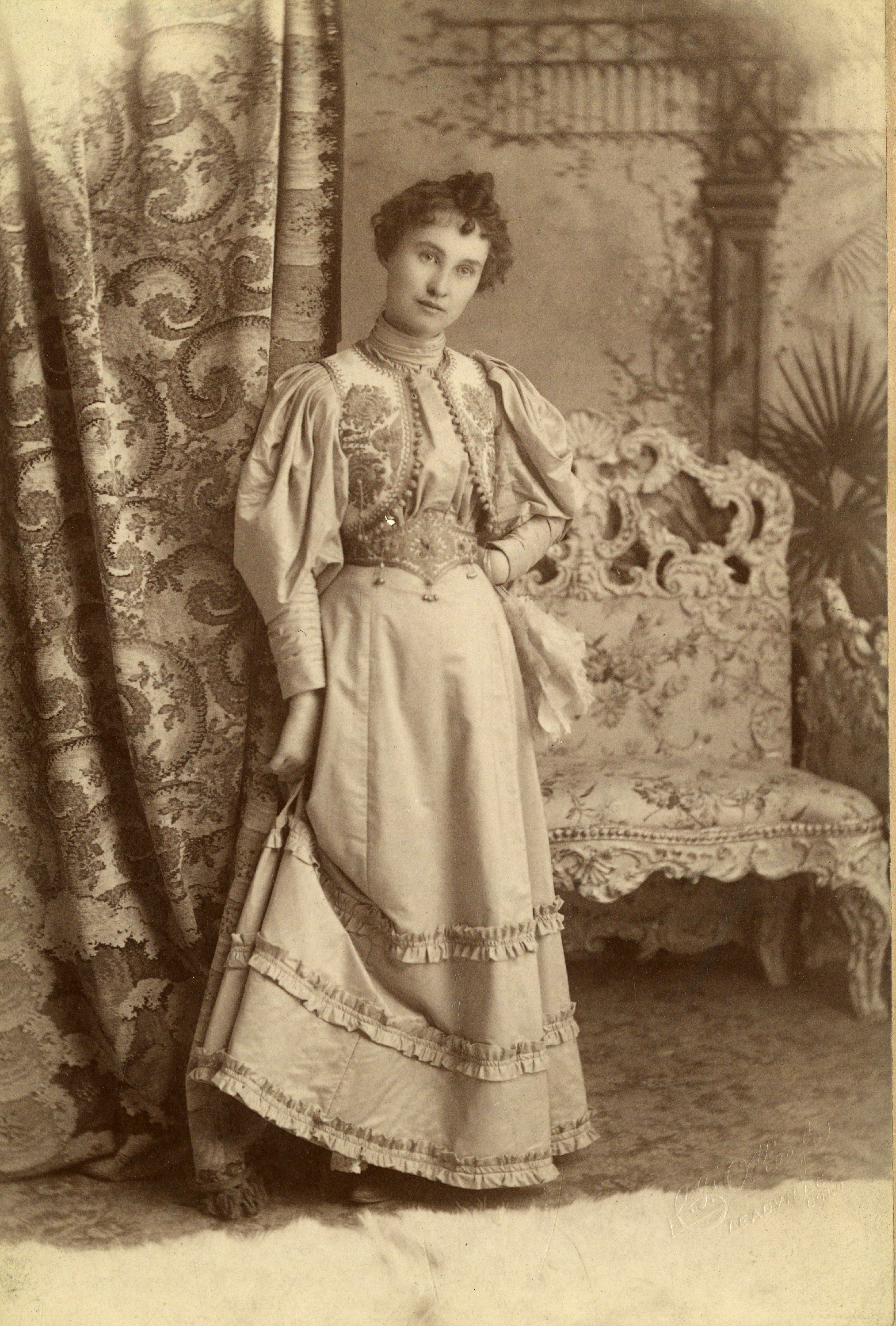
Mrs. Beulah Trimble, the woman who Harry attempted to blackmail during his confirmed second stint in Colorado.
I was as undeterred in my quest to get to the bottom of this story as Harry was in continuing his schemes and tricks. As I looked deeper into the sordid story, I found news reports going well into the early 1920s discussing Harry’s antics and travels around the world. Remarkably, the biggest one was still to come: his 1909 plot to swindle investors across the pond in London out of hundreds of thousands of dollars using a railroad scheme in Chile. In Harry’s own words, he turned up in Chile in 1907 and impersonated another journalist, this time from a New York newspaper. He fell in with a group that introduced him to the President of Chile and, with his permission, secured the backing to build a railroad. Harry obtained additional capital via contacts in London for the project, which for all intents and purposes seemed legitimate. An American judge who served as counsel to the railroad’s company became suspicious of Silverberg, who was now going by the name James Jeffrey Williams. His quest to discover more about “Williams” led back to the picture of “rogues” at Scotland Yard in London, where Harry’s face was predominantly featured. And with that, Harry’s cover was blown, and he disappeared “to parts unknown.”
Persistence Paid Off
Unknotting the immense web of this incredible story, I was admittedly disappointed to learn that, despite incredible notoriety during his lifetime, Harry seems to have successfully passed into obscurity. No confirmed death notice was published in any papers. His family stayed out of the news. For all the women he married, not a single one seemed to reach out to the papers to tell their tales, nor were any children discussed from any union. Perhaps the women had the resources to keep their names off the society pages, and tried to forget about any encounter they had with the trickster. And that would have been that. Except for one ordinary souvenir photograph recently found in our collection.
Going through collections at museums always feels like searching for buried treasure, and I enjoyed every moment of this twisting, turning hunt. And yet, questions still remain. The photograph in the Humphreys Collection at History Colorado was given to “Mrs. C. Boettcher.” With two “Mrs. C.” Boettchers alive in 1902, it’s not known if this was Charles or Claude’s wife, but it came into the possession of Ruth Boettcher, daughter of Charles, sister of Claude, respectively. She married A.E. Humphreys Jr. in May 1919 and brought many Boettcher family heirlooms and photographs with her. No other information is known about this photograph, and in fact, it raises even more questions. I could not determine whether the Browns knew about this photograph being in Boettcher's possession. It probably would not be a reminder of fond times for either of them. But it does capture a moment in time when the fake J. Coleman Drayton and Mrs. Susette spent a lovely day out with the Browns. It also highlights the lengths Harry went to in order to maintain his elaborate ruse, even after he had been exposed! And it reminds us that museum collections do have stories to tell—sometimes of mystery and misidentification—even if it takes a few decades to get to them.
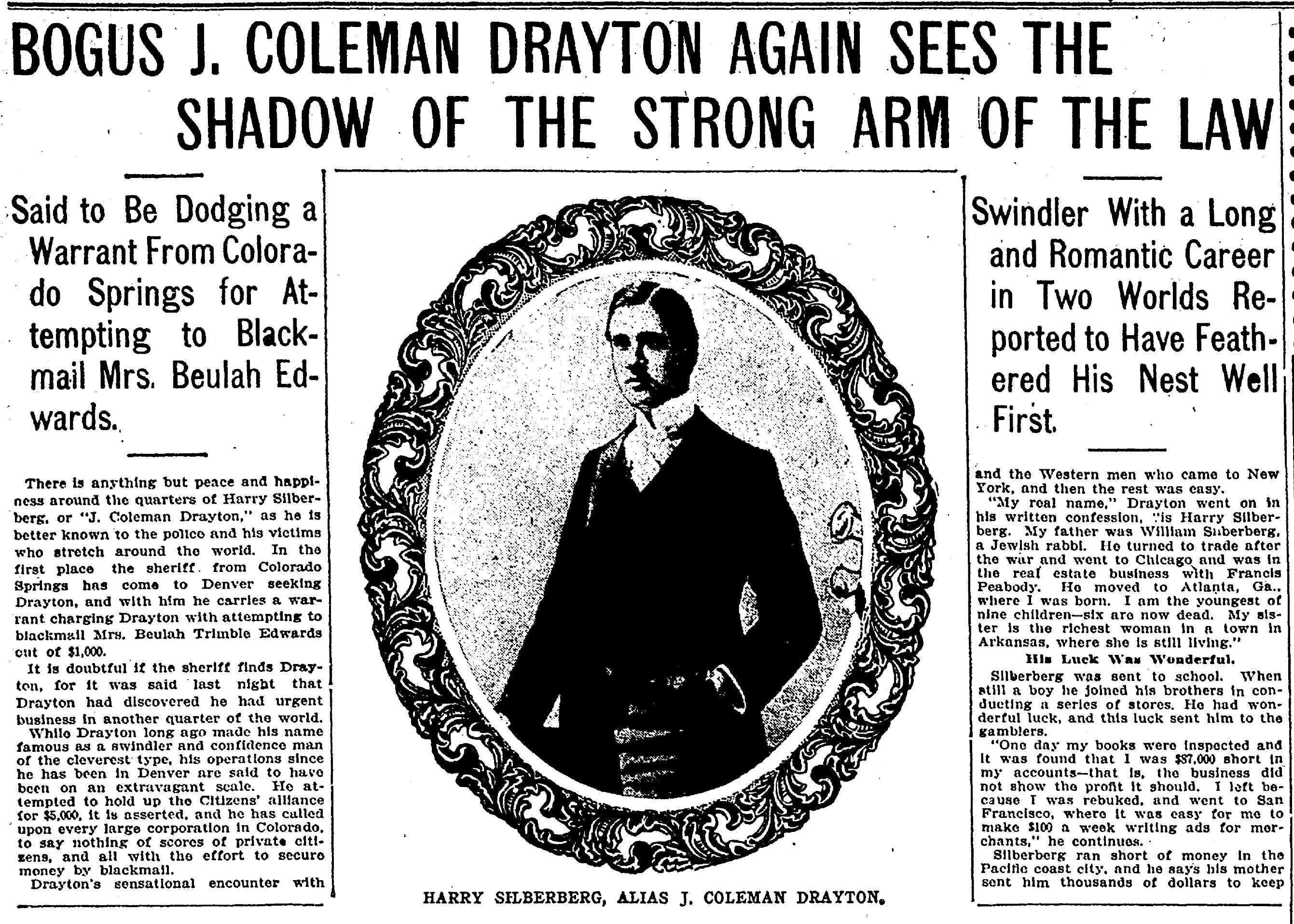
Harry Silverberg, a.k.a. J. Coleman Drayton. The photograph from the Denver Post article was the key link confirming the photograph reported to be of Mr. J. C. Drayton was, in fact, Harry.