
 Membership
 Donate
 Shop
Shop



















Lost and Found
How my pandemic pastime led me to rediscover some of Colorado’s earliest records.
Standing at the foot of the stairs leading into the Pueblo County Courthouse, I gazed up at the towering structure, its architecture a testament to the endurance of history. In that moment, I reflected on the unexpected journey that had brought me here. After years in high-tech jobs focused on future technologies, I found myself exploring Colorado’s past and unearthing treasures that had long been hidden.
I invite you to ride along with me on a journey of discovery, and see how a simple curiosity led to the unearthing of some long-forgotten secrets of Colorado’s history.
The Jenks Journals
In 2012, Christie’s Auction House sold a remarkable five-volume collection of Gold Rush journals, describing it as "one of the most vivid and best-written gold rush journals we have ever handled." The handwritten diaries, which had never been published before, fetched an impressive $185,000. The collection, known as the Jenks Journals, was sold in two lots. Volumes one through three, detailing the California Gold Rush from 1849 to 1859, were acquired by an anonymous bidder for $104,500—and then vanished from public view. The US Library of Congress purchased volumes four and five, which contain a firsthand account of the journey to the Pikes Peak Gold Rush in 1859, for $80,500.
By sheer luck, I learned the library held these two volumes just before the Covid-19 pandemic shut the world down. Almost overnight, museums, libraries, and historical societies began closing, making my already challenging research even more difficult. I worried that the lockdowns would halt my progress, but after some serious sleuthing, I learned that a digital copy of the Jenks Journals had quietly been made before Christie’s sold the originals. Persistence paid off, and I finally secured access. The thought of binge-watching Netflix during the lockdowns never appealed to me. Instead, I spent months transcribing those long-lost journals, diving into the mind of Daniel Jenks, the son of a Rhode Island Baptist Deacon who was both an adventurer and an astute observer.
Between 1849 and 1865, Jenks wrote in his journals to what he called an “imaginary confidant,” obviously hoping others would read about his adventures someday. As I pored over the Jenks Journals, one particular entry stopped me cold. Jenks glued a picture over the passage he wrote on February 14, 1849—as if trying to bury a painful memory. But time had other plans. The glue degraded, the image came loose, and Daniel’s gut-wrenching words emerged: “And Sarah dear, although we may never again meet here on Earth, may your life be one of happiness, may you never know what it is to feel as I now do, so utterly bereft of friends and bourn down by sorrow, so broken.”
The first time I read this excerpt, I felt an undeniable connection to Daniel—not just as a historian, but as a human being. It was more than a passage in an old journal—it was a plea, a fragment of a lost love story that time had almost erased. And in that moment, I knew I had to tell his story.
The Cherokee Trail: Colorado’s Forgotten Highway
In 2021, I self-published The Lost Gold Rush Journals of Daniel Jenks, finally bringing his extraordinary firsthand account of that era to light. By then, I had developed a growing curiosity about the route Jenks took through Colorado—one that ran surprisingly close to my own home. This led me to download every survey the General Land Office made of this territory in the 1860s, which I used to plot Jenks’s path onto a modern map. I soon realized that Daniel had been following the historic Cherokee Trail, a significant yet lesser-known emigrant route that reshaped westward migration.
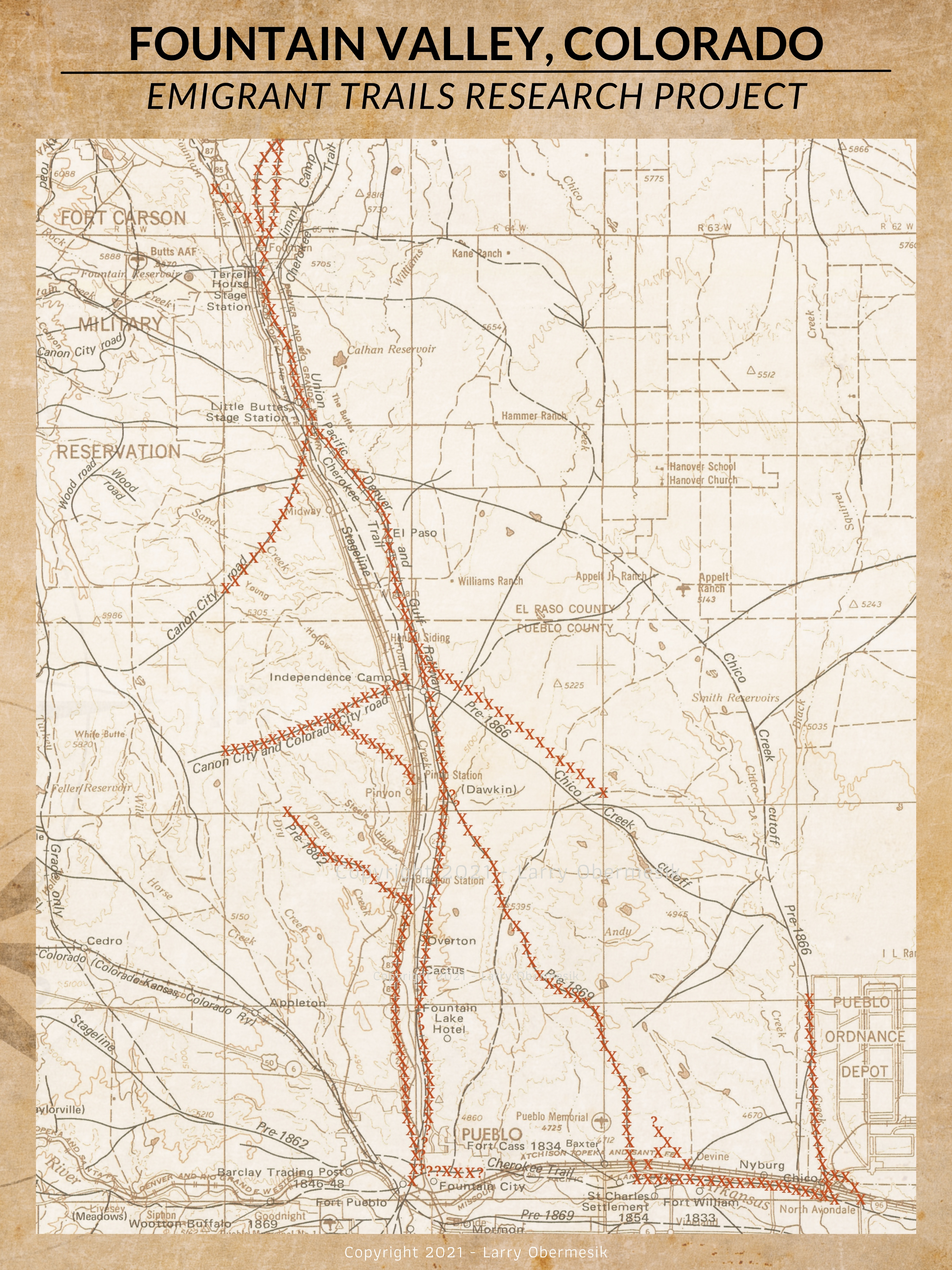
"Mapping Colorado's Historic Emigrant Trails" by Larry Obermesik.
With help from Bruce Watson, a trail mapping expert from the Oregon-California Trails Association, we began piecing together Jenks’s cross-country route, tracing his movements and pinpointing each campsite. In 1859, Daniel followed segments of the Santa Fe Trail, the Cherokee Trail, the Overland Trail, and the California Trail—a path Bruce and I now call The Jenks Trail. Our ultimate goal is to chronicle his journey using Google Earth, allowing others to retrace the route and gain a deeper understanding of the struggles nineteenth-century emigrants faced.
By 2022, I was eager to share my research with experts like Dr. Jack Fletcher, Pat Fletcher, and Lee Whiteley, authors of the Cherokee Trail Diaries. The Fletchers told me they had inquired about the Jenks Journals years earlier while researching their books and were thrilled to see them finally emerge from the shadows. Their validation that Daniel’s journals were historically significant—and that I hadn’t just wasted years of my life chasing a dead end—was both humbling and empowering. After that meeting, I happily jumped into this historical rabbit hole with both feet.
The Jenks Family
As I delved deeper into Jenks’s story, the journals revealed intriguing details about his cousins, Loren and Judson Jenks, both of whom made their marks on Colorado history but have largely been forgotten. Daniel came to Colorado with Loren and Judson in 1859, bound by a shared sense of adventure. Loren had been with Daniel in California during the Gold Rush, where both men weathered the hardships of frontier life. After returning to Michigan and marrying Elizabeth, a young schoolteacher, Loren invited Daniel to join his family on their westward trek to Colorado.
Judson, meanwhile, had already experienced the wilderness at its most unforgiving. In 1852, he and Loren left Michigan for the western plains, where Jud almost lost his life in a harrowing snowstorm near Ash Hollow, Nebraska. With their wagon train’s provisions running low, three volunteers, including sixteen-year-old Jud, went ahead to seek assistance from Fort Laramie. They got lost in a blizzard and spent days without food. Jud’s traveling companions left him for dead, but he wasn’t ready to expire just yet.
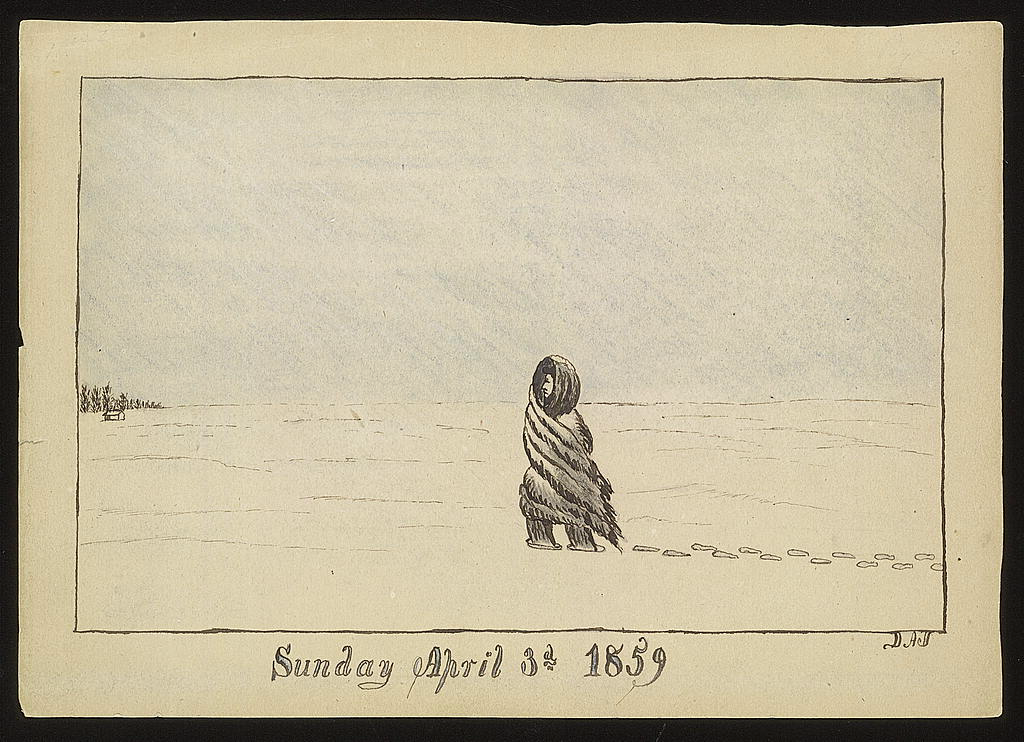
A drawing by Daniel Jenks dated Sunday, April 3rd, 1859.
For nine days, Jud crawled through the snow on his hands and knees, grubbing for roots. Just as all hope must have seemed lost, a search party from Fort Laramie arrived and rescued him. Although he lost all of his toes and most of his fingers to frostbite, Jud’s near-death experience seemed to deepen his love for the mountains and the life of a frontiersman. After recuperating at Fort Laramie, Daniel tells us Jud lived at Bent’s New Fort among well known figures, some of whom defined Colorado’s early history—men like the brothers Bent, John Wesley Prowers, Charles Autobees, and “Uncle” Dick Wootton.
The Jenks family endured many struggles, including the tragic loss of Loren and Elizabeth’s newborn baby shortly after arriving in Pueblo. Daniel Jenks noted in his Gold Rush journal that Lissy was the first emigrant mother to give birth to a child in this territory. However, Hall’s History of the State of Colorado corrects the record, referring to Elizabeth as “one of the first” emigrant mothers. Either way, Elizabeth’s strength and character were pivotal in shaping the Jenks family's legacy and their contributions to Colorado’s history.
In 1863, Loren Jenks played a role in the pursuit of Felipe and Vivian Espinosa—two of the most storied outlaws in nineteenth-century Colorado. As a seasoned guide and skilled scout, he joined Tom Tobin’s posse, tasked with tracking down the Espinosas. Yet, despite his involvement, Loren’s contributions have largely faded from history—buried under misspellings of his name (Tobin referred to him as “Loring Jinks”) and omitted entirely from some of the wildly conflicting accounts of the events that have survived.
Meanwhile, Jud gained a reputation as a true mountain man rooted deep in Colorado’s wilderness. In 1860, Jud was one of the founding members of the Canon City/Arkansas Valley Claim Club. In 1861, Judson Jenks and Dick Wootton were chosen as local delegates to represent the residents of Fountain Valley in Colorado’s first territorial elections. And when the boundaries of the new county seat—Pueblo City—were first defined in 1862, the town abutted Judson Jenks’s land. Without this research, the memory of Toeless Jud’s exploits would probably have been lost to time.
Jud met an untimely death in 1862, when his ferry capsized and he drowned in the Arkansas River. It’s heartbreaking to imagine the difficulty a man who had lost all his toes and most of his fingers would have faced in trying to swim to safety. Judson Jenks remains one of Colorado’s forgotten mountain men. It is my hope that someday his amazing story will be recognized as part of Colorado’s legend, a testament to the harsh and unpredictable nature of frontier life.
After his role in the Espinosa affair Loren moved on to new adventures, becoming the first marshal in Prescott, Arizona, and investing in a Bradshaw Mountain silver mine that hit a mother lode. This strike made Loren a rich man and attracted some famous Wild West characters, including Wyatt Earp, who had a 100-foot drift mine at one of Loren’s claim. Loren’s legacy also lives on at Jenks Lake in California, the reservoir he built near San Bernardino that’s been memorialized by the National Forest Service.
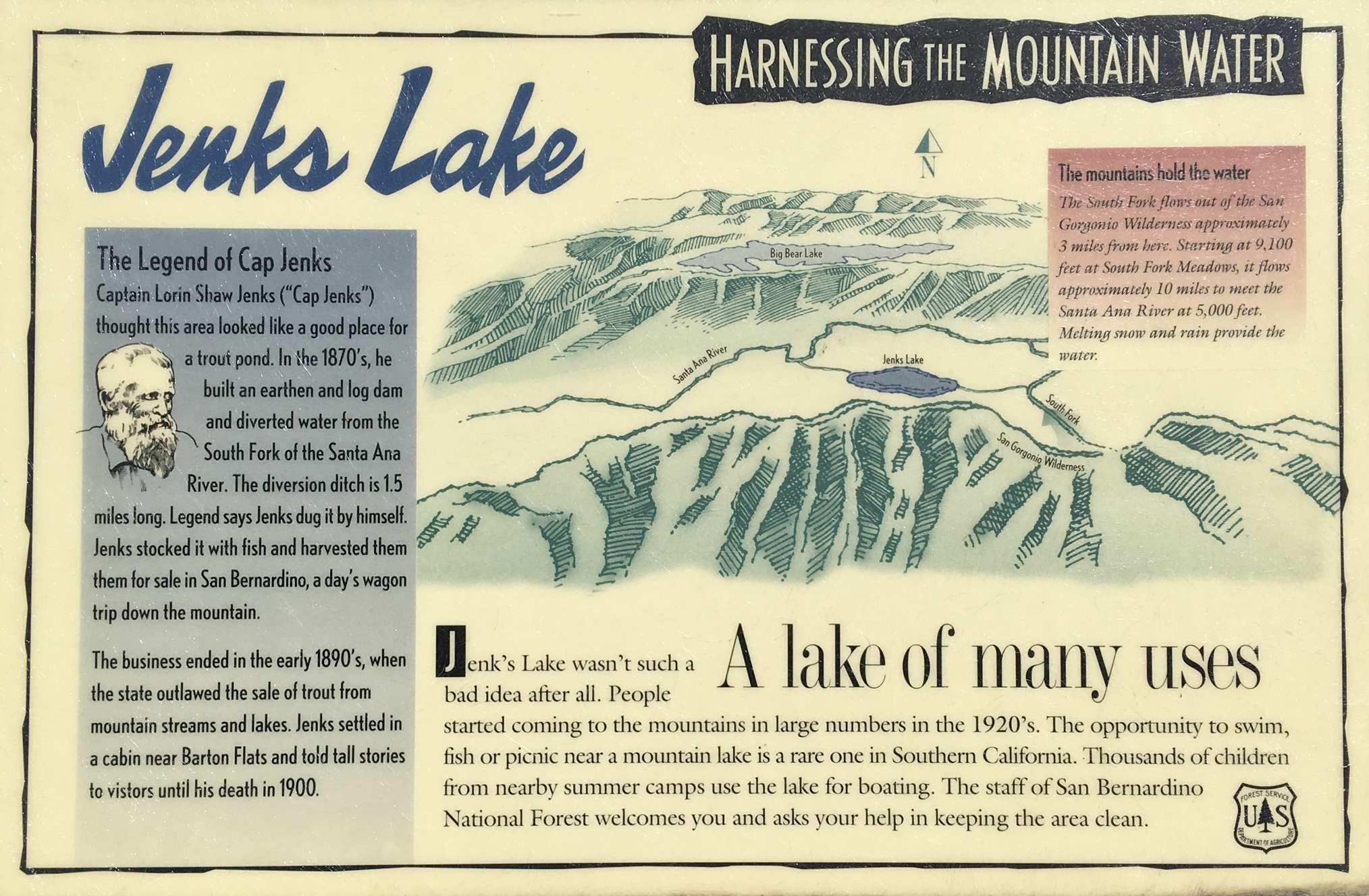
An informational placard about Jenks Lake, now located in San Bernardino National Forest in southern California.
The remarkable stories we’ve unearthed about the Jenks family highlight the resilient spirit of Colorado’s early pioneers and the countless, often-forgotten contributions of other unnamed migrants who helped shape the state.
Where Are the Jenks Records?
Upon learning of Loren’s connection to the Espinosas, I was driven to explore whether the Jenks family’s pre-territorial land claims had survived in Colorado’s oldest public records.
Thus began my next chapter; a quest through Pueblo County’s archives to see if any traces of the Jenks family had survived on paper. As a newcomer to archival research, I had no idea where to start. Fortunately, I wasn’t alone. My friend Nancy Prince—a geologist, genealogist, and accomplished author—agreed to guide me. We began at the Pueblo Courthouse, leafing through Pueblo County’s master index book, hoping to find references to the Jenks family. We came up empty. Undeterred, we decided to dig deeper into the county’s oldest surviving record books. In Record Book One, with entries dating from the early 1860s, we finally struck gold! That book was a marvel—a hefty volume filled with meticulously handwritten entries, faded yet intact, like whispers from Colorado’s formative days.
Together, Nancy and I pored over each page and eventually found actual records confirming the presence of Loren and Judson Jenks. These invaluable links to both the Jenks Journals and Colorado’s early history offered new insights, but the most significant discovery I made that day was when I realized Pueblo County’s oldest records had never been data-mined before, rendering them non-searchable. The “IT Guy” in me couldn’t overlook the implications; those historic Pueblo records represented an untapped goldmine of information. So, I took matters into my own hands. I purchased digital photographs of all the pages in Record Book One up to 1867 and began months of meticulous data-mining, transcribing, and cataloging.
Thanks to this effort, Pueblo’s oldest records are now digitized and will soon be publicly available for researchers and historians to explore for the very first time.
The Long-Lost El Paso Claim Club Record Books
Despite our thorough search, we were unable to locate the original land claim for Jenks Ranch in Pueblo’s archives, but we did learn it was located near the boundary between Pueblo and El Paso Counties. Determined to find the missing pieces of this historical puzzle, I headed north to the El Paso County Clerk and Recorder’s Office, unaware that my discovery there would reveal a long-forgotten piece of the Pikes Peak Region’s early history.
When I asked the staff about the Jenks family’s land claims, they were perplexed. They knew nothing about the pre-territorial records I sought nor the El Paso Claim Club. I explained that the El Paso Claim Club was a settler organization founded before Colorado became a US territory in 1861. Settlers organized into claim clubs, land associations, and mining districts to protect their claims, buying and selling parcels they had no legal right to. Yet these clubs provided the foundations of self-governance in Colorado.
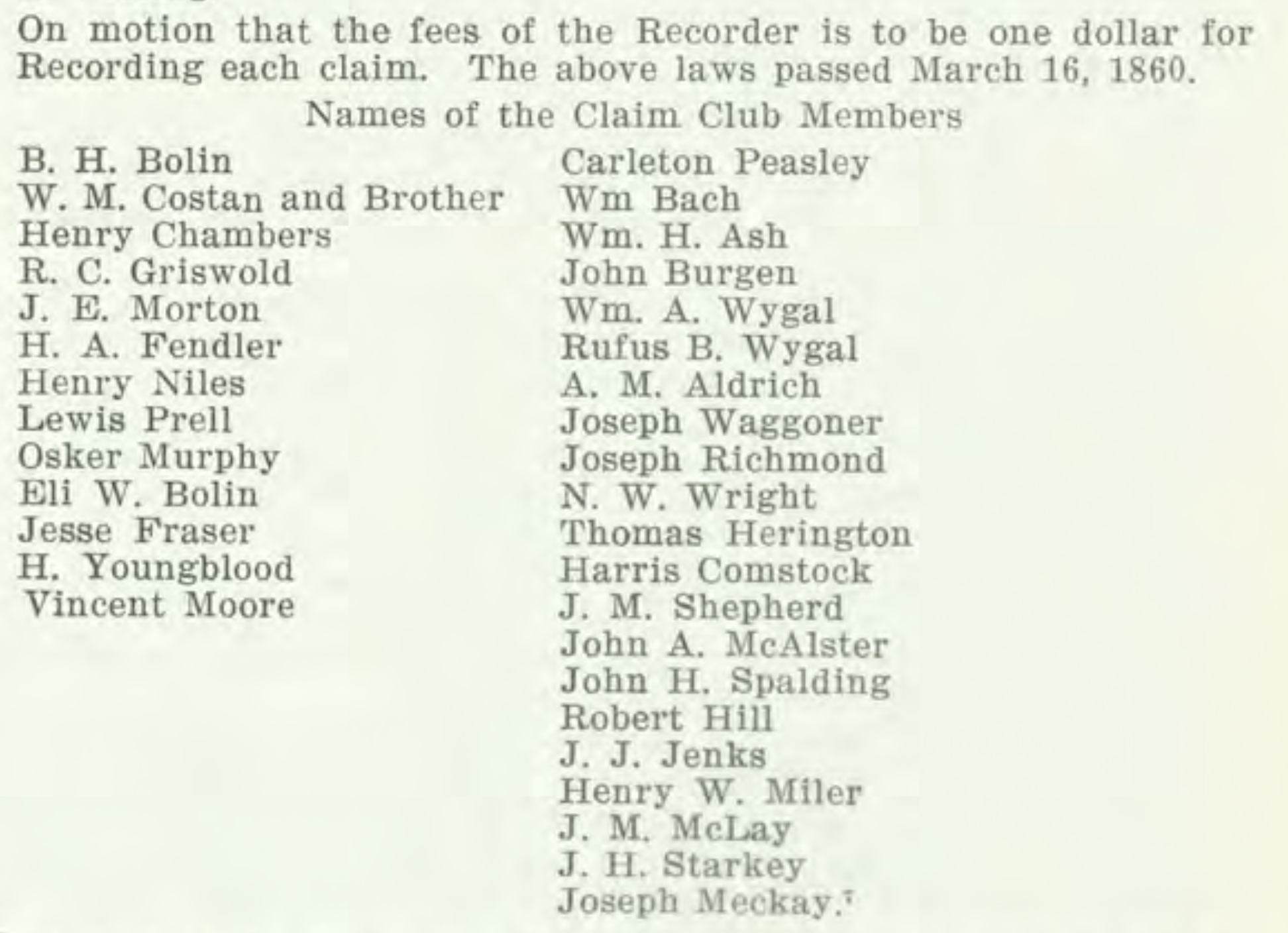
Judson Jenks was a founding member of the Cañon City–Arkansas Valley Claim Club.
Between 1803, when President Thomas Jefferson negotiated the Louisiana Purchase, and 1848, when the Treaty of Guadalupe Hidalgo was signed with Mexico, United States territory expanded by more than two million square miles. To put that in perspective, only twelve countries on Earth today are larger. In less than fifty years, the US acquired a vast continent that seemed, to many, like an endless bounty of natural resources just waiting to be claimed.
But while land could change hands on paper, the federal government lacked the infrastructure and funding to properly manage it. There were few official surveys, no clear legal framework for settlement, and little to no protection for emigrants heading west.
This created serious problems. People were pouring into the West, building homes, starting farms, and carving out lives on land that, by right of treaty and occupation, belonged to Indigenous peoples. Legally speaking, settlers had no real claim to the land beneath their feet. To address this, Congress passed the Preemption Act of 1841. It gave settlers—commonly called “squatters”—the right to purchase 160 acres of public land at a minimum price, as long as they lived on and improved it.
But in practice, claiming land was a chaotic affair. With no official surveys or boundary markers in place, settlers used the old “metes and bounds” system—describing property by natural landmarks like trees, rocks, and streams. It was easy to manipulate and even easier to dispute. “Claim jumping” soon became a widespread problem. A settler might spend weeks building a cabin, only to find someone else had moved in, staked their own boundaries, and challenged the original claim.
Loren Jenks himself was once the target of such a dispute. As one local newspaper reported: “A man by the name Loraine [sic] Jenks went out one night, and sticking a stake laid down beside it and slept. In the morning he found another stake within three inches of the one he set.”
By 1860, tensions had boiled over. The Rocky Mountain News issued a special edition with bold headlines declaring “War Against Claim Jumpers & Thieves.” To protect their claims and maintain order, settlers banded together into grassroots cooperatives. Each group had a constitution, elected officers, membership dues, and—perhaps most importantly—a “People’s Court” whose rulings members were sworn to uphold.
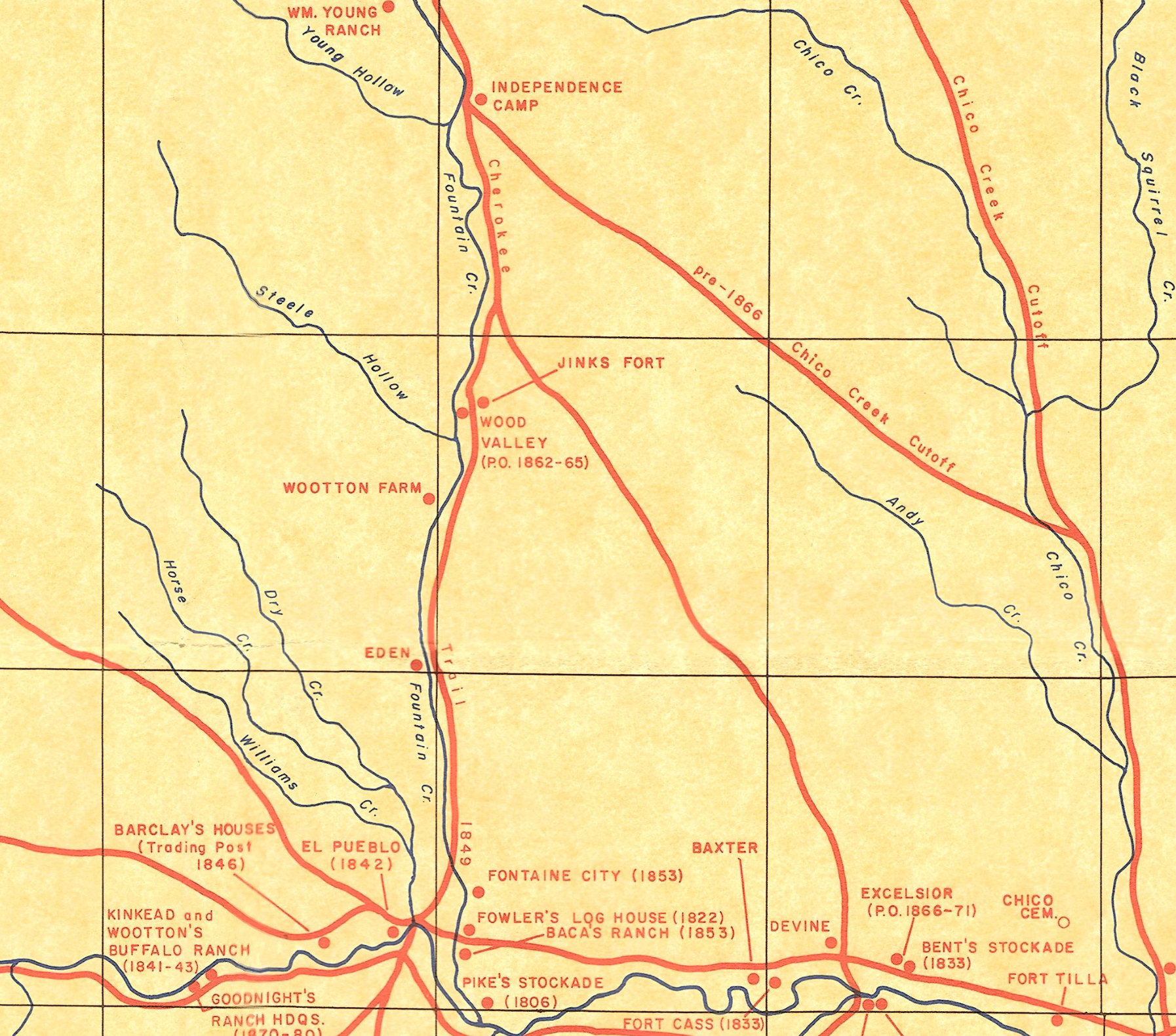
A map showing early settlements in Colorado's Fountain Valley, including Independence Camp (also known as Jenks Ranch), Jinks [sic] Fort, Wood Valley, Wootton, and Eden.
These locally-organized systems filled legal voids, long before official laws or government offices reached the frontier. Once Colorado officially became a US territory in 1861, those pre-territorial records were no longer seen as necessary—and many were discarded or lost. But a few have survived, offering us a rare and valuable glimpse into a time when law, order, and community were being built in Colorado from scratch.
Colorado’s claim clubs had all but been forgotten until the 1930s, when Professor George Anderson of Colorado College wrote about them in The Colorado Magazine, dedicating significant time to studying the El Paso Claim Club. Anderson’s team had located one of the club’s record books in El Paso County’s archive and transcribed it, but frustratingly, they couldn’t find the rest. Intrigued by Anderson’s note that the original volume was stored in the El Paso County Clerk & Recorder’s Office, I headed there next, hoping to pick up where his search had left off.
The staff at the Recorder’s Office listened politely, then offered to escalate my request. A few minutes later, I found myself retelling the story to a county data specialist, who hadn’t heard of the El Paso Claim Club either. She took down my contact information and promised to keep an eye out for anything resembling those record books. Leaving the Recorder’s Office, I felt deflated, as if my research journey had just hit an abrupt dead end.
Then, as I sat in my car contemplating my next move, my phone rang—it was an unknown caller from Colorado Springs. Instinct told me to pick up, and I’m glad I did. It was the data specialist calling with amazing news; they found that El Paso Claim Club record book! I raced back inside and saw it—the original book Professor Anderson had transcribed in the 1930s, still intact. Leafing through its pages, I recognized familiar entries from Anderson’s transcription. I couldn’t contain my excitement and asked, “Where did you find this book?”
They showed me a box of old miscellaneous items that had been sitting in their archive for years. In that box, I also discovered a cache of El Paso Claim Club records that had eluded George Anderson nearly a century ago. When the binding of the original record book(s) deteriorated, the stewards at the El Paso County Clerk & Recorder’s Office had the foresight to rebind those records into a whole new book. Upon closer inspection, it appeared the book contained pages from more than one original record.
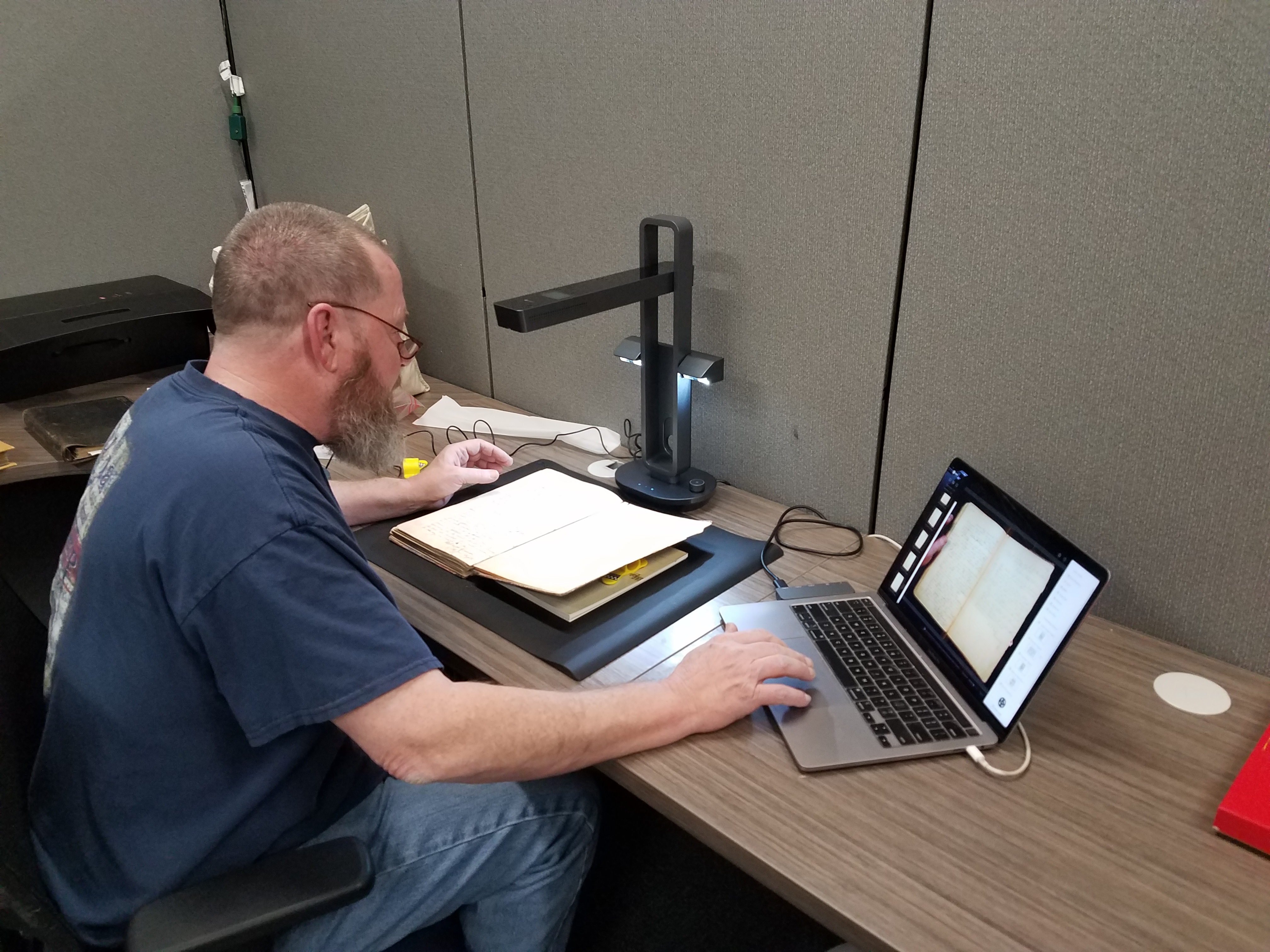
Larry Obermesik scanning the newly discovered El Paso Claim Club record books at the El Paso County Clerk and Recorder's Office.
Preserving History for Future Generations
The realization that those historic El Paso Claim Club record books had likely never been photographed or digitized intrigued me, and I asked for permission to scan them. The gracious staff at the Recorder’s Office agreed, and a week later I returned to carefully digitize each page, capturing this invaluable historical resource before it could be lost again. When I finished scanning those record books, the office supervisor approached me and said: “Five years ago a gentleman came into our office and asked the same question as you, but he didn’t leave his contact info.”
Now, I had another research angle to explore. Who was that Claim Club Guy? I would later learn that man was Dave Hughes from the Old Colorado City Historical Society, and Lorene Englert, a fellow historian, had played an instrumental role in saving the books decades earlier. Thanks to an old audio interview uncovered by Amanda Severeid-Long, a board member at the Old Colorado City Historical Society, I heard a voice from the past—Lorene herself—recounting how she had rescued the books from an attic while the new El Paso County building was being built in the late 1970s:
"After they moved down to the courthouse, Mr. Russell, the surveyor, allowed me to use his vault. And I went into the attic, and I dug through all that rubbish for years, and would bring these books down and put them on those shelves. And there's court proceedings, there's district court, there's civil court, there's everything. But up from 1859 to 1870, I hand-delivered every one into the departments.”
Lorene’s dedication ensured these records weren’t lost to history—but it wasn’t until 2023 that I stumbled upon them once again, tucked away in that box of old miscellaneous items at the Recorder’s Office. Their rediscovery reinforces what Amanda so aptly put into words: "Ensuring these important records are accessible for all historians, genealogists, researchers, and interested citizens alike is such an important piece to our puzzle. It's a priceless asset that will deliver rare glimpses into our early history for many years to come!"
Because of the tireless efforts of those who came before us, these records are now finding their rightful place in the historical narrative. Now that the El Paso Claim Club records have been digitized and data-mined, historians, genealogists, and researchers have an entirely new tool at their disposal. By carefully documenting the witness names on each of the transactions that were recorded in those books, we’ve begun connecting the dots between emigrants who traveled together and settled near one another. Small connections, long overlooked, can now help researchers piece together a more complete story of Colorado’s past.
These records also confirm that the El Paso Claim Club was probably not the first land association in the area—entries reference an earlier, failed settlement that existed even before Colorado City (the precursor to modern Colorado Springs) was founded. The data implies there’s much more to be learned about Colorado’s pre-territorial land associations, and that our research project—however extensive—has only scratched the surface.
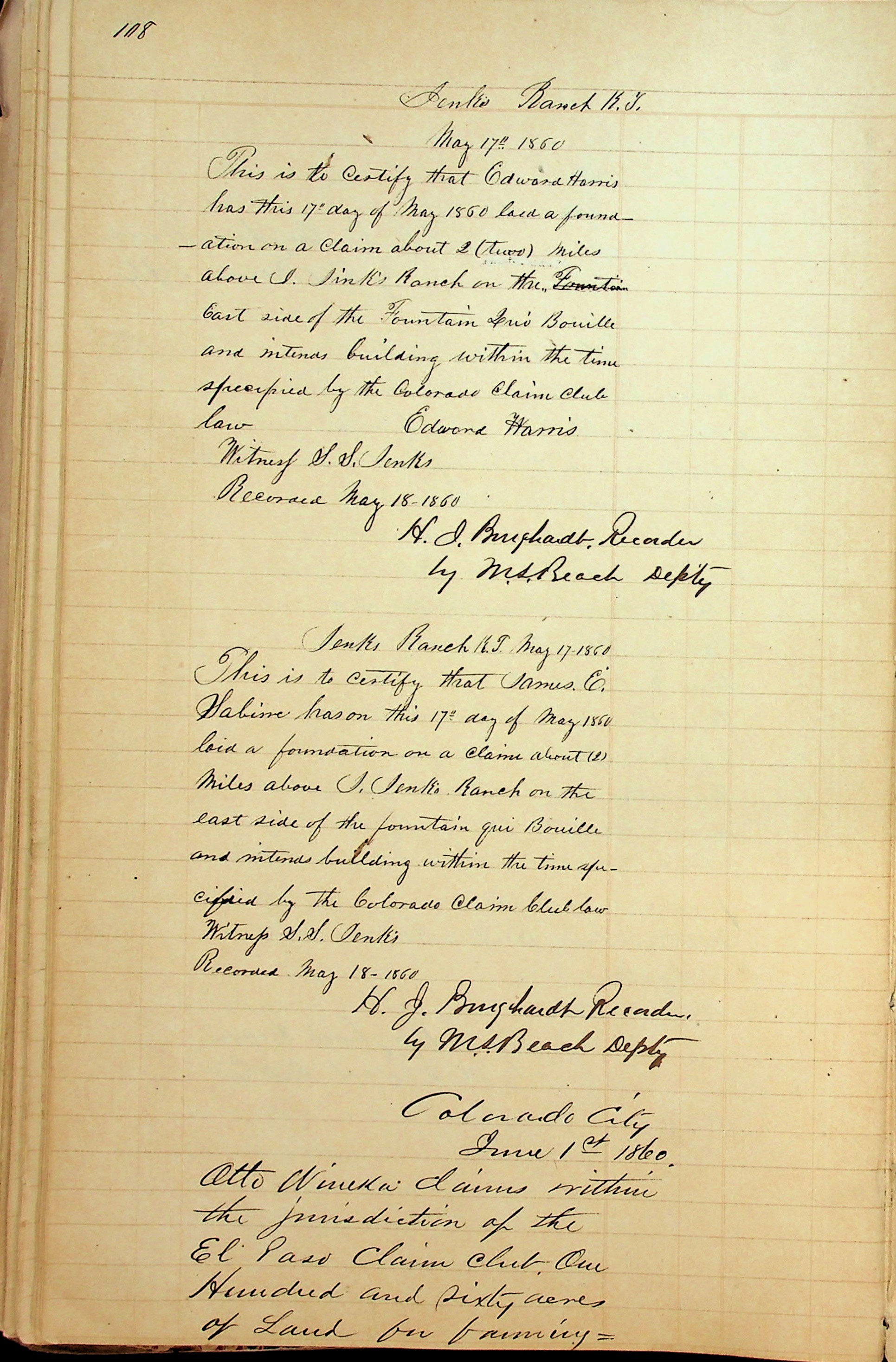
James Sabirre's original Fountain Creek land claim two miles above Jenks Ranch.
History’s Tapestry Unfolds
Discovering the El Paso Claim Club record books was like finding a time capsule—one that had been waiting for someone to open it. Holding those pages, I felt a strange mix of exhilaration and responsibility. This wasn’t just a stack of old documents; it was the key to a past that had been locked away for over 160 years. I thought about the people whose names were scribbled in ink, their hopes tied to claims that, for many, defined their futures. In some small way, I’m hoping my research will help give those forgotten pioneers back their voices.
One of the most surprising things to me, so far, is that few historians have heard of the claim clubs before. Their records shaped early land ownership in Colorado, yet they remained buried—both figuratively and literally. That realization fuels my belief that countless other historic records are still out there, undiscovered. While this research can be slow, even frustrating at times, when you uncover something truly lost to history, the feeling is indescribable.
Beyond the thrill of rediscovering those lost historic documents, this research has deepened my respect for the complex relationships between settlers and Native inhabitants. The land upon which these claims were made belonged to Indigenous nations, who thrived in the region long before the first pioneers arrived. In their fervor to establish roots, settlers often overlooked this reality, ignoring that they profited from land taken from its original caretakers. Many early settlers were well-meaning but complicit in a larger narrative of dispossession, a truth that deserves acknowledgment. I hope this article encourages readers to grapple with these stories honestly, and recognize both the valor and the moral dilemmas inherent in our shared past.
Through the records of Colorado’s earliest settlers, I felt as though I was witnessing history unfold with a richness I’d only glimpsed before in textbooks and movies. As I sifted through each archival discovery, a more nuanced portrait of early Colorado emerged—a landscape not just of gold-hungry miners, but of diverse communities whose lives were woven together through ambition, hardship, and sometimes tragic misunderstandings. Jenks’s accounts and those of the El Paso Claim Club members echoed with stories of alliances, rivalries, and steadfastness that defined the first waves of settlement in Colorado.
This research has reminded me that history is not simply a string of dates or isolated events. Instead, it’s an intricate web, rich with overlapping narratives and layered truths, some of which are challenging to face. Yet these stories deserve to be told, not just because they are compelling but because they force us to reflect on how these early chapters have shaped the Colorado we know today.
Looking back on this journey, I realize it has changed me. The retired IT manager who began this project with a passing curiosity has become a custodian of a piece of Colorado’s past. Each discovery deepened my understanding of the role I can play in preserving and sharing these stories. I hope others, especially young readers, will be inspired to embark on historical explorations of their own.
So, to the next generation of historians, I offer an invitation—start digging! Visit local archives, dive into primary sources, and ask questions no one else is asking. The trail of history is alive, and there’s always more to discover. Colorado’s past is not a closed book but a living document, waiting for you to add your voice to its ongoing story.