
 Membership
 Donate
 Shop
Shop




















Who Has the Right to Remember?
An excerpt from a speech by History Colorado Chief Executive Dawn DiPrince.
Editor’s note: History Colorado President/CEO and State Historic Preservation Officer Dawn DiPrince delivered this speech on May 18, 2014 to around 1000 people at the site of the Ludlow Massacre in southern Colorado. It was part of the Centennial Remembrance event hosted by the United Mine Workers of America. It has been lightly edited for publication.
A little over 100 years ago, on April 20, 1914, a very pregnant Cedelina Costa and her two young children entered the maternity cellar in the Ludlow tent colony. The maternity cellar was a bit larger than the other tent cellars and was used by women giving birth. On that day, Cedelina and the Costa children used this cellar as a safe haven from the violence surrounding their canvas homes. Patria Valdez was also in the tent cellar, that day, with her three children. As they tried to wait out the gun fire, Patria held her three-month-old daughter who likely was born in this same Ludlow maternity chamber.
Cedelina Costa, or Cedi as her family called her, lost a child to illness and poverty in August—just before the strike started. She and her husband, Charlie, used to host parties in the coal camps with dancing and music to help recruit miners to join the union. On April 20, while Cedi and her children—Lucy and Onofrio—took shelter underground, her husband fought against the militia in this very place where we are today. He was shot and killed in the battle and, later in the day, his pregnant wife and two young children would suffocate under the flames of a burning tent. And, in those desperate moments, as the mothers tried to get their children out of the cellar but were trapped by a raging fire, the maternity chamber became something very different—a death chamber.
One hundred years later—just last month, Linda Linville, a descendent of the Costa family, made a pilgrimage to Colorado to learn more about the final days of her great aunt and uncle. Linda’s grandparents also lived in the Ludlow tent colony and were witnesses to the Massacre and its aftermath. Linda had a very strong record of her grandmother’s memories of Ludlow and the deaths of Cedi and her children. During a book discussion that was part of the April commemoration activities, author Scott Martelle told Linda that her grandmother’s memories were incorrect because they were different from the “facts” documented by the coroner. After this, the discussion grew very heated and was one of the most controversy-laden moments of the entire commemoration thus far. And, the disagreement was not about the militia or the miners; rather, it was about who has the right to remember.
As mentioned in my introduction, I am the Co-Chair of the Ludlow Centennial Commemoration Commission. This Commission was created by Executive Order of Governor John Hickenlooper on April 19, 2013. There are twelve people on the Commission from around the state of Colorado, and we represent a variety of viewpoints. There are a number of goals for the Commission—as outlined in the Executive Order. But, they can simply be summarized as “to remember.”
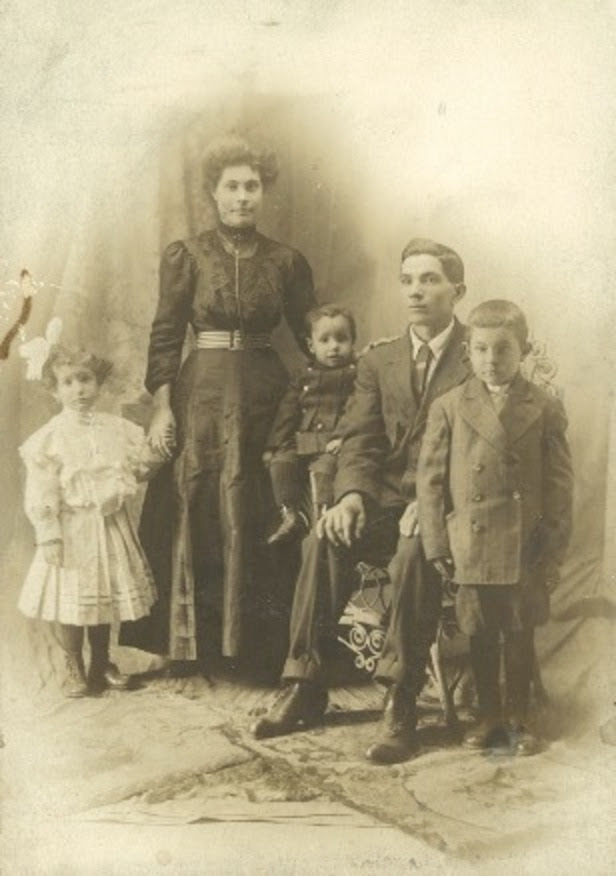
The Costa Family.
There is nothing simple or passive about remembering the story of Ludlow. Ever since the immediate aftermath of the Ludlow Massacre, the memory of Ludlow has been contested. Read the newspaper reports the day after the Massacre, and you can see a swift attempt to blame the miners and to deny the deaths of children. John D. Rockefeller, co-owner of Colorado Fuel & Iron whose labor-busting tactics were widely blamed for the violence that led to the massacre at the time,took strides—from handing out shiny dimes to children on the streets of New York to establishing a company-controlled representation plan—to not be remembered as the villain of Ludlow.
History is not just an objective summary of events, but rather, it is made of what we choose to remember and what we choose to forget. Ludlow has not been taught in schools and bears little-to-no mention in our textbooks. There have been efforts throughout the last century to erase this story from our history. A variety of people from Segundo, Aguilar, Trinidad and Pueblo have told me that there was a time when people did not talk about Ludlow outside of the privacy of their own homes because—even into the second half of the twentieth century—many of the people in southern Colorado were still employed by CF&I. One person told us that books about Ludlow were removed from the Aguilar school library shelves.
Over the past year, we have heard many stories like this. It reminds us that the powerful not only try to control the events of our past—but they also have attempted to control the memory of these events. The only reason that we remember Ludlow today is because the United Mine Workers’ monument and memorials have deliberately preserved and protected this memory. In addition to the union, Ludlow has been preserved because of the brave, defiant memory of the people of southern Colorado who passed on its memory from grandmother to granddaughter, from father to son. One woman who visited our “Children of Ludlow” exhibit wrote that her father took her to Ludlow each year—to this sacred spot—and told her: “This is who we are.”
This is who we are. My ancestors worked for CF&I around the time of Ludlow. And, like many of you, my ancestors helped to build the empire of the astronomically wealthy Rockefeller family. For those of us who live in southern Colorado, Ludlow is both our landscape and our legacy. And, we not only have the right to remember this story. We also have an obligation. Over the past year, we have had many events commemorating the Ludlow Massacre. Thousands of people have attended Ludlow events throughout the state of Colorado. The Commission is proud that, while we are sanctioned by the Governor’s office, our work has been entirely grassroots. The Commission received no funding. We have been successful because we have organized events around the people who are compelled to participate. And, we have sought to share both the official and unofficial stories of Ludlow.
Most importantly, the Commission has worked to give voice to the memories and stories of those without power, while we have simultaneously worked to gain recognition of the Ludlow Massacre from those with power. On April 22 of this year, the entire Colorado State House of Representatives stood and observed a moment of silence in remembrance of those who lost their lives at Ludlow. When you consider the role that the state of Colorado played—100 years ago—in the many tragedies of the Colorado Coalfield Strike, this unanimous and documented recognition of Ludlow at the State Capitol is remarkable.
The work we have done this past year has been important, but commemoration should not stop simply because the 100th anniversary is over. We urge you to share your memories of Ludlow with the next generation. Ensure that school libraries are stocked with books on Ludlow. Ask your school district to include Ludlow as part of the history curriculum. Whether you live near here or not, take regular trips to this site with your own children and grandchildren and remind them that this is who we are.
Ludlow is a war story. One hundred years ago, our ancestors stood up to one of the wealthiest American families. And, they were fighting for more than wages. They were fighting for this country and what they believed America should be.
On April 6, 1914 (two weeks before the massacre), Rockefeller testified to Congress that defeating a worker’s right to organize was a great principle—as important as the ideals of the American Revolution… and worthwhile even if it cost him all his property and killed all of his employees. On the other hand, our ancestors (even though so many of them were not even American citizens) had a greater vision for this country—an America built by the people for the people, not just a few wealthy Americans.
When you examine the history of the world, you recognize that war stories are complicated. And, Ludlow is certainly no different. Award-winning author Tim O’Brien famously asks: “How do you tell a true war story?” Do we believe the coroner’s report or do we believe the hand-me-down memories of an eyewitness? Do we believe the official report of Gen. Chase or the immediate and powerful testimony of the grieving Mary Petrucci?” O’Brien writes that sometimes the details of war—like the fiery suffocation deaths of women and children—are too horrific for us to believe… too disturbing to be true. But, he writes: “You can tell a true war story if you keep on telling it.”
So, please after today, after this year, and in another hundred years, keep on telling the story of Ludlow.