
 Membership
 Donate
 Shop
Shop



















Denver’s Armory Show
Fraud upon the Public! Bolshevists! Anarchists! Selections from a Madhouse! Idiocies of conception! Outrages that should be prohibited! Madness that can only be blamed on the War!
One would scarcely have expected such frenzied responses to the twenty-fifth annual exhibition of the Denver Art Museum in 1919.
The previous exhibitions were rather comfortable and conventional. Denverites went to see—and buy—art that was familiar, pleasing, and, above all, “real.”
But in Paris, art capital of the world, art was changing. Cezanne, Braque, Picasso, and Matisse had revolutionized painting. Post-Impressionism, Fauvism, Cubism, all were transforming paintings from “windows” to objects in themselves. Colorado had seemed immune from the new influences. Residents of the Centennial State liked their art straightforward and plain-spoken, like themselves. Their purchases favored conventional landscapes that glorified the already glorious beauty of the state, especially the work of artists like Charles Partridge Adams, George Elbert Burr, and Thomas Moran. Many Colorado artists had studied in Europe and were well aware of the seismic shift shaking the art world, but the wider Colorado public remained blissfully traditional.
An art scandal in Denver, just over 100 years ago, was about to traumatize that tranquility.
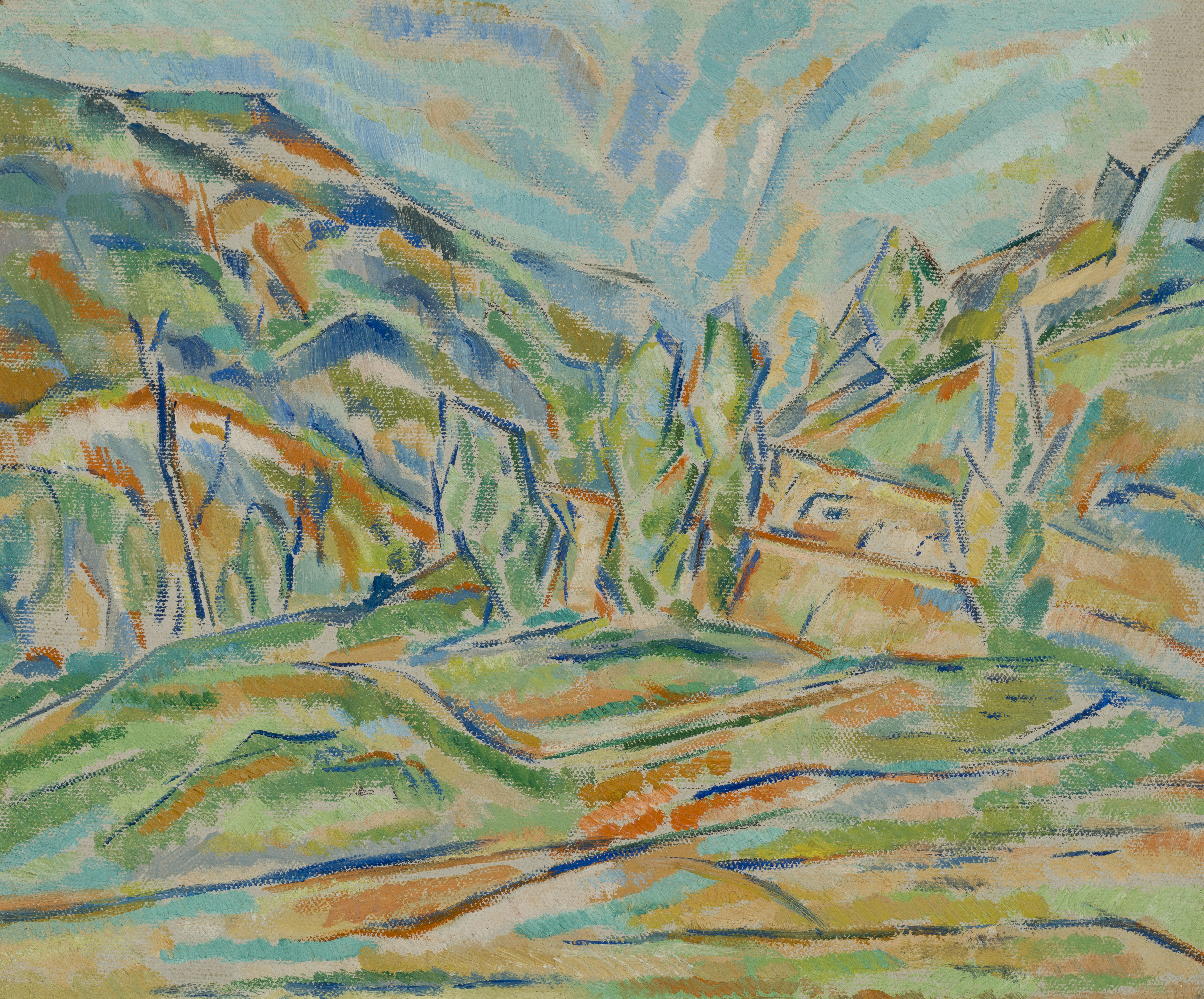
Pine, Colorado, circa 1915, oil on canvas, 10 x 12 in. By John Edward Thompson.
A Burgeoning Art Scene
In 1919, Denver’s best-known resident artists included Burr, Adams, Allen Tupper True, Albert Byron Olson, Albert Bancroft, Dean Babcock, and David Spivak. Three women artists—Anne Evans, Elisabeth Spalding, and Marion Hendrie—would also profoundly influence Denver’s art awareness.
Evans, Spalding, and Hendrie were friends from childhood. They called Elisabeth “Sky” and Marion “Maizie.” Each had had significant training, particularly at the Art Students League of New York, probably the foremost art school in America at the time. They studied in Woodstock with John Carlson, who went on to become the first director of the Broadmoor Art Academy in Colorado Springs. They had all traveled extensively in Europe and the eastern United States.
Evans had decided that her contributions to the art world would come through means other than her painting. She threw her impressive energies into political and volunteer organizations. Appointed to the Denver Public Library Commission in 1904 and chosen for Mayor Speer’s inaugural Municipal Arts Commission in 1909, she served for years, usually as the only female member. With great foresight, she collected southwestern native arts, especially santos and bultos, and contributed to the conservation of missions and pueblos. She took an active role in her family’s business interests, served on the boards of charitable organizations, and influenced generations of art projects in Denver and Colorado. Denver’s Civic Center, its art museum, and the Central City Opera House stand as monuments to Anne Evans’s civic devotion. She shunned publicity and commented on “how much one could get done if one didn’t need to take credit.”
Hendrie painted and exhibited and, following Evans’s example, served on the Municipal Arts Commission and as head of the Denver Art Museum’s Educational Committee. Along with Spalding, she had spearheaded the creation of a Colorado Diocese Commission on Church Architecture and Allied Arts to both encourage interest in the arts and guarantee that churches bought the very best of what was available. More and more, she focused on philanthropy and collecting—and not just any art but, surprisingly, modern art. Her taste evolved from early purchases of Rembrandt etchings to Impressionists to startling modernists such as Picasso and Matisse. She put her money where her heart was: in amassing beautiful artwork.
Elisabeth Spalding was the daughter of Denver’s Episcopal bishop. Based at St. John’s Cathedral (also known as the Cathedral of St. John in the Wilderness), her father traveled widely, leaving his wife and five children alone for extended periods. The entire family was involved in Bishop Spalding’s life’s work.
Elisabeth Spalding graduated from Wolfe Hall then studied with J. Alden Weir, Childe Hassam, Kenyon Cox, John Twachtman, and Henry McCarter. She was a founder of the Le Brun Art Club, the first women’s art organization in Denver. Spalding persisted as a dedicated artist. She specialized in landscapes and still lifes and worked in both oil and watercolor. She exhibited in shows across the country and, in 1918, held the distinction of exhibiting at the Corcoran Gallery in Washington, D.C.
Spalding’s civic activities and her art contended for her time. For the dutiful and hard-working daughter of a bishop, service to church and community was an expectation, not an option. She taught Bible studies and hosted endless teas, socials, fundraisers, and Aid Society meetings. She chaired the Commission for Church Architecture and Allied Arts, working alongside Marion Hendrie and architect Arthur Fisher.
By 1919, now in middle age, the three women had significant accomplishments behind them. In 1893 Evans and Spalding, along with eight or so others, had founded the Denver Artists Club, which would morph over many years and with huge effort into the Denver Art Association and finally into the Denver Art Museum. The club sponsored annual shows starting in 1894. The 1919 show was held at the Denver Public Library building because the Denver Art Association still had no premises of its own. And that show proved to be the most memorable and disturbing in the twenty-five-year history of the exhibitions.
![[Self Portrait], circa 1910, by John Edward Thompson](https://hcdrupal10.exemplifi.io/sites/default/files/media/images/2025/Image%203_1.jpg)
[Self Portrait], circa 1910, oil on board, 8 x 10 in. By John Edward Thompson.
The instigator of the commotion was John Edward Thompson. Born in Buffalo, New York, Thompson, like the Evans/Spalding/Hendrie trio, had studied at the Art Students League of New York. He then spent twelve years in Europe, primarily in Paris. He studied at Académie Julian and La Palette, institutions often attended by American artists. Over those years, Thompson’s style evolved. He started in the traditional manner of Academy-trained artists, first drawing from plaster casts then progressing to live models. Realism was the goal, and the French Academy system demanded a strict hierarchy of subject matter and style. For years, Thompson followed that system and met with some success, exhibiting at the prestigious Paris Salons—huge exhibitions that conferred validity on an artist in the academic tradition. They could make or break an artist’s career.
In 1906, Thompson’s career changed dramatically. He attended the memorial exhibit of Cezanne’s work—and it struck him like a thunderbolt. Both Picasso and Matisse called Cezanne “the father of us all.” For Thompson, Cezanne had unearthed the fundamentals of painting—Cezanne’s truths. Thompson dropped out of classroom study and vowed to find his own truths, regardless of the consequences.
He experimented with Impressionism (introducing Thomas Hart Benton to the technique). He visited Matisse’s studio, met Picasso, and attended Gertrude Stein’s legendary salons. He tried a variety of styles, investigating and testing what was meaningful to him.
In 1914, he returned to the United States, convinced, like Kaiser Wilhelm, that the war would be over by Christmas. In Buffalo he encountered shocked dismay when he showed his paintings. The only encouragement he found was among young students desperate to experience the new art forms revolutionizing Paris. European travel was unavailable, but Thompson was. He opened his own art school, forging lifelong bonds with his Buffalo students.
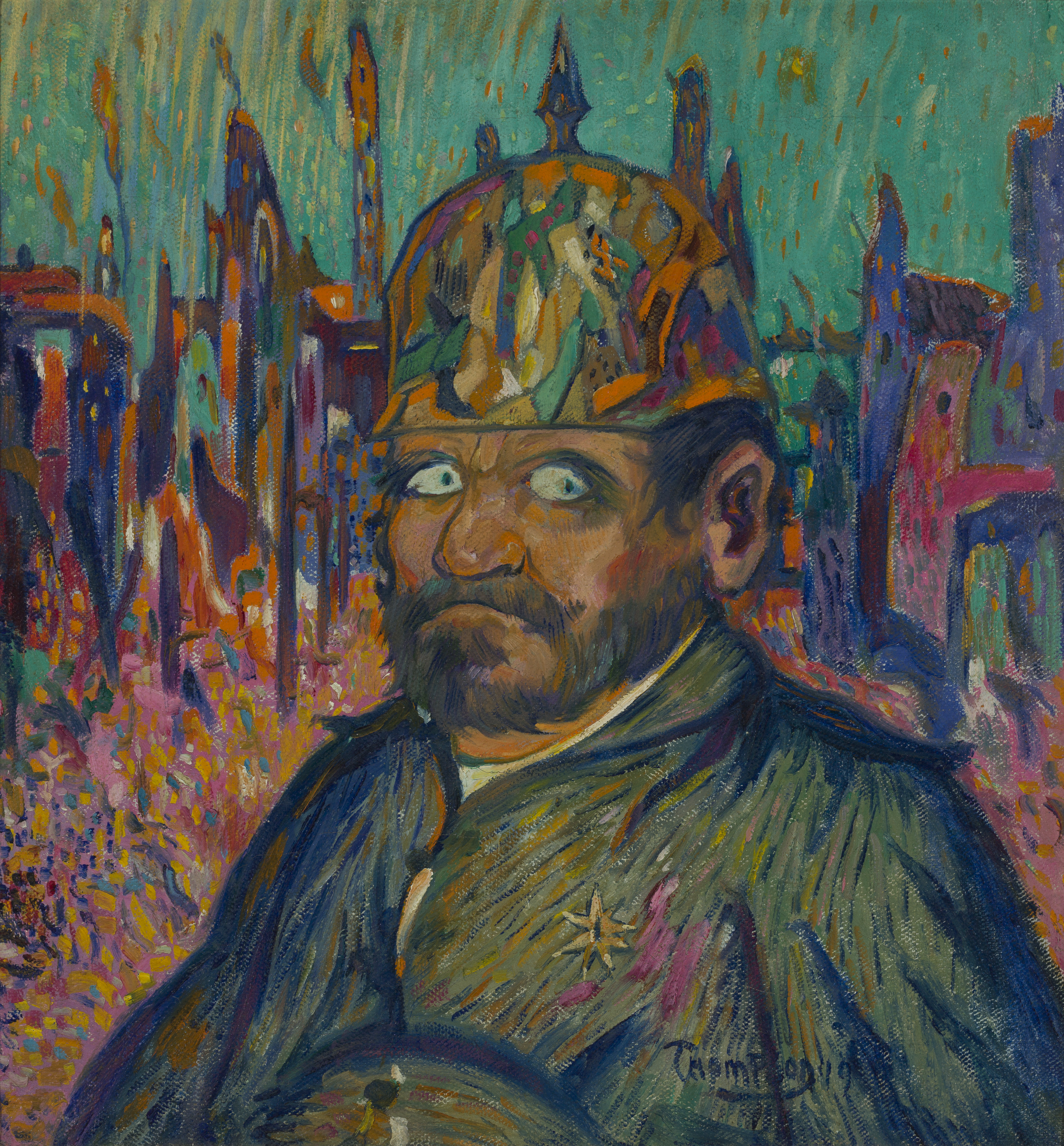
German Soldier, World War I, circa 1915, oil on canvas, 15 x 14 in. By John Edward Thompson.
In frustration with Buffalo’s conservatism and at the recommendation of an enthusiastic railway agent, Thompson boarded a train for Colorado in the summer of 1914. He said later that he came for the light. He spent the summer painting near the town of Pine, grappling with the brilliant light, a different palette, and an unfamiliar terrain. He found more than just new artistic challenges; he met his future wife, Harriette. After a brief return to Buffalo, the young couple settled in Denver.
Thompson listed his profession as a self-employed mural decorator on his draft card in early September 1918. He quickly started establishing himself as a working artist in Denver, opening a new school and advertising in The Denver Post: “Study mural painting, drawing and composition Instructor, John E. Thompson: exhibitor Paris Salon. Studio, 608 Charles bldg., 15th and Curtis.” The reference to the Paris Salon emphasized his European credentials, a rare and hopefully saleable commodity in the West.
A World in Chaos
In the fall of 1918, the so-called Spanish flu reached Denver. The pandemic would kill between twenty and fifty million people worldwide. Between September 1918 and June 1919, influenza and its complications, particularly pneumonia, killed nearly 1,500 (out of a population of about 200,000) in Denver and nearly 8,000 in Colorado. Fatalities in Colorado exceeded the national average, perhaps because so many of its residents had preexisting pulmonary problems since Colorado was a magnet for sufferers of asthma, tuberculosis, and other breathing issues. Seemingly healthy people died as well, often in a matter of days. Many of the fatalities were young people.
Health officials including Dr. William H. Sharpley, Denver’s manager of health and the city’s former mayor, tried in vain to curb the spread of a disease they did not understand and against which they had few weapons. Sharpley shut down schools and forbade social gatherings like movies, theater performances, church services, and political meetings. When the business community protested, the government rescinded the closings, only to reapply them when infections flared up again. Some of the recommended precautions like handwashing and not sharing utensils were effective, while others, such as not wearing tight clothing, did little to help. State officials relented enough to allow celebrations of the Armistice on November 11, 1918, but flu deaths spiked again shortly after. The contagion lingered through winter, and death tolls rose. It must have been a particularly worrisome time for the Thompsons with a new baby and a toddler.
In Europe, the war dragged on. Thompson lost one of his closest boyhood friends and many other colleagues, and an appalling percentage of the French and expatriate classmates he had known in Paris were crippled or dead. In France, the death toll numbered more than four percent of the population, with a similar proportion in Germany. The Great War decimated an entire generation of young men. A cadre of ghosts populated Thompson’s memories of Europe.
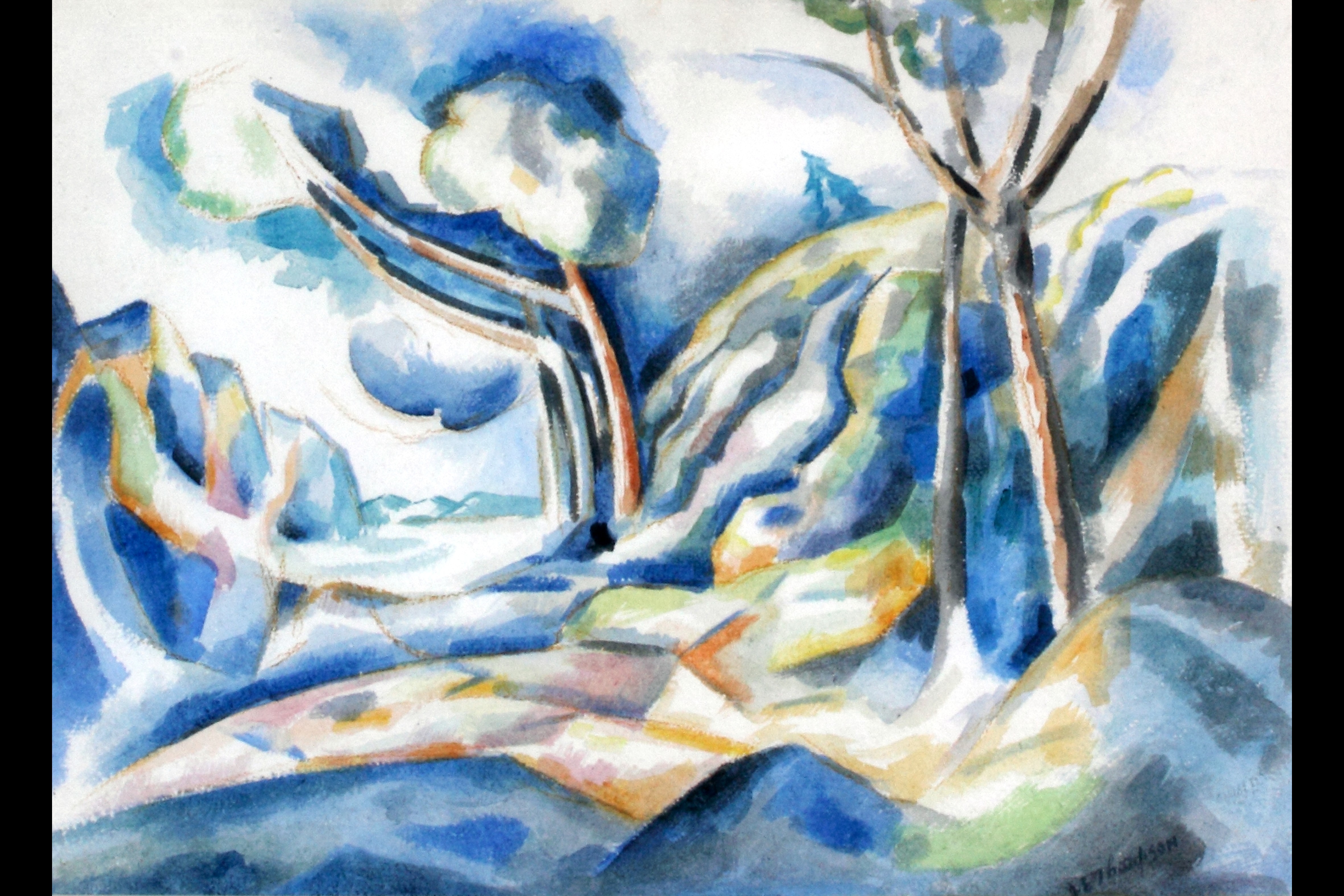
Scene near Pine, Colorado, 1914, watercolor, 14 x 20 in. By John Edward Thompson.
Colorado mourned its own casualties. After the government implemented the draft, Colorado sent more than 43,000 citizens to the military. Many deployed to Europe, an experience that was shocking and/or exhilarating to farm and ranch boys. Four won the Congressional Medal of Honor, but only two of them survived. Nearly 1,100 Coloradans died in the devastating trench warfare, and many more were disabled. The survivors returned to a Colorado that was not the one they had left, nor were they the same themselves. Many were unable to find work, since wartime industrial demand had slowed and the flu was killing even more than the war had. Strikes and unrest followed.
The effects of the war touched everyone. Four European monarchies fell, and colonialism came under attack worldwide. Europe’s economy reeled from runaway inflation, decimated infrastructure, demolished industry, and a devastated workforce. Previously unthinkable mechanisms of slaughter had been unleashed, and neither warfare nor peacetime would be the same again. The men who returned had seen horrors beyond description while the women they had left at home had discovered new skills and new potentials doing “men’s work” to support the war effort.
John Thompson’s life resonated with themes like those that haunt our own time. Chaotic acts of desperate and brutal anarchists threatened the order of European and American society and struck at the heart of civilization. The epithet "anarchist" of Thompson’s days equates with the infamy and fear associated with "terrorist" in our own. And that specter of anarchy loomed everywhere: The pandemic, the war, the recent bloody Bolshevik Revolution in Russia, and widespread labor unrest sowed the seeds of anxiety. The world seemed to be going mad. The chaos was evident even in art…
Art Amidst the Anxiety
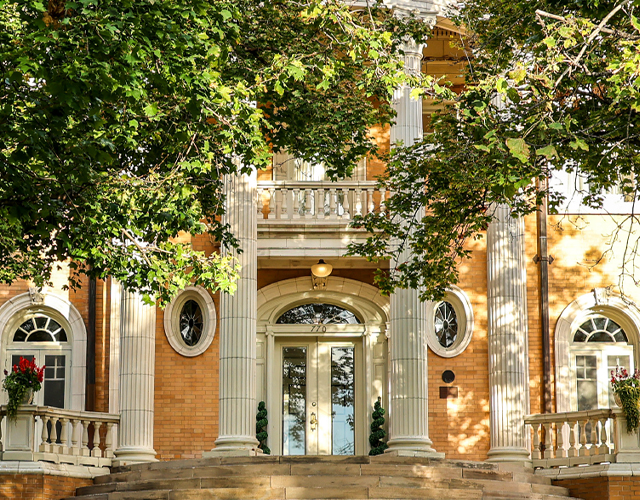
In the midst of it all, in April 1919 Thompson took part in the exhibition that would be a turning point in Colorado art history. He responded to an invitation to exhibit in the Denver Art Association’s twenty-fifth annual exhibit, held in the Denver Public Library’s galleries from April 4 through the 30th. The library’s “Old Main” location, the Carnegie-sponsored building on the northwest corner of the Civic Center (today’s McNichols Civic Center Building), housed the exhibition. Since its opening in 1910 the public library had often served this function, since the Denver Art Association had no building of its own. Anne Evans leveraged her place as a board member of both the art association and the library to plan for the future. She lobbied hard—and successfully—for an art gallery in the new library with the dual purpose of guaranteeing exhibition space and forging stronger bonds between the art association and Denver’s civic government. She knew that the art association could never hope to gain a building of its own without the blessing and support of city leaders.
![[Self Portrait with French Poster], circa 1915, by John Edward Thompson](https://hcdrupal10.exemplifi.io/sites/default/files/media/images/2025/Image%204_1.jpg)
[Self Portrait with French Poster], circa 1915, crayon on paper, 15.5 x 16 in. By John Edward Thompson.
Accepting the invitation, Thompson exhibited, as did three of his Buffalo students: Jozef Bakos, Alexander Korda, and Walter Mruk, all of whom had followed their teacher to Denver. In all, the show displayed seventy-nine pieces by twenty-six artists. The exhibition pamphlet listed seven women—at about 25 percent, a high percentage for a time when women artists were chronically underrepresented. Three exhibitors were 1893 founders of the Denver Artists’ Club. Four lived in New Mexico, while three more came from Kentucky, Illinois, and Texas. Nearly half had studied in Europe, and at least three were foreign born.
Not all were professional artists. Belle Hartung, who taught art at Broadway Junior High School, had graduated from Denver’s North High and the Teachers College in Greeley (today’s University of Northern Colorado). Helen Dorsey was a student of sculptor Margaret George. Theodore Holland, a Denver insurance man, painted as a hobby.
Robert Reid, a noted New York artist, had exhibited at the Paris Salon, the 1893 Columbian Exposition in Chicago, the Paris Exposition, the Pan-American Exposition, and the St. Louis Exposition, winning prizes and medals. As a founding member of the Ten American Painters (“The Ten”), he rebelled against traditionalism by painting in the Impressionist style. In the early 1920s, Reid would move to Colorado Springs and join fellow exhibitor Frances Drexel Smith in the local art community. Smith, who had lived there since 1900, was to become one of the founders of the Broadmoor Art Academy, an influential institution that attracted nationally known artists to Colorado.
The New Mexico contingent included Gustave Baumann, William Penhallow Henderson, Bert Geer Phillips, and Bror Julius Olson Nordfeldt. Colorado and New Mexico had long shared artistic exchanges, with both states’ artists showing their work in each other’s competitions and exhibitions. Many had known each other in Paris and back east before coming west. Thompson and his students formed immediate bonds with the New Mexico artists and began visiting Taos and Santa Fe on a regular basis.
The preliminary articles in The Denver Post and the Rocky Mountain News highlighted the credentials of the various artists, including Baumann’s recent gold medal at the Panama Pacific Exposition of 1915 and Nordfeldt’s silver medal at the same exposition. They extolled the exhibitors’ academic records and predicted that the show would be the most promising in recent history. The papers highlighted John Thompson in particular as “a painter of decided ability who has exhibited extensively and who after years of study in Paris is now making Denver his home.”
![The Sculptor [Arnold Rönnebeck], 1926](https://hcdrupal10.exemplifi.io/sites/default/files/media/images/2025/Image%202_0.jpg)
The Sculptor [Arnold Rönnebeck], 1926, oil on board, 20 x 16 in. By John Edward Thompson.
The show consisted primarily of paintings, with only a couple of sculptures. Landscapes comprised the great majority, with five or six portraits affording a change of pace. The landscapes of well-known local artists George Elbert Burr, Henry Read, Emma Richardson Cherry, and Elisabeth Spalding provided familiarity and comfort to their audience. Henry Richter, teaching at Western State Teachers College in Gunnison, had exhibited repeatedly in Denver and was a known quantity. The New Mexico group brought a variety of subjects and styles, with their Native American and Hispano subject matter providing a familiar western aura.
The controversy centered on the four newly arrived “modernists”: Thompson, Bakos, Mruk, and Korda. Thompson showed six paintings, Bakos two, Mruk two, and Korda three. Sadly, almost none of the seventy-nine paintings in the exhibit are traceable now, but there are two exceptions: Thompson’s Organization of Rocks and Trees is in the collection of the author, as is a watercolor study for his Roof Tops, both from Thompson’s estate. The Portrait Thompson showed was probably similar to The Sculptor [Arnold Rönnebeck], painted in the same period, if not in fact the same painting.
“Modernism” in art has many definitions, but in 1919 a working definition described it as art that reacted against the realism and formality of the academic tradition. Or, as Elisabeth Spalding wittily defined it, modernism “is a convenient word which covers all that we do not understand.” Thompson’s works look comparatively innocuous to our twenty-first-century eyes, but they shocked and unsettled Denver audiences who expected realistic landscapes and even more realistic portraits. In fact, few places in the United States exhibited modernists. Starting in about 1907 until it closed in 1917, Alfred Stieglitz’s 291 art gallery in New York City was the only place where such works appeared regularly. Certainly, the other professional artists in the Denver show were acquainted with European modernism. Most had visited or were even born in Europe, and many would have viewed the Buffalo contingent’s bright colors and geometric forms with interest.
But the rest of Denver was another matter.
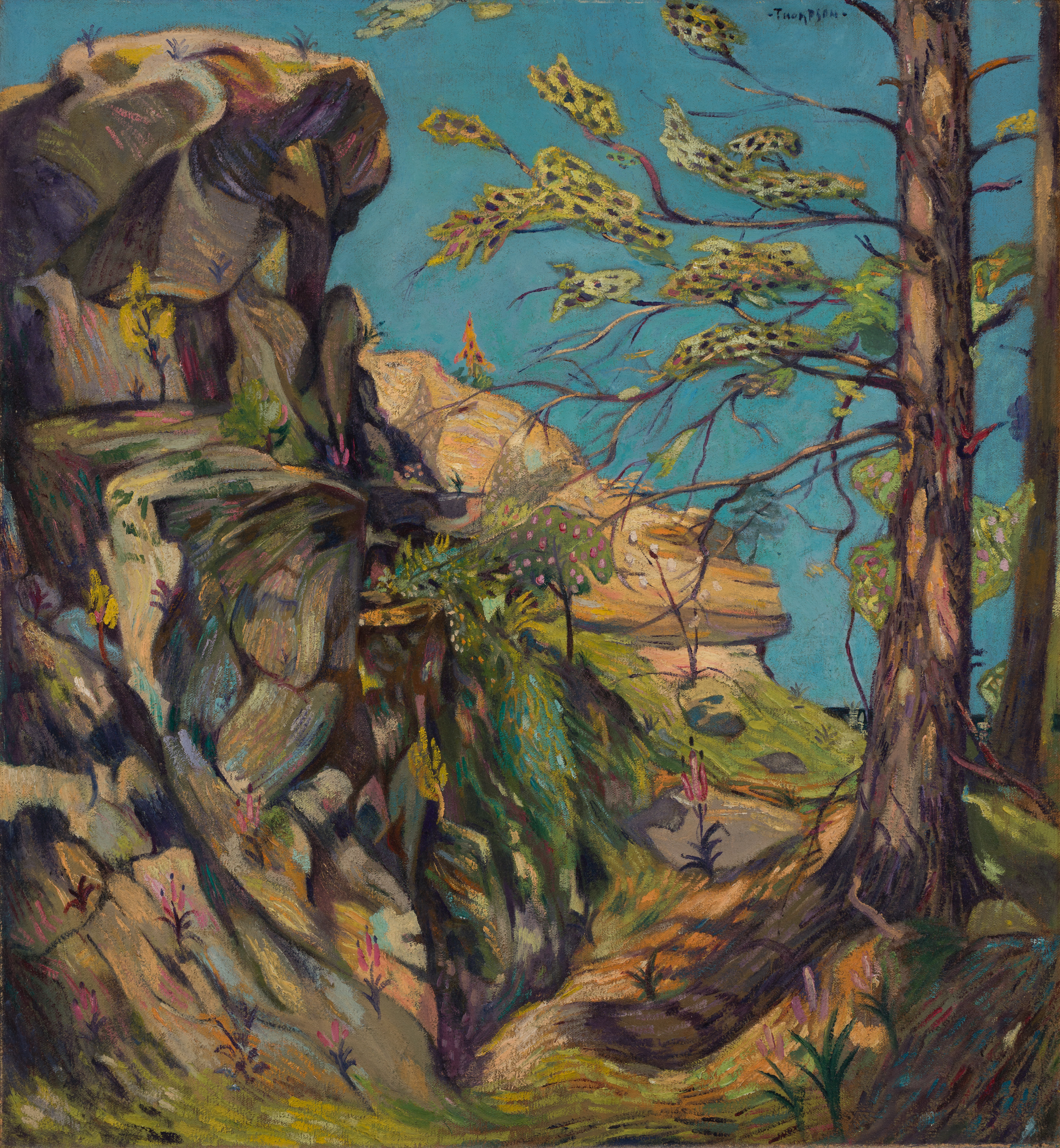
Organization of Rocks and Trees, circa 1919, oil on canvas, 27 x 25 in. By John Edward Thompson.
“A Fraud Upon the Public”
Within two days, the outcry erupted. Among the outraged was none other than Henry Read—an exhibitor in the show, a member of the Municipal Arts Commission, and the proprietor of the Student’s School of Art in Denver. The English-born Read directed the Art Department at Wolfe Hall, Denver’s elite girls’ school, and had headed the Denver Art Association for years. With his letter to the Rocky Mountain News—quoted here with another letter and a response from the paper—he presumed his opinions would carry great weight:
Library Art Exhibit Called "Fraud" And Monstrosity By Two Writers
Modernist Offering Draws Ire of Visitor
Two correspondents of The News take the position that the art exhibit at the library indicates that we are deteriorating, both of them criticizing much of the work shown there as not worthy of a place in a display intended to be representative. The letters received by the News follow:
To The Rocky Mountain News:
I derived some amusement from an account in The News of last Sunday of the pictures now being shown at the public library. As it was published under the sanction of the Denver Art Association, an innocent reader might be led to suppose that the article was based upon some sort of critical judgment. When I say that the exhibition is characterized by mediocrity, I use a very mild expression. Indeed, one might be pardoned for thinking that by accident the rejected instead of the accepted pictures had found their way to the walls of the gallery. As modernism is responsible for the eccentricities of the collection, the following extracts from an editorial in the current number of the American Art News will be read with interest:
Movement Called Fad.
“If any proof were needed, not alone of the waning, but of the near ending of the so-called modernist movement, or, to call it by its true name, the modernist fad in painting and sculpture, in this country at least, the current independent display on the very appropriate roof garden of the Waldorf-Astoria hotel, where the show is literally ‘up in the air,’ furnishes this. Both painting and sculpture in America will now proceed upon saner and healthier lines than for some years past, and will in a short time free themselves from the hysterical and other influences of the so-called modernists. The modernist fad was founded upon the desire to attract public notice thru making a noise and consequent sensation, with the hoped-for public attention and resultant commercial support.” Henry Read
Want City to Put Ban Upon All Such “Outrages.”
To The Rocky Mountain News:
After reading the account in the Sunday News of the art exhibit at present in the Public library I cannot refrain from expressing the views of one citizen—and I am sure 200,000 others.
The people of Denver love pictures—real pictures—and the great majority have reached a plane of intelligence where they can distinguish between real pictures and frauds. At least half of this exhibit is an insult to the people’s intelligence.
There are a few real pictures. There is an excellent group of small landscapes, rather photographic in their style, but of the first order; another group of four large landscapes in water color, two pastel portraits, a view on the Gunnison River, a snow scene among evergreens, one Indian picture and a few smaller pictures that will afford pleasure to any observer, and well repay one for going to the exhibit.
While I do not condemn all the other pictures, I look upon most of them as a Fraud upon the public, and particularly some of those mentioned in your article of Sunday morning. “The Cascade,” “Quaking Aspens,” and “Man from Chaos” [sic] might find a permanent place on the walls of a mad house. With these may be mentioned “A French Cliff,” a group of foothills about Golden, and outdoing all of these in downright idiocy of conception is an “Organization of Trees and Rocks” [sic]. Besides these there are many others which are a little less bad. There is one large decorative piece in which the drawing is so painfully poor that it becomes an eyesore instead of a thing of beauty.
Should Prohibit “Outrages.”
I think it is time for the mayor and city council, or whoever controls the library should have their representatives upon the jury of selection to prohibit such outrages from cluttering the walls of our public library under the guise of art. Is it possible that several hundred members of the Denver Art association have seen these monstrosities? Do they endorse the selection of their jury? Would they, for instance, place the “Organization of Trees and Rocks” in a prominent window on Sixteenth street where thousands of people would see it, with a placard on it reading, “We, the members of the Denver Art association, indorse this as an excellent picture and a work of art?”
It might be interesting to try as an experiment, and let the people guess what the thing in the frame was intended for.
The jury should try this experiment for their own vindication. Would they dare? It might arouse a great interest in art among the people of Denver and prevent what interest there is from being killed by a group of eccentric people. Horace Simms
Bolshevism In Art
Art, painting in particular, is imitative. It takes on the hue of its surroundings. An art craze may follow more often than it precedes an outbreak in some other quarter. Pre-Raphaelitism denoted a movement broader than the school of painting that gave it its name. Female militantism and love of destruction preceded the European war. Before the war, we had pantasmagories [sic] in dress, poetry and painting in America and abroad. In music we had “rag time” and now the super-rag, the “jazz.” In the choreatic art we have had the Russian-Oriental ballets and their freakish settings.
We have in a modest way over at the public library an exhibition of pictures. Our conservative correspondent in The News yesterday complained that it is not art. What is art? Perhaps the exhibit represents the post-war art—the art of Bolshevism. Why should not art have its Lenines [sic] and Trotzkys [sic] and its strivings after vain things? Why not a Rosa Luxembourg [sic] in colors?
The sad part of the business is that the “hanging” committee failed to confine itself to the new schools. If it had chosen pictures solely from the Anarchs [sic] in art, say Futurist, Modernist, Cubist, Tubist or Taoist school or schools, all might have been well. The ingenuous visitor would have walked in, rubbed his eyes, pinched his arm, shook his head, and walked out again, wondering what it was all about. But there are pictures of the sane period in the exhibit. And it is the contrast that sets the bile going. When the eye dwells lovingly and musingly upon an Arizona landscape, painted according to approved methods, and turns a few inches to find a flare of colors never seen in nature and drawings that defy anatomy and common sense, the onlooker is inclined to see things on his own account.
No doubt the association responsible for the free exhibit—should we look a gift horse in the mouth—even if it is out of all proportion?—had its reasons for the selection of pictures. Maybe the bizarre ones were intended as a warning and a lesson to the public never to go to extremes. At any rate, until we are otherwise advised or better informed, we will blame it on the war.
A Welcome Show of Support
These media responses echo those that assailed the 1913 Armory Show in New York City. Indeed, this Denver show almost immediately became known as “Colorado’s Armory Show.” Both shows’ conservative entries far outnumbered their modernist ones, but it was those modernist pieces that people remembered. The 1919 show represents a watershed moment in Colorado art. For the first time, artists working locally presented their modernist works in a local venue to the local community. Their vivid colors and distorted forms struck Denver’s face just as those of the Impressionists and Post-Impressionists had assailed that of France. For some Denverites, the new styles appealed to their western independence and tolerance of personal eccentricity. For others, modernism threatened tradition, stability, and authority. For still others, the new styles were simply incomprehensible.
Today, the turmoil that greeted the 1919 show might seem hard to understand, but it was real, bitter, and vehement. The labels “Anarchist” and “Bolshevist” must have put Thompson in mind of President McKinley’s 1901 assassination in Buffalo. The more recent assassination of Archduke Ferdinand and the brutality of the Russian Revolution were immediate in people’s minds. These epithets were not trivial, but neither were they new to Thompson’s experience with controversy. Conservatives like Read were an expected contingent of any art community, and Thompson had encountered and surmounted it elsewhere. As his friend Arnold Rönnebeck commented later about Thompson being called a “Bolshevist in art,” “We do not know who the critic was, but we are quite certain that he did not hurt Thompson’s feelings.”
From long before, Thompson was determined to follow his own convictions. What differed in Denver was the support he garnered. Elisabeth Spalding and Anne Evans leapt to his defense with public affirmations of the value of modern art, endorsing Thompson by name. He was used to rejection, but much less used to such affirmation from knowledgeable fellow artists.
Anne Evans was the first to vindicate him, and she defended his students with equal vigor. In her article “New Tendencies Revealed in Contributions of Modern Artists at Denver Library,” she identifies herself as “Chairman, Executive Committee, Denver Art Association.” After acknowledging the editorials, she cuts right to the thrust of her defense: “It is the right of men who have worked seriously for many years and who have received recognition from the most conservative and most academic of juries and critics to express their own conviction in paint even if they differ very greatly from certain accepted standards.”
Evans then expounds on the credentials of several of the artists, cheekily including those of Henry Read, the author of one of the condemnatory editorials. At length she comes to Thompson, writing,
J. E. Thompson…is new to the Denver public, but comes with an enviable record of achievement in Buffalo, New York and Paris. For ten years prior to the war he lived in Paris, where he exhibited for two successive years in the Salon, and later, becoming more interested in the modern movement, he exhibited in the shows of “The Independents.” He has a scholarship from the Art Students’ league of New York and he won the Sherwood Smith prize in Buffalo. His time, since he arrived in Denver, has been occupied almost exclusively with five large decorative panels, each ten by five feet, which are to be placed in New York. He deliberately broke away from the tenets of Laurens, with whom he first studied in Paris and became a student at La Palette, under Jacques Blanche, Rene Menard and Aman-Jean.
Evans follows Thompson’s defense with similar accounts of B.J.O. Nordfeldt and Dudley Saltonstall Carpenter, both of whom Denver audiences knew well. She has surrounded Thompson—the focus of the controversy—with more “respectable” artists and drawn parallels between them. She finishes by writing, “With such records of achievement, these artists may surely claim serious consideration from the visitors to the gallery. It is the unquestionable privilege of both artist and layman to differ as to taste and to arrive at diametrically opposed conclusions. The association welcomes all honest and fair criticism.”
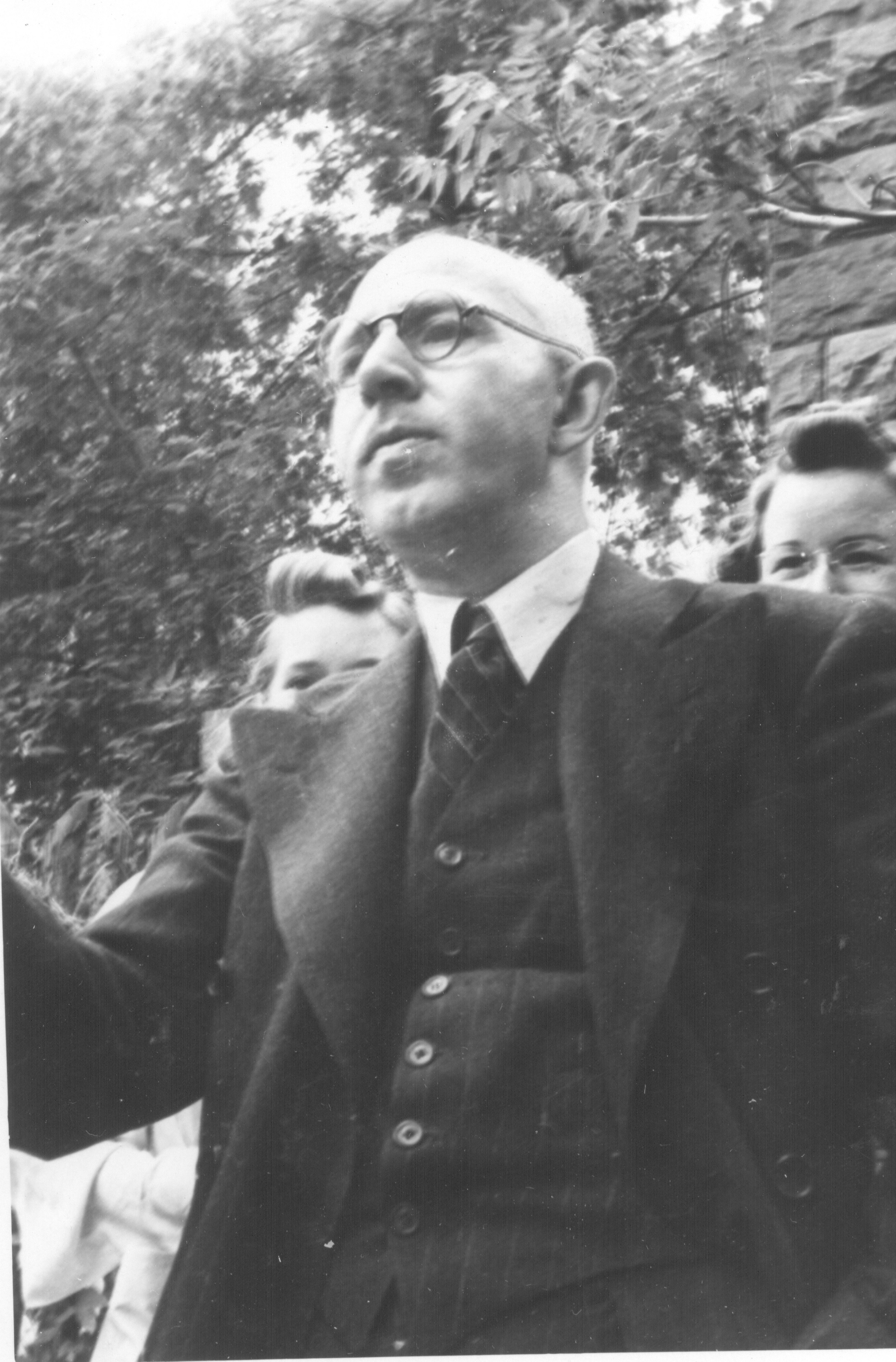
Thompson with his DU students, circa 1944.
Elisabeth Spalding voiced her own support the following week in her Art Notes column for the Rocky Mountain News. In a tone less lofty than Evans’s, she appealed to the less scholarly but still potentially open-minded exhibition visitor with questions—and answers—that are as pertinent today as they were in 1919.
A listener in the gallery might easily overhear conversations like the following: “I don’t know anything about art, but I know what I like.” And in reply, “An honest liking is the best way to begin to understand art. But don’t stop with just the things that first strike your fancy. Try to see what the artist wants to express in the pictures that you don’t like and to be sympathetic with his efforts.”
“Why don’t they paint all the details so that the picture would look more finished?”
“The important thing is the big structure, in form and color, of a landscape or figure and it is often better to leave details to the imagination.”
Questioner: “Why do artists try all these new experiments? We don’t understand these new things.” One of the artists replies: “It would be dreadfully monotonous, wouldn’t it? I like to try new ways of expression. Variety is stimulating and constant repetition does make one dull!”
Another visitor said: “Well, I like a picture that tells a story, and I like plain facts.” “We artists have nothing against either the story or the fact, but we prefer color harmony without facts to the statement of facts with color or harmony.”
“But I never saw anything look like that!” The great English artist, Turner, once said, when someone made that remark to him: “Madame, it would be worth £20,000 to you if you could.” Some artists think that a picture should be painted in as abstract a way as a Persian rug. No one questions the beauty of the rug’s color-harmony and design. Why not accept the canvas on the same terms?
“But do you really like these modern things?” “If I didn’t I wouldn’t and couldn’t paint them. The important thing is the sincerity of the artist. He must work with a sincere conviction. Whether work is conservative or radical does not seem to us to be of primary importance, for honest work of the conservative helps to steady the radical, while the sincere radical helps to broaden the conservative.”
The measured and rational responses of Evans and Spalding stood in vivid contrast to the venom expressed in the pages of the Rocky Mountain News.The publicity and controversy that surrounded the 1919 “Colorado Armory Show” introduced John Thompson to far larger public recognition in Colorado than he might have expected—or even preferred. Years of European debate and competition had toughened him, but the unexpected defense soothed more than the criticism stung. The support, camaraderie, and respect rooted Thompson in Denver. He determined to make his life in the city and spent the next twenty-five years there, teaching and painting. And he never wavered in following his own artistic conscience.
Beginning in 2021, for the first time in seventy-five years, the Denver Art Museum exhibited a work of Thompson’s. Organization of Rocks and Trees, the painting that caused such outrage in 1919, hung amidst the collection of the Petrie Institute of Western Art for the reopening of the museum’s newly renovated and renamed Martin Building designed by Gio Ponti. It was displayed next to a Jozef Bakos painting of the same scene and near a landscape by Andrew Dasburg, another of Thompson’s modernist associates.
The three friends’ paintings seemed to be enjoying a companionable conversation. And museum patrons seemed remarkably free of the outrage of a hundred years prior.
Thompson and the ladies would have been pleased.