
 Membership
 Donate
 Shop
Shop
























Last Paper Standing: A Century of Competition between the Denver Post and the Rocky Mountain News
A review of Ken J. Ward's 2023 book.
Editor's note: This review comes to you from the Colorado Book Review. More reviews can be found at the Denver Public Library.
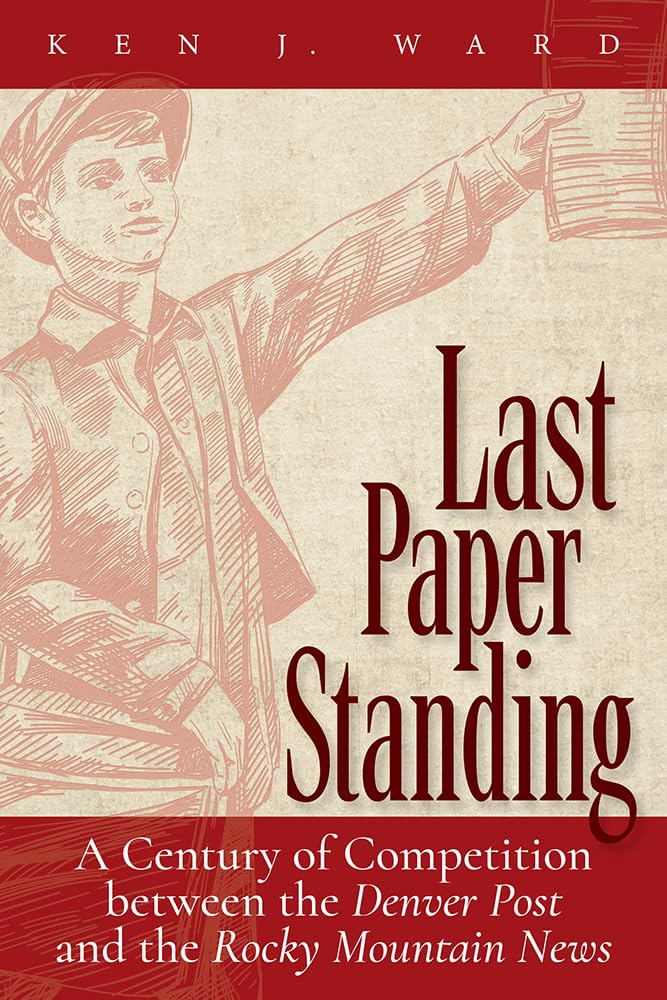
This otherwise worthy book begins with a blunder.
The Denver Post’s official title has an italicized The in The Denver Post, not the lowercase the used throughout. Perhaps the author should be pardoned as he is an assistant professor of media journalism at Pittsburg State University in Pittsburg, Kansas. He could blame this on the University Press of Colorado, which follows the Chicago Manual of Style in prescribing a lowercased the in newspaper titles. This blemish should not keep readers away from a fascinating look at two of the longest lived and most important and entertaining foundations of Colorado history. Another warning—we home subscribers who now pay more than $1,100 for home delivery of a much skinnier paper may be chagrined by Ward’s in-depth coverage of the warfare when each paper sold for a penny.
Ward combines a micro focus on the Post and News with a macro focus on the national newspaper industry in general. As Gene Fowler’s semifictional, classic Timberline: A Story of Bonfils and Tammen (1933), and Robert L. Perkins’s The First Hundred Years: An Informal History of Denver and the Rocky Mountain News (1959), and Bill Hosokawa’s Thunder in the Rockies: The Incredible Denver Post (1976) have covered the earlier story, Ward wisely spends most of his book on the subsequent years since 1976. This book ends before the 2010 acquisition of the Post by Alden Global Capitol, a hedge fund with offices in Manhattan’s “Lipstick Building.” Noted for gutting its acquisitions, Alden has cut staff and expenses drastically, leaving many to wonder how long the Post will survive. Or switch to just digital.
Despite many competitors, as Ward notes, the Rocky led the field after its April 23, 1859, beginning, outlasting thirty short-lived papers during its first twenty years. This changed in 1894 when The Denver Post was born. It rapidly became one of the most sensational and profitable newspapers in the land. It made the Rocky and other competitors look dull. One early competitor Ward might have mentioned was the Rocky Mountain Herald, later reincarnated by Colorado poet laureate Thomas Hornsby Ferril who, with his wife Helen, made it a literary work with contributions from the likes of Bernard DeVoto, Robert Frost, and Carl Sandberg. While hundreds of other mostly short-lived newspapers watched from the sidelines, the Post and the Rocky fought Colorado’s great newspaper war with the Post on top most years. The Pest, as some called it, used screaming red ink headlines for stories such as “Does It Hurt to Be Born?” Ward shows how the Post blackmailed reluctant advertisers. If you did not sign up, your wife could be banished from the society pages. While most books focus primarily on Bonfils, including his criminal past, Ward argues that Tammen’s role is underestimated. Tammen had built up quite a following with his Great Divide magazine and his curio and postcard business, which had a mailing list of 30,000. Tammen fancied innovations still seen today, such as banner headlines and large front-page illustrations. Red ink atop stories returned in 2023.
After its 1894 founding, the Post soon surpassed the News’s circulation. The News continued to languish until its 1926 purchase by the Scripps-Howard newspaper chain. The News still struggled until 1940 when Scripps put 34-year-old Jack Foster in charge. To save money on ever more expensive newsprint, he shifted the paper to a tabloid format in 1942. Foster also recruited a better editorial staff and enhanced the News in many ways. In 1943, the News reached a circulation of 50,000 for the first time in its history and finally caught up with the Post.
After the death of Bonfils in 1933, the Post slowly faded. Not until Helen Bonfils, Frederick’s daughter and the principal stockholder, hired Palmer Hoyt in 1946 did the paper come back to life. Until then, Ward notes that The Denver Post was one of the few U.S. examples of yellow journalism long after its demise in most cities. Hoyt rehabilitated the Post, bringing it into respectability by separating news from opinion and by editorially adopting progressive causes such as opposition to McCarthyism. Whereas Bonfils had boasted that his paper and its readers cared more about a dogfight in Denver than a war in Europe, Hoyt beefed up national and international news and assigned a full-time staffer to Washington. Hoyt also launched an armada of special sections, including the outstanding Empire Magazine, rich in local history written by staff and free lancers. At its peak in 1966, the Sunday Post ran as high as 358 pages, according to Ward. The News never caught up in size or Sunday circulation, but its daily caught up with the Post circulation in 1980. To keep up with its morning rival, the Post switched to a morning paper in 1983 when it also shifted from paper boys and girls to adult carriers.
Ward does not explore, for either paper, the role of columnists in attracting readers. Yet regulars such as Gene Amole, Lee Casey, Red Fenwick, Tom Gavin, Tina Griego, Dick Kreck, Dottie Lamm, and Woody Paige were often the first pages readers turned to.
Ward points out that, unlike most newspapers, the Post was nonpartisan and could—and did—criticize both parties. The Post’s editorial views could also be for sale. Bonfils, as Ward points out, accepted a large bribe from Henry Sinclair to kill the Post’s unfolding exploration of the 1920s Teapot Dome scandal. Ward wisely admits that “Bill Hosokawa’s Thunder in the Rockies explores Bonfils’s role in the Teapot Dome scandal to such an extent that it need not be treated at length here (p. 47).” Ward also credits Robert Perkins’s The First Hundred Years with “the most colorful and well documented” coverage of the pre-1959 story.
Both papers were threatened as early as the 1920s when, as Ward points out, radio cut into their advertising, even before television took not only advertising but also content with its timelier coverage away from the printed press. The battle between Denver’s two leading papers heated up again during the 1970s and the return of the penny papers. During that time both papers hit their all-time high subscriptions. This peak came despite another threat, little noted by Ward: the 1960s rise of free neighborhood newspapers, published weekly, monthly, or quarterly.
Not only did loss of advertising and circulation batter newspapers. So did the ever-rising cost of newsprint. Efforts to stop the downhill slide were made with the Newspaper Preservation Act of 1970, a national effort to help newspapers. One of the tools was the Joint Operating Agreements. These JOAs encouraged newspapers to consolidate their production, advertising, printing, publication, distribution, and other expenses but left editorial distinct and independent. This was the route taken in Denver from 2000 to 2009. It blessed Denver with two strong dailies, ending with the last issue of the News on February 27, 2009. Although the News looked healthy in Denver, it was losing millions every year in the 1990s for Scripps. JOA profits enabled the News to survive. Scripps gave no advance warning, and we readers found the News looking healthy right up to its abrupt end. However, one of the few signs of its impending demise was when the News confined delivery to only ten Front Range counties, surrendering the “Rocky Mountain Empire” to the Post.
The last—and one of the best—News editors, John Temple, arrived in 1992. He kept the News in its prime and fought its murder by Scripps’ television-preferring dollar counters. Temple enhanced the editorial staff, which won three Pulitzer Prizes during his reign. He relished and advanced the reputation of the Rocky as a “working class,” “fun, “adventuresome,” “investigative,” and Denver-centric with “gut grabbing” reporting. Both papers launched their own websites and digital versions. Both, however, suffered the erosion of once-lucrative want ads. Local television programming, governmental stations, local and national cable news, local magazines, bloggers, podcasters, and no end of television stations all stole customers from the two Denver dailies.
The Post won the war but, as Ward notes, it was a shallow victory. The Post’s parent, MediaNews Group, overwhelmed by $930 million in debt, filed for bankruptcy in 2010. Post publisher William Dean Singleton stepped down as chief executive officer of MediaNews and publisher of the Post. He remains interested in the Post and lives in and is civically active in Denver. The Post survives, but its newsroom has been skeletonized by wave after wave of layoffs and buyouts. It is an ever-skinnier product and has moved from its 2006 $100-million, eleven-story building on a prominent Civic Center site to far humbler quarters in suburban Adams County.
The Post faces competition from online member/subscriber daily newspapers including the Colorado Sun, the Denverite, and the Gazette. Westword, a free weekly published with much advertising since 1977, offers some of the best Colorado investigative reporting, including coverage of the News-Post war.
Ward concludes that the great newspaper war benefited readers by competitively offering cheaper subscription and advertising and by offering varying editorial content. Both papers profited from outside cash infusions after the News was bought by the Scripps Howard chain in 1926 and the Post by Times-Mirror in 1980, then by the MediaNews Group led by Dean Singleton in 1987. MediaNews, in turn, was swallowed by Alden Global in 2010. Both of the last two owners gutted the Post, laying off or buying out many staff and reducing the Post to a shadow of its former self.
Ward makes good use of many sources, notably manuscript collections and interviews. He documents things well. He points out the sad truth that the loss of dailies leads to decreased civic activity, an increase in political polarization, and ignorance about local government and political issues. He is strong on journalism technology and on the financial details of the battle that left only one paper standing.