
 Membership
 Donate
 Shop
Shop


















The Beanie Boom
Beanie Babies captured our hearts and wallets for a brief period in the ’90s, playing a pivotal role in the growth of the internet.
We were lucky. On a brisk fall evening back in 1997 my Mom and I found out we were the thirty-ninth and fortieth people in line at the Hallmark Shop. We were guaranteed to get the most coveted Beanie Baby to ever exist. You see, only forty Princess Diana bears were set to go on sale the following morning. I could see the dejection in the eyes of the person who showed up shortly after we got in line. They’d have to hunt down some other limited release of the nation’s hottest toy. We slept outside the store that night, and with dawn came our chance to buy the purple plushy. We were certain the stuffed bears would make us a ton of money when we sold them on the World Wide Web.
Back then, the internet was a new invention experts told us would open up possibilities we’d never imagined. Other so-called experts were skeptical and unsure what those possibilities actually looked like. There were newspaper articles about how the internet was just a fad that would come and go like disco, and nobody was quite sure. A lot of people were dubious about sending their credit card information into the internet ether, and credit cards themselves weren’t the ubiquitous thing they are today. E-commerce was in its infancy. Now we know that consumer goods would drive the shift to shopping online, and create the demand that made it worthwhile for people to divulge their much-guarded financial details.
The Beanie Baby craze of the late ’90s provided that incentive. You couldn’t buy all of them at the store because (in a brilliant marketing move) Beanie Babies were periodically retired to create false scarcity. The only way to find the Beanie you needed to complete your collection was to search for it online, and the best place to do that turned out to be eBay. Launched in 1995, eBay was one of the first major e-commerce platforms, pioneering online peer-to-peer transactions and revolutionizing the way people bought and sold goods online.
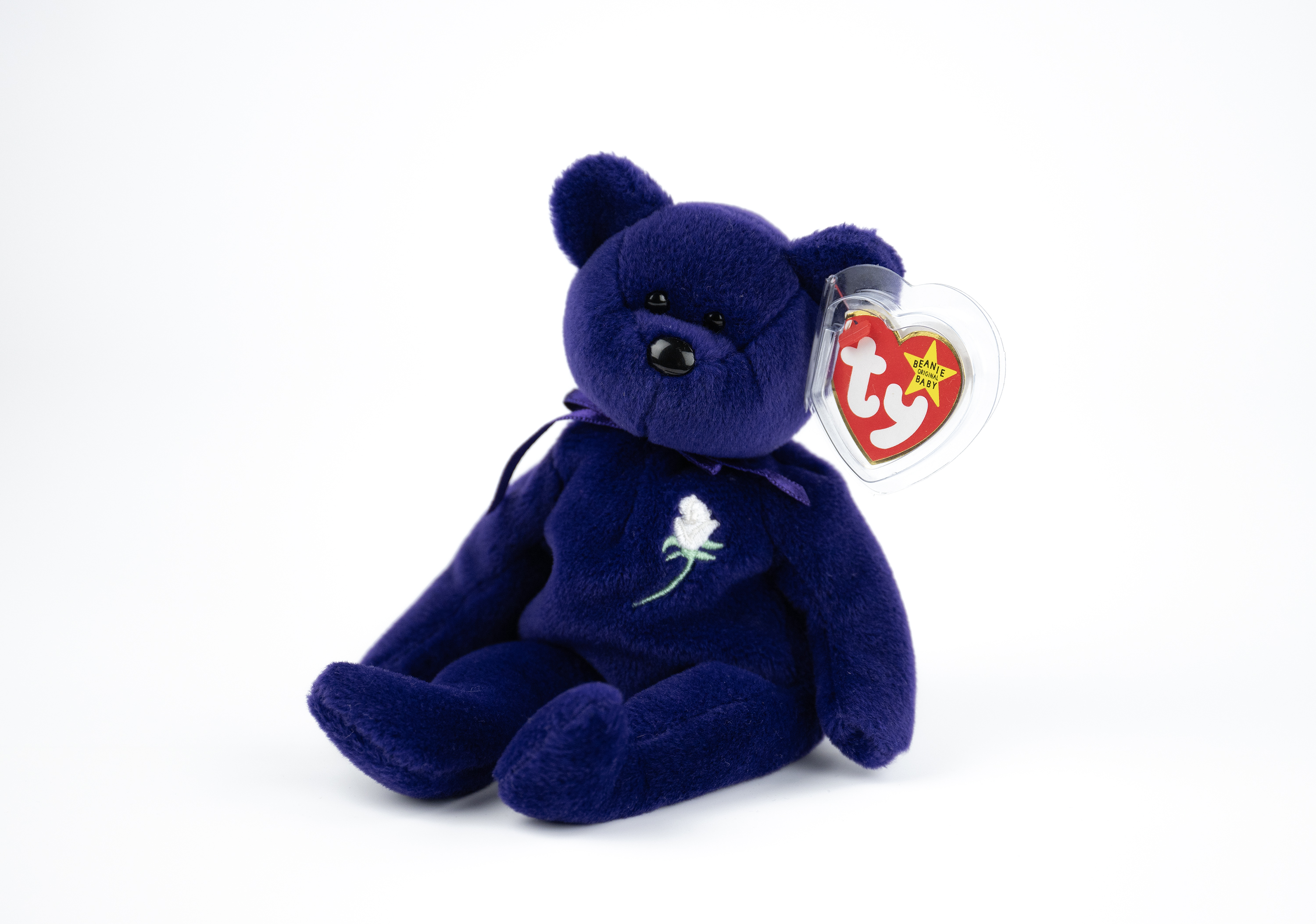
The highly sought-after Princess Diana bear, owned by Kelly Utter-McCloskey, featuring a plastic tag protector to preserve its condition.
Cashing in on the Beanie Boom
Mom was early to the Beanie Baby frenzy, snatching up understuffed animals for $4.99 and then hawking them on eBay for a nice profit. She was so successful that when my teacher asked me what I wanted to be when I grew up, I told her I wanted to start my own eBay business. She hadn’t even heard of eBay, and was skeptical that anyone could make money selling things on the internet. But I saw it with my own eyes. Mom was making bank selling these cuddly critters. At least that’s how I perceived it. Seeing her online Beanie profits compelled her to venture into selling other things. Soon she operated her own version of an online thrift store. Just a couple years earlier Mom and I never bought anything online, and almost overnight we were comfortable buying and selling everything on the internet.
Naturally, Mom held on to her favorites—mostly bears. That was one reason getting the Princess Diana bear felt so important. It also brought together two obsessions: the worldwide fascination with Princess Diana following her tragic death, and the feverish Beanie craze.
By the time the Diana bear was released, Beanie Baby mania hit its peak. Thousands of people cashed in on the eBay trend, following a path paved by people like my mom. People were forced onto eBay since it was the only means of improving their Beanie Baby collection. Once there, they grew more and more comfortable paying faceless strangers for things on the internet. Consumers were reassured in part due to the feedback system honed by the most avid eBay entrepreneurs. The company’s innovative new system allowed buyers and sellers to rate each other. They could leave a positive, neutral, or negative rating, and had the option to add a short comment. Before anyone ever heard of social proof—the psychological phenomenon where people rely on the actions or opinions of others to determine their own behavior—eBay users were building trust and credibility by rating each other after each transaction. If a seller mailed someone an allegedly mint-condition Beanie Baby, and it arrived with a creased tag, well, that was unforgivable. That offense warranted a negative review, a review that elaborated that the seller was a liar, a cheat, a seller who couldn’t be trusted. It could easily derail an entire e-commerce empire. Your virtual reputation was everything. It didn’t matter if you had a Royal Blue Peanut the Elephant—the most valuable Beanie of all—nobody would buy it if your feedback score was too low.
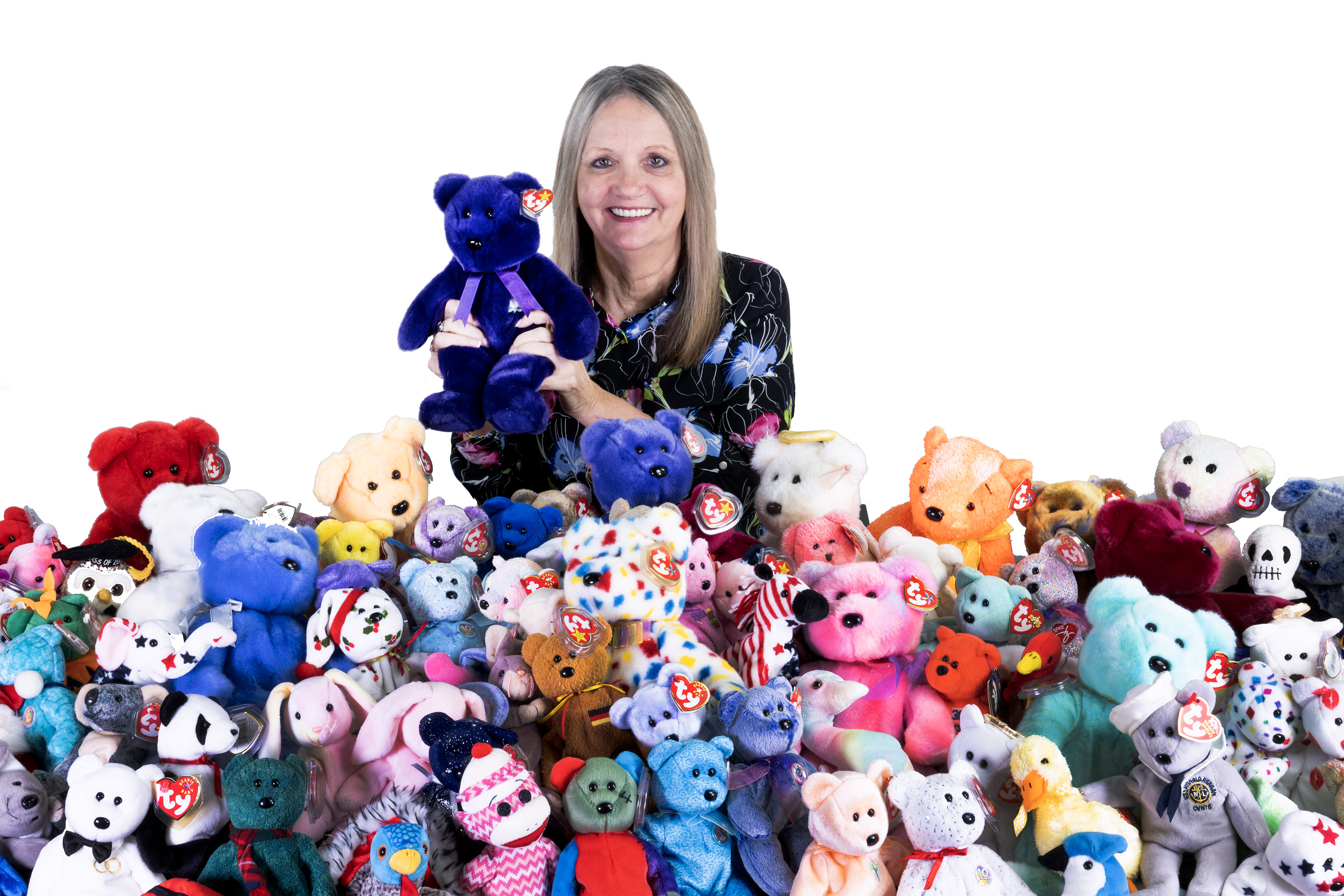
Kelly Utter-McCloskey, mother of the author, proudly displays part of her Beanie Baby collection.
As a perpetually broke preteen, I wanted to get in on what seemed like a money fountain, and the only way for me to do so was to buy and sell using Mom’s account since she already had hundreds of positive eBay reviews. I collected football cards and Pogs, so it was easy for me to see the value in this new fad. I followed Mom’s lead and started my own Beanie collection.
As a Colorado-based Beanie believer, the most impressive to me was Glory. This bear was the giveaway souvenir fans took home from the 1998 Major League Baseball All Star Game at Coors Field in Denver. The bear combined three of my favorite things: Denver, sports, and collecting things most people thought were worthless. Mom made sure to get a special plexiglass case to protect Glory since it was sure to only appreciate in value. Once the bear was safely tucked into its case, Mom gave it a prime spot in the China cabinet, which slowly transformed from a display of our finest knickknacks to a shrine for her expanding Beanie Baby collection. Even though she still sold plenty, she became increasingly attached to certain ones, sometimes choosing sentiment over sales.
That’s the thing about collectibles, they’re inherently irrational. They don’t have objective value. We give them their worth, and sometimes we suddenly change our minds. Beanies were easy to collect. Their whimsical nature resonated with both kids and adults, offering an emotional connection that transcended age. Each Beanie Baby had a name, a unique personality, and a poem, appealing to the human desire to rescue something soft and lovable. In a society that was continuously embracing “gotta-have-it” toys like Tickle Me Elmo and Furby, it makes sense that Beanie Babies became such a phenomenon. These toys tapped into the overwhelming power of marketing, from high-energy TV commercials to viral word-of-mouth, fueled by playground chatter. Mass media amplified the frenzy, while early e-commerce platforms and chatrooms introduced a new way to hunt for the hottest items, making the act of collecting part of the thrill.
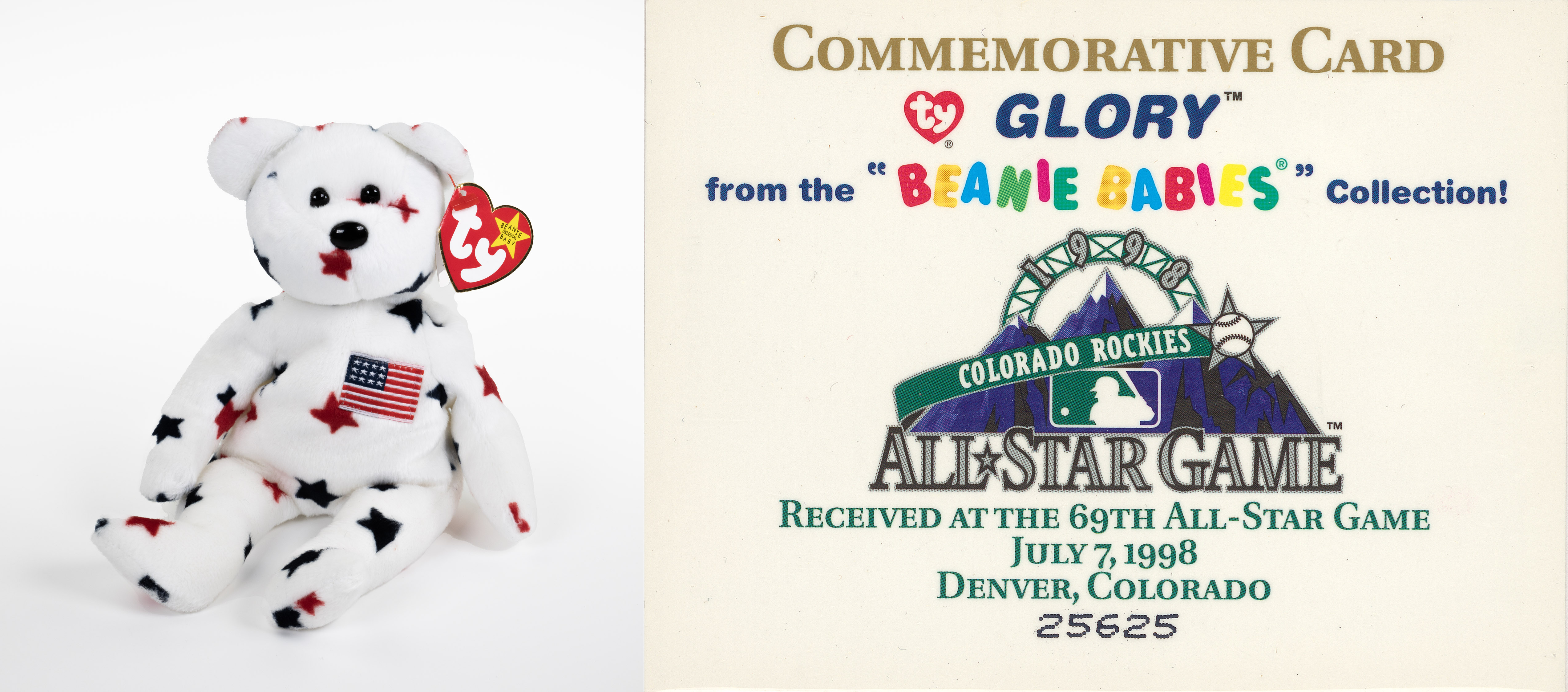
Glory, the bear given away at the 1998 baseball All-Star Game, alongside its commemorative card.
Beanie Bandits
The frenzy only intensified as the ’90s went on. Children were injured in stores as consumers stampeded toward new releases. Divorced couples ruthlessly negotiated for their most prized animal assets. An underground economy emerged for the understuffed toys. Criminals targeted everything from car dashboards to toy distributors’ vans. A burglar dubbed the “Beanie Baby bandit” swiped 200 plushies in a single heist. Scammers worked overtime. People forged checks to pay for rare first-generation toys like Honks the goose. Counterfeiters flooded the market with knockoff creatures sporting wonky snouts and dull eyes. One woman in Florida used fake auctions to fund home renovations instead of delivering Chilly the polar bear.
Meanwhile, groups of strangers banded together in online forums to avoid being duped. Experts in Beanieology taught people how to identify originals as opposed to fakes and re-releases. Apparently it had something to do with the type of plastic pellet it was filled with or its type of tag—I’m not sure, I never mastered that aspect. Had they known, the people filling the online forums would’ve insisted I wasn’t dedicated enough, that I’d never be able to compete in the intense online marketplace with such a blasé attitude. Sooner or later, if I didn’t pay closer attention, I was going to get swindled in this cutthroat world driven by understuffed animals like Humphrey the camel, Patti the platypus, and a tie-died bear named Peace.
The Beanie Collapse of 1999
As a growing adolescent, with what I’m pretty sure was undiagnosed ADHD, I became laser-focused on getting all the best Beanies, only to suddenly lose interest and abruptly shift my attention to exotic pets. In 1999, I resolved to create a terrarium where as many reptiles and amphibians as possible could peacefully coexist. The only way to raise the money for such an endeavor was to sell my collection. So, one day I sat on a corner near Belleview and Federal, and held up a poster board to passing drivers that read “Beanie Babies For Sale” Dozens of cars nearly got in accidents as they whipped u-turns in order to get to my pop-up shop on a grassy Littleton hill. There was no time for them to legally drive to my blanket-based Beanie store. What if I had the most sought after, discontinued Beanie Babies? I made about $150 that day, a testament to the Beanie mania that gripped Denver as much as it did the nation. As soon as I could, I got a ride to the closest PetsMart and bought everything I needed to start my terrarium.
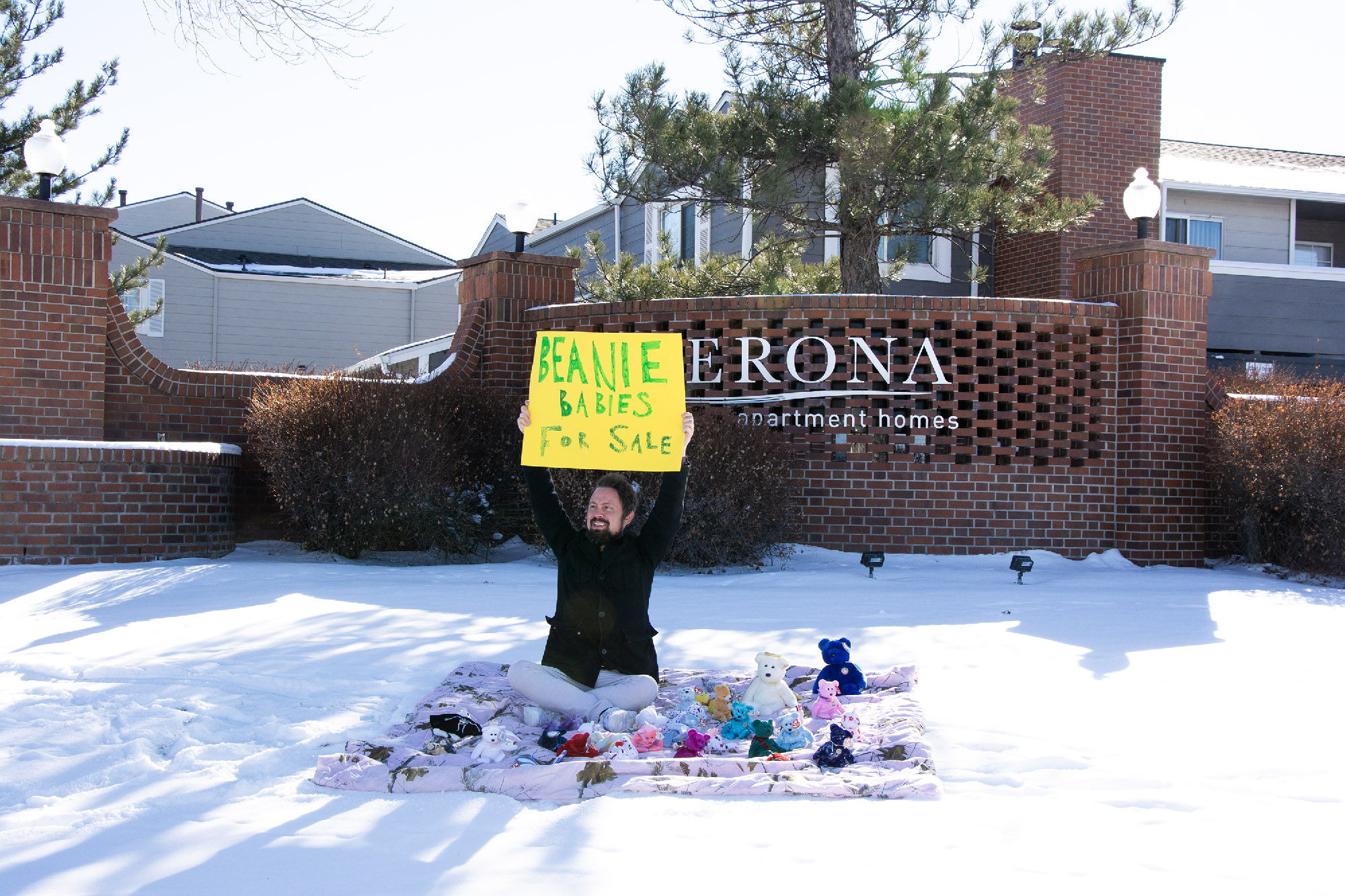
Jeremy Morton recreates his blanket-based Beanie store on the same corner twenty-five years later.
It turned out I bailed on my Beanies at just the right time. Later that year, the market abruptly collapsed. If only I had the same foresight with my Pog collection. Those stuffed animals I sold just months earlier—the ones people nearly wrecked their cars to get—were suddenly worthless. Just like the gold-hunters flocking to the Rockies in the late 1800s hoping to strike it rich, some Beanie collectors cashed in big, while others were left holding the bag when the frenzy fizzled. It was a small-scale replay of the booms and busts that have shaped Colorado's history. The silver crash of 1893, the oil shale bust of 1982, the Beanie Baby collapse of 1999—these moments share a common thread in Colorado history.
So, those Princess Diana bears never did make us as rich as we’d hoped. I eventually traded mine for a Terrell Davis football card. Mom still has her bear, and hopes that the Beanie Baby market will return. She even bought plastic tag protectors to keep the most valuable plushies in mint condition. Her collection lives somewhere in the basement awaiting the return of the Beanie Baby to its rightful place atop the e-commerce foodchain. Maybe the market will return one day. Probably not. But she hung on long enough for her Diana bear to make it into an exhibition at the History Colorado Center.
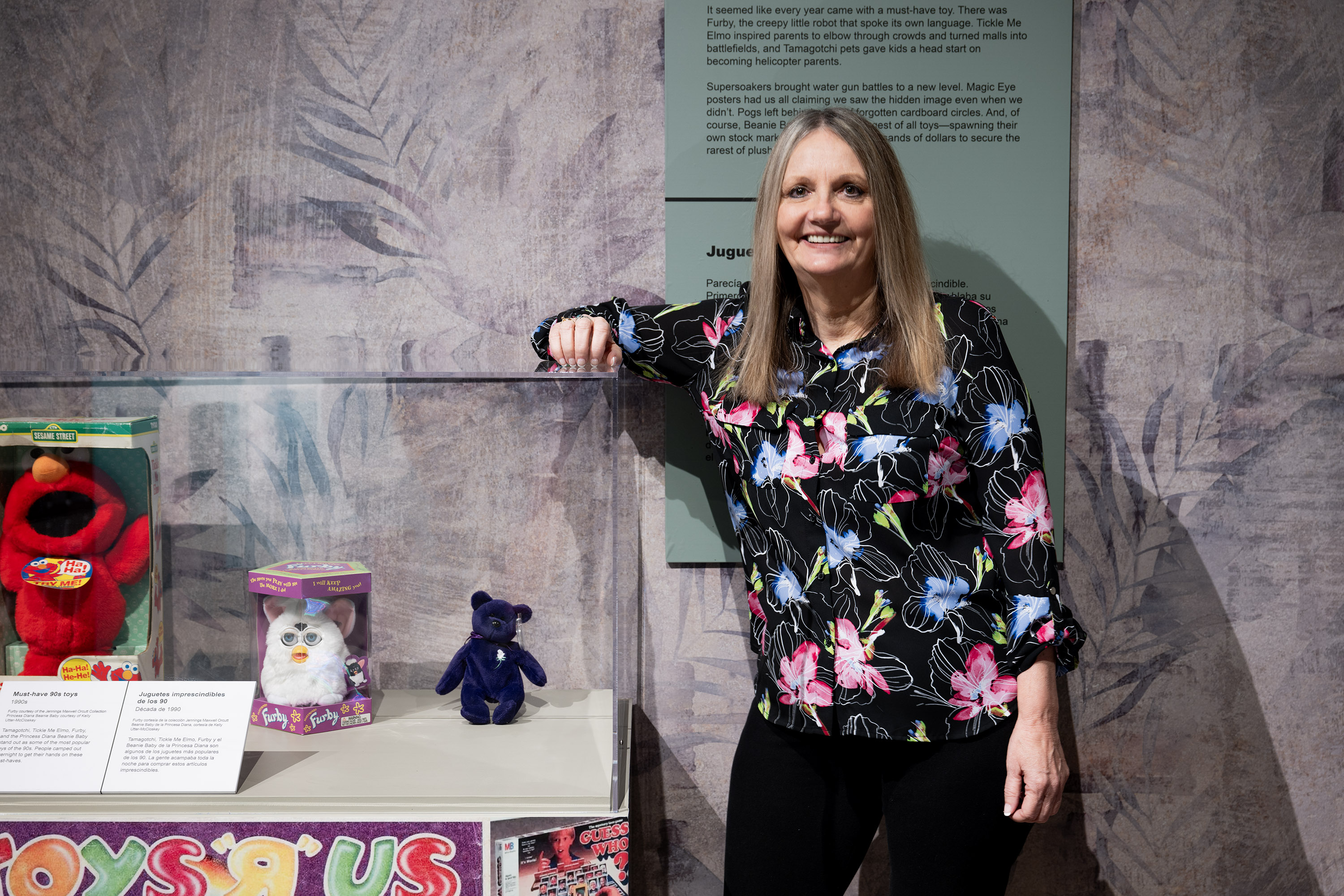
Kelly Utter-McCloskey next to her Princess Diana bear in History Colorado’s exhibition The 90s: Last Decade Before the Future.
A Candle in the Wind
It’s easy to look back and trivialize Beanie Babies, even to mock the people who built an entire economy around buying and selling those beanbag animals. But it’s no exaggeration to say that Beanie Babies normalized the online marketplace for thousands of people. The Beanie boom accelerated the growth of the internet and made thousands of people comfortable with e-commerce—mom and me included. I’m sure shopping on the internet would’ve become popular even if the Ty corporation hadn’t captured our hearts and wallets, but the fact is they did. As a result, the history of online shopping will forever be inextricably linked to the rapid rise and abrupt fall of Pinchers the lobster, Waddle the penguin, and Chocolate the moose.
For Mom and me, Beanie Babies came and went like a candle in the wind, but their footsteps will always fall there along Littleton's greenest hill. Their market burned out long before their legend ever will.