
 Membership
 Donate
 Shop
Shop




















Cow Talk: Work, Ecology, and Range Cattle Ranchers in the Postwar Mountain West
A review of Michelle K. Berry's 2023 book.
Editor's note: This review comes to you from the Colorado Book Review. More reviews can be found at the Denver Public Library.
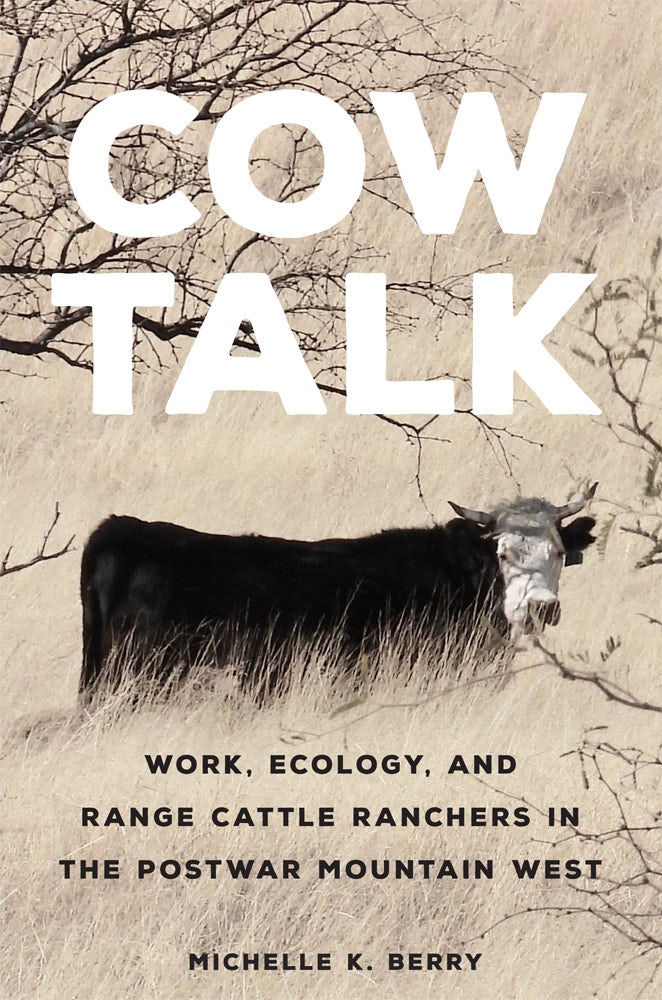
Settling down one evening to review Berry’s book, I found an unexpected narrative that proved to be incredibly more intriguing than I had anticipated. I thought I was delving into a book about ranch history and the ecology of raising and working with cattle. Growing up, I spent time with my grandfather, a cowman in southern Utah, and I was partially familiar with the topic. However, as I read the stories rich with ranch jargon and lingo, I recognized Berry had assembled much more than a ranch and ecology guide. In Cow Talk, the reader will come to understand the connection ranchers across the Mountain West have formed with one another, their collective organizing strategies, and the contemporary political and economic issues they faced. Cow Talk examines environmental, agricultural, and governmental issues associated with ranching while providing the reader a glimpse into the substantial nonhuman world ranchers live in. Through narrative and visual examples of what Berry calls “cow talk,” she explores how ranching has influenced politics, culture, and natural resources in Mountain West states between 1945 and 1965.
The narrative is supported with a lively collection of antidotes, stories, cartoons, and images that both support and define “cow talk.” As Berry states, ranchers “loved their cows and worried about nearly everything from bugs to wolves to even, ironically, sagebrush” (209). They liked to talk with other ranchers who understood their language. “Nothing connected ranchers through cow talk more than cows” (p. 206). According to Berry, “cow talk” is the vernacular that ranchers used to make sense of their ever-changing rural lifeways. During and after World War II, road building became common through pristine rural grazing lands. These same ranch lands were increasingly encroached on by hunters who did not always know the difference between wild game and a cow. Urbanization and tourism presented other forms of conflict. “The increased presence of ‘dudes’ (as ranchers disdainfully referred to non-ranchers) created a need for cow talk” (29) and outsiders were the focus in many pages of ranch and stock grower publications.
As change continued, ranchers memorialized and created a heroic past, one that Berry argues drew “connections from their cattle baron predecessors in order to stake a claim on legitimacy in the newly alienating modern era” (p. 154). As ranchers engaged in conversations about things they valued and feared, their collective cultural and political group identity grew strong. Cattle, as Berry describes, are known to congregate in groups around a salt lick, a block of salt set out in pastures to ensure they get enough salt in their diet. Ranchers likewise congregate in groups through associations, newsletters, stock grower magazines, and even cowboy poetry. Throughout her book, Berry’s extensive research into archives and stock grower records is evident. “Cow talk” she explains, “illuminates the means through which ranchers continued their quests for power after the glory days of the open range” (p. 211). Collectively they established an “assurance of the critical contributions they were making to society”(p. 211).
Berry also tackles the role of ranch women with captivating documentation. For instance, women’s auxiliary chapters, known as Cowbelles, organized social events, supported one another, and created marketing campaigns to encourage the consumption of beef. One prevalent slogan was, “Lil’Dudette eats BEEF…You bet!” (p. 144). The slogan was used in ads sporting a drawing of Lil’ Dudette, a caricature of a young woman “with blonde hair, cowboy-like accoutrements, and sexy short shorts” (p. 144). After a few years, Dudette was replaced by Barbie Q, a Hereford cow who walked upright on two legs, used ranch lingo and jargon and, on the pages of Cow Country, gave out recipes for cooking beef and everything else from talk about cattle conventions, ranching modernization, or breeds of cattle (p. 149).
Cow Talk is an informative look at ranching in the Mountain West detailing conditions and elements of ranching that very likely contributed to the 1970s sagebrush rebellion. I recommend this book to anyone interested in ranching history in the Mountain West, specifically the states of Arizona, New Mexico, Colorado, Wyoming, and Montana. and how the power of shared identity can connect community, environment, and society in a changing and challenging world.