
 Membership
 Donate
 Shop
Shop



















The Legend of La Llorona
A conversation with Adele Aguilar, southern Colorado actress, artist, and storyteller.
Ghost stories are one of those things that bring us together. They bridge cultures and generations and even cross borders. In Hispano, Chicano, and Mexican communities across the Southwest, the legend of La Llorona (“the Crying Woman,” in English) is one of the most popular ghost stories. It’s one that has endured hundreds of years, evolving each time it’s told and changing from family to family, but this common story—often told as a warning for children to stay away from dangerous waterways—links millions of people, past and present.
This story is experiencing a resurgence lately, likely because of La Llorona being featured in some popular media, including two movies in 2019. In Pueblo, where a project is ongoing to resurrect the world record-holding Arkansas River levee mural, a painted image of La Llorona now looms large on a levee for anyone visiting the river to see.
This spooky season, we caught up with Adele Aguilar, a southern Colorado actress, artist, and storyteller whose life has been interwoven with this story from the first time she heard it from her grandmother on an old Hispano homestead not far from Trinidad.
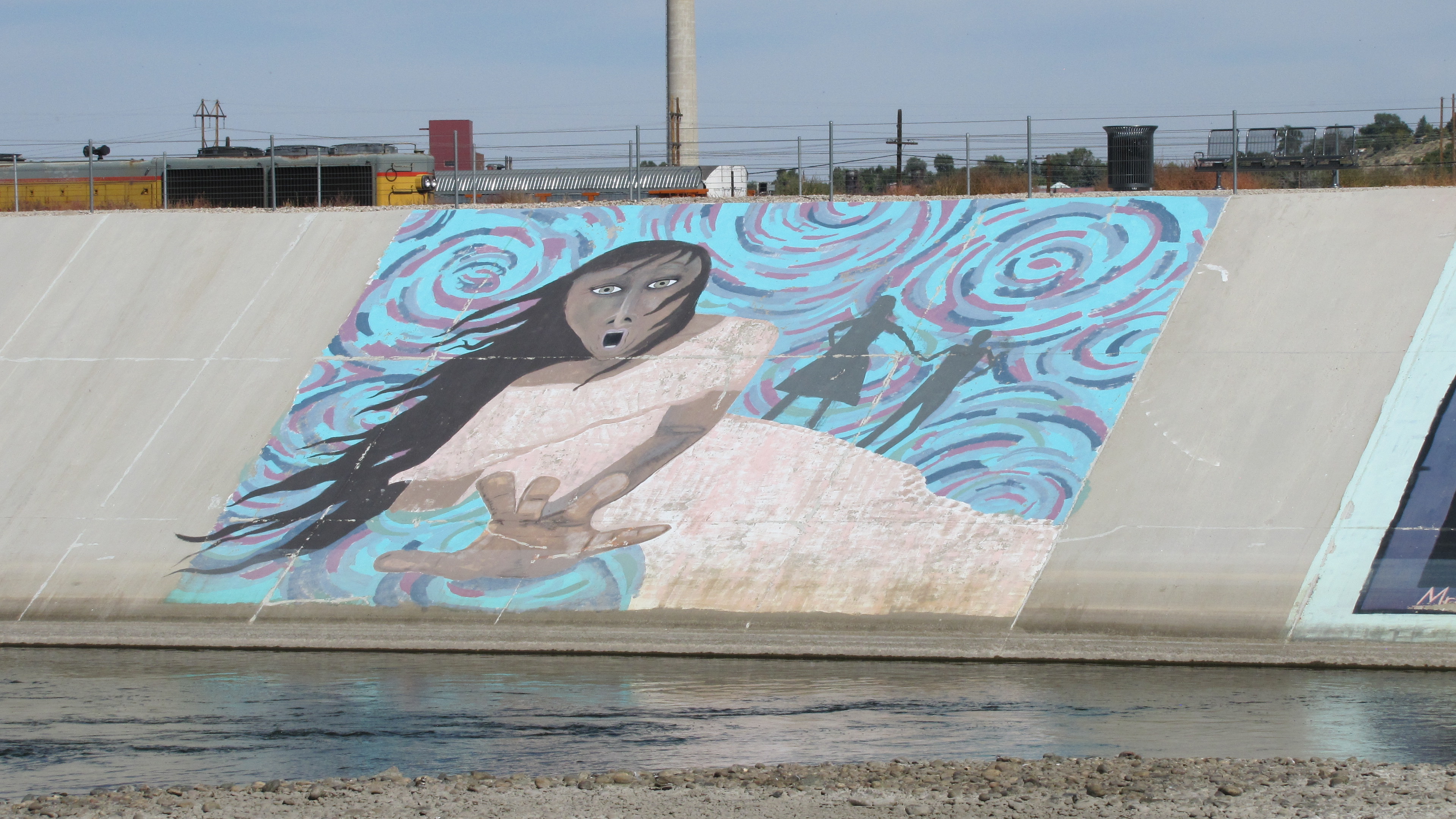
A mural depicting La Llorona on the Arkansas River Levee in Pueblo, painted by Adele Aguilar.
Tell us about the first time you heard the story of La Llorona.
My grandma was real animated in telling us stories. I now live where my grandmother grew up, on our homestead which was founded in 1808. It’s right along the Purgatoire River, in a town called Hoehne, Colorado. My grandmother would tell stories about the river, and La Llorona would come up. I grew up in a different time. Back then, when we’d hear the story from our grandparents, we were in a house with no electrical lights…so when it got dark, it was really dark! So of course, every sound at night seemed exaggerated. Every sound made you think that La Llorona was real and is coming for you.
What has the story of La Llorona meant to you?
She's been part of me all my life, and playing her for two years, she became a part of me. I have been a volunteer and actress in Pueblo for about thirty years, and the role of La Llorona came to me a few years ago while volunteering for the Pueblo Historic Ghostwalk. They were kind enough to let me rewrite the story to fit more how I had learned it as a child. I also painted La Llorona on the levee, when they opened up the Pueblo Levee Mural Project again.
What is the legend of La Llorona as you know it?
This is the version of the story I grew up with.
My grandma told us that La Llorona was an adelita, a type of female soldier, in a war. She fought alongside her husband, for her community and for her culture. Her husband died in one of the battles. After the fighting, she settled in a little town, which she made her home. She was fine up until she met another man, who happened to be the son of a Spanish rancher. So even though he courted her and they had children together, they can’t stay together because she’s Mexican. She carries on with her life, and is fine, until he comes back with another woman—and now he’s threatening to take her children away. So she went to the river, crying, and asks the river what she will do with her children and how she will carry on. In a moment of insanity, she heard the river speak to her, and it says that it will take care of her children. She threw her children in the river.
Realizing what she’s done, she dove in after them to try and find them, but she couldn't. She crawled ashore and died of heartbreak. The townsfolk found her the next morning and, knowing what she’s done, they buried her in a shallow grave. But that night she rose again to search for her children, and she’s done that every night since. That’s the story we tell to our children, as a warning, to say: Stay away from the river, or La Llorona will take you away.
What was it like painting La Llorona on the levee?
We had a lot of fun putting it up there! It came together well. She really comes out, with her hand reaching out to you. She’s also in front of a whirlpool, so when kayakers go down the river they get stuck in front of her for a while. It’s a great location. I remember back in the day, when they were painting the levee for the first time—when they weren’t allowed to paint it—my ex-husband knew some artists who were doing that. They would come running to our house and hide there after painting, and I’d get them all coffee. I wasn’t very involved back then, but it’s great to be a part of it now.