
 Membership
 Donate
 Shop
Shop


















Lost Highways
Set in Stone
Season 5, Episode 6
Since the racial justice protests of 2020, when most people think of monuments being torn down, they think of confederate statues in the south being toppled from their pedestals. But a Civil War monument to Union soldiers that stood in front of the Colorado capital for more than a hundred years was also pushed over during the protests that followed in the wake of George Floyd’s murder. On this episode, we’ll look the ways History Colorado has pioneered a new approach to dealing with controversial monuments. We’ll also take a look at what monuments should mean, the purpose they serve in maintaining our cultural narratives, and the challenges of reframing those monuments as the stories we tell ourselves about the past evolve over time.
Guests: David Allison, Derek Everett, Julian Chambliss, Jose Zuniga, Jason Hansen
Resources:
- David B. Allison (Ed.) - Controversial Monuments and Memorials - A Guide For Community Leaders
- The Civil War Monument "On Guard"
- History Colorado Displays Civil War Statue Toppled Outside the State Capitol by Spencer Campbell
- Changing of the Guard (2023)
Set in Stone
Speaker 1 Lost Highways from History Colorado is made possible by a major grant from the National Endowment for the Humanities: Exploring the Human Endeavor, and by the Sturm Family Foundation, proud supporters of the humanities and the power of storytelling for more than 20 years.
Noel Black In 2018, Jose Zuniga was asked to write an essay for the book "Controversial Monuments and Memorials - A Guide for Community Leaders" for the American Association for State and Local History.
Jose Zuniga I'm Jose Zuniga. I'm an informal educator and performer at the Denver Museum of Nature & Science. I've been in informal education for almost 15 years.
Noel Black As he was thinking about how to explore the topic in an accessible way, he found inspiration in an unexpected place.
Jose Zuniga And so that's when I hit on the idea of The Simpsons. You know, because I've been a big fan for most of my life, and I think that's true for a lot of people. They talk about everything, you know, Simpsons did it. So that's why I went with them.
Noel Black In its nearly four decades on the air as a topical, observational, and sometimes even prescient satire of the American family, The Simpsons is a record of our cultural trends and anxieties.
Jose Zuniga There's the episode where Lisa discovers that the founder of Springfield was actually this con man, you know, and the whole episode revolves around, you know, what's the truth?
Speaker 1 What would you say if I told you that Jebediah Springfield wasn't as great as he's cracked up to be? Look, he was one of the evilest men of the 1780s. He even tried to kill George Washington.
Noel Black The episode, which first aired in 1996, could easily be set in 2017 or 2020 or 2024.
Jose Zuniga But obviously, the citizens of Springfield put the statue up of him and it was important to them, and that's true for all of the monuments that the people invested time, money and effort to put up. And they all had agendas. You know, everybody just, they know Jebediah Springfield founded Springfield. They know the myth. They understand. And I think that there is this idea that these monuments just become a set dressing for our lives.
Noel Black And they often go completely unnoticed until some cultural flashpoint suddenly makes them the subject of everyone's most strongly held opinions.
Jose Zuniga Lisa goes to the Springfield Historical Society for a, you know, sort of school assignment and is looking at some of the artifacts from the founder of Springfield, Jebediah Springfield. She spends the whole episode trying to convince the citizens of Springfield of the truth.
Noel Black But when it comes to history, the truth can be a fuzzy thing to nail down.
Jose Zuniga It's right around the Springfield bicentennial and the historian, is, you know, trying to conceal the truth, and there's all this grappling with what should and should not be told. And then at the end of the episode, when they're kind of on the same page to tell the people of Springfield about, this, you know, sort of, I guess, betrayal, you could say, or misunderstanding, she decides not to do it, and, she says that, you know, that's the best choice for the town.
Noel Black Jose says that in The Simpsons, just like in real life, these matters are complicated. And Lisa found it easier to let the dominant narrative continue, rather than swim upstream and break the story that made people feel comfortable with their past.
Jose Zuniga And she's surprised when the people of Springfield are not responsive to her trying to knock down this person they've mythologized. And then at the end of the episode, she has a complete about face. She completely, you know, says, well, actually, it's more important, the myth is more important than the man.
Noel Black Monuments, like history, says Jose, are about the stories we tell ourselves. And those stories are representations of who has access to the power to define public memory and the historical narrative. From History Colorado, this is Lost Highways - Dispatches from the Shadows of the Rocky Mountains. I'm Noel Black. On this episode, we explore different approaches to dealing with controversial monuments through the lens of one of Colorado's most prominent and contentious sculptures. We'll discuss the purpose monuments serve in maintaining our cultural narratives and the challenges of reframing those monuments as our narratives evolve with the times.
Jason Hanson I think monuments are something very specific. They are objects or otherwise, attempts to convey knowledge and wisdom from past generations to the present about what happened and what they hope we can learn from it so that our experience is better. That's the most generous interpretation of what a monument is.
Noel Black This is Jason Hanson, chief creative officer at History Colorado.
Jason Hanson And so the way I think about monuments, it is absolutely the statues. Those are probably the most visible types of monuments. But the names we give our parks, our streets, our public buildings, our squares - all of that is part of this narrative that we are just, we're so immersed in it that we're just swimming in it like water that we don't notice anymore. It is all around us, and it is meant to help us understand our world today in a very particular sort of way.
Noel Black Derek Everett is a historian at Colorado State University and Metropolitan State University, Denver. He's also been giving tours at the Colorado State Capitol for almost 30 years.
Derek Everett For me, when I think of a monument, a memorial that's set up especially in, in a very public place, a park, the grounds of a courthouse or a capitol building or whatever, the community is essentially saying this, this is a story that's important to us and we want to remember it. You are essentially trying to shape the narrative for future generations that we want you to think of this place and this time through this lens.
Noel Black Derek says that monuments, like history, are crafted by the victors.
Derek Everett How you choose to design a monument, what you choose to memorialize, whether it's a statue or a stained glass window or whatever is, is going to be a statement of power. It's going to be a statement of memory and interpretation and trying to control how memories, how stories are interpreted, how they get passed on and in what form and format.
Noel Black But the United States might be one of the only countries in the world that has over 1,500 monuments to losers.
Derek Everett When it comes to Confederate monuments in southern states that were mostly erected early 20th century, the Jim Crow era, trying to, to whitewash the Confederacy, it's, you know, it was all about states' rights and protecting the, the right of local communities against tyrannical national governments. When, of course, you go back and you read the secession declarations and they make very clear, we're doing this to protect the institution of slavery. This is why we're causing this rebellion. The, it's as, the Confederate vice president said that the cornerstone of Confederate society is human enslavement.
Noel Black These monuments have always been offensive to the Black people whose ancestors they fought to keep in inhuman conditions of bondage, who have to see them on a day-to-day basis. But in our national consciousness, they've existed largely as background noise, only becoming relevant again during flashpoint times of social unrest, or when those who want to reframe the narrative are met with violence as a last attempt to preserve their narrative.
Julian Chambliss My name is Julian Chambliss. I'm professor of English at Michigan State University, I'm also the Val Berryman Curator of History here at the MSU Museum at Michigan State.
Noel Black In 2015, Julian participated in a performance art piece where a funeral was held for the Confederate flag in all 13 former Confederate states.
Julian Chambliss Obviously, because what we were doing, kind of struck at the very heart of, like, southern mythology around the Civil War, much to my sort of chagrin, in a way, because I was like, hey, it's 2015, surely, people. But, you know, I was being naive and people were very, very upset. And I think everybody got death threats and accusations of "we will get you" and "if you show up to do this, we will shoot you" and all these other things. But it sort of reminded me of the sort of potency of the mythology around these things.
Noel Black Julian faced personal backlash, too, and he was disappointed, but not surprised.
Julian Chambliss As a historian, I knew well why it was happening. As a human being, I was sad of the reaction sometimes. People call my school, he should be fired. Threatening emails. The president got threatening emails. School got threatening email.
Noel Black The art project was, maybe, ahead of its time, if only by a little bit. Later that year, Dylann Roof walked into a Bible study at a Black church and killed nine people and injured a 10th in an attempt to ignite a race war. His manifesto and website were littered with white supremacist iconography, including many instances of the Confederate flag.
Julian Chambliss And then after the massacre of the people in the church, everyone was, like, okay that I did it. And then all this stuff happened with the Confederate flag. And I always felt a little like, man, it took the murder of people in a church for you to see.
Noel Black Then, in 2017, the Unite the Right rally would bring white supremacists and neo-Nazis from around the country to protest the removal of a statue of Robert E Lee. There, more violence broke out, resulting in another death, and Confederate monuments would again become the subject of much controversy and violence in 2020, after the police murder of George Floyd led to protests and riots nationwide.
Julian Chambliss Often, monuments are not actually tied directly to facts about the past. They are tied more directly about how we wish to feel about the. Sometimes those, that, that distortion is primarily neutral, slightly benign, but sometimes it's really hostile.
Noel Black Confederate monuments are a perfect example of that hostility. Here's David Allison, editor of the book "Controversial Monuments and Memorials - A Guide for Community Leaders", the same book for which Jose Zuniga wrote his Simpsons essay.
David Allison One thing that people should always do when you consider a monument is, what is the context in which this monument was erected, and looking at that time period, because often that time period is different than even the time period that whoever the individual was that's being memorialized in the statue, they might have lived, you know, 50, 30, 20 years prior.
Noel Black And when were these Confederate monuments put up?
David Allison The vast majority of statues to leaders of the Confederacy were erected between, like, 1910 and 1930. And then there's another wave, actually, during the Civil Rights Movement. And so then you look at what was happening then, and this was an opportunity for white Southerners, after Reconstruction, to reassert their dominance, their power over Black people, and to do that quite visibly through erecting monuments. And so that to me, is, is really the key.
Noel Black Julian Chambliss.
Julian Chambliss The periods that these statues are put up are direct responses to an effort to control and react to any sort of narrative of African-American freedom or liberty, and they are an attempt to control space and control narratives around space.
Noel Black The wave of Confederate monuments that went up in the Jim Crow era was primarily sponsored by groups like the Daughters of the Confederacy.
David Allison More rights were being granted to African-Americans, and so the response then was to relitigate what happened during the Civil War. This idea of the Lost Cause narrative emerges, and white Southerners are able to say, naw, it was really more about our heritage, it wasn't about slavery. And use this as kind of a smokescreen to justify, you know, erecting these, these statues.
Noel Black The so-called Lost Cause narrative was an essential part of whitewashing the Confederates' motivations in the Civil War. It first developed in the early 20th century during Reconstruction, and came back with a vengeance in the 1950s and '60s during the Civil Rights Movement. It cast the Confederacy as a group of noble heroes who were simply outmatched against the resources and manpower of the Union, and most importantly, frames the cause of the war as being about States' Rights and tyrannical government overreach, rather than slavery. This is in direct contradiction to the words of the Confederate founders themselves.
David Allison And, I think it bears mentioning that when we talk about the Confederacy, we're really talking about a group of people who wanted to destroy the United States government and fought against the United States, United States soldiers. So, so we're, in fact, talking about a rebellion against the United States, of which we are now part of. And so it bears, I think, mentioning that the Confederacy, you know, it's not just some sort of a mild little rebuke of, federal power, but instead it really is, a violent rebellion that sought to destroy, the United States.
Noel Black Julian Chambliss again.
Julian Chambliss And, these are narratives that are about white supremacy. They're not about the actual facts of the war. These are markers that very, very publicly place at a moment that remind and demean people of color, then that becomes a kind of accepted narrative that is reinforced by Jim Crow segregation, right, so you're putting these markers in public spaces, and you're also creating a de facto social economic, cultural narrative about control around Black bodies, around Black space, about, the use of violence.
Noel Black And Julian says that one reason people get so deeply upset when it comes to recontextualizing these monuments or taking them down, is that our understanding of the present and future are inextricably tied to the stories we tell ourselves about the past. And when our ideas about the past are thrown into question, it can jeopardize our very sense of who we are. If someone asks, why is this problematic monument still standing?, they eventually have to also ask, how did this monument get here in the first place?
Julian Chambliss So you basically end up arguing about the past because you're arguing about right now, because if you're able to question the past in meaningful way, then you question how you got here.
Noel Black And, says Julian, you have to question who put it there. But narratives and revisionism aside, the facts of history tell us that the Civil War was about slavery and slavery was about money, and the money from slavery wasn't limited to the South.
Julian Chambliss Famously, there were people in New York City, because they made so much money from cotton, that were, like, advocating that New York leave the Union. There was so much money being made from that kind of agricultural hegemony of the slave economy in places like Boston, in places like New York, you know, the textile industry is a global industry, and they're financing things, they're insuring things, they're, they're making as much money as anyone.
Noel Black Add to this the fact that the country was continuing to expand westward, and though it's not often the focus of Civil War education in this country, the fighting went a lot further west than most people realize.
Derek Everett Glorieta Pass was a fight in the spring of 1862, essentially on what's now I-25, just outside of Santa Fe, New Mexico. There was a Confederate invasion that was moving north, basically with the goal of taking control of Colorado's gold fields, getting that gold for the Confederacy to be able to buy all the stuff they needed to fight the war.
Noel Black Derek Everett again.
Derek Everett And Colorado troops joined up with New Mexico troops at this fight at a, you know, a gap in the Sangre de Cristo Mountains, Glorieta Pass, where the Santa Fe Trail passed through. And it was a two day battle. The first day on March 26th, 1862, the forces kind of accidentally ran into each other, didn't realize they were marching toward each other, fought a little skirmish, and then retreated.
Noel Black Two days later, there was a bigger, more climactic battle.
Derek Everett The battle itself was essentially won by the Confederates, the fighting itself at Glorieta Pass, Confederate troops won that fight. It was the Union troops with Colorado and New Mexico that were retreating.
Noel Black But sometimes you can win the battle and lose the war.
Derek Everett In the midst of the battle, a faction of Colorado soldiers had slipped through the forest behind the Confederates and burned down their supply wagons. So the Confederates had won the battle, but they couldn't really keep the war going. They had lost all the supplies they needed to, to keep this forward momentum going, and it's the arrival of Colorado troops that helps to guarantee that Colorado will stay a Union territory, it will be protected for the federal side, and the Confederates don't get access to that essential gold. And if the South had had that influx of cash to buy the stuff they needed for the war, who knows how that might have affected the conflict.
Noel Black The Battle of Glorieta Pass, as well as Colorado's other contributions to the Union's victory in the Civil War, were commemorated by a statue called On Guard, which has long been one of the state's most prominently placed statues, and in recent years has become one of its most controversial.
Derek Everett There is no more important place in the state of Colorado than the Capitol building. It is the physical embodiment of all of the people of the state coming together. When you think about the state of Colorado, the diversity of landscapes and cultures, and political and economic attitudes and interests, there's so much complexity in this giant, invisible rectangle that we love so much.
Noel Black The Capitol, says Everett, is the place where people gather together from every corner of the state to debate what we want, what we need, and what makes us Coloradans.
Derek Everett What are our goals? What are our interests? How do we accomplish those? How do we define them and then set out to, to make them happen? And because of its role as the home of Colorado's democratically elected representative government, it is essentially the embodiment of the state of Colorado.
Noel Black In the early 20th century, 40 years after the end of the Civil War, the Lost Cause narrative was being established in the South, and Confederate monuments sprung up in every town.
Derek Everett And the Union veterans say, well, now, wait a minute, we want to make sure that our side of the story is being told. And so monuments start sprouting up at capitols and courthouses across the North and into the West, in places that were loyal to the Union during the Civil War, as, it's sprouting like crabgrass at the end of the 19th, early 20th century.
Noel Black In 1905, a group of Union veterans called the Grand Army of the Republic convened in Colorado. Jason Hanson.
Jason Hanson And they had come for an encampment, which was their word for a convention. They'd come to Denver and they looked around and said, where's the Civil War monument? And the city leaders embarrassedly said, oh, we, we don't have one of those. So the Grand Army of the Republic was coming back in 1909, and city leaders were going to be sure not only to have a monument, but to put it in pride of place in front of the Capitol, on the west steps.
Derek Everett And placing Civil War monuments on the west front of the Capitol was an incredibly powerful statement, because if the state Capitol is this unifying place, drawing people together from across this community, the west front that faces out to Civic Center Park today, that has the view out to the mountains, it's, it's essentially the stage of, of Colorado.
Noel Black Like all monuments, On Guard was meant to say something to future generations about who we are. And it wasn't placed on one of the most prominent vistas of the Capitol by accident.
Derek Everett What happens in front of the Capitol building is an expression of the community. It's the place where we gather to celebrate and to protest and to rally and to mourn the things that happen on the west front of the Capitol. It, it's tapping into that incredible imagery in the power of the Capitol building, symbolically. And the Civil War monument's location was, was a remarkable statement. This is what we're saying. Our role in helping to preserve the Union, as limited as it might have been, is something that we consider essential to the story of Colorado.
Noel Black As such, the lone soldier has had a front row seat to some of Colorado's most important historical moments, as who we are has evolved.
Derek Everett Because of its location, the Civil War monument, it gets drawn into every other event that happens on the west front of the Capitol building, it becomes almost like the scenery, part of the furniture of every rally and protest and event that takes place.
Noel Black It was there when Franklin Roosevelt spoke on the west grounds of the Capitol in 1936, and when Chicano protesters demanding better representation climbed on it during rallies in the 1960s.
Derek Everett And so the statue becomes like a, a, a platform of the First Amendment. You have this embodiment of Colorado's service to help preserve the Union, that then becomes this statement of free speech, of protest, of rally, of celebration. It, it's inextricably connected to every other big event. It's almost like it becomes an easel on which every group that follows is, is going to, kind of, broadcast, to project their cause, their concern, their interest. And so the Civil War monument has its own history from when it was created, but then it has a century of being incorporated into every other story that happens at this most essential place.
Noel Black Even in recent history, On Guard has watched over any congregation that happened in front of the Capitol or at Civic Center Park.
Jason Hanson Whether it was Super Bowl celebration, you can see people climbing on On Guard to get a better view or, immigration rally or Women's March, On Guard was, was in the middle of all of these big gatherings of Coloradans who were exercising, you know, their right to come out and and say what they thought, whether it was Go Broncos or Go Avs or Go Nuggets or, you know, we want things to be better.
Noel Black And, says Everett.
Derek Everett The plaque that was installed in 1921 had Sand Creek November 29, 1864 on it. So lumping the massacre together with the other battles, the Colorado troops that fought in actual Civil War battles, this has been an issue from the very beginning, although it didn't seem particularly contentious to, let's say, white Coloradans at the time.
Noel Black Sand Creek was not a battle. As we've said before on this show, many times, it was a massacre. It was the deadliest day in Colorado history. Colonel John M Chivington, who allegedly led the flanking attack on the supply train at Glorieta Pass, orchestrated the brutal slaughter of more than 230 Cheyenne and Arapaho elders, women and children at Sand Creek in what's now the Eastern Plains, 40 minutes north of Lamar, Colorado, on November 29th, 1864. Sand Creek should not have been included in Colorado Civil War monument, much less described as a battle, and for years, urban legend circulated that On Guard was actually a statue of Chivington himself, but the artist insisted otherwise. Here's Jason Hanson.
Jason Hanson They commissioned a local artist, John Dare Howland, who had himself been a private in the Union Army. He created the sculpture. He always said it was a composite of his comrades in arms, and I think if you look actually at pictures of John Dare Howland, it looks more like him than anyone else.
Noel Black Regardless, it's unsurprising that the people who erected the monument would have considered Sand Creek a battle or even a part of the Civil War. It was part of the story they were telling themselves in an attempt to cast themselves to future generations as the good guys.
Jason Hanson But it's important to note that Union troops here in Colorado weren't just here to hold the gold. Part of the, the project during the Civil War was, was clearing land for settlement, and that meant clearing tribes off of their traditional homelands. And so the Union Army, broadly across the West, was also involved in that project. During the Civil War, you also have the passage of the Homestead Act and the Transcontinental Railroad Act, so you've got a railroad being built to bring people west where they can claim land. But the problem is, of course, that land already belongs to the native people who live here.
Noel Black The union that northern soldiers were fighting to preserve was still and had always been a colonial project.
Jason Hanson So when we talk about, in this case, what this particular monument is meant to commemorate, it is meant to commemorate the actions of Colorado troops who fought for the Union during the Civil War. But we can't ignore the fact that some of those actions were clearing tribes off of their homelands.
Noel Black And the Sand Creek Massacre was among some of the most egregious efforts to do so.
Jason Hanson It was incredibly gruesome, even by the standards of the day. The United States Congress and the U.S. Army who were busy fighting a civil war, they stopped to investigate this after they heard of some of the atrocities committed by the troops, and it took them about six months to conclude that this was a massacre and something that was far outside the rules of military conduct, killing more than 230 of the people who were in those villages, mostly women and children, and then came back to Denver parading trophies from the battlefield, as they call it, which often meant body parts that they had taken from the victims of the massacre. But the people of Denver celebrated the troops as they returned. They had a parade. They auctioned off some of these trophies for charities to support businesses or organizations in the fledgling city.
Noel Black Though the massacre was condemned on the national level, Denver locals all but erased it from their memory, and their denial lived on in cultural attempts to remember Sand Creek as a battle, a narrative that still persists to this day in some circles.
Jason Hanson But, when it comes time to list all of the battles that Colorado troops fought in for the Union Army, right there on the plaque, the very last one listed is the Battle of Sand Creek, 1864. And I think it's pretty clear that that wasn't incidental, it wasn't just sloppy history, it was the culmination of this campaign to assert that people's friends and family and loved ones could not have participated in a massacre, that it had been a legitimate battle. And so they put it right there in bronze on the plaque meant to honor Colorado troops who fought for the Union. And there it sat. It was they, you know, this is that moment where all monuments are making an argument about the past. They are trying to leave us with something, they're making value judgments, and they were asserting and trying to advance a very specific value judgment that Sand Creek couldn't have been a massacre, despite what the U.S. Army said, despite what Congress said, despite what participants who had been there, like Silas Sewell and who had notified the authorities of, of what he saw. Eyewitness accounts. The soldiers closed ranks and their families closed ranks behind them and tried to just will it to be legitimate.
Noel Black Their will to make Sand Creek legitimate was part and parcel with the very idea of Manifest Destiny and westward expansion.
Jason Hanson And they may do heinous things in order to make it happen, but it was in service of the greater good, and so you get to some of those just terrible moments where people did atrocious things and you see pretty quickly, like in the case of the Sand Creek Massacre, this effort to repackage it as not so bad, part of the, the greater project, justified by that. And, from that point, I think it's a pretty easy step to say, well, how do we convey that to future generations? And one great way is to make a monument.
Noel Black And a monument, if nothing else, is set in stone. Or, in this case, bronze.
Jason Hanson And once you have that monument and you've got it standing there, and that is sort of the official version of the story, because bronze, if it conveys nothing else, conveys officialness. But I think once you have that official version codified in bronze, then the mythmaking really can begin, because you've sort of hit this, this milepost where we're not debating it anymore. We've, we've put it in bronze, people, it's got to be the official story, and now we can sing hymns about it and write fairy tales about it and all of the other things that people do to, to then create the myth.
Noel Black And so there On Guard stood, telling the story of the good guys for over a hundred years.
Jason Hanson And so, during the protests in 2020, after the murder of George Floyd and the, the calls for racial justice, On Guard was again right in the center. Our curators were out at the protests every day, photographing what was going on, talking with people who were out there, collecting items that would help us understand, you know, would help future generations understand what happened during the summer of 2020, why people made the decisions they made, how it worked out.
Noel Black Throughout the course of the protest, On Guard was covered in graffiti, signs and other expressions of civil disobedience. And on June 25th, it was toppled.
Jason Hanson I've been told that it was, there's evidence that it was not a spontaneous action, that it had been planned out, but regardless, when, when the next day broke, On Guard was laying very unceremoniously, facedown in the flowerbed.
Noel Black The monument was loaded onto a truck and taken away to an undisclosed location.
Jason Hanson And so I woke up to this news, like lots of people on that day, oh, the monument's been toppled. But our president, the director of the museum, Dawn DePrince, and I were texting about it, and she said, do you think we could bring it here to the museum? Because we had heard all those pundits saying, controversial monuments belong in museums. And we thought that was an interesting idea. And so I said maybe. And I made some calls, reached out to some contacts at the Capitol, found out that there was an openness to History Colorado, you know, keeping the monument safe while they decided what to do with it, whether it should be reinstalled, whether it should be moved.
Noel Black But the museum wanted to do more than just hang on to the statue and keep it in storage somewhere, like in Raiders of the Lost Ark. They wanted to recontextualize it and put it in an environment where it was neither background furniture for our daily lives nor the focal point of a protest. They wanted to put it in a space where people could really think critically about it.
Jason Hanson And we looked around, we thought, okay, we'll just see what the best practices are for doing this sort of thing. And we couldn't really find any. We couldn't find a recent example of any other museum taking in a controversial monument and then putting it on public display. We'd seen examples of some of those monuments going into museum storage, where they were available to researchers, but no one who had built an exhibition around a toppled monument. And so we had to invent the best practice, and we came up with a playbook that divided it into three phases.
Noel Black The first phase was to draw attention to the actions the monument was meant to commemorate.
Jason Hanson In this case, the activities of Colorado troops during the Civil War.
Noel Black The second phase looked at the circumstances under which the monument was created and installed.
Jason Hanson In this case, an effort to continue litigating that Sand Creek was a legitimate battle instead of the massacre that it was.
Noel Black And the third phase, what does it mean today?
Jason Hanson And we knew that that wasn't for us to say, that we are decades past the idea that museums get to be the hegemonic voice of the community, you know, that we get to say what everyone is thinking or should know. And so we knew we had to reach out to people, to stakeholders who would have views on the meaning of the monument today.
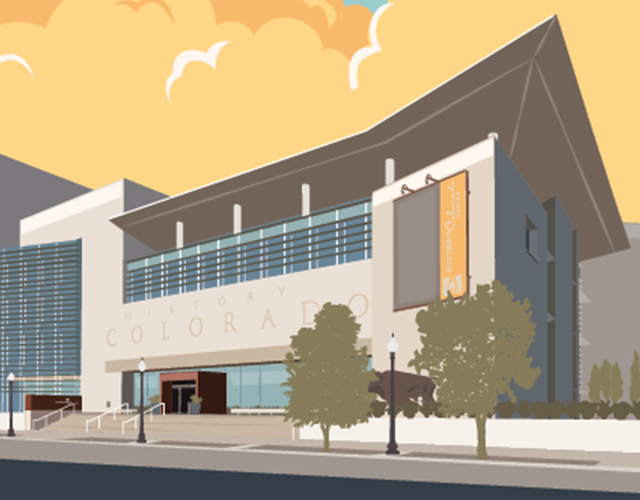
Noel Black The museum reached out to everyone they could think of: tribal representatives, veterans, community figures, historians, artists, Black Lives Matter activists. They took their feedback and made a display featuring those communities' interpretation of the monument and put it, along with the statue, in the middle of a spiral staircase at the History Colorado Center at 12th and Broadway in Denver. And in so doing, they took it off its pedestal, both figuratively and literally, and at eye level, where everyone could see it face to face. Then.
Jason Hanson We asked people to continue the conversation. We put two questions on the wall next to the monument. Do we need monuments and what should their purpose be? And we put out pads of post-it notes and pencils because for some reason, museums just love post-it notes.
Noel Black It wasn't long until the walls around the staircase were covered in post-it notes.
Jason Hanson That's been the best part of this experience is, we have dozens and dozens of post-it notes on the wall and people in really tiny handwriting writing out really thoughtful responses to those questions. And then sometimes people drawing an arrow to one of those thoughtful responses and writing a response to that response and these chains of conversations developing.
Noel Black And those conversations, says Jason, are the most important part.
Jason Hanson I think many of us have had the experience where we just happened to be walking past it, and you'll see people or a group of people approach it, and, you know, in my case, I saw a group of people approach it and you could tell one of them was just upset. They couldn't believe that we had put this on display.
Noel Black One visitor was shocked that the museum didn't clean off the graffiti that had accumulated during the protests before it was toppled.
Jason Hanson And this person was upset that we had left some of the graffiti on it, much less that, in their view, we had condoned the, the illegal activity of toppling it in the first place by then putting it in the museum, and then you could see the group walk up and start to read some of the perspectives and start to talk about it, and, you know, I'm not saying that we changed that person's mind. He was upset, but you could see the temperature come down and you could see them say, oh, look at this, you know, this person, this tribal representative is saying this, I hadn't thought of it in those terms before.
Noel Black Since placing On Guard on display in this way, other museums have started reaching out to History Colorado and learning how they can recontextualize their own controversial monuments. And.
Jason Hanson It's led to some renaming processes getting underway in Denver, although they've proved pretty contentious, and so the city seems to be moving cautiously and thoughtfully through that. We've recently seen the renaming of a mountain, two mountains, here in Colorado, names that were either outright offensive or just not reflective of who we want to honor anymore.
Noel Black The process, like any historical endeavor of reconciliation, is slow and ongoing. But Derek Everett says that treating these monuments the way History Colorado has isn't a bad place to start.
Derek Everett And engaging the community in such an effective way has been, as far as I'm concerned, the most valuable part of that exhibit, of including On Guard in that display. And I think that it has been a phenomenal tool, reminding people that history is not just the past, it's the present as well, how we think of ourselves today is very much a creation of how we have thought of ourselves in the past, and how we today think of the past and the stories in the past that have shaped us. So the use of On Guard in the exhibit at History Colorado, I think, has been an incredibly effective, useful tool for engaging members of the public in, in thinking about the world we live in yesterday and today, and hopefully giving a little bit of context for tomorrow.
Noel Black David Allison notes that context is rarely, if ever, black and white.
David Allison And so, then you have to start weighing or looking at these two different, groups and saying, you know what? What kind of community, how do we view this, together, collectively? And maybe there's a different path. And I think that's where the questions really get interesting, good and bad and, like, tarring people as evil or, you know, whatever. There's so much more complexity to individuals, to humanity, and, and being able to reveal that however we can, I think is really, more exciting to me than, than either saying hang our tail between our legs and say how terrible we are, or on the other side, lionizing people and glorifying the past. I don't think either of those paths is best.
Noel Black Jason Hanson.
Jason Hanson We have these moments where the narrative that upheld that particular or the narratives, the many, many narratives that upheld that particular understanding of the way the world works, starts to fray because it's usually insufficient. It doesn't account for all of the complexity, typically doesn't include all human experience. It often conspicuously leaves out particular people's experiences and once it starts to fray, you have this moment where we're looking for the new narrative, right? But you've got the, the group who wants to protect the one that they grew up with and that they know and they know how to operate within, and you've got another one saying, that's not going to work for us anymore, and we want to create a new one, and you've got, you know, it's far more than just two groups. It's many. It's, it's fractal. It's, it's multivariate contests over these narratives because ultimately, especially when you get to that crystallization process of which monuments are you going to put in the public space, it's saying, this is who we are.
Noel Black Jose Zuniga.
Jose Zuniga It's easy to fixate on somebody who is removed from you by several hundred years and say, this, oh, this person is responsible for all of this death and misery. Well, you know, there were lots of opportunities after him to, and now there are lots of opportunities to, to try and make things better, and so, it's not just, I think, on the one end of, you know, he's a person of pride, I think he also becomes a focus of ire. But it, it's not, in my opinion, as productive. Most effective monuments are the monuments that, that people can see themselves in. As a first person interpreter of history, dates, figures, things like that will not mean something to you unless you can see yourself there, whether that's building a connection or an understanding or a perspective that you can see yourself participating in. If it doesn't resonate with somebody, they're not, it's not going to work. You're not going to be able to tell the story that you want to tell.
Noel Black Jose was at the protest downtown the day before On Guard was toppled.
Jose Zuniga I was right there in front of the Capitol, and, you know, it had some wood put up around it. Somebody had climbed on it, spray painted the face, there was flowers on the, on the rifle. And I was like, I kind of felt like we should just leave this the way that it is now. You know, I think we should allow it to be a living part of the history of Colorado.
Noel Black However we approach monuments in the future, says Jason Hanson, we will continue to erect them. And it would be foolhardy to think that they won't be put up for the same reasons our predecessors installed them, or that they won't be subject to the same judgment in future generations. For Hanson, the answer is to remain humble.
Jason Hanson Maybe just the lesson here is that the people who create monuments from all of the best intentions, right, because they want to embody this knowledge and wisdom in ways that will inspire and benefit future generations, they should just also do so with humility, that the purpose of monuments is to provide useful information to future generations. And if they stop doing that, if they are no longer in sync with who we want to be, if we're not able to draw inspiration from them, then I think, you know, the people who are the owners of all history have a right to reconsider which monuments they want, sort of on pedestals, guiding them.
Noel Black Lost Highways is a production of History Colorado and History Colorado studios. It's made possible by a major grant from the National Endowment for the Humanities: Exploring the Human Endeavor, and by a founding grant from the Sturm Family Foundation, with particular thanks to Stephen Sturm and Emily Sturm. You can find links to other episodes of Lost Highways at HistoryColorado.org/LostHighways. Many thanks to Tyler Hill, who produced this episode. Special thanks also to Susan Schulten, our history advisor; to chief creative officer Jason Hanson; to publications director Sam Bock; to Ann Sneesby-Cook for her newspaper and periodical research; to Kim Kennedy-White for her voice work; and to History Colorado's editorial team, Lori Bailey and Devin Flores. If you'd like to see a transcript of any of our episodes, either as a matter of accessibility or because you'd like to use Lost Highways in your classroom, you can find them at HistoryColorado. org/LostHighways. The Merry Olivers composed the music for this episode and our theme is by Connor Brigall. Many thanks to our editorial advisors Shawn Boyd, Eric Carpio, Terry Gentry, Chris Jurgens, Aaron Marcus, and Ann Sneesby-Cook; and to our advisory group Susan Schulten, Thomas Andrews, Tom Romero, and Kara DuGuette. Finally, a huge thanks to the entire staff at History Colorado. And thanks for listening. I'm Noel Black.