
 Membership
 Donate
 Shop
Shop

















Press Release
History Colorado Proudly Presents Smithsonian Exhibition Exploring Prevalence of Indian Images, Words and Stories in American History and Contemporary Life
Fort Garland Museum will be the first of five museums in Colorado to host acclaimed Smithsonian traveling exhibition, “Americans”
FORT GARLAND — September 9, 2025 — A renowned traveling exhibition from the Smithsonian’s Museum on Main Street and the National Museum of the American Indian will be featured at select History Colorado community and affiliate network museums starting September 13, 2025, through July 2026.
PRESS CONTACTS:
History Colorado: Jeannie McFarland Johnson, Director of Marketing and Communications
720-840-1914 | hc_media@state.co.us
Smithsonian: Jennifer Schommer, Assistant Director of Public Affairs, Smithsonian Institution Traveling Exhibition Service
202-633-3121 | schommerj@si.edu
Five History Colorado community and affiliate museums have been selected to host “Americans,” which explores how deeply intertwined American Indians are in the history, popular culture and identity of the United States. The exhibition is part of the Museum on Main Street program—a partnership between national, state and local organizations to bring exhibitions and programs to rural America. The exhibition will tour five communities in Colorado, beginning at the Fort Garland Museum and Cultural Center on September 13. Following an eight-week series, the exhibit travels to the Trinidad History Museum opening November 15. Additional sites that will host this landmark exhibition across the Centennial state are the Breckenridge Welcome Center Museum in Breckenridge, the Overland Trail Museum in Sterling and the White River Museum in Meeker. In total, “Americans” will travel to small towns across approximately 20 states throughout the next six years. A full itinerary of the traveling exhibition can be found here.
Based on a major exhibition at the Smithsonian’s National Museum of the American Indian in Washington, D.C., “Americans” highlights the ways in which American Indians have been part of the nation’s identity since before the country began. Images of American Indians are everywhere, from imagery on commercial products and professional and high school sports mascots, to classic Westerns and episodes of Seinfeld and South Park. Indian names are everywhere too, from state, city and street names to the Tomahawk missile. Beyond these images and names are familiar historical events and stories—Thanksgiving, Pocahontas, the Trail of Tears and Battle of Little Bighorn—that have become part of everyday conversation.
Through photographs, hands-on interactives, objects and videos, the exhibition offers a new way of understanding a country forever fascinated, conflicted and shaped by its relationship with American Indians.
A short, animated film, The Invention of Thanksgiving, provides a whimsical take on how a simple meal shared between Native Americans and early English settlers evolved into a central part of America’s traditional origin story and a national holiday.
The exhibition examines three stories that are part of American national consciousness and popular culture. The first is devoted to Pocahontas, the young Powhatan woman who played a key role in saving the colony of Jamestown. Another story explores the Indian Removal Act of 1830. Signed by President Andrew Jackson, the act envisioned a United States without Indians. One of the boldest and most far-reaching laws in American history, removal transformed the country—generating great wealth for the nation and catastrophe for Native Americans. The third looks at the complicated story of the Battle of Little Bighorn, also known as Custer’s Last Stand. The “Americans” exhibition explores how these events have been remembered and represented throughout the years.
The exhibition title is a play on words and nods to the name originally given to this country’s Indigenous inhabitants by Europeans. It is meant not only as a reminder of the primacy of American Indians in the territory known as the United States but also of the tangled relationship between Indians and the people now called Americans.
With support from History Colorado, each location will host public programs and facilitate educational initiatives to explore this complicated history further and share local stories about Native American identity and representation in American culture. In partnership with the Arapaho, Cheyenne and Ute Tribal communities, each location will host a dynamic speaker program that openly discusses the challenges in preserving and presenting the unique history of the region, and the community's shared experiences.
"We are proud of and grateful for the chance to share this remarkable and eye-opening exhibition with museum visitors in rural communities across our state over the next few months," says Philip Gover III, senior director of Tribal and Indigenous engagement at History Colorado. "These critical Indigenous and Tribal stories are interwoven in the fabric of our country. It is vital for all of us, regardless of our background, to hear them and understand why they are important."
History Colorado is committed to serving all Coloradans and offers access to national and state history through enriching experiences across its network of 11 community museums and historic sites, as well as at more than 100 Affiliate museums and organizations throughout the Centennial State. A Smithsonian exhibition team choosing History Colorado's rural museums and affiliates for this prestigious display speaks to the caliber and credibility of those organizations' dedication to telling a more complete history.
Support for Americans is provided by the Smithsonian’s Our Shared Future: 250, a Smithsonian-wide initiative commemorating the nation’s 250th. Signature support for Smithsonian’s Our Shared Future: 250 has been provided by Lilly Endowment Inc.
About Museum on Main Street (MoMS)
MoMS is a collaboration of the Smithsonian Institution Traveling Exhibition Service | Smithsonian Affiliations and state partner organizations. It serves museums, libraries and historical societies in rural areas, where about one-fifth of all Americans live. The partnership brings exhibitions, educational resources and programming to small towns across America. MoMS has visited all 50 U.S. states as well as Guam and inspired over 1,900 towns to rediscover their local histories while finding a renewed sense of community pride. Visit online at museumonmainstreet.org.
About the Fort Garland Museum & Cultural Center
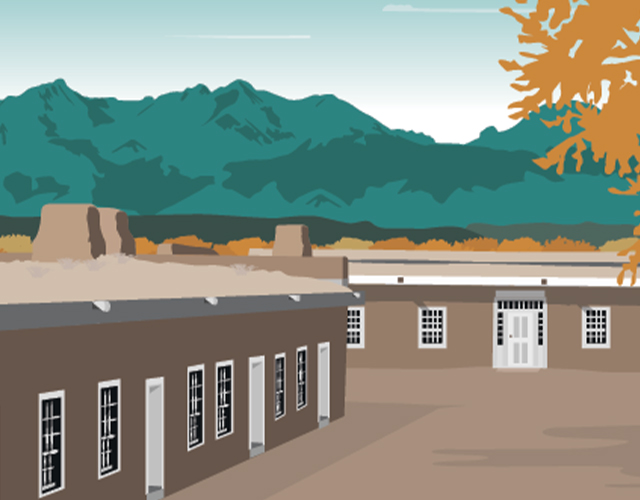
Fort Garland was built in 1858, ten years after the Treaty of Guadalupe Hidalgo, during American expansion into the west. Today, visitors can explore life in a nineteenth century military fort by walking the parade grounds and touring five of the original adobe buildings. The Fort Garland Museum & Cultural Center offers two dual-port accessible Electric Vehicle charging stations on site for travelers through the San Luis Valley.
The Fort Garland Museum & Cultural Center is located at 29477 CO-159, Fort Garland, Colorado, and is open every day from 9 a.m. to 5 p.m Visit www.FortGarlandMuseum.org or call 719-379-3512 for more information. The Fort Garland Museum &Cultural Center is a community museum of History Colorado.